Spaced repetition revision timetable: how to plan revisits across the Singapore school year
A spaced repetition revision timetable brings you back to each topic several times, with gaps of days or weeks between visits, so the same hours of study are spread across the term. A 2013 review rated this distributed practice as high utility. The best gap grows with the time left to the test: about 20 to 40% of a one-week wait, about 5 to 10% of a one-year wait.
Spaced repetition or a one-night cram: what separates the two?
Spaced repetition means studying the same material in several sessions separated by time, while cramming, or massed practice, packs that study into one sitting. Researchers call the spaced version distributed practice, and the 2013 review by Dunlosky, Rawson, Marsh, Nathan and Willingham rated it high utility.
The comparison in the research is fair on time. Two groups spend the same minutes on the same material; one group spreads them across sessions days apart, and the other masses them into a single session. Whatever difference shows up on the later test comes from the spread alone, which is why the finding matters to a learner who has a fixed number of evenings in a week.
The review gave its high rating for reasons that suit a school year. Spacing has worked across ages, across a wide variety of materials, on most standard measures of learning and over long delays, and the authors judged it easy to put into practice, though some learners need a little training to run it well. Kang's 2016 overview adds that spaced encounters help memory, problem solving and the use of a method in a new situation, and that adding small tests to spaced sessions amplifies the gain.
So a timetable built on spacing answers the one question a plain list of topics leaves open: when does each topic come back? The rest of this page shows how to set that answer from your own exam date.
How do I build a spaced revision timetable step by step?
Build it backwards from the exam. List your topics, mark the month of the test window, set a gap between revisits that fits the time left, then place the revisits around your school terms and the assessments your school sets, and review the plan after each one.
Seven steps cover the whole job. A sheet of paper, a spreadsheet or a calendar app all work equally well; the part that matters is that every topic carries a date on which it returns.
Expect the first version to take one evening. After that, keeping it up is a few minutes each week: tick the revisits done, carry the missed ones forward and move any topic that slipped in a test.
- List every topic by syllabus strand. For SEC G3 Additional Mathematics, syllabus K341, which follows O-Level Additional Mathematics 4049 from 2027, that means Algebra, Geometry and Trigonometry, and Calculus, with each chapter written under its strand.
- Mark the month your exam window opens. Use the month only, and take exact paper dates from our O-Level level guide or your school's notice once they are published.
- Set the gap from the distance to the test. In the 2008 study by Cepeda and colleagues the best gap was a large share of a short wait and a small share of a long one, so a test several months away suits revisits about one to three weeks apart.
- Place the first revisit of each topic soon after it is taught in class, then chain the later revisits at your chosen gap.
- Lay the plan over the MOE school year: four terms, the March, June and September vacations, the year-end holiday, and the assessments your school runs, which MOE says may include termly weighted assessments.
- Leave one empty slot a week as a buffer for a late assignment, a CCA event or a topic that needs a second pass.
- Review after each school assessment. Any topic that cost marks joins next week's revisit list, and topics that held up keep their gap.
How far apart should I revise the same topic?
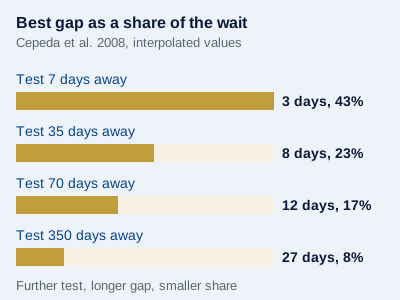
The best gap depends on how far away the test is. In the 2008 study by Cepeda, Vul, Rohrer, Wixted and Pashler, the measured best gap was 1 day for a test 7 days later and 21 days for tests 70 and 350 days later; as a share of the wait it fell from about 20 to 40% of a week to about 5 to 10% of a year.
Read the table as a range. The experiment tried a fixed set of gaps, so the measured best is the closest point it tested, and the interpolated figures smooth the curve between those points. Both columns point the same way: the further off the test, the longer the gap that pays.
The curve also has a peak. At every test delay, final recall first rose as the gap grew and then fell gradually once the gap passed its best, so a topic left alone for months gives back some of what spacing earned.
The participants were adults online learning obscure trivia facts, so the figures guide proportion and set no rule for a Singapore syllabus. Our working reading for a school learner: a test months away suits revisits one to three weeks apart, shortening to days in the final stretch. That is also why this page sets no fixed ladder of intervals, because the right gap moves with your exam date.
| Wait from second session to final test | Best gap measured | Interpolated best gap | Interpolated gap as share of the wait |
|---|---|---|---|
| 7 days | 1 day | about 3 days | about 43% |
| 35 days | 11 days | about 8 days | about 23% |
| 70 days | 21 days | about 12 days | about 17% |
| 350 days | 21 days | about 27 days | about 8% |
How do I set the revisit gap from my own exam date?
Count the days to the paper, find the nearest test delay in the 2008 Cepeda results, and read off the best gap; then shorten the gap each time the wait shrinks. The worked example below runs that rule for a Sec 4 A-Math learner starting in Term 2.
Use the measured gaps as the outer limit and the interpolated ones as a guide to the trend. Since the study tested adults on trivia facts, the result is a proportion to borrow for your own calendar, and the plan stays yours to adjust after each school assessment.
Worked example
Setting the A-Math revisit gap from the time left
A Sec 4 learner starts a spaced rota for SEC G3 Additional Mathematics at the start of Term 2, in late March, and assumes the written papers fall in October or November. How far apart should revisits of one topic sit in Term 2, and how should the gap change through the year?
- Count the wait. Late March to October is about seven months, roughly 210 days.
- Find the nearest delays in the 2008 Cepeda study. The tested best gap was 21 days for both the 70-day and the 350-day delay, so about three weeks marks the top of the range for a wait of seven months.
- Set Term 2 gaps at about two to three weeks, so each strand returns two or three times before the June vacation.
- Shorten as the wait shrinks. With about five months left in June, use gaps of about two weeks; with about three months left in Term 3, the study's 70-day delay had an interpolated best gap near 12 days, so use one to two weeks.
- In Term 4 the papers are weeks away. The study's 7-day delay had a best gap of 1 to 3 days, so revisits now come every few days.
Two to three weeks between revisits in Term 2, about two weeks in the June vacation, one to two weeks in Term 3 and a few days in Term 4. The gap shrinks as the papers come closer, which is the rule the study found.
What does a spaced timetable look like for Sec 4 A-Math?
Here is a worked example for a Sec 4 learner taking SEC G3 Additional Mathematics, syllabus K341, running from the start of Term 2 to written papers assumed to fall in October or November, about seven months later. With a runway that long, each strand returns every two to three weeks, and the gaps tighten as the papers near, down to days in the final weeks.
The months come first, then the strands. The worked example above sets the gap for each stretch of the year; the table below turns those gaps into a plan the learner can copy into a calendar, strand by strand.
As an example only, a learner might give A-Math three blocks of 40 minutes a week in Term 2: one for the newest chapter and two for revisits that fall due. No study sets a weekly hour total, so size the blocks to your own load and protect the gaps.
The June vacation of about four weeks carries the heaviest rota, revisiting Term 1 and Term 2 topics on a fixed cycle with no new chapters crammed in. Any weighted assessment your school sets then works as a checkpoint: a topic that lost marks moves onto the next week's list.
| Period | Strands revisited | Gap between revisits of one topic | Checkpoint |
|---|---|---|---|
| Term 2, late March to end May | Term 1 topics plus each new chapter about a week after class | about 2 to 3 weeks | Any Term 2 assessment your school sets |
| June vacation, about four weeks | Algebra, Geometry and Trigonometry, and Calculus topics from Terms 1 and 2 on a fixed rota | about 2 weeks | One timed mixed set at the end of the break |
| Term 3, end June to early September | Chapters taught in Term 3, with older strands kept on the rota | about 1 to 2 weeks | Any Term 3 assessment your school sets |
| Term 4 to the paper window | Every strand, weighted toward topics that cost marks | a few days, shortening as the papers near | Each completed practice paper |
What do the spacing studies show and how big is the gain?
The evidence is large and points one way. A 2006 synthesis by Cepeda and colleagues pooled 839 assessments of distributed practice from 317 experiments in 184 articles, and their 2008 study of 1,354 adults found that the best gap raised final recall by 64% over a zero gap.
Two cautions keep the table honest. The samples are adults and college students working on trivia, word pairs and short maths tasks, so the percentages describe those studies and make no forecast for a Singapore school exam. What the five studies share is the direction, with spaced practice ahead of massed practice at the longer test delays, and the two Cepeda papers add the rule that the best gap grows with the wait.
The maths studies speak most directly to a Sec 4 learner. In the 2006 study the same ten problems split across two weeks paid off only when the test was a month away; in the 2007 experiment, two problems in each of two sessions beat four problems in one session by 25 percentage points.
| Study | Who and what | Spaced versus massed result |
|---|---|---|
| Cepeda et al. 2006, synthesis | 839 assessments in 317 experiments from 184 articles on verbal recall | The gap giving the best retention grew as the time to the test grew |
| Cepeda et al. 2008 | 1,354 adults online; 32 obscure but true trivia facts; gaps of 0 to 105 days; final tests after 7, 35, 70 or 350 days | Best gap against zero gap: 64% more recall (d = 1.1); gains of 10%, 59%, 111% and 77% at the four delays |
| Rohrer and Taylor 2006 | 216 college students; one kind of maths problem; 10 problems in one session or split over two sessions a week apart | No difference at 1 week; an extremely large spacing benefit at 4 weeks; six extra problems in one session added nothing |
| Rohrer and Taylor 2007, Experiment 1 | 66 undergraduates counting permutations of letter sequences with a repeated letter | Spacers 74%, massers 49%, light massers 46% on a test a week after practice |
| Kornell 2009 | Three experiments with web flashcards of GRE-type word pairs; one large stack against four small stacks, and against last-day cramming | Spacing beat massing for 90% of participants and also beat cramming |
Why does cramming feel like it works?
Learners often judge cramming the better method, and in the research that judgement has proved wrong. In Kornell's 2009 flashcard study, 72% of participants believed after the first session that massing had worked better, yet spacing came out ahead for 90% of them. The 2013 review also cites one study in which students rated their learning higher after massed study.
The order of events in Kornell's study is the useful part. The participants gave their verdict after the first session, and the test that showed spacing ahead came later. So judge a revision method by a test set days or weeks after the study, and give the feel of the session itself no weight in that decision.
Short tests can also hide the cost of cramming. In Rohrer and Taylor's 2006 study, massed and spaced practice scored the same on a test one week later, and the gap opened only at four weeks; their 2007 experiment did find spacers ahead at one week, so a short test hides the cost only some of the time. A learner who crammed for a class quiz and did well has seen a real result, from a test that may sit too close to show the difference.
Kornell also compared spacing with cramming on the last day before the test, and spacing won again. A national paper that covers many months of content is the long-delay kind of test, and the longer delays are where these studies found the larger spacing gains.
Is it too late to start spacing a few weeks before the exam?
No. With a few weeks left, spacing still applies and the gaps simply shrink to days. In the 2008 study the best gap for a test a week away was about 1 day (about 3 days on the smoothed curve), and even at that short delay the best gap lifted recall by 10%.
A short runway changes the arithmetic. With five weeks to go, the measured best gap in that study was 11 days and the smoothed curve put it near 8. So a learner starting late builds a tighter loop: each topic is visited, left for a few days, and visited again, with the whole set cycling more than once before the paper.
Expect a smaller lift. The gain at a one-week delay was the smallest in the 2008 results, and one maths study found no spacing benefit at all on a test one week away. In Kornell's flashcard study, cramming on the last day still came out weaker than spacing.
Reading this early in the year? In the 2008 study the gain was 10% at a 7-day delay against 59%, 111% and 77% at 35, 70 and 350 days, so an early start buys the longer waits.
Worked example
A five-week rota for eight topics
As an example only: a learner has five weeks before a paper and eight topics still to revise. How should the revisits be spaced?
- Read the gap for the wait. For a test 35 days away, the 2008 study measured a best gap of 11 days and the smoothed curve put it near 8 days, so start with gaps of about one week.
- Week 1: give each of the eight topics a first visit, two topics on each of four evenings.
- Weeks 2 and 3: bring each topic back about a week after its last visit, so the set cycles twice more.
- Week 4: the test is about a week to ten days away, so shorten gaps to a few days and favour the weakest topics.
- Week 5: the study's 7-day delay had a best gap of 1 to 3 days, so revisit each topic once or twice more in short, tested sessions.
Each topic is visited four to six times across the five weeks, with gaps of about a week at first and a few days at the end.
What should I do inside each spaced session?
Test yourself in each spaced session. Kang's 2016 review reports that adding tests to spaced practice amplifies its benefit, and the second session in the 2008 Cepeda study was itself two tests per fact with the correct answer shown afterwards.
In practice a revisit opens with a closed book: write out the method, attempt two or three questions, then check against worked solutions and mark what went wrong. Keep a one-line log per revisit with the topic, the date and the questions right out of those attempted, so the next gap is set from evidence.
How to run those self-tests in depth is the subject of our retrieval practice guide, and how to mix question types inside one session sits in the interleaved practice guide. This page owns the calendar: when each topic comes back.
How do Singapore school terms and weighted assessments shape the timetable?
Four MOE terms set the frame of a revision rota: Term 1 runs into a March break, Term 2 closes on the longer vacation from late May to late June, Term 3 ends on a September break, and the year-end holiday opens in late November. Mid-year examinations were removed for all primary and secondary levels by 2023, so the checkpoints are the range of assessments your school runs, which MOE says may include termly weighted assessments, and the end-of-year examinations.
The 2026 and 2027 MOE calendars follow the same month pattern, so the table holds for the coming year. In 2026 the O-Level orals, listening tests, practicals and written papers fell between June and November, and the N(A) and N(T) components between July and October.
If your school runs weighted assessments, copy each date into the plan on the day it is announced.
| Period | Months | What the timetable does |
|---|---|---|
| Term 1 | Early January to mid-March | Lay out the topic list and start revisits of last year's content |
| March vacation | Mid to late March | Clear overdue revisits |
| Term 2 | Late March to end May | Revisit each new chapter about a week after class; any school assessment as a checkpoint |
| June vacation | Late May to late June, about four weeks | Fixed rota over Term 1 and Term 2 topics with no new chapters |
| Term 3 | End June to early September | Rota continues; SEAB holds SEC non-written components, such as orals, before the written examinations, so mark them from your school's notice |
| September vacation | September | Tighten the gaps and sit full timed papers |
| Term 4 and exam window | Mid-September to late November | Gaps of days for national candidates; end-of-year examinations for other levels |
| Year-end holiday | Late November to end December | A light rota to hold the year's topics |
What changes for the timetable when the O-Level becomes the SEC from 2027?
From 2027, Sec 4 and Sec 5 learners on this rota sit a single qualification, the Secondary Education Certificate, which merges the GCE O-Level, N(A) and N(T); every subject the rota spaces is then taken at G1, G2 or G3. The spacing logic stays the same; what you update is the exam window you plan backwards from.
One calendar change matters in 2027. A school that hosts SEC written papers closes Term 4 at the end of October, which can leave its candidates fewer weeks of class time for their final revisits than the term table above implies. Build the final stretch from your own school's notice.
For A-Math the change is a new code on the same paper. Syllabus K341 keeps the paper structure of the O-Level syllabus 4049 that ended with the 2026 sitting: two papers, each 2 hours 15 minutes long, worth 90 marks and half the grade. Paper 1 holds 12 to 14 questions of up to 10 marks each and Paper 2 holds 9 to 11 of up to 12 marks, every question must be answered, and the assessment objectives are weighted AO1 35%, AO2 50% and AO3 15%. Since no question can be skipped, every strand needs its place on the rota.
Paper formats, subject levels and exam dates for the SEC sit on our O-Level level guide, which follows SEAB's announcements. Once those months are known, mark them on your plan and count back to set your gaps, exactly as in the Sec 4 example above.
How does a spaced timetable differ for primary, secondary and JC?
The method is the same at every level; what changes is who keeps the schedule and how long the wait to the big test is. Younger learners often have an adult set short revisits, while JC learners usually run their own rota.
A paper planner, a calendar app and a rota set by a tutor all hold the same schedule. The difference is who notices a missed revisit. The 2013 review notes that students do not necessarily spread their study unless the situation makes them, so the strongest format is the one with a second pair of eyes on it.
| Level | Who keeps the schedule | Gap logic | Checkpoint |
|---|---|---|---|
| Primary, P5 to P6 | The learner, with a parent, guardian or tutor setting the revisits | Short revisits of core skills | School assessments through the year, then the year-end papers; for the PSLE countdown itself, see our PSLE guide |
| Lower secondary | The learner, with a weekly check from an adult or tutor | Revisits one to three weeks apart over a whole year | School assessments, which may include termly weighted assessments, and end-of-year examinations |
| Upper secondary, Sec 3 to Sec 4 or 5 | The learner, with a tutor-set rota for heavy subjects | One to three weeks apart, shortening to days in the exam window | School assessments, then the SEC papers from 2027; the last N(A) and N(T) papers ran July to October 2026 |
| JC | The learner runs a self-set rota | Long gaps across JC1, shortened before the A-Level papers | JC1 Term I begins in February; JC2 timeline on our A-Level guide |
Why do spaced timetables fail, and how do I fix that?
Spaced timetables fail in six predictable ways, and each has a fix you can write into the plan today. Most of them come down to a plan that has no deadline of its own.
Read the list against last term's plan and mark which failures you recognise. One fix applied this week beats a perfect plan drawn up for next term.
- The plan slides into the last week. In a study reviewed by Dunlosky and colleagues, learners tested only every three weeks raised their study time across the interval and peaked right before the exam, while daily tests kept study steady. Fix: put a small self-test on every revisit day so each week has its own deadline.
- Nothing forces the spacing. The same review notes that students do not necessarily distribute study unless the situation makes them. Fix: write revisit dates into a calendar you already obey, or have someone else check them.
- Gaps grow too long. In the 2008 Cepeda study, recall fell gradually once the gap passed its best. Fix: cap the gap at about three weeks while the exam is months away, and cut it to days in the final stretch.
- The textbook sets the pattern. The 2013 review reports that American elementary mathematics textbooks grouped practice problems together, presumably at the end of chapters, so the practice of a topic tends to sit in one place. Fix: if your book does the same, hold back a few of those questions for the topic's later revisits.
- Revisits turn into rereading. Kang's 2016 review reports that adding tests to spaced practice amplifies its benefit. Fix: open every revisit with a closed book and questions.
- No checkpoint. Fix: after each school assessment, move every topic that cost marks onto next week's list.
Who checks the revisit gaps in one-to-one lessons, and where does a learner sign up?
One-to-one lessons add the second person that a spaced timetable needs: the learner brings the rota to lessons, and the tutor writes notes after every session, which the learner can keep beside the rota. The tutor comes to the learner's own home, matched to their town and timetable, or teaches online.
The 2013 review notes that students do not necessarily spread their study unless something makes them, and Kornell's study shows the feel of cramming can mislead. A tutor gives the rota an outside reader, worksheets and lesson plans for the revisits are part of the service, and a monthly progress report sums up each month's work beside the learner's own log.
The cost of spaced revisits in A-Math, or in whichever subject sits on the rota, is printed by the engine price table on that subject's tuition page; the one-time registration fee for a new learner is listed in that table too. Payment is in full, or 50% at the start and 50% mid-package.
- A learner with a topic list ready presses Register Now, which opens the registration form; a learner still weighing up the rota presses Ask a question, which opens the contact form. That opening consultation, held with our team, costs nothing.
- Next we choose a tutor whose teaching experience and skill lie in the spaced subject, selected around where the learner lives and which evenings the rota leaves open for home lessons, or arranged for online lessons.
- The rota opens on Starter, 4 lessons of 60 minutes and the smallest package we offer.
- Bring your topic list and school assessment notices to the first session so the rota starts from your own calendar.
Once lessons begin, which records show the revisits are really happening?
Every lesson leaves a record you can set beside your own timetable: a monthly progress report and tutor notes after every session.
Keep the tutor notes next to your own revisit log, and bring any topic you skipped to the next session.
- Tutor notes after every session, which you can keep beside your own revisit log.
- A monthly progress report summarising the month's work, to read against your school assessment results.
- A tutor who no longer serves the rota is swapped on the learner's request at no charge, at any point in the package, as many times as the learner asks.
- A deep bench behind every rota, with 12,000+ tutors on our books, so a learner who asks for a replacement is matched from a large pool.
Which page answers my next question?
Exam dates, SEC formats and grading sit on our O-Level level guide; the P5 to P6 plan sits on the PSLE guide, and the JC2 timeline on the A-Level guide. Spacing decides when a topic returns, and four of our study guides handle the rest. The retrieval practice guide explains the work done during a revisit, the interleaved practice guide explains mixing question types within a sitting, our guide to weighted assessments and end-of-year exams explains the school checkpoints this rota targets, and the sleep and exam revision guide deals with rest on the nights before a paper.
A learner who wants a tutor to run this rota can start broad with O-Level tuition in Singapore, or go straight to one subject or track through the O-Level A-Math, O-Level maths, secondary school or N-Level tuition pages. Each of those pages shows its own price table and a Register Now button to the registration form.
Sources
- Dunlosky et al. (2013), PSPI
- Cepeda, Pashler, Vul, Wixted, Rohrer (2006). Distributed Practice in Verbal Recall Tasks: A Review and Quantitative Synthesis. Psychological Bulletin 132(3), 354-380
- Cepeda, Vul, Rohrer, Wixted, Pashler (2008). Spacing Effects in Learning: A Temporal Ridgeline of Optimal Retention. Psychological Science 19(11), 1095-1102
- Rohrer, Taylor (2006). The Effects of Overlearning and Distributed Practise on the Retention of Mathematics Knowledge. Applied Cognitive Psychology 20(9), 1209-1224
- Rohrer and Taylor (2007)
- Kornell (2009). Optimising Learning Using Flashcards: Spacing Is More Effective Than Cramming. Applied Cognitive Psychology 23(9), 1297-1317
- Kang (2016). Spaced Repetition Promotes Efficient and Effective Learning. Policy Insights from the Behavioral and Brain Sciences 3(1), 12-19
- MOE school calendar
- MOE, 14 July 2026
- MOE, 7 March 2022
- SEAB: SEC page
- SEAB syllabus 4049 (2026, last O-Level sitting)
- SEAB: SEC G3 Additional Mathematics syllabus K341 (2027)
One-to-one lessons with Eduprime
At home in Singapore or online. The first consultation is free, and a tutor can be changed whenever the learner asks.