IB Diploma Singapore: Subjects, Score, Schools and University Entry International Baccalaureate Diploma Programme
The IB Diploma in Singapore is a two-year pre-university programme of the International Baccalaureate, taught in the last two years of secondary education. Each candidate carries six subjects, three or four at Higher Level, held together by a core of the Extended Essay, Theory of Knowledge and CAS. Subjects are graded 1 to 7, the core adds up to 3 points, and the Diploma is scored out of 45.
4.8 average from 4,686 reviews across these programmes
Last updated
What is the IB, and which IB programmes run from primary to pre-university?
The International Baccalaureate (IB) runs a ladder of programmes, and the Diploma Programme (DP) is the pre-university rung for learners aged 16 to 19.
The Diploma is the IB programme that sits at the same stage as the A-Level, and it is the one Singapore universities read for admission. The IB places the Diploma in the last two years of secondary education. Two local routes show the shape clearly: SJI and SOTA both place their Diploma candidates in Years 5 and 6, the final pair of school years before university.
The table names the four programmes so a learner can place each one. This guide follows the Diploma from here on, and treats the Career-related Programme only where it touches the Diploma's own courses.
| Programme | Stage | What it holds |
|---|---|---|
| Primary Years Programme (PYP) | Primary years | The IB's first rung; outside the scope of this guide |
| Middle Years Programme (MYP) | Middle years of school | The IB's middle rung; outside the scope of this guide |
| Diploma Programme (DP) | Ages 16 to 19, the last two years of secondary education | Six subjects, the three-part core and a score out of 45 |
| Career-related Programme (CP) | Pre-university, offered alongside the DP at SOTA | Diploma courses combined with career-related study |
How is the IB Diploma put together?
Six subjects drawn from the six IB subject groups make up the bulk of the Diploma, and a compulsory three-part core binds them: Creativity, Activity, Service, the Extended Essay and Theory of Knowledge.
Each of the six subject groups covers one field of study, so the Diploma spreads a learner's week across language, the humanities, science, mathematics and the arts. Three or four of the six subjects are taken at Higher Level (HL) and the rest at Standard Level (SL), with a minimum of three HL and a maximum of four.
The core is where the IB Diploma differs most from a set of separate subject exams. Theory of Knowledge is assessed through an essay and an exhibition. The Extended Essay is a piece of independent research ending in a paper. CAS keeps a learner active outside the classroom through creative work, physical activity and service. All three are compulsory for the award.
For planning, the useful habit is to read the list below as six slots to fill, then decide early which three or four slots deserve Higher Level, since that choice shapes both the weekly load and the university courses that stay open.
- Studies in language and literature
- Language acquisition
- Individuals and societies
- Sciences
- Mathematics
- The arts
What is the difference between HL and SL, and how many HL subjects does a learner take?
Higher Level means more teaching hours and more depth: 240 hours per HL subject against 150 per SL subject, with three or four subjects taken at HL.
The gap of 90 teaching hours per subject is the clearest way to feel the difference. Across three HL subjects, that is 270 hours more than the same three at SL, so the HL choice decides where most of a learner's two years go.
The points scale stays the same at both levels. A 7 at SL earns the same 7 points as a 7 at HL, because the IB grades every subject from 1 to 7 on one scale.
The extra weight of HL shows up in the depth of the syllabus and in university entry rules, where several NUS programmes taken with a minor name an HL subject by title. A learner taking four HL subjects gains breadth at depth, and also carries the heaviest timetable the Diploma allows.
| Item | Higher Level (HL) | Standard Level (SL) |
|---|---|---|
| Number taken | At least three, at most four | The remaining subjects, two or three |
| Teaching hours per subject | 240 | 150 |
| Points scale | 1 to 7 | 1 to 7, the same scale |
| Where it matters for entry | Named in several NUS and SUTD subject rules | Counts toward the 45-point total and SUTD's SL requirement |
Worked example
Teaching hours with three or four HL subjects
A learner compares two Diplomas: three HL and three SL subjects, or four HL and two SL subjects. How many teaching hours does each choice carry across the six subjects?
- Three HL subjects at 240 hours each give 720 hours.
- Three SL subjects at 150 hours each give 450 hours.
- The three-HL Diploma totals 720 plus 450, which is 1,170 hours.
- Four HL subjects at 240 hours each give 960 hours, and two SL subjects at 150 hours each give 300 hours.
- The four-HL Diploma totals 960 plus 300, which is 1,260 hours.
1,170 teaching hours with three HL subjects and 1,260 with four, so the fourth HL subject adds 90 hours, the gap between one HL and one SL subject.
Which IB subjects should a learner pick for the university course they want?
IB subject choice should start from the university course: NUS publishes IB prerequisites for its programmes taken with a minor, and several of them name a Higher Level subject.
The safest order is backwards. A learner first lists two or three courses they would apply for, reads each university's IB rule, and only then fixes the HL subjects. Reversing the order is how a learner reaches DP2 holding a Diploma that misses one named subject.
The examples below come from the NUS prerequisite list for its Minor Programmes, written for IB Diploma holders from the May 2021 session onward and accurate as of November 2023, the SUTD page for the Singapore IB Diploma, and the NTU general admission requirements. Rules are revised from time to time, so a learner should read the current page of each university in DP1 before the subject choice locks.
A pattern is easy to see in the table. In the NUS Minor Programmes list, Higher Level Mathematics: Analysis and Approaches is the subject asked for most often in the quantitative and engineering rows, and HL Biology with HL Chemistry is the pairing the Life Sciences rows ask for.
| Course example | Institution | Subject asked for |
|---|---|---|
| Data Science and Analytics with a Minor in Entrepreneurship | NUS | A pass in HL Mathematics: Analysis and Approaches |
| Biomedical Engineering with a Minor in Business Analytics | NUS | A pass in HL Mathematics: Analysis and Approaches |
| Computer Engineering with a Minor in Data Engineering | NUS | A pass in HL Mathematics: Analysis and Approaches and in HL Physics, Chemistry or Computer Science |
| Life Sciences with a Minor in Public Health | NUS | A pass in HL Biology and HL Chemistry |
| All programmes | SUTD | Good passes in at least three HL subjects and one SL subject plus TOK; HL Mathematics and an HL science recommended |
| Programmes requiring Mathematics | NTU | Mathematics: Analysis and Approaches or Applications and Interpretation |
Should a learner take Math AA or Math AI?
Mathematics: Analysis and Approaches (AA) keeps the most Singapore university courses open, because several NUS programmes taken with a minor ask for a pass in HL AA by name.
The IB offers two mathematics courses, Mathematics: Analysis and Approaches and Mathematics: Applications and Interpretation, and each runs at SL or HL. Singapore university documents name them AA and AI, and their rules are the best place to start the choice.
The university rules give the choice its weight. NTU accepts both AA and AI for programmes that require Mathematics. SUTD recommends HL Mathematics and counts either AA or AI.
NUS is stricter in its Minor Programmes list: Data Science and Analytics with a Minor in Entrepreneurship, Quantitative Finance with a Minor in Information Security, Statistics with a Minor in Entrepreneurship, Biomedical Engineering with a Minor in Business Analytics and Computer Engineering with a Minor in Data Engineering each ask for a pass in HL AA.
A learner aiming at one of those should plan for HL AA from the first week of DP1.
Lessons for each course are set out on the IB Math AA tuition and IB Math AI tuition pages.
What do TOK, the EE and CAS ask of an IB Diploma candidate?
The IB Diploma core asks for two assessed pieces of writing, TOK and the Extended Essay, which share up to 3 points between them, plus one activity programme, CAS, which earns no points.
Theory of Knowledge is assessed through two pieces. The TOK essay runs to at most 1,600 words. The TOK exhibition holds three short commentaries, a format that rewards tight, precise writing.
The Extended Essay is independent, self-directed research ending in a paper of at most 4,000 words. Alongside the paper, the learner writes reflections on the research process, up to 500 words. Choosing an EE subject that matches an HL subject gives the research a stronger base, since the learner already spends 240 hours in that field.
CAS carries no points. It still decides the Diploma, because completing CAS is a requirement for the award, so a learner who scores well everywhere else still needs CAS signed off.
| Component | What the learner produces | Length | Counts toward points? |
|---|---|---|---|
| Theory of Knowledge essay | An essay | At most 1,600 words | Yes, shared with the EE: up to 3 points |
| Theory of Knowledge exhibition | An exhibition with three commentaries | Short; the limit is set in the IB's TOK guide | Yes, as part of TOK |
| Extended Essay | An independent research paper, plus reflections | At most 4,000 words; reflections up to 500 words | Yes, shared with TOK: up to 3 points |
| Creativity, Activity, Service | Creative, active and service experiences | Set by the school's CAS programme | No points; completion is required for the Diploma |
How is the IB score calculated out of 45?
The IB score adds six subject grades of 1 to 7 to up to 3 points from TOK and the Extended Essay, for a maximum of 45.
Six subjects at a top grade of 7 make 42, and the core adds at most 3, which is where the familiar 45 comes from. HL and SL grades count equally, so a 6 in an SL subject adds exactly as much as a 6 in an HL subject.
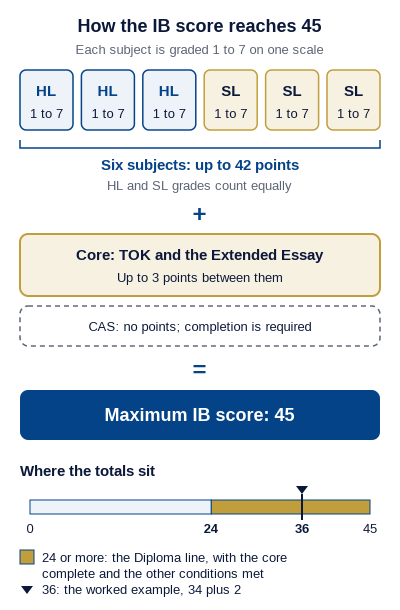
Here is a worked example for a learner with three HL and three SL subjects. The steps show how each part feeds the total, and where a single point moves the result. The diagram sets the six subject grades, the core points and the 24-point award line on one scale from 0 to 45.
The example also shows where effort pays. One extra grade in any subject, HL or SL, lifts the total by one point, and so does one extra core point. A learner who sees two subjects sitting just below the next grade often gains more by working on those two than by pushing an HL subject already at 6 or 7.
- HL subjects: grades 6, 6 and 6 give 18 points.
- SL subjects: grades 5, 6 and 5 give 16 points.
- Subject total: 18 plus 16 gives 34 points out of a possible 42.
- Core: TOK and the Extended Essay together add 2 of the possible 3 points.
- IB score: 34 plus 2 gives 36 points out of 45.
- Check: lifting one SL grade from 5 to 6 gives 37; dropping one core point gives 35.
What does a learner need to be awarded the IB Diploma?
The IB Diploma is awarded at 24 points or more, provided the learner also meets the IB's minimum performance conditions, including completion of all three core elements.
The 24-point line is the number most searchers know, and it is only the first condition. A candidate on 24 points still leaves the award unclaimed when one core element is unfinished, since the IB counts a completed TOK, EE and CAS among its conditions. The IB also sets further minimum performance conditions, which each school explains to its own candidates.
The practical reading is simple: the core deserves the same calendar space as the six subjects, from the first term of DP1.
- A total of at least 24 points out of 45.
- The Theory of Knowledge essay and exhibition completed.
- The Extended Essay completed.
- CAS completed.
- The IB's other minimum performance conditions met.
Worked example
Checking a total against the 24-point line
Mei takes three HL and three SL subjects. Her grades are 4, 4 and 4 at HL and 4, 3 and 4 at SL, and TOK with the Extended Essay earns her 1 core point. Does her total reach the award line?
- HL subjects: 4 plus 4 plus 4 gives 12 points.
- SL subjects: 4 plus 3 plus 4 gives 11 points.
- Subject total: 12 plus 11 gives 23 points.
- Core: 23 plus 1 gives 24 points out of 45.
- 24 meets the line of 24 points or more, so the award now rests on the other conditions: TOK, the Extended Essay and CAS completed, and the IB's other minimum performance conditions met.
24 points out of 45, which meets the points line; Mei is awarded the Diploma once all three core elements are complete and the IB's other minimum performance conditions are met.
When are IB exams held and when do IB results come out?
IB Diploma examinations run in two sessions, May and November; May results are issued in July and November results in December.
A learner sits the final Diploma examinations in one of the two sessions, at the end of the two years. The session decides when results arrive, and that month sets the university calendar that follows.
November results moved earlier. From the November 2024 session onward, the IB issues November results in December, where they used to arrive in January. Some older pages still print January, so a learner planning around a December offer date should read the IB's own results page.
The month matters for university plans. At NTU, a May-session candidate can apply by the closing date, before results exist, and send final results within three days of the July release; Medicine and a small number of other NTU programmes are excepted from this rule.
| Session | Exam month | Results month |
|---|---|---|
| May session | May | July |
| November session | October and November | December (from the November 2024 session onward) |
How should a learner spread the two IB Diploma years?
The two Diploma years work best in stages: settle subjects early in DP1, start the core by its end, finish the core early in DP2, then revise.
The plan below is the one we use with learners on a May-session Diploma, built on the IB's teaching hours, the core word limits and the NTU application calendar. Each school sets its own internal deadlines for the core, and those come first.
- DP1, first term: confirm three or four HL subjects against the university rules, since each HL subject carries 240 teaching hours and the choice is costly to reverse.
- DP1, final term: choose the Extended Essay subject and research question, and draft the TOK exhibition and its three commentaries.
- DP2, first term: finish the Extended Essay inside 4,000 words and write the 1,600-word TOK essay. From October, the NTU application window for the next intake is open.
- DP2, before March: submit university applications. NTU lets May-session candidates apply by March and send final results after release.
- DP2, final term: revise all six subjects for the May session, then send results to universities when they arrive in July. NTU asks for them within three days of release for most programmes.
Which Singapore schools offer the IB Diploma?
SUTD names four local schools whose IB Diploma it treats as the Singapore IB Diploma: Singapore Sports School, the School of the Arts, Anglo-Chinese School (Independent) and St. Joseph's Institution.
Each of the four reaches the Diploma by its own road. ACS(I) runs its IBDP for learners aged 16 to 19. The School of the Arts offers the Diploma and the Career-related Programme side by side. Singapore Sports School runs the Diploma within its post-secondary programmes.
St. Joseph's Institution shows the route in most detail. Its Integrated Programme spans six years, with the first four in secondary school and the IB Diploma taking the final two, Years 5 and 6. The Diploma itself is a co-educational, two-year pre-university programme. Learners can move between the IP and SEC tracks at the end of Year 2.
An SJI learner on the SEC track sits the SEC examinations after four years and may then apply to join the school's IB Diploma cohort, or move on to a junior college or polytechnic.
Admission into the IP years that lead to these Diplomas belongs to the Integrated Programme guide, which covers the IP schools and how learners enter them.
Do NUS, NTU and SUTD accept the IB Diploma, and what do they read?
NUS, NTU and SUTD all admit IB Diploma holders, and each reads named subjects, a Mother Tongue route for Singapore Citizens and PRs, and its own calendar.
NTU needs direct access to the official IB transcript through the IBO and processes no IB application without it. NTU also publishes no IB grade profile, because its IB applicant numbers are too small, so a learner should treat any quoted NTU cut-off with care.
Mother Tongue is a separate rule for Singapore Citizens and PRs, and it is worth checking in DP1. For Singapore Citizens and PRs, NTU reads a pass in a Mother Tongue language as Language A or Language B at SL or HL in the Diploma, or a Mother Tongue in-lieu subject that MOE has approved.
A learner who misses it must fulfil it before graduating, unless exempted. SUTD accepts Mother Tongue as Language A Literature, Language A Language and Literature, or Language B, at SL or HL.
The May-session route at NTU excludes Medicine and two education-linked programmes, which follow their own timing.
| University | What it reads | Mathematics | Mother Tongue route | Timing |
|---|---|---|---|---|
| NTU | The official IB transcript, accessed directly through the IBO; no published IB grade profile | AA or AI accepted where Mathematics is required | MTL Language A or B at SL or HL, or an approved in-lieu subject | Window October 2026 to March 2027 for the 2027 intake |
| NUS | IB subject prerequisites published per programme | HL AA for several quantitative courses | Set out by NUS admissions | Set by the NUS admissions calendar |
| SUTD | Good passes in at least three HL subjects and one SL subject, plus TOK | HL Mathematics recommended, AA or AI | MTL A Literature, MTL A Language and Literature, or Language B MTL, at SL or HL | Set by the SUTD admissions calendar |
IB or A-Level in Singapore: how do the two compare?
The IB Diploma and the Singapore-Cambridge A-Level differ in structure: the IB scores six subjects plus a core out of 45, and the A-Level university score runs to 70.
The A-Level changed shape recently. Its 10,977 candidates in 2025 were the first scored on the revised University Admission Score, a 70-point total built from three H2 subjects plus H1 General Paper. A fourth content subject counts only when it raises the score, and the total is then rebased to 70.
Project Work earns a Pass or a Fail, and the autonomous universities ask for that Pass before they admit an A-Level candidate.
The IB Diploma keeps its research element inside the score. The Extended Essay shares up to 3 points with TOK, so the core moves the total directly.
Neither route is ranked here. The table sets out structure only, and the choice belongs to the learner's subjects, school and university plan. The A-Level guide covers H1, H2 and H3 and the UAS in full.
| Item | IB Diploma | Singapore-Cambridge A-Level |
|---|---|---|
| Subjects taken | Six, from six subject groups | The UAS reads three H2 subjects with H1 General Paper, adding a fourth content subject when it lifts the total |
| Levels | Higher Level and Standard Level | H1 and H2; H3 for school candidates only |
| Compulsory core | Theory of Knowledge, Extended Essay, CAS | Project Work |
| Score scale and maximum | 1 to 7 per subject plus up to 3 core points; 45 | University Admission Score out of 70 |
| Project element | Extended Essay of at most 4,000 words, scored with TOK | Project Work, Pass or Fail; the autonomous universities admit an A-Level candidate only with the Pass |
| Results month | July for May; December for November | 2025 results released February 2026; 2026 results tentatively February 2027 |
| Who examines | The International Baccalaureate | SEAB, MOE and Cambridge International Education |
How much does IB tuition cost?
Eduprime prices IB Diploma tuition per programme, and our pricing engine writes the rates into the table on this page, set for one-to-one lessons of an hour each.
The table lists the rate for each lesson format, so a learner can compare online lessons with lessons at home before registering. IB lessons open with the Starter package of four 60-minute sessions, which a learner might give to one HL topic or to a first Extended Essay draft.
Payment is made in full, or in two parts: half at the start and half at the middle of the package. A Diploma candidate joining Eduprime for the first time also pays a one-time registration fee, and that table prints it too.
Higher Level subjects, the Extended Essay and TOK use the same lesson format, so the table applies to every part of the Diploma.
How do one-to-one IB lessons work and how does a learner register?
IB Diploma lessons run one-to-one, online or with a tutor who comes to the learner's home, matched to the learner's town and weekly timetable, and every IB registration opens with a free consultation.
Each lesson follows the learner's own Diploma: the HL subject that needs depth, the Extended Essay draft that needs structure, or the TOK essay title that needs an argument. Every IB lesson arrives with its own worksheets and lesson plan, both part of what the learner pays for.
Register Now opens the registration form for IB tuition, and Ask a question opens the contact form for anything about the Diploma that needs an answer first.
- Register: the learner, or whoever registers them, fills in the registration form with the IB subjects, levels and session.
- Consult: our team holds the first consultation, which is free, to understand the subjects, HL choices and core deadlines.
- Match: we match a tutor experienced and skilled in that IB subject, for home lessons near the learner's town and timetable or for online lessons.
- Start: lessons begin with the Starter package of four 60-minute sessions, paid in full or half at the start and half mid-package.
- Adjust: whenever the learner asks for a new tutor, we replace the tutor free of charge, at any point in the package and however many sessions have passed.
How does a Diploma candidate see progress and judge the tutor?
Each IB lesson ends with tutor notes, each month brings a progress report, and a Diploma candidate who wants a different tutor gets one free of charge whenever they ask.
A Diploma runs for two years, so a learner needs to see progress as it happens. The notes show what each lesson covered, from an HL topic to an EE paragraph, and the report shows the month's direction against the learner's own targets.
- Tutor notes after each IB lesson, and a progress report every month across the two Diploma years.
- IB tutors chosen for the learner's HL and SL subjects, each experienced and skilled in the subject they teach.
- A replacement tutor whenever the learner asks, free of charge, however many sessions have passed.
- More than 12,500 tutors to match an IB Diploma candidate from.
Where does each next IB question go?
This guide explains how the IB Diploma works in Singapore. Lessons live on their own pages: general IB tuition, then each subject, from IB Math AA and IB Math AI to IB Physics, Chemistry, Biology, Economics, English, History and Geography, with Statistics for the data work behind Math AI.
Learners still choosing a route can read the Integrated Programme guide for IP schools that end in the Diploma, the IP tuition page, the A-Level guide for the Singapore-Cambridge route, and the IGCSE guide for the international route before the Diploma.
- ib tuition singapore
- ib math aa tuition singapore
- ib math ai tuition singapore
- ib physics tuition singapore
- chemistry tuition singapore
- biology tuition in singapore
- economics tuition singapore
- english tuition singapore
- history tuition singapore
- geography tuition singapore
- statistics tuition singapore
- integrated programme singapore
- integrated programme tuition singapore
- a level guide singapore
- IGCSE guide Singapore
Sources
- IBO: Diploma Programme curriculum
- IBO: Diploma Programme brochure
- IBO: Diploma Programme assessment FAQ
- IBO: Understanding IB assessment
- IBO: What is the Extended Essay
- IBO: Receive and evaluate IB transcripts (results issue)
- IBO: Examiner instructions, Theory of Knowledge
- IB: new release date for November 2024 results (French edition)
- NTU: Undergraduate general admission requirements
- NUS: IB Diploma subject prerequisites
- SUTD: International Baccalaureate Diploma (Singapore)
- SJI: Overview of SJI education
- ACS(I): IBDP overview
- ACS(I): IBDP core requirements
- ACS(I): IBDP curriculum overview
- ACS(I): IBDP subjects offered
- Singapore Sports School: IB Diploma Programme
- SOTA: Learning (IBDP and IBCP)
- SEAB: About GCE A-Level
- MOE: Release of 2025 GCE A-Level results
- MOE: National examination dates
Fees
What a lesson costs
Every programme is priced per 60-minute session in three formats. These are the lowest figures among the programmes on this page; each programme page shows its own.
- Widest availability
Online International Tutor
fromS$26/ session
60-minute session
The widest bench of tutors across time zones, so a slot is open at almost any hour. Lessons run online over a shared screen.
Online Local Tutor
fromS$44.20/ session
60-minute session
A tutor based here who knows our schools, syllabuses and exams, teaching online.
Home Tutor
fromS$52/ session
60-minute session
A local tutor who comes to the learner, at home or at a nearby study spot, matched to their town and timetable.
Minimum 4 sessions. Larger packages lower the per-session price. One-time S$15 registration fee for new learners.
Programmes
Programmes for IB
IB Diploma subjects at SL and HL, plus support for the IA, EE and TOK, with a tutor matched to your school timetable.
Biology Tuition in Singapore for Upper Sec and JC
Chemistry Tuition Singapore for Secondary and JC

Economics Tuition Singapore from the SEC to A-Level

English Tuition Singapore for PSLE, SEC and A-Level
Geography Tuition Singapore with Fieldwork and Case Study Coaching

History Tuition Singapore for O-Level, A-Level and IB

IB Economics Tuition Singapore for SL and HL

IB Math AA Tuition Singapore for SL and HL

IB Math AI Tuition Singapore for SL and HL Students

IB Physics Tuition Singapore for SL and HL

IB Tuition Singapore for MYP and Diploma Students

Integrated Programme Tuition Singapore for the IP Through-Train
IP English Tuition Singapore: Close Reading to the Year 6 Papers
IP Maths Tuition Singapore Built on Each School's Own Course
Maths Tuition Singapore from Primary to JC

Physics Tuition Singapore for O-Level and JC

Science Tuition Singapore for Primary and Secondary

Statistics Tuition Singapore from H2 Maths to Research Projects
Frequently asked
IB: your questions
How is the IB Diploma Programme structured?
The IB Diploma Programme is built from the DP core and six subject groups: studies in language and literature, language acquisition, individuals and societies, sciences, mathematics and the arts. Each learner takes at least three and at most four subjects at higher level (HL), and the rest at standard level (SL). The IBO sets SL courses at 150 teaching hours and HL courses at 240, so the HL choices a learner makes at the start shape the weekly load across the programme.
How do learners in Singapore reach the IB Diploma?
Learners in Singapore reach the IB Diploma through two routes that MOE describes. After secondary school, a junior college place can lead to the IB Diploma Programme (IBDP), since JC courses include the A-Level course and the IBDP. The Integrated Programme also runs six years from Sec 1 to the IB Diploma as one of its exit qualifications. Both routes end in the same Diploma, and lessons follow the subjects the learner's school has set.
Does NTU accept the IB Diploma, and when do May 2027 candidates apply?
Yes, NTU admits IB Diploma holders, and its general admission requirements ask for the official IB transcript, sent through the IBO. A learner sitting the May 2027 session may apply by NTU's closing date of 19 March 2027, the same date it gives learners who sat in November 2026 or earlier, and send the results later. Medicine and NTU's two Education programmes are the exceptions, so a May candidate aiming at one of them checks that programme's own arrangement first.
What is the IB bilingual diploma?
The IB awards a bilingual diploma to a learner who earns grade 3 or higher in two languages selected from studies in language and literature. A second way in is grade 3 or higher in one studies in language and literature course plus an individuals and societies or science subject completed in a different language. For a Singapore learner who reads and writes well in more than one language, the subject plan made at the start of DP Year 1 decides whether the award is within reach.
Do IP students on the IB track sit the SEC at Sec 4?
No. IP learners do not take the national exam at Sec 4, and from 2027 that exam is the Secondary Education Certificate (SEC), sat at G1, G2 and G3. An IP learner on the IB track moves from Sec 1 to the IB Diploma in six years, so school assessments mark progress until the Diploma papers. Lessons follow the learner's school topics and calendar, at home matched to their town and timetable, or online from anywhere.
Find your IB tutor today
Tell us the subject and your exam timeline, and we match a screened tutor to your town and timetable for home lessons, or teach you online.