IB Economics Tuition Singapore for SL and HL
IB Economics tuition Singapore prepares DP1 and DP2 learners for the IBO Economics course at SL or HL: Papers 1 and 2, the HL-only Paper 3, and a three-commentary IA worth 30% at SL and 20% at HL. Our bench of 12,000+ tutors teaches 1-to-1 at home or online, proposed by our Singapore team after one form.
Last updated

At a glance
- Who it's for
- DP1 learners settling the SL or HL choice · DP2 HL learners facing Paper 3
- Format
- 12,000+ tutors for DP1 and DP2, at home or online
- Why Eduprime
- Diagrams that carry the argument
DP1 and DP2
Who our IB Economics tutors in Singapore work with
DP1 and DP2 learners at SL or HL form three groups here, and each group meets a different paper or portfolio deadline first.
DP1 learners settling the SL or HL choice
You have started the Diploma and Economics sits among your six subjects, with at most four at HL. The gap between 150 and 240 teaching hours decides how much of your week the subject takes, so the first lessons map both loads against your timetable.
- Unit 1 feels easy, then Unit 2 diagrams arrive at speed
- Unsure whether HL-only 2.10 to 2.12, market failure and equity, fit your load
- Definitions memorised, then the 15-mark Paper 1 part (b) wants a weighed argument
DP2 HL learners facing Paper 3
Paper 3 is the HL-only policy paper: two compulsory questions, each ending in a 10-mark recommendation built on data you are handed in the hall. The other 20 marks of each question sit in part (a), set as subparts, and the paper as a whole asks for quantitative and qualitative work.
- HL calculations go wrong when values are misread from the diagram
- Part (b) recommendations restate the data and skip the policy choice
- Running out of time across 105 minutes of HL Paper 3 policy work
SL and HL learners building the IA portfolio
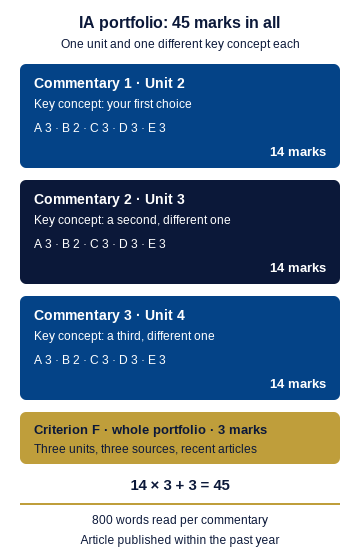
The portfolio asks for three commentaries on three recent articles, one each for Units 2, 3 and 4, with a different key concept every time. At SL it is 30% of the grade and at HL 20%. Criterion F checks the unit, source and one-year rules, and a commentary that repeats a key concept risks losing 3 marks under criterion D.
- An article chosen before deciding which unit it serves
- The same key concept, sustainability or intervention, reached for twice
- Commentaries that run past 800 words, so the conclusion goes unread
Why Eduprime
What an IB Economics tutor works on, lesson by lesson
IB Economics lessons with us centre on six moves drawn from the IBO guide, each tied to a paper or IA criterion where marks are won.
Diagrams that carry the argument
Criterion A gives 3 marks per commentary for diagrams, and the papers expect one wherever the question suits it, with some questions calling a diagram essential. You redraw each Unit 2 and Unit 3 diagram until every shift is explained in a sentence beside it.
A different key concept for each commentary
Lessons run practice grids that pair Units 2, 3 and 4 with three different key concepts from the nine, so planning before searching becomes a habit. A concept used twice risks 3 criterion D marks, and the grid for your own IA is yours to build.
HL Paper 3 handled as policy advice
For HL learners, Paper 3 part (b) asks for a 10-mark policy recommendation built from the data provided. Lessons practise the move from calculation to a recommendation that names who gains, who pays and what could go wrong.
HL calculations read straight off a diagram
The 2022 guide sets HL calculations such as surplus, tax revenue and welfare loss from a diagram. HL learners practise reading every value off the axes first, then setting out each step of the calculation on its own line.
Singapore policy matched to each unit
Exchange-rate policy, the carbon tax and the vehicle quota give you local cases for Units 2 and 3, all published by MAS, NEA and LTA. Lessons sort each case under the sub-topic it illustrates.
A free tutor replacement whenever you ask
Your IB Economics tutor is proposed by our Singapore team, and you can ask for a different one at any point. We give you a free tutor replacement whenever you ask.
Units 1 to 4
IB Economics units and key concepts, mapped for lessons
IB Economics runs through four units numbered 1 to 4, with Unit 2 doubling from 35 to 70 teaching hours once you take HL.
Unit 1: Introduction to economics
Ten teaching hours at both levels set up what economics studies and how economists think. Lessons use this short unit to fix the vocabulary that criterion B later rewards in every commentary.
Sub-topics 1.1 and 1.2; scarcity and choice as key concepts; the economist's way of building a model; terms you will define in every paper
Unit 2: Microeconomics, the shared core
SL learners give Unit 2 about 35 teaching hours, from 2.1 Demand to 2.9 Market failure, public goods. One of the three IA commentaries rests on a Unit 2 article.
Core sub-topics include 2.1 Demand, 2.3 Competitive market equilibrium, 2.5 Elasticity of demand and 2.7 Role of government in microeconomics. Carbon taxes are among the responses listed in 2.8 Market failure, externalities and common pool or common access resources. At HL, 2.1, 2.2, 2.5 and 2.6 also hold HL-only sub-topics
Unit 2 at HL: three extension sub-topics
HL learners add 2.10, 2.11 and 2.12, which lifts Unit 2 to about 70 teaching hours. These HL-only sub-topics bring asymmetric information, market power and equity into HL Papers 1, 2 and 3.
2.10 asymmetric information; 2.11 market power; 2.12 the market's inability to achieve equity; HL-only calculations in 2.3, 2.7 and 2.8, each read from a diagram
Unit 3: Macroeconomics
Unit 3 takes about 40 hours at SL and 75 at HL across sub-topics 3.1 to 3.7. Singapore's exchange-rate centred monetary policy gives HL and SL learners a ready local case for this unit.
Both 3.3 Macroeconomic objectives and 3.4 Economics of inequality and poverty carry HL-only calculations. MAS gives the local case for 3.5 Demand management (demand side policies), monetary policy. HL-only sub-topics also sit inside 3.5 and 3.6
Unit 4: The global economy
Unit 4 is the largest unit at SL, about 45 teaching hours, and takes 65 at HL. Its ten sub-topics run from 4.1 Benefits of international trade to 4.10 Economic growth and/or economic development strategies.
Both 4.1 Benefits of international trade and 4.2 Types of trade protection carry HL-only calculations. It also covers 4.5 Exchange rates, 4.6 Balance of payments and 4.7 Sustainable development. HL-only sub-topics sit inside 4.1, 4.5, 4.6 and 4.7
Internal assessment portfolio
Twenty teaching hours at both levels go to three commentaries, one each for Units 2, 3 and 4. The teacher marks the portfolio and the IB moderates it, so each learner plans every criterion before writing.
Article selection within the one-year window; one unit and one key concept per commentary; criteria A to E per commentary; criterion F across the portfolio; 800 words each
Lesson formats
Home or online IB Economics lessons: which suits your DP week?
IB Economics lessons run 1-to-1 in two formats: a tutor at your home, matched to your town and timetable, or a live online lesson from anywhere.
Home lessons, 1-to-1
An IB Economics tutor comes to your home at times matched to your town and your Diploma timetable. Home lessons suit learners who like to sketch diagrams together on paper, mark up a printed practice article, and talk through a Paper 1 plan at the table.
- Diagrams drawn and corrected on paper beside you
- Practice articles annotated for diagrams and concepts
- Paper 1 and Paper 2 practice under a set clock
Online lessons, 1-to-1
A live 1-to-1 lesson on screen fits DP2 weeks crowded with internal deadlines. Online lessons suit talking through a Paper 2 data table, checking HL Paper 3 working line by line, and revisiting the theory behind your next commentary.
- Diagrams and HL calculations worked through live
- Practice articles and data tables analysed on screen
- Lessons from wherever you study that week
Across the two Diploma years
How IB Economics lessons run from DP1 to the DP2 papers
IB Economics lessons follow the Diploma calendar in seven steps, from the first form to the timed papers at the end of DP2.
- 1
Send one form
Tell us your Diploma year, SL or HL, home or online, and which part of the course feels open: a unit, the IA or HL Paper 3.
- 2
A consultation call
Our Singapore team holds a free initial consultation with you after the contact form, covering the papers you sit and your weekly timetable.
- 3
Your tutor is proposed
We propose an IB Economics tutor who teaches your level and format. You meet them in the first lesson and agree the term plan together.
- 4
DP1: Units 1 and 2 with diagrams
Lessons build Unit 2 diagrams and terminology early, from 2.1 Demand onwards, since one IA commentary has to come from this unit.
- 5
IA plan: units and concepts first
On your own, you set the unit and key concept for each commentary before choosing an article. You then select the articles and write alone.
- 6
DP2: Units 3 and 4, Paper 3 for HL
Lessons move on to Units 3 and 4, from measuring economic activity to development strategies, and HL learners add policy practice for both compulsory Paper 3 questions.
- 7
Timed papers, then the next step
The last weeks rehearse each paper at full length. When you are ready to begin, send the form and our team takes it from there.
Our tutors
IB Economics tutor profiles and how each one teaches
IB Economics tutors on our bench each lean on one part of the course; these six composite profiles show the range we match from.
Ms Rachel T.
9 to 11 years teaching DP Economics at SL and HL
HL Paper 3 policy questions and the 10-mark recommendation
“I ask every HL learner to name the stakeholder who pays before writing a single recommendation.”
Mr Daniel W.
6 to 8 years with DP1 and DP2 learners
Diagrams for criterion A and for Paper 2 data questions
“Every practice diagram we draw is labelled in full, and the sentence after it has to put that diagram to work.”
Ms Priya N.
7 to 9 years coaching IA commentary skills
IA commentary skills, coached on practice articles and samples
“We work on practice articles; you plan your own grid and choose every article for it yourself.”
Mr Faizal R.
5 to 7 years teaching DP macroeconomics
Unit 3, with MAS exchange-rate policy as the worked local case
“Singapore steers the exchange rate inside a band, which makes Unit 3 far easier to picture.”
Ms Huimin C.
8 to 10 years across Units 2 and 4
Trade protection and the HL calculations from a diagram
“We read the tariff diagram axis by axis before anyone touches a calculator.”
Mr Arjun S.
4 to 6 years with DP1 learners
SL Paper 2 data response and the 15-mark final part
“Part (g) closes SL Paper 2 with 15 marks, so we practise ending on one clear judgement.”
In their words
IB Economics learners describe their lessons
IB Economics learners at SL and HL wrote these illustrative notes on what changed in their papers and their IA portfolio.
We drilled the key-concept grid on practice articles, and that made me check my own plan, where Units 2 and 3 shared a concept. I picked interdependence for Unit 3 myself and the argument got sharper.
Shu Fen L.
DP2 learner, SL · IB Economics SL
Paper 3 practice felt hopeless at first because I kept misreading the producer price. After six weeks of reading values off the diagram first, my working finally matched the answers.
Marcus O.
DP2 learner, HL · IB Economics HL
I was set on HL until we laid out the teaching hours against my other two HL subjects. I chose SL and used the time on my portfolio, which I am glad about.
Aisyah K.
DP1 learner, SL · IB Economics SL
My recommendations used to repeat the data table. Now each one names a trade-off and who bears it, and my part (b) answers read like advice.
Kenji M.
DP2 learner, HL · IB Economics HL
Online lessons fitted between my other DP deadlines. Practice commentaries showed me where my words leaked, so I cut my own IA to 790 alone, evaluation intact.
Divya P.
DP2 learner, HL · IB Economics HL
Diagrams were my weak spot in Paper 1. My tutor made me explain every curve shift in one sentence, and my essays stopped stalling halfway.
Ethan Y.
DP1 learner, HL · IB Economics HL
Fees
IB Economics tutor fees for DP1 and DP2
IB Economics fees for both Diploma years are shown in the table below for all three lesson formats, read directly from our rate engine.
- Widest availability
Online International Tutor
fromS$34.50/ session
60-minute session
The widest bench of tutors across time zones, so a slot is open at almost any hour. Lessons run online over a shared screen.
Online Local Tutor
fromS$58.65/ session
60-minute session
A tutor based here who knows our schools, syllabuses and exams, teaching online.
Home Tutor
fromS$69/ session
60-minute session
A local tutor who comes to the learner, at home or at a nearby study spot, matched to their town and timetable.
Minimum 4 sessions. Larger packages lower the per-session price. One-time S$15 registration fee for new learners.
| Level | Home tutor | Online, Singapore tutor | Online, international tutor |
|---|---|---|---|
| IB Diploma Economics, DP1 and DP2 (SL or HL) | S$69 | S$58.65 | S$34.50 |
As an IB Economics learner, you get a free tutor replacement whenever you ask.
Student journeys
Three IB Economics journeys through the Diploma
IB Economics learners at SL, at HL and on the IA each started from a different gap; these illustrative stories trace what changed.
Wei Jie understood the theory in class, yet his SL Paper 2 scripts faltered at part (g), the 15-mark final part asking for an extended argument.
- Practised one data response a week under the 105-minute clock
- Learned to quote a figure from the data in every part
- Ended each part (g) with one clear judgement
His timed SL Paper 2 practice rose from 22 to 31 out of 40, and he now finishes with ten minutes to check.
Wei Jie T., SL · DP1 to mid-DP2
Natalie chose HL and found HL Paper 3 the hardest paper: her calculations were right, but her part (b) recommendations restated the data.
- Rebuilt each recommendation around one named policy choice
- Added a stakeholder and a trade-off to every answer
- Sat two full HL Paper 3 rehearsals at 1 h 45 min
Her timed HL Paper 3 practice moved from 34 to 43 out of 60, and her part (b) answers now read as advice.
Natalie G., HL · DP2
Hana had picked three articles she liked before planning, and two of them pointed to the same key concept and the same unit.
- Planned her own unit and key-concept grid before any new search
- Chose fresh articles inside the one-year window herself
- Practised trimming sample commentaries to 800 words before writing her own
Her portfolio met every criterion F requirement, and she says planning first now feels like the natural order of work.
Hana S., SL · One term in DP1
The course in one view
What IB Diploma Economics covers at SL and HL
IB Diploma Economics (SL and HL) is the IBO's two-year Diploma Programme economics course, taught from the guide first assessed in 2022. It runs through four units and nine key concepts over 150 teaching hours at SL or 240 at HL. Grades come from written papers plus a teacher-marked IA portfolio that the IB moderates.
- 01Four units: introduction, microeconomics, macroeconomics and the global economy.
- 02Nine key concepts, from scarcity to intervention, thread through every unit.
- 03SL is graded on Paper 1, Paper 2 and the IA portfolio.
- 04HL adds Paper 3, a policy paper worth 30% of the HL grade.
- 05The IA is three commentaries, each read up to 800 words.
- 06IB Economics tuition Singapore follows this guide for 2026 and 2027 candidates.
Routes into the DP
IB Diploma Programme pathway into DP1 and DP2 Economics
The IB Diploma Programme is a two-year pre-university course for ages 16 to 19, and learners reach DP1 Economics from several routes.
- 1
IGCSE (international schools)
Learners from international schools reach DP1 after IGCSE in Year 10 or 11, then meet the four units and nine key concepts.
- 2
MYP
Before DP1 comes the MYP, which our IB tuition page covers; the Diploma Programme itself runs two years as a pre-university course for ages 16 to 19.
- 3
IP Year 4 (IP schools whose route ends in the IB Diploma)
MOE describes the Integrated Programme as a six-year course; some schools certify it with the IB Diploma, which begins after Year 4.
- 4
DP1
The SL or HL choice is made here, in the first year of a two-year pre-university course.
- 5
DP2 (examination session)
DP2 is the second and final year, and it closes with the written papers: two at SL, three at HL.
- 6
Alternative route: H2 Economics 9570
Learners on the A-Level route sit SEAB H2 Economics 9570, which for 2026 sets two written papers and no coursework component.
IA and paper rules
Which IB Economics rules cost marks before any analysis starts?
Criterion F marks go before analysis begins
Criterion F is worth 3 marks for the whole IB Economics IA portfolio. It checks three rules: a different unit for each article, a different source for each commentary, and articles published no earlier than one year before you write. Marks lost here never return through better analysis.
Four MAS statements a year for Unit 3 articles
MAS releases its Monetary Policy Statements in January, April, July and October, each with an at-a-glance summary of what MAS decided and what it expects for the economy and inflation. The Macroeconomic Review joins it, so Unit 3 work on exchange-rate policy can follow the latest decision.
Deciding SL or HL at the start of DP1
Moving from IP Year 4 or IGCSE into DP1, weigh 150 SL hours against 240 HL hours. HL adds Paper 3 and three HL-only sub-topics, so count your other HL subjects before choosing.
Calculator rules differ by paper
Paper 1 allows no calculator at either level. Paper 2 and the HL-only Paper 3 can be answered with a four-function calculator, and graphic display calculators are also allowed, so lessons practise both setups.
SL, HL or H2
What changes between IB Economics SL and HL?
IB Economics HL adds Paper 3 and 90 teaching hours, and its IA share falls from 30% to 20%; H2 Economics 9570 sits beside them for comparison.
| Decision point | IB Economics HL | IB Economics SL | H2 Economics 9570 |
|---|---|---|---|
| Who sets the course | IBO guide, first assessed 2022 | IBO guide, first assessed 2022 | SEAB syllabus 9570, A-Level route |
| Written papers | Papers 1, 2 and 3 | Papers 1 and 2 | Paper 1 Case Studies, Paper 2 Essays |
| Time in the exam hall | 4 h 45 min in total | 3 h in total | 2026 syllabus: 5 h, two papers of 2 h 30 min |
| Coursework share | IA portfolio, 20% | IA portfolio, 30% | No coursework component |
| Essay-style paper | Paper 1: 25 marks, 20%, one question of three | Paper 1: 25 marks, 30%, one question of three | Paper 2 Essays (2026): 75 marks, 60% |
| Data or case paper | Paper 2: 40 marks, 30%; Paper 3: 60 marks, 30% | Paper 2: 40 marks, 40% | For 2026, Paper 1 Case Studies: 60 marks, 40% |
SL, HL or H2
What is IB Economics Paper 3, beside Papers 1 and 2?
IB Economics Paper 3 is the HL-only policy paper: 60 marks across two compulsory questions, worth 30% of the HL grade, with calculations and written policy advice.
| Feature | Paper 1 | Paper 2 | Paper 3 (HL only) |
|---|---|---|---|
| What it asks | An extended response in two parts | A data response in seven parts, (a) to (g) | Policy questions mixing calculation and written analysis |
| Choice of questions | Answer one of three | Answer one of two | Both questions are compulsory |
| Marks and time | 25 marks in an hour and a quarter | 40 marks across 105 minutes | 60 marks across 1 h 45 min (HL) |
| Share of the grade | SL 30%, HL 20% | SL 40%, HL 30% | HL 30% |
| Calculator rule | No calculator allowed | Four-function or graphic display calculator | Four-function or graphic display calculator |
Syllabus, papers and IA criteria
How is IB Economics marked, from papers to the IA?
IB Economics is marked against criteria: papers use markscheme points with markbands, and the IA portfolio totals 45 marks across criteria A to F.
The four IB Economics units and where HL goes further
IB Economics has four units, and HL learners spend 90 more teaching hours than SL learners, mostly in Units 2 and 3. That extra time decides how early HL learners must start Paper 3 practice.
Unit 1: Introduction to economics
Sub-topics 1.1 to 1.2, ten hours at either level; the foundation for definitions that criterion B checks in each commentary.
Unit 2: Microeconomics
Sub-topics 2.1 to 2.12; HL adds 2.10 to 2.12 and calculations in 2.3, 2.7 and 2.8, taking HL to 70 hours against 35 at SL.
Unit 3: Macroeconomics
Sub-topics 3.1 to 3.7, 40 hours at SL and 75 at HL; HL calculations in 3.3 objectives and 3.4 inequality and poverty.
Unit 4: The global economy
Sub-topics 4.1 to 4.10, 45 hours at SL and 65 at HL; HL calculations in 4.1 benefits of trade and 4.2 trade protection.
IB Economics Papers 1 to 3 and the IA, part by part
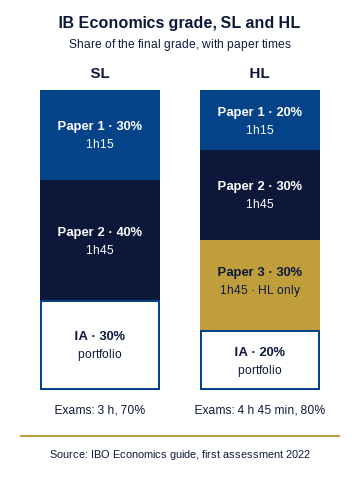
IB Economics SL is examined for 3 hours and HL for 4 hours 45 minutes, with the IA making up the rest. The SL or HL weights change how your revision time should split.
| Component | What it covers | Marks / weight | Time |
|---|---|---|---|
| Paper 1, extended response | One question from three: a 10-mark part (a) sets out the theory and a 15-mark part (b) weighs a wider argument. HL questions can draw on HL extension material. | SL 30% · HL 20% | 1 h 15 min |
| Paper 2, data response | One question from two, parts (a) to (g), including quantitative items; the final part carries 15 of the 40 marks. | SL 40% · HL 30% | 1 h 45 min |
| Paper 3, policy paper (HL only) | Two compulsory 30-mark HL questions; part (a) carries 20 marks with subparts, part (b) a 10-mark policy recommendation. | HL 30% | 1 h 45 min |
| Internal assessment portfolio | Three commentaries on articles for Units 2, 3 and 4, marked by your teacher and moderated by the IB. | SL 30% · HL 20% | 20 teaching hours |
IA criteria A to F, with the objective each one tests
Each commentary is marked out of 14 on criteria A to E, and criterion F adds 3 across the portfolio, so the IA totals 45. Knowing which objective a criterion tests tells you what to fix first.
| Criterion | Marks | Objective | What the criterion looks at |
|---|---|---|---|
| A Diagrams | 3 per commentary | AO2 and AO4 | Diagrams in the commentary and how they are explained |
| B Terminology | 2 per commentary | AO1 | Economic terminology used in the commentary |
| C Application and analysis | 3 per commentary | AO2 | Application and analysis of economics to the article |
| D Key concept | 3 per commentary | AO2 | One key concept per commentary, a different one each time; a repeat risks 3 marks |
| E Evaluation | 3 per commentary | AO3 | Evaluation within the commentary |
| F Rubric requirements | 3 for the portfolio | AO4 | A different unit per article, a different source per commentary, each article within one year; lessons rehearse the check on practice grids |
Worked HL problem
IB Economics HL calculations, worked from a diagram
IB Economics HL calculations in the 2022 guide are read from a diagram; this one covers tax revenue, incidence and welfare loss in 6 steps.
An HL carbon-tax diagram: revenue, incidence and welfare loss
The problem
A diagram shows an illustrative textbook market for a polluting good. Without intervention, price is $40 and output 900 units. The government sets a tax of $12 per unit, equal to the constant marginal external cost. After the tax, consumers pay $48, producers receive $36, and output falls to 700 units. Calculate the tax revenue, each group's share of it, and the welfare loss the tax removes.
Worked solution
- 1Read every value off the diagram before calculating: original price 40, original output 900, consumer price 48, producer price 36 and new output 700. The tax is 48 minus 36, which is 12 per unit.
- 2Tax revenue is the tax per unit times the new output: 12 × 700 = $8,400, the rectangle between the two post-tax prices up to 700 units.
- 3The consumer share is the rise in price paid times new output: (48 − 40) × 700 = $5,600.
- 4The producer share is the fall in price received times new output: (40 − 36) × 700 = $2,800. Check: 5,600 + 2,800 = 8,400.
- 5Before the tax, the industry overproduces by 900 − 700 = 200 units, each carrying an external cost of 12. The welfare loss triangle is ½ × 200 × 12 = $1,200.
- 6Because the tax equals the marginal external cost, output moves to the social optimum of 700 units and the $1,200 welfare loss is removed; consumers carry two-thirds of the burden.
Answer: Tax revenue $8,400 (consumers $5,600, producers $2,800); welfare loss removed $1,200.
Reading the producer price as the original price throws every later step off, so lessons rehearse naming all five diagram values before any working.
Where IB Economics marks leak, paper by paper and in the IA
The six IB Economics slips below touch three papers and the IA, and each one has a fixed routine that lessons rehearse until it holds.
Reading the producer price as the pre-tax price in an HL diagram calculation.
Label all five values on the diagram first, then write each calculation with its unit.
Reusing one key concept across two IA commentaries, which risks 3 criterion D marks.
Fill the unit and key-concept grid before searching for any article.
Picking an article older than one year, or two articles from one source.
Record publication date and source on the cover sheet the day you choose each article.
Drawing a Paper 1 diagram and never referring to it in the paragraph.
Write one sentence per curve shift that names the diagram and the change it shows.
Ending an HL Paper 3 part (b) answer by restating the data.
Close with one named policy, the stakeholder who pays, and the main risk.
Writing a commentary past 800 words, so the evaluation at the end goes unread.
Cut definitions to one line each and keep calculations in tables, which are left out of the count; lessons then rehearse a full practice commentary inside the limit.
Singapore cases and the planning method
Which Singapore policies fit the IB Economics units?
IB Economics learners in Singapore can draw on at least three published policies, from MAS, NEA and LTA, each matching a sub-topic of Units 2 or 3.
Singapore policy, sorted under the IB Economics units
Three of these Singapore facts sit under IB Economics units as policies you can draw; the fourth shows how the IP route leads into the Diploma.
MAS exchange-rate policy, Unit 3
MAS centres monetary policy on managing the trade-weighted exchange rate, keeping the S$NEER within a policy band for medium-term price stability. Use it when Unit 3 asks how monetary policy works in a small open economy.
Carbon tax, sub-topic 2.8
NEA records the carbon tax introduced on 1 January 2019 under the Carbon Pricing Act. It applies to industrial facilities whose annual direct greenhouse gas emissions reach the 25,000 tCO2e threshold. The rate was $5 per tCO2e from 2019 to 2023, $25 in 2024 and 2025, and $45 for 2026 and 2027, with a view of $50 to $80 by 2030.
COE and the vehicle quota, Unit 2
LTA explains that a Certificate of Entitlement gives the right to own and use a vehicle for 10 years, released through open bidding twice a month. The Vehicle Quota System controls the vehicle population because road space is limited, a clear case of scarcity and intervention.
The IP route into the Diploma
An IP learner meets DP1 Economics where the school's six-year Integrated Programme ends in the IB Diploma. MOE lists the GCE A-Level and NUS High School Diploma as the other endings. Because MOE keeps the IBDP apart from the national curricula, the IBO guide sets what you study.
The unit and key-concept grid for the IB Economics IA
The grid lines up three units with three different key concepts before any article search begins, following the criterion D rule on concepts and the criterion F rule on units. Lessons practise it on sample grids, and you build your own.
- 1
List the three units
Write Unit 2, Unit 3 and Unit 4 as the three rows; Unit 1 is outside the IA.
- 2
Assign three key concepts
Pick a different key concept for each row from the nine, choosing ones your units naturally raise.
- 3
Search for your own articles
You find newspaper, journal or internet articles yourself, each from a different source and within one year.
- 4
Fill the cover record
Log title, source, access and publication dates, writing date, word count, unit and key concept.
- 5
Draft alone, then check criteria
You write each commentary individually; lessons teach the theory, diagrams and criteria on practice articles.
- 6
Count to 800 and close the gap
Trim to the limit, keeping the evaluation; lessons rehearse this on practice articles until it is routine.
The course in numbers
IB Economics in four numbers
IB Economics results rest on diagrams, terminology, evaluation and following the IA rules; lessons give each one its own practice routine, and grade boundaries are set for each examination session.
- 4
- Syllabus units, Units 1 to 4
- 9
- Key concepts to choose from for the IA
- 45
- Marks in the IA portfolio
- 800
- Words read per IA commentary
Questions DP learners ask
IB Economics tuition questions from DP1 and DP2 learners
IB Economics questions here come from DP learners choosing a level, planning the IA or preparing for HL Paper 3.
IA portfolio and HL Paper 3
Rehearse IA planning with an IB Economics tutor
Tell us your DP year, SL or HL, and which IA commentary or HL Paper 3 question is open; our Singapore team proposes your tutor.
- 1-to-1 at home or online
- One form, then a call
- Tutor proposed by our team
Eduprime · IB Diploma Economics, home or online
Beside this page