IP English Tuition Singapore: Close Reading to the Year 6 Papers
IP English tuition in Singapore is one-to-one English for Integrated Programme learners on a six-year course with no Secondary 4 national exam. Lessons work from each school's own English tasks, then build toward H1 General Paper 8881, two papers of 50 marks each, the IB Diploma's Group 1 English, or the NUS High School Diploma.
Last updated
At a glance
- Who it's for
- Year 1 and Year 2 IP learners · Year 3 and Year 4 IP learners, including Sec 3 transfers
- Format
- IP English, Years 1 to 6, taught by one of our 12,000+ tutors at home or online
- Why Eduprime
- Lessons start from your school's own English work
Year groups we teach
Which IP years, from Secondary 1 to Year 6, do our English tutors teach?
IP English at Eduprime covers Years 1 and 2, Years 3 and 4, Years 5 and 6, and SEC-track Sec 2 learners applying for a Secondary 3 transfer.
Year 1 and Year 2 IP learners
The first IP years replace PSLE-style answers with open analysis: who wrote this, for whom, and how the writer persuades. With no national exam before Year 6, school tasks are the early checkpoints, so lessons give each one a clear method.
- Answers that retell a passage when the task asks for its purpose and audience
- School-set pace with no national paper to measure progress against
Year 3 and Year 4 IP learners, including Sec 3 transfers
Years 3 and 4 ask for full arguments: claim, evidence, counter-argument and evaluation, on issues from society to the environment. Learners who join an IP school at Secondary 3 from the SEC track meet this step up to full argument while still learning how their new school frames its English tasks.
- Paragraphs that state opinions without evidence or a counter-argument
- Narrow reading that leaves whole issue areas without examples
Year 5 and Year 6 IP learners
Year 5 and Year 6 IP learners write toward their school's certificate: H1 General Paper 8881 on the A-Level route, or Group 1 English at Higher or Standard Level on the IB route.
- One 500 to 800 word essay in a single 1 h 30 min sitting
- Summary and application answers that carry the Paper 2 language marks
Why Eduprime
Why do IP learners take one-to-one English with Eduprime?
IP English courses differ from school to school, so lessons can work from the learner's own task sheets, set texts and Year 6 route.
Lessons start from your school's own English work
MOE describes each IP programme as unique to its school, so lessons can work from your current texts, essay prompts and teacher comments.
Argument taught as a repeatable structure
Claim, evidence, counter-argument, evaluation, link: the same five moves carry a Year 3 paragraph and a Year 6 General Paper essay.
Close reading for purpose, audience and effect
Tutors model annotation for purpose, audience and effect line by line, then hand the pen over until the method holds without prompts.
Tutors skilled and experienced in English argument
Experienced and skilled in close reading, essays and argument; our team proposes one after the first consultation, matched to your year, route and timetable.
A written English record every lesson and every month
With no national paper until Year 6, tutor notes after every session and a monthly report give a written record of each skill as it grows.
A new English tutor whenever you ask, free of charge
A new tutor is matched free whenever the learner asks, for the same year and route, however many lessons have passed.
Six years in three bands
What does IP English tuition teach in each of the three year bands?
IP English tuition moves from purpose-and-audience reading (Years 1 and 2) to full argument (Years 3 and 4) and the GP, IB or NUS High end-point (Years 5 and 6).
Years 1 and 2: reading for purpose, audience and technique
Lessons build an annotation habit on opinion pieces, speeches, letters and feature articles: name the purpose and audience, find two persuasive techniques, then state the main claim in one sentence. Writing follows the same logic, with each paragraph aimed at a stated reader, using the texts your school sets.
Purpose and audience; persuasive techniques and their effect; one-sentence main claims; tone and vocabulary range
Years 3 and 4: building and testing an argument
Lessons teach one argument paragraph at a time, then join paragraphs into a full essay. Reading widens across the six issue areas H1 General Paper later uses: society and culture, economics, politics, the arts and humanities, science and technology, and the environment.
Argument paragraphs; counter-argument and evaluation; essay planning; reading log by issue area
Years 5 and 6: the end-point papers
On the A-Level route, lessons prepare both 8881 papers: the 500 to 800 word essay chosen from eight questions, and the comprehension paper with its summary, connections and application questions. On the IB route, lessons follow the Group 1 English course the school offers, with timed practice throughout.
8881 essay planning; summary and application answers; connections across passages; IB Group 1 English course work
Lesson formats
Should IP English lessons happen at home or online?
IP English lessons pair one learner with one tutor, in the learner's home or over a shared screen, with the format chosen at registration.
Home lessons in Singapore
An IP English tutor comes to the learner, picked to suit the neighbourhood and the weekly school schedule. Home lessons suit annotation on printed school texts and handwritten timed General Paper essays.
- Fitted to your area and school week
- Annotation on printed school texts
Online lessons
A shared screen lets tutor and learner mark up the same passage live, with no travel around a busy IP timetable.
- Live annotation on a shared screen
- No travel between commitments
From form to first lesson
How do IP English lessons start, and how do I register?
IP English tuition starts with one form and one consultation; our team then proposes a tutor for your year and route.
- 1
Register through the form
Give your IP year, your school's Year 6 route if known, and home or online lessons.
- 2
First consultation with our team
The free first consultation is with our team: your current English tasks, your school's texts and the skill to strengthen first.
- 3
Tutor proposal and Starter package
Our team proposes a tutor for your year, route and weekly schedule, and your first IP English package, the Starter, gets under way.
- 4
Lessons on your school's own work
Your tutor works on the texts and essay tasks your IP school sets, supplies practice sheets and a plan for each lesson, and keeps the written record described in the progress question below.
- 5
Review and the next package
The notes and report show what moved. The next step is a package planned around the next school term.
Our tutors
Who teaches IP English tuition at Eduprime?
IP English tutors are experienced and skilled in close reading, argument and essay craft; the six portraits below are composites drawn for illustration.
- Working knowledge of H1 General Paper 8881
- Comfort working from a school's own texts and task sheets
Ms Lim K.
Close reading and annotation for Years 1 and 2
Mr Ravi S.
Argument paragraphs and counter-argument for Years 3 and 4
Ms Chua W.
8881 Paper 1 essay planning across the six issue areas
Mr Tan J.
Politics and economics questions for Years 4 to 6
Ms Nur A.
8881 Paper 2 summary and application answers
Mr Wong D.
Group 1 English on the IB route, at Higher and Standard Level
In their words
What do IP learners say about their English lessons?
Six illustrative accounts from IP English learners in Years 1 to 6, each signed with a privacy-style name.
My Year 1 answers used to retell the passage. Now I write the purpose and audience in the margin first, and my teacher's comments say 'good analysis'.
Jia Hui T.
Year 1 IP learner · Home lessons · Years 1 and 2
The five-move paragraph clicked after two lessons. My Year 3 essays now carry a counter-argument in every body paragraph.
Aaron L.
Year 3 IP learner · Home lessons · Years 3 and 4
I joined at Secondary 3 and the English tasks felt new. My tutor worked through my school's task sheets with me week by week until the format felt normal.
Priya R.
Sec 3 transfer into the IP · Home lessons · Years 3 and 4
Summary was my weakest question. Picking points first and paraphrasing second means I reach the last point before the word limit.
Marcus O.
Year 5 IP learner · Online lessons · Years 5 and 6
I kept a reading log for all six issue areas. By Year 6 I had examples for the environment and economics questions I used to avoid.
Hui Min C.
Year 6 IP learner · Home lessons · Years 5 and 6
My Year 4 training days are packed, so online lessons slot in after them, and each lesson note lists the next fix for my essays.
Daniel K.
Year 4 IP learner · Online lessons · Years 3 and 4
Fees
What do IP English lessons cost per package, and how are payments split?
IP English fees appear in the table this section renders; the Starter covers four hour-long English lessons, and the cost question below explains how payment divides.
- Widest availability
Online International Tutor
fromS$21.50/ session
60-minute session
The widest bench of tutors across time zones, so a slot is open at almost any hour. Lessons run online over a shared screen.
Online Local Tutor
fromS$36.55/ session
60-minute session
A tutor based here who knows our schools, syllabuses and exams, teaching online.
Home Tutor
fromS$43/ session
60-minute session
A local tutor who comes to the learner, at home or at a nearby study spot, matched to their town and timetable.
Minimum 4 sessions. Larger packages lower the per-session price. One-time S$15 registration fee for new learners.
Whenever an IP learner asks for a new English tutor, we make the change free of charge, however many lessons have passed.
Student journeys
Has one-to-one English worked for an IP learner like me?
IP English tuition stories from two year bands, each a composite sketch drawn for illustration.
Comprehension answers described each paragraph and earned little credit on questions about purpose and technique.
- Annotated purpose and audience on every school passage
- Named two techniques and their effect per answer
- Wrote one-sentence main claims without prompting
School comprehension answers moved from description to analysis, and the learner now plans them alone.
Year 2 IP learner, home lessons · Two Starter-length packages over one term
Essays ran short of evidence outside two familiar issue areas, and summaries ran over the word limit.
- Built a reading log across all six issue areas
- Planned essays in ten minutes with a counter-argument
- Kept summaries inside the limit with full point coverage
The learner writes on four issue areas with confidence and finishes the summary with time to check language; stamina for a full paper improved steadily.
Year 5 IP learner on the A-Level route, online lessons · Three packages across Year 5
What IP English is
What is English on the Integrated Programme, and who sets it?
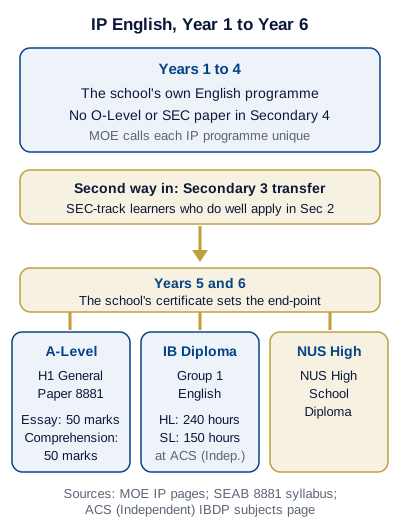
IP English is the English strand of Singapore's six-year Integrated Programme, which skips the Secondary 4 national exam and leads, school by school, to an A-Level certificate, an IB Diploma or the NUS High School Diploma. MOE describes each IP programme as unique to its school, so Years 1 to 4 English follows that school's own course.
- 01Six years from Secondary 1 to the Year 6 certificate (MOE)
- 02No O-Level or SEC paper in Secondary 4 for IP learners
- 03MOE calls each IP school's programme unique to that school
- 04A-Level route: every student takes H1 General Paper 8881
- 05IB route: Group 1 English at Higher or Standard Level
Year 1 to Year 6
Where does each IP year sit on the way to the Year 6 certificate?
IP English runs six years, with school-set English through Year 4 and an A-Level, IB or NUS High end-point in Years 5 and 6.
- 1
Year 1 (Secondary 1)
The school's own English programme begins, with reading turned to purpose, audience and technique.
- 2
Year 2 (Secondary 2)
Analysis deepens and writing aims at a stated reader. Sec 2 learners on the SEC track with strong results may apply for an IP place from Secondary 3.
- 3
Year 3 (Secondary 3)
Argument paragraphs take shape. Sec 3 transfers join here, and MOE expects every learner to complete the full programme at one school.
- 4
Year 4 (Secondary 4)
No O-Level or SEC paper for IP learners. Essays widen across the six issue areas that General Paper later draws on.
- 5
Year 5
A-Level route: H1 General Paper 8881 and Project Work for every student, beside four content-based subjects, at least three at H2. IB route: Group 1 English at Higher or Standard Level.
- 6
Year 6
Year 6 finishes the course: A-Level schools sit the two 8881 General Paper papers separately, IB schools reach final Diploma assessment, and NUS High learners complete their own diploma.
Four rules to read first
What should an IP learner know about English first?
No Secondary 4 English paper on the IP
Secondary 4 brings no GCE O-Level or SEC sitting for an IP English learner, since MOE states they do not need to take either. The first English end-point comes in Year 6: H1 General Paper on the A-Level route, Group 1 English on the IB route, or the NUS High School Diploma. Until then, school tasks carry the measuring.
Moving between IP schools is limited
Under MOE's rules, an IP learner switches to a different IP school only in exceptional circumstances and is expected to stay for the full duration of the programme. English lessons therefore plan around one school's texts and tasks.
Sec 3 transfer applicants can prepare early
A Secondary 3 transfer into the IP is open, by application, to SEC-track learners who do well. Starting IP-style argument writing in Sec 2 shortens the adjustment to a new school's English tasks in Year 3.
H2 English Language and Linguistics 9508 is revised for 2027
SEAB's 2026 list marks 2026 as the last year of exam for the current 9508 syllabus, and its 2027 list carries English Language and Linguistics [Revised] 9508. Both lists also carry Literature in English at H1 (8841), H2 (9539) and H3 (9805), beside H1 General Paper 8881.
IP track and SEC track
How does IP English differ from SEC-track English?
IP English and SEC-track English differ in who sets the course, which national papers apply and when English is first examined nationally.
| What changes | IP track | SEC track |
|---|---|---|
| Years 1 to 4 English course | The school's own programme, which MOE calls unique to each IP school | MOE's English Language syllabuses, taken at G1, G2 or G3; the G2 and G3 syllabus dates from 2020 |
| National English paper in Secondary 4 | None: IP learners sit no O-Level or SEC paper | SEC English Language from 2027, with K300 as the G3 code |
| Syllabus code before 2027 | No O-Level English paper sat in Secondary 4 | GCE O-Level English Language 1184, up to and including 2026 |
| English in Years 5 and 6 | H1 General Paper 8881 (A-Level route), IB Group 1 English (IB route) or the NUS High School Diploma | H1 General Paper 8881 for learners who go on to the A-Level |
| Moving schools | Transfers between IP schools only in exceptional circumstances; MOE expects the full duration | Learners who perform well can apply, in Sec 2, to transfer to the IP at Secondary 3 |
IP track and SEC track
Which A-Level subjects on SEAB's 2026 and 2027 lists build on IP English?
SEAB's A-Level lists for school candidates carry these six subjects, which an IP learner on the A-Level route may meet in Years 5 and 6.
| Subject | Code | 2026 list | 2027 list |
|---|---|---|---|
| H1 General Paper | 8881 | Listed; taken by every A-Level student with Project Work | Listed, with the same two papers |
| H1 Literature in English | 8841 | Listed | Listed |
| H2 Literature in English | 9539 | Listed | Listed |
| H3 Literature in English | 9805 | Listed | Listed |
| Knowledge and Inquiry | 9759 | Listed | Listed |
| H2 English Language and Linguistics | 9508 | Listed; last year of the current syllabus | Listed as [Revised] |
The IP landscape
Which IP schools and routes shape IP English?
IP English sits inside a six-year programme that MOE's school dataset flags at 19 schools, and MOE calls each IP programme unique.
Six facts about the Integrated Programme that decide how English is taught
IP courses differ by school, so these six points cover the common rules that shape English lessons across the programme.
Three possible certificates
MOE lists three end certificates on the IP, the GCE A-Level, the International Baccalaureate Diploma and the NUS High School Diploma, and says certification varies across schools. The certificate shapes the Year 6 English course.
19 schools flagged IP in MOE's dataset
MOE's General Information of Schools dataset on data.gov.sg flags 19 schools: Anglo-Chinese School (Independent), Catholic High School, Cedar Girls' Secondary School, CHIJ St. Nicholas Girls' School, Dunman High School, Eunoia Junior College, Hwa Chong Institution, Methodist Girls' School (Secondary), Nanyang Girls' High School, National Junior College, NUS High School of Mathematics and Science, Raffles Girls' School (Secondary), Raffles Institution, River Valley High School, Singapore Chinese Girls' School, St. Joseph's Institution, Temasek Junior College, Victoria Junior College and Victoria School.
Schools versus programmes
Some of those 19 records are the Year 5 and 6 partner college of another IP school, so the dataset counts schools. Our integrated programme Singapore guide sets out which school leads to which certificate.
A school-designed English course
MOE says each IP programme builds on its school's strengths, culture and ethos, so lessons can work from the learner's own task sheets.
Joining at Secondary 3
An SEC-track learner who performs well can apply in Sec 2 to transfer at Secondary 3 and pick up IP English halfway through the course.
One school for six years
MOE expects a learner to stay at one IP school for the full duration of the programme, so English is built against that school's tasks.
Years 1 and 2 worked task: annotating a short opinion piece
Practice text: a letter to a community newsletter arguing that a neighbourhood park should close its car park on Sundays so residents, runners and cyclists can use the space. The task asks for purpose, audience, two persuasive techniques and the main claim in one sentence.
- 1
Name the purpose
Ask what the writer wants the reader to do or believe. Here the letter wants readers to support closing the car park on Sundays, so the purpose is to persuade residents to back a change.
- 2
Name the audience
Look for who is addressed and what they share. A community newsletter reaches local residents who use the park, so the writer appeals to their weekends, their health and their shared space.
- 3
Find two techniques and their effect
Mark an inclusive pronoun such as 'our park', which makes readers feel the space belongs to them, and a rhetorical question such as 'Who needs a car park on a day of rest?', which pushes readers toward one answer.
- 4
State the main claim in one sentence
Combine purpose and position: 'The writer argues that closing the park's car park on Sundays would give residents more room to rest and exercise together.' One sentence, the writer's view, no retelling.
The Year 6 end-points
What do the Year 6 English end-points of IP English ask for?
IP English ends in H1 General Paper 8881 for an A-Level learner, two papers of 50 marks each, and in IB Group 1 English at Higher or Standard Level for an IB learner.
H1 General Paper 8881 and IB Group 1 English at a glance
General Paper sets two equal papers of 50 marks, so the comprehension paper, with its summary and application answers, deserves as much practice as the essay.
| Component | What it covers |
|---|---|
| 8881 Paper 1: Essay | Eight questions, answer one, in 500 to 800 words; 50 marks (Content 30, Language 20); 50%; 1 h 30 min. Six issue areas, from society and culture to the environment. |
| 8881 Paper 1: top content band | Content carries 30 of Paper 1's 50 marks, and Band 5, the top content band, covers 25 to 30 of them. |
| 8881 Paper 2: Comprehension | Three passages of about 1,200 words in total with comparative analysis; 8 or 9 questions; 50 marks (Content 35, Language 15 from the summary and application answers); 50%; 1 h 30 min. |
| 8881 Paper 2: question mix | Passage 1 comprehension, inference, analysis, evaluation and synthesis for 9 to 11 marks; a summary on Passage 2 for 8 marks; connections across passages for 4 to 6 marks; and an application question on a related theme for 12 marks. Paper 1 and Paper 2 are taken at separate sittings. |
| IB Group 1 English: Higher Level | At Anglo-Chinese School (Independent), Group 1 is Studies in Language and Literature: Literature (English) or Language and Literature (English). Higher Level carries 240 teaching hours. |
| IB Group 1 English: Standard Level | The same courses at Standard Level carry 150 teaching hours, within a Diploma of three Higher and three Standard Level subjects. |
The two 8881 assessment objectives as skills to practise
SEAB's 8881 syllabus names two assessment objectives: AO1 Critical and Inventive Thinking and AO2 Communication. Each sub-skill below becomes a lesson target.
| Criterion | What strong work shows |
|---|---|
| AO1: analyse arguments | Break a case into claim, reasons and assumptions, then judge where it holds. |
| AO1: analyse and evaluate issues | Weigh local, regional and global issues with Singapore and international examples. |
| AO1: evaluate and synthesise across texts | Compare arguments and evidence across passages, as the connections question asks. |
| AO1: formulate cogent arguments | Build informed arguments with a clear line from claim to evaluation. |
| AO1: observe trends and apply ideas | Carry an idea into a new context, as the application question requires. |
| AO2: English for purpose, context and audience | Fit register and tone to the reader and the task. |
| AO2: accurate, coherent, succinct presentation | Make each sentence earn its place, above all inside a summary limit. |
| AO2: spelling, punctuation and grammar | Keep conventions steady across a full 1 h 30 min paper. |
| AO2: range of vocabulary | Use precise words for argument and evaluation. |
Years 3 and 4
Where does IP English argument writing slip, and how is it fixed?
IP English argument work in Years 3 and 4 rests on five moves per paragraph, tested across six issue areas.
Four habits that weaken a Year 3 or Year 4 argument
Each habit below comes from the move from PSLE-style answers to open analysis, and each has a fix the tutor practises in lessons.
Retelling the source when the task asks for analysis of purpose, audience and argument.
Start every answer with the writer's aim in one clause, then explain how one feature serves that aim.
A claim followed only by more claims, with no evidence a reader could check.
Attach one concrete example to each claim: a policy, an event or an observed trend, with where and when it happened.
Mentioning the other side in one line and moving on.
Write the counter-argument at full strength, then evaluate it: say what it gets right and why the main claim still stands.
Reading in two comfortable issue areas only, leaving no examples for economics, politics or the environment.
Keep a reading log with one page per issue area and add one example a week to the thinnest page.
Worked example for Years 3 and 4: a five-move paragraph on phones in class
The problem
Write one argument paragraph in response to the question: 'Should secondary schools in Singapore keep mobile phones out of lessons?' Include a claim, evidence, a counter-argument, an evaluation and a link back to the question, in no more than 100 words.
Worked solution
- 1Claim: choose a clear position the paragraph can defend. 'Keeping phones out of lessons helps secondary learners sustain attention on demanding work.'
- 2Evidence: give an example a reader can picture and test. 'A learner working through a two-page comprehension passage loses the thread each time a notification pulls the eye away, and must reread to recover it.'
- 3Counter-argument at full strength: 'Phones also carry dictionaries, timers and class materials, and some teachers build lessons around them.'
- 4Evaluation: weigh the counter-argument honestly. 'These uses are real, yet a school device or a teacher-led moment of phone use delivers them without leaving the distraction on the desk all lesson.'
- 5Link: return to the exact words of the question. 'Keeping mobile phones out of lessons, with planned exceptions, therefore protects the attention that secondary work demands.'
- 6Check: count the five moves, confirm each sentence answers 'should', and count the words: the five sentences above come to 96, inside the 100-word limit.
This paragraph fixes pitfall three: the counter-argument gets a full sentence of its own, followed by an evaluation that says why the claim still stands.
Years 5 and 6
How is a GP-style summary built in IP English at Years 5 and 6?
IP English at Years 5 and 6 meets the 8881 summary question, worth 8 marks and part of Paper 2's 15 language marks.
Years 5 and 6 worked example: a summary in your own words within a limit
The problem
A passage on rooftop gardens in dense cities gives these benefits: they cool buildings, absorb rainwater, give residents a place to meet, grow some food close to home and attract birds and insects. It also gives examples and a long anecdote. Summarise the benefits in no more than 45 of your own words.
Worked solution
- 1Read the question for its focus word: 'benefits'. Ignore the anecdote, the examples and any drawbacks the passage mentions.
- 2List the points as bare notes: cooling; rainwater; meeting place; food; wildlife. Five points for an 8-mark question means each one counts.
- 3Paraphrase each point: 'lower indoor temperatures', 'soak up heavy rain', 'shared space for neighbours', 'produce grown nearby', 'habitats for birds and insects'.
- 4Join the points into two short sentences that a reader follows at once, using commas and one linking word such as 'also'.
- 5Count the words of the two-sentence draft (shown in the answer below): 31 words, inside the 45-word limit.
- 6Check coverage against the note list: all five points present, no copied phrases longer than a key term, no examples or opinions added.
Answer: Rooftop gardens lower indoor temperatures and soak up heavy rain. They also give neighbours a shared space to meet, let residents grow produce nearby and create habitats for birds and insects. (31 words)
Points first, paraphrase second: the note list doubles as the coverage check, so no point is lost while the wording changes.
A six-page reading log keyed to the 8881 Paper 1 issue areas
General Paper Paper 1 offers eight questions across six issue areas, and a learner answers one. One log page per area keeps evidence ready for any of them.
Society and culture page
Identity, ageing and community examples, local and global.
Economics page
Cost of living, work and trade examples for questions on money and jobs.
Politics page
Governance, policy and international relations, each with a date and place.
Arts and humanities page
Literature, history and heritage for questions on what a society keeps.
Science and technology page
AI, medicine and data, with one benefit and one risk for each.
Environment page
Climate, conservation and urban planning, ready for trade-off questions.
Accountability
How is progress in IP English shown before the Year 6 papers?
IP English progress is recorded in writing after every session and every month, since the first national paper arrives only in Year 6.
Tutor notes after every session
What was practised, such as annotation, counter-argument or summary, and what to work on next.
Monthly progress report
Once a month a written report sets out the English skills worked on and what comes next.
Worksheets and lesson plans
Practice sheets and a plan for each lesson come with the service, built around the work the learner brings.
School tasks as material
Lessons can work from the learner's own school tasks and teacher comments, so practice answers what the school asks for.
Figures that shape the six years
What can IP English tuition change, and what decides the result?
IP English results depend on how often the learner reads, practises between lessons and meets the school's tasks; lessons build method, evidence and timed stamina against each factor.
- 6 years
- Integrated Programme length, Year 1 to Year 6
- 2 × 50 marks
- H1 General Paper 8881: essay paper and comprehension paper
- 6 issue areas
- Paper 1 themes a reading log covers
- 240 / 150 hours
- IB Group 1 English teaching hours, HL and SL, at one IP school
IP English questions
What do IP learners ask before starting English tuition?
IP English tuition questions on the course, the Year 5 route, lessons, cost and progress, each answered in full.
Year 4 into Year 5
Step from Year 4 English into Year 5 ready
Year 5 opens H1 General Paper 8881, IB Group 1 English or the NUS High route; each IP learner's tutor trains argument and summary skills.
- One-to-one, home or online
- Works from school texts
- Monthly progress report
- Free tutor replacement
Eduprime · IP English tuition, at home or online
Next pages for IP learners