Primary English Tuition in Singapore for P1 to P6
Primary English tuition in Singapore at Eduprime gives a P1 to P6 learner a personal English tutor, whose lessons follow the six Areas of Language Learning set out in MOE's English Language Syllabus 2020. Home or online, the work climbs year by year towards the 200-mark PSLE English Language examination: reading aloud, grammar cloze, compositions and oral.
Last updated
At a glance
- Who it's for
- P1 and P2 learners · P3 and P4 learners
- Format
- 12,000+ tutors ready for P1 to P6 English
- Why Eduprime
- One tutor, one learner
Who it serves
Which P1 to P6 learners does primary English coaching serve?
Primary English learners at three stages, each with its own English work to master before the next year begins.
P1 and P2 learners
Learners at P1 and P2 are still turning letters into sounds and sounds into fluent reading. Some are in the school's Learning Support Programme; others read well and want richer words.
- Reads word by word with long pauses
- Guesses at unfamiliar words from the first letter
P3 and P4 learners
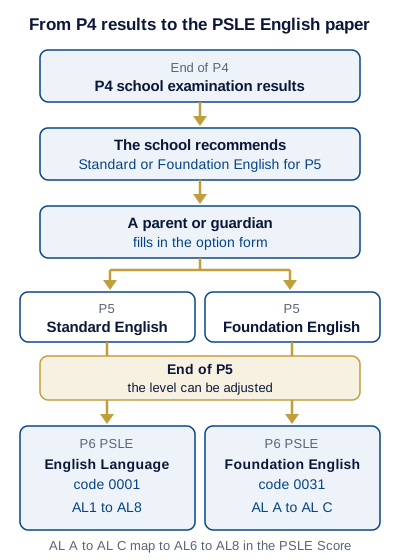
Learners at P3 and P4 work on grammar and comprehension answers that need a reason behind each choice. After P4, the school recommends Standard or Foundation English for P5 from the P4 school examination results.
- Tense shifts halfway through a paragraph
- Answers inference questions by copying a line
P5 and P6 learners
Learners at P5 and P6 practise the four PSLE English papers, where situational writing, continuous writing, comprehension and the oral conversation each carry their own marks.
- Misses one content point in situational writing
- Composition drifts away from the chosen picture
Why Eduprime
Why choose one-to-one primary English tuition with Eduprime?
Eduprime matches each primary English learner with one tutor who plans around the learner's year and school topics.
One tutor, one learner
With one tutor beside one learner, every read-aloud is actually heard, and a slipped vowel sound, a wandering tense or a forgotten content point is fixed in the moment.
Six syllabus areas in every plan
Lesson plans cover all six Areas of Language Learning in the MOE English Language Syllabus 2020, weighted by the learner's year.
School topics welcome
The learner can bring the week's worksheet, spelling list or composition topic, and the tutor builds the lesson around it with our own materials.
A new English tutor, free on request
When the learner or the registrant asks, a fresh English tutor steps in free, at any time, for every request with no cap.
A note after every English lesson
Each lesson ends in a tutor note listing the spelling, tense or comprehension slips that returned, and the month's English review sets the targets ahead.
A deep bench of English tutors
We draw on 12,000+ tutors to find one skilled in P1 to P6 English whose hours and travel fit the learner's school week.
Year by year
What English work fills each school year, Primary 1 to Primary 6?
Primary English tuition in Singapore follows the year the learner is in, from reading aloud at P1 to the four PSLE papers at P6.
Primary 1: reading aloud and first sentences
In schools that teach STELLAR, P1 classes may read Big Books through the Shared Book Approach. Lessons at home build matching habits: linking letters to sounds, reading aloud with expression and retelling in one complete sentence.
Sound-letter decoding · sight words · reading aloud · retelling in full sentences · capital letters and full stops
Primary 2: fluent reading and short writing
P2 learners move from single sentences to short paragraphs. With no weighted assessments or examinations at P1 and P2 since 2019, the year is for fluency, new words in speech and a few linked sentences about a picture.
Vowel teams and blends · past and present tense · describing words · joining sentences with and, so, because · picture writing
Primary 3: grammar in context
P3 lessons work on grammar, vocabulary in context and short comprehension passages, the same skills that PSLE Paper 2 later tests through components such as Grammar Cloze and Vocabulary Cloze. Grammar is treated as a resource for saying things clearly, with each answer's reason spoken aloud.
Tense consistency · subject-verb agreement · prepositions · vocabulary from context · literal comprehension questions
Primary 4: inference and the step to P5
After P4, the school recommends Standard or Foundation English for P5 from the P4 school examination results, and a parent or guardian fills in an option form. Lessons widen comprehension from finding answers to inferring feelings and causes, and build compositions with a clear beginning, problem and ending.
Inferential questions · grammar cloze · editing for spelling and grammar · paragraphing · composition planning
Primary 5: the PSLE papers take shape
P5 learners take English at Standard or Foundation level. On the Standard path the PSLE skills become regular practice: situational writing, continuous writing of at least 150 words based on at least one of three pictures, and synthesis and transformation.
Situational writing · continuous writing from pictures · synthesis and transformation · comprehension cloze · visual text comprehension
Primary 6: four papers, one plan
P6 learners on the Standard path sit the PSLE English Language examination, 200 marks across four papers. Most weeks go to the written papers, with listening practice on texts read twice and oral practice on reading aloud and one photo.
Paper 1 writing under time · Paper 2 open-ended comprehension · listening comprehension · reading aloud · stimulus-based conversation
Lesson formats
Home lessons or online lessons for a primary English learner?
Primary English runs in two one-to-one formats, and the learner's pick between them goes on one registration form.
Home lessons
A tutor reads with the learner at home, chosen to suit the town and the hours left after school. P1 and P2 learners often settle best at their own table, where reading aloud feels natural, and a parent or guardian agrees the lesson time.
- Tutor chosen near the learner's town
- English worksheets and lesson plans supplied
Online lessons
On screen, P4 to P6 learners annotate cloze passages and type situational-writing emails while the tutor watches each draft grow. Each online lesson still closes with a tutor note, and the month's report arrives as it does at home.
- Shared screen for cloze and editing
- Same notes and monthly report
How it works
How do primary English lessons start, step by step?
Primary English begins on the registration form, moves to a first consultation where our team hears about the learner's reading and writing, then settles into planned lessons.
- 1
Register through the form
A parent, guardian or the learner completes the form with English, the school year from P1 to P6 and home or online lessons, adding any class topics worth tackling first.
- 2
First consultation with our team
Our team holds the first consultation, free of charge, to hear what the learner reads, writes and finds hard, and chooses the tutor from it.
- 3
A tutor is proposed
Our team proposes a tutor with long practice in primary English, able to reach the learner's home at the learner's hours, or to teach online. The Starter, four hour-long English lessons, opens the year's work.
- 4
Payment for the package
The English package is paid in one go, or in two 50% halves, before the first lesson and at the package's midpoint. Joining for the first time carries a one-time registration fee, listed beside the English lesson fees on this page.
- 5
Lessons that follow the school year
Each lesson follows the learner's year and the class topics the learner brings, and in the months before the P4 school examinations, lessons can give extra weight to grammar and comprehension.
- 6
Notes, reports and the next package
After each lesson a tutor note logs the reading, grammar and writing work, and each month a progress report draws those notes together. The next step is renewing the package, with the same tutor or, on request, a different one at no cost.
Our tutors
Who teaches primary English tuition at Eduprime?
Every primary English tutor we propose is experienced and skilled with grammar, reading and composition; the six profiles below are composites written to show the range.
- Years of one-to-one primary English teaching
- Skilled in P1 to P6 grammar, reading and composition
Ms Tan W.
9 years
P5 and P6 situational and continuous writing
Mr Rahman S.
7 years
P3 and P4 grammar cloze and editing
Mrs Pillai K.
11 years
P1 and P2 reading aloud and retelling
Ms Chua L.
6 years
Vocabulary in context and comprehension cloze
Mr Lee J.
8 years
Reading aloud and the stimulus-based conversation
Ms Nur A.
5 years
Foundation English learners at P5 and P6
In their words
What do primary English learners say about their lessons?
Learner and registrant voices below are illustrative, written to show the progress one-to-one primary English lessons bring.
I used to stop at every long word. Now we read a page three times, and I can read it aloud without stopping.
Aiden T.
P2 learner · Home lessons · Primary English tuition
Grammar cloze used to be guesswork. My tutor makes me say why each word fits, and I get most tense questions right now.
Mei L.
P4 learner · Home lessons · Primary English tuition
The notes after each lesson list the errors that came back that week, so we practise those three at home.
Mrs Goh P.
Registrant for a P3 learner · Home lessons · Primary English tuition
I always forgot one point in situational writing. Now I tick the points off first, and my emails cover the whole task.
Ryan K.
P6 learner · Home lessons · Primary English tuition
We mark up the comprehension passage on the shared screen, and I can see where my answer missed the inference.
Priya S.
P5 learner · Online lessons · Primary English tuition
Photo practice helped most. I give an opinion, a reason and a story from my own life, so my oral answers are longer.
Daniel W.
P6 learner · Home lessons · Primary English tuition
Fees
What will primary English lessons cost, and how is the package paid?
Primary English fees for each level, at home and online, appear in our engine's grid on this page; the Starter opens with four 60-minute English lessons, paid whole or in two parts.
- Widest availability
Online International Tutor
fromS$17/ session
60-minute session
The widest bench of tutors across time zones, so a slot is open at almost any hour. Lessons run online over a shared screen.
Online Local Tutor
fromS$28.90/ session
60-minute session
A tutor based here who knows our schools, syllabuses and exams, teaching online.
Home Tutor
fromS$34/ session
60-minute session
A local tutor who comes to the learner, at home or at a nearby study spot, matched to their town and timetable.
Minimum 4 sessions. Larger packages lower the per-session price. One-time S$15 registration fee for new learners.
Should the learner or the registrant ask for a different primary English tutor, one takes over free, at any time and request after request.
Student journeys
Has primary English tuition helped learners like this?
The P3 and P6 learner stories below are composites, written to illustrate how one-to-one lessons changed their English work.
Zara read fluently and still lost grammar marks: tenses changed halfway through answers, and prepositions were chosen by sound.
- Said a reason aloud for every grammar answer
- Kept one tense through a whole paragraph
- Corrected her own errors in an editing passage
By the end of P3, Zara made fewer tense errors and checked her own work, a habit she carried into P4.
Zara M., P3 · Two school terms
Marcus wrote long compositions and kept losing situational writing marks: one content point went missing, and his tone suited a friend when the task named a principal.
- Listed every content point before writing
- Matched tone to the reader named in the task
- Finished Paper 1 practice with time to check
Marcus now covers every content point and matches his tone to the reader, a writing method he took into the PSLE.
Marcus L., P6 · Four months
The syllabus
What does the MOE English syllabus ask of a primary learner?
The English Language Syllabus 2020 is the MOE syllabus that shapes primary English lessons in Singapore. Its overarching aim is effective and affective language use. It hopes to grow empathetic communicators, discerning readers and creative inquirers, working across six Areas of Language Learning.
- 01Six Areas span listening, reading, speaking, writing, grammar and vocabulary.
- 02Receptive skills are listening, reading and viewing.
- 03Productive skills are speaking, writing and representing.
- 04Grammar and vocabulary are treated as resources for expression.
- 05Learners also learn metalanguage, the words used to talk about language.
- 06PSLE English Language is built on the syllabus Learning Outcomes.
P1 to the PSLE
Where does each primary year sit on the road to the PSLE?
Primary English pathway from P1 to P6, with the P4 to P5 step where the school recommends Standard or Foundation English.
- 1
Primary 1
No weighted assessments or examinations since 2019; learning is reported with qualitative descriptors. Schools identify learners for the Learning Support Programme at the start of P1.
- 2
Primary 2
Still no weighted assessments or examinations. Lessons build fluent reading of longer texts and short linked writing.
- 3
Primary 3
Lessons grow grammar, vocabulary in context and literal comprehension; some learners join the Reading Remediation Programme at P3 and P4.
- 4
Primary 4
After P4, the school recommends Standard or Foundation English for P5 from the P4 school examination results, and a parent or guardian fills in an option form. Lessons widen into inference questions and longer compositions.
- 5
Primary 5
The P5 year runs at Standard or Foundation level, and the level can be adjusted at the end of P5; on the Standard path, learners begin regular work on PSLE paper skills. Mid-year examinations ended for all levels by 2023.
- 6
Primary 6
The PSLE: English Language (Standard), code 0001, graded AL1 to AL8, or Foundation English Language, code 0031, whose AL A to AL C map to AL6 to AL8.
Before P5
What should a primary learner know before P5 English?
P4 results shape the school's P5 recommendation
After P4, the school recommends Standard or Foundation English for P5 from the P4 school examination results, a parent or guardian fills in an option form, and the level can be adjusted at the end of P5. Steady grammar and comprehension work through P3 and P4 prepares the learner for that step.
Bring the school worksheet to the lesson
The tutor can build a lesson around this week's spelling list, grammar worksheet or composition topic. The learner then meets each idea twice in a week, once in class and once one to one.
P1 and P2 carry no examinations
Since 2019, P1 and P2 have no weighted assessments or examinations, and learning is reported with qualitative descriptors. Those years belong to reading, speaking and early writing habits.
Mid-year examinations ended by 2023
By 2023 MOE had dropped mid-year examinations at every primary and secondary level. Each tutor note records which reading or writing skill moved forward.
The PSLE English format in force since 2025
The PSLE English Language (Standard) format in force from 2025 carries 200 marks: Writing 50, Language Use and Comprehension 90, Listening 20 and Oral 40. Lessons from P5 practise to these weights.
Compare the options
Which English help fits a primary learner best?
Primary English tuition compared with PSLE English tuition and with phonics or reading classes, by years served, focus and the moment each one fits.
| What you are weighing | Primary English tuition | PSLE English tuition | Phonics or reading classes |
|---|---|---|---|
| Years served | P1 to P6 | P5 and P6 | Mostly P1 and P2, or any year where reading lags |
| Main focus | All six syllabus areas, weighted by year | The four PSLE English papers and their marks | Decoding, fluency and reading comprehension |
| Syllabus areas covered | All six syllabus areas | All six, organised by paper | Reading and Viewing, Speaking and Representing |
| Link to the PSLE | Builds the skills from P1; papers practised from P5 | Paper by paper across 200 marks | Indirect: fluent reading feeds every paper |
| When to choose it | Any primary year needing steady English work | A P5 or P6 learner focused on the papers | A young learner still decoding or reading slowly |
Compare the options
How do Standard and Foundation English compare at P5 and P6?
Standard and Foundation English share one route to the P5 level and lead to different PSLE papers.
| What to compare | Standard English | Foundation English |
|---|---|---|
| How the P5 level is set | School recommends it from P4 results; can be adjusted at the end of P5 | School recommends it from P4 results; can be adjusted at the end of P5 |
| PSLE paper and code | English Language, code 0001 | Foundation English Language, code 0031 |
| PSLE grades | AL1 to AL8 | AL A to AL C |
| In the PSLE Score | Adds 1 to 8 | Maps to AL6 to AL8 |
Syllabus and school
How do syllabus and school support shape English lessons?
English Language Syllabus 2020 sets six Areas of Language Learning; lessons map each one to the learner's year and to the school's own programmes.
Six Areas of Language Learning, year by year
Primary English tuition uses the six Areas as its checklist, with the weight shifting year by year.
Listening and Viewing
Spoken instructions and stories at P1 to P2; details at P3 to P4; texts read twice, 20 multiple-choice questions at the PSLE.
Reading and Viewing
Shared reading and reading aloud at P1 to P2; literal, then inferential comprehension at P3 to P4; visual texts and open-ended comprehension at P5 to P6.
Speaking and Representing
Retelling in full sentences at P1 to P2; reasons aloud at P3 to P4; reading aloud and a conversation on one photo at P5 to P6.
Writing and Representing
Linked sentences at P1 to P2; planned paragraphs at P3 to P4; situational and continuous writing at P5 to P6.
Grammar
Tense and full stops early; agreement, prepositions and grammar cloze at P3 to P4; editing, synthesis and transformation at P5 to P6.
Vocabulary
Sight words early; words in context at P3 to P4; vocabulary cloze and precise word choice at P5 to P6.
What school already provides, and where tuition fits
Primary schools run their own English programmes; a tutor who knows them connects home lessons to class work.
STELLAR
MOE says primary schools are equipped to teach STELLAR, STrategies for English Language Learning And Reading. One school's page describes it from P1 to P6 with Big Books and authentic children's texts; another school's model starts lower primary on the Shared Book Approach and adds Supported Reading and the Writing Process Cycle higher up.
Learning Support Programme
Early intervention for English literacy at P1 and P2. Learners identified at the start of P1 work half an hour a day in groups of 8 to 10 with trained teachers.
Reading Remediation Programme
At P3 and P4, learners still needing help may join the Reading Remediation Programme, or a school-based dyslexia remediation programme after a diagnosis; support may continue at P5 Standard.
Foundation English
Offered at P5 and P6 alongside Standard English. The school recommends the level from P4 school examination results, and it can be adjusted at the end of P5. Foundation English Language is PSLE code 0031, and its AL A to AL C map to AL6 to AL8.
A P1 to P2 worked task: read, repeat, retell
Problem: read aloud the set 'The snail waits in the rain. A train passes the main gate. Gail paints a sail on her pail.' and retell it in two sentences.
- 1
Find the team
The learner underlines every a and i sitting together: snail, waits, rain, train, main, Gail, paints, sail, pail. Nine words, one long a sound.
- 2
Say the sound, then the word
The learner says the long a alone, then blends it inside each word: s, n, ai, l, snail.
- 3
Read the set aloud
The learner reads the three sentences with a finger under each word; the tutor quietly marks the words that stalled.
- 4
Read it twice more
The second reading drops the finger; the third adds expression and a pause at each full stop.
- 5
Retell in two sentences
Book closed: 'A snail waits in the rain while a train passes the main gate. Gail paints a sail on her pail.'
- 6
Note it for next time
The tutor note records the stalled words, so a later lesson can return to the same vowel team with a fresh set: one-to-one listening a full class has little time for.
Assessment
How is a primary learner assessed from P1 to P6?
PSLE English Language (Standard), code 0001, carries 200 marks across four papers; the years before it are assessed by schools, with no examinations at P1 and P2.
School assessment and the four PSLE English papers
P1 and P2 carry no examinations, and the PSLE at P6 carries 200 marks; the weights tell a P5 learner where practice time pays most.
| Component | What it covers |
|---|---|
| P1 and P2 | No weighted assessments or examinations since 2019. Learning is reported with qualitative descriptors, and the Holistic Development Profile shows no class or level position. |
| P3 to P5 | No mid-year examinations at any level since 2023. After P4, the school recommends Standard or Foundation English for P5 from the P4 school examination results, and the level can be adjusted at the end of P5. |
| Paper 1 Writing | 50 marks, 25% of the total, 1 h 10 min. Situational Writing 14 marks; Continuous Writing 36 marks, at least 150 words built on at least one of three pictures. |
| Paper 2 Language Use and Comprehension | 90 marks, 45%, 1 h 50 min. 25 multiple-choice and 50 open-ended questions across grammar, vocabulary, cloze, editing, synthesis and transformation, visual text and comprehension. |
| Paper 3 Listening Comprehension | 20 marks, 10%, about 35 min. 20 multiple-choice questions, with each text read twice. |
| Paper 4 Oral Communication | 40 marks, 20%, about 10 min including 5 min of preparation. Reading Aloud 15 marks; Stimulus-based Conversation 25 marks on one photo. |
How PSLE English results are reported
Each PSLE subject is graded in eight Achievement Levels, and the PSLE Score adds four subjects' ALs into a range from 4 to 32, with 4 the best. A mark of 74% sits in AL5 and 75% in AL4, so recovering marks on the papers that leak most is the practice one-to-one lessons target.
- AL1
90 and above
Adds 1 to the PSLE Score.
- AL2
85 to 89
Adds 2 to the PSLE Score.
- AL3
80 to 84
Adds 3 to the PSLE Score.
- AL4
75 to 79
Adds 4 to the PSLE Score.
- AL5
65 to 74
Adds 5 to the PSLE Score.
- AL6
45 to 64
Adds 6 to the PSLE Score.
- AL7
20 to 44
Adds 7 to the PSLE Score.
- AL8
Below 20
Adds 8 to the PSLE Score.
- AL A to AL C
Foundation English
Foundation subjects map to AL6 to AL8 in the PSLE Score.
P3 and P4
Which grammar habits trip up P3 and P4 learners?
Grammar Cloze, a component named in PSLE Paper 2, rests on tense and agreement habits that lessons build from P3 and P4, with a spoken reason for every blank.
Worked example: a P3 to P4 grammar cloze
The problem
Fill each blank with one word from the box: at, has, was, were, walked. 'Last Saturday, Mei (1) ___ to the library with her brothers. The boys (2) ___ excited about the new comics. Mei (3) ___ looking for a book on space when she saw her teacher. The library opens (4) ___ nine o'clock. Now Mei (5) ___ three books to finish.'
Worked solution
- 1Blank 1: 'Last Saturday' fixes the past tense and the blank needs a verb of movement, so the answer is walked.
- 2Blank 2: 'The boys' is plural and the story is past, so the verb is were.
- 3Blank 3: 'Mei' is one person and 'looking' is an action in progress in the past, so the answer is was.
- 4Blank 4: a clock time takes the preposition at.
- 5Blank 5: 'Now' moves the sentence into the present and 'Mei' is one person, so the answer is has.
Answer: (1) walked (2) were (3) was (4) at (5) has
Read the time word before choosing a tense. It is the clue behind blanks 1 and 5, and it is the fix for the first trap in the list below.
Six grammar and vocabulary traps at P3 and P4
Each trap has a fix a tutor drills one to one, with the learner saying the reason aloud.
Choosing a tense by how it sounds
Underline the time word first (last Saturday, now, every day) and let it decide the tense.
Matching the verb to the nearest noun
In 'The box of pencils ___ heavy', ask what is heavy. The box is, so the verb is is.
Picking a preposition by feel
Learn prepositions in fixed pairs with an example each: at a time, on a day, in a month.
Copying a line for an inference question
Ask 'how do I know?' and answer with a clue from the text plus what that clue shows about the character.
Knowing a word in speech and missing it in a cloze
Read the whole sentence and the one after it before choosing; vocabulary cloze tests meaning in context.
Losing the tense halfway through a paragraph
Circle every verb after writing and check each against the time of the story; a tutor beside the learner hears this slip and corrects it in the moment.
P5 and P6
How is situational writing done well at P5 and P6?
Situational Writing carries 14 of the 50 marks in PSLE Paper 1, judged on purpose, audience and context and on how clearly the ideas are organised.
What the Paper 1 objectives ask of a P5 to P6 writer
SEAB's Paper 1 objectives give two broad aims; lessons turn them into five checks for every draft.
| Criterion | What strong work shows |
|---|---|
| Purpose | The piece does the job the task sets, and every content point appears. |
| Audience | Tone, greeting and sign-off suit the reader named in the task. |
| Context | Details fit the event, place and time given in the task. |
| Accuracy | Vocabulary, grammar, punctuation and spelling are accurate (AO1). |
| Coherence and cohesion | Ideas are selected and organised so each paragraph links to the next (AO2). |
Worked example: a short email for situational writing
The problem
You are Leon, a P6 pupil. Your class held a recycling drive last Friday. Write an email to Mrs Wong, your form teacher, who was away that day. Include: what the drive collected, one problem that came up, how the class solved it, and one request for next term.
Worked solution
- 1Name purpose, audience and context: a report to a teacher, so the tone is polite and the details come from the task.
- 2List the four content points first: what was collected, the problem, the solution and the request.
- 3Open with a greeting and one sentence of purpose.
- 4Write one paragraph per point: past tense for the drive, the request as a polite question opening with 'Could', and 'However' and 'To solve this' to link the problem and the fix.
- 5Close politely, tick all four points, reread for tense and spelling, and sign with the full name.
Answer: Dear Mrs Wong, I am writing to tell you about our class recycling drive last Friday. We collected 14 bags of old newspapers and 6 boxes of plastic bottles. However, the paper bags tore when it rained in the afternoon. To solve this, we moved everything into the plastic boxes from the classroom store. Could the class use sturdier bins for the drive next term? Thank you for your support. Yours sincerely, Leon Tan
A missing content point costs marks neat grammar cannot win back, so the step 2 list comes first on each draft, until the learner writes it without a prompt.
Accountability
How does a primary learner's English progress show up on paper?
Primary English progress is written down twice: a tutor note closes every English lesson, and a monthly report gathers those notes for the registering parent or guardian.
A note closing each English lesson
What was practised, what stalled, which errors came back and what the next lesson targets.
Monthly progress report
The month in summary, set against the goals agreed in the first consultation.
Goals set by year
Reading aloud at P1 and P2, grammar and inference at P3 and P4, the PSLE papers at P5 and P6.
Lessons moved with notice
A lesson can be moved or cancelled free with 24 hours' notice, and the tutor note from the next lesson keeps the record unbroken.
What changes
What can primary English lessons change, and what decides a result?
A primary English result rests on daily reading, practice between lessons and each paper's weight; one-to-one lessons work on all three with the learner.
- 6
- Areas of Language Learning practised from P1
- 200
- PSLE English marks, practised paper by paper from P5
- 4
- 60-minute English lessons open a Starter package
- 12,000+
- tutors to draw on for P1 to P6 English
Questions we hear
Which primary English questions come up before lessons begin?
Primary English questions on timing, the P5 level decision, cost, tutor changes, reports and school support.
Primary English
Build P5 writing skills before the papers count
From the P4 results behind the school's Standard or Foundation recommendation to Paper 1 and Paper 2 skills at P5: register and our team plans the year.
- Form asks year and goals
- Consultation with our team
- Tutor proposed after consultation
Eduprime · Primary English tuition · home or online
Related English pages