Primary School Tuition Singapore, Planned Year by Year
Primary school tuition in Singapore with Eduprime takes one registration per subject for a P1 to P6 learner, at home or online, planned around the learner's school year. Three or more passes in the P4 school exams open four Standard subjects, so P4 learners in 2027 plan earliest. The form starts it, then Singapore ops propose a matched tutor.
Last updated

At a glance
- Who it's for
- Lower primary: P1 and P2 learners in 2027 · Middle primary: P3 and P4 learners in 2027
- Format
- A 12,000-strong tutor bench, matched one subject at a time
- Why Eduprime
- Lessons set by the learner's year and PSLE year
Lower, middle and upper primary
Who is primary tuition for, year group by year group?
Primary learners in 2027 fall into three bands, each with a different school task: early habits, the P4 decision, then Standard or Foundation subjects and the PSLE.
Lower primary: P1 and P2 learners in 2027
Primary 1 tuition and P2 lessons build reading, number and Mother Tongue habits in two years with no exams or weighted assessments, the MOE rule since 2019. A P1 learner in 2027 sits the PSLE in 2032, so routines set now carry a long way.
- Reading aloud slows down on longer words
- Number bonds still worked out on fingers
- Mother Tongue words learnt at school fade over weekends
Middle primary: P3 and P4 learners in 2027
A P3 learner in 2027 meets Science for the first time and sits the PSLE in 2030. A P4 learner in 2027 has the year that shapes P5: the end-of-2027 school exams set the combination the school recommends for 2028.
- Science answers that name the idea and skip the reason
- Maths word problems started before the question is fully read
- Composition ideas that stop after one paragraph
Upper primary: P5 and P6 learners in 2027
Primary 6 tuition and P5 lessons work inside each learner's Standard or Foundation subjects. A P5 learner in 2027 gets school results in ALs and sits the PSLE in 2028. A P6 learner in 2027 sits it in 2027, then lists up to six secondary schools.
- Marks lost to unchecked working in longer Maths questions
- Science explanations that miss the keyword the question asks for
- Oral answers that stay short when a follow-up comes
Why Eduprime
Why plan primary tuition with Eduprime?
Personalised primary tuition starts from two facts about the learner: the year group in 2027 and the subject registered, so each lesson aims at that year's school task.
Lessons set by the learner's year and PSLE year
Each plan opens by placing the learner on the 2027 year map: a P2 learner in 2027 works towards the 2031 PSLE, a P5 learner towards 2028.
One registration for each subject a learner takes
Every registration names one programme and one subject, and Singapore ops propose a tutor for it, matched to the learner's primary year group and weekly timetable.
The P4 year of 2027, built around its year-end exams
For P4 learners in 2027, lessons in each registered subject build toward the end-of-2027 school exams that shape the P5 combination for 2028.
Foundation subjects aimed at their S1 level
Under MOE's rule, a Foundation AL A can open that subject at G2 in Secondary 1 for a Posting Group 1 learner, so Foundation work has a clear target.
Lower primary habits in years without exams
P1 and P2 learners in 2027 sit no exams, so lessons spend the time on reading stamina, number facts and spoken Mother Tongue.
Home lessons by town, online from anywhere
Home lessons are matched to the learner's town and weekly timetable; online primary tuition reaches the learner anywhere, with the same tutor match.
Four PSLE subjects and two decision years
Which subjects does primary tuition cover, and in which years?
Primary tuition follows the four PSLE subjects through the years MOE schedules them, plus two decision years: P4 in 2027 for the P5 combination, P6 in 2027 for the PSLE.
English Language, P1 to P6
The PSLE assesses English on the English Language Teaching and Learning Syllabus 2020 (Primary) from the 2025 exam, so P6 learners in 2027 sit it on that syllabus. Depth by year sits with primary English tuition.
Reading and comprehension, grammar and vocabulary, composition and situational writing, listening and oral
Mathematics, P1 to P6
MOE's 2021 Mathematics syllabus started with the 2021 P1 cohort and reached P6 in 2026, so every primary class in 2027 learns on it. Topic depth lives with primary maths tuition.
Number and Algebra, Measurement and Geometry, Statistics, multi-step word problems
Science, P3 to P6
Science begins in P3 on the 2023 syllabus for every P3 to P6 class in 2027, with Standard or Foundation level from P5. Primary science tuition carries the theme-by-theme content.
Diversity, Cycles, Systems, Energy and Interactions, plus experiment questions and open-ended answers
Mother Tongue Language, P1 to P6
In 2027 the 2024 MTL syllabus covers P1 to P4, while P5 and P6 learners stay on the earlier one. Mother Tongue, Chinese, Malay and Tamil tuition go deeper.
Standard MTL, Higher MTL, the Mother Tongue Support Programme in P3 and P4, Foundation MTL in P5 and P6
The P4 decision year
For P4 learners in 2027, the end-of-2027 school exams lead to a recommended combination for P5 in 2028, recorded through an option form.
Year-end exam preparation in four subjects, reading the recommendation, the five combinations after two passes or fewer
The PSLE year and the S1 choice
P6 learners in 2027 sit the PSLE in 2027 and then list up to six secondary schools. PSLE Score strategy sits with the PSLE tuition page.
Paper routines in the four subjects, oral and listening practice, the S1 choice window after the results
Lesson formats
Home or online primary tuition: how do lessons run?
Primary lessons run one-to-one in two formats, at the learner's home or online, both planned around the same year map and the subject registered.
1-to-1 home lessons, matched to the learner's town
The tutor comes to the learner's home, matched to the town and weekly timetable, so a lower primary learner works at a familiar desk with school books in reach.
- Tutor matched to town, year and timetable
- Worksheets and lesson plans included in the service
- Free to move or cancel a lesson, given 24 hours' notice
1-to-1 online primary tuition
Online lessons reach the learner anywhere, which suits upper primary weeks full of CCAs, with the same tutor match and year plan.
- Same subject match as home lessons
- Shared worksheets on screen during the lesson
- Lessons fitted around CCA days
From the form to the first lesson
How does primary tuition start, step by step?
Primary tuition starts with one form per subject and runs through six steps, from the free initial consultation to the first lesson and the term plan.
- 1
Register the learner and one subject
The form names the programme, the subject and the learner's year group in 2027. A learner with two subjects sends a second registration.
- 2
Free initial consultation
Singapore ops talk through the learner's year, the school task ahead and the preferred format.
- 3
Tutor proposal
Ops propose a tutor for the registered subject, fitted to the learner's primary year group and timetable, and to the town for home lessons.
- 4
Package and first invoice
Lessons come in packages from 4 sessions. The first invoice carries the one-time registration fee for a new learner, shown beside the price table.
- 5
First lesson on the year's checkpoint
The tutor checks where the learner stands against the year's next checkpoint, such as the end-of-2027 exams for a P4 learner in 2027.
- 6
Term rhythm and the next step
Weekly lessons follow the plan through the school terms. The next step is the form: name the learner's year and first subject, and the tutor proposal follows.
Our tutors
Who teaches primary learners at Eduprime?
Primary tutors are matched by subject and year band; these six composite profiles show how each subject's tutor works with a primary learner.
Ms Lim H.
9 years teaching English Language to P1 to P4 learners
Reading fluency and first compositions in lower primary
“A P2 reader who stops at long words usually needs syllables first. We clap them out, then read the page again together.”
Mrs Tan W.
12 years teaching Chinese at primary level
Spoken Chinese and character writing from P1 to P6
“Five minutes of talk in Chinese at the start of each lesson does more for oral than an extra worksheet.”
Mr Rahman S.
7 years teaching upper primary Mathematics
Multi-step word problems and model drawing in P5 and P6
“I ask for the model before any sum. Once the bars are right, the arithmetic is the easy part.”
Ms Priya K.
8 years teaching Science from P3 to P6
Open-ended answers and experiment questions
“Every Science answer gets two checks from us: did it name the idea, and did it explain the change.”
Mrs Aisyah N.
10 years teaching Malay to primary learners
Composition structure and oral picture discussion
“We build a bank of linking phrases early, so a P5 composition reads as one story.”
Mr Kumar V.
6 years teaching Tamil at primary level
Reading aloud and comprehension for P3 to P6
“Reading the passage aloud first tells me which words to teach before the questions start.”
In their words
What do primary learners and their registrants say?
Primary learners from P3 to P6, and registrants of younger learners, describe one concrete change from their lessons.
I used to rush the long Maths questions. Now I draw the model first, and my last school test had no blank answers.
Jun Hao T.
P5 learner in 2026 · Sengkang · Mathematics
My Science answers were too short. My tutor taught me to write what happens and why it happens, and I use that every time now.
Aditi R.
P6 learner in 2026 · Jurong West · Science
I registered my granddaughter for Chinese in P1 in 2026. She now reads her school storybook to me on Sundays, slowly but all the way through.
Mrs Goh L.
Grandmother and registrant of a P1 learner in 2026 · Toa Payoh · Chinese
Before my P4 exams in 2026 I made a list of every mistake from my practice papers. My Maths went up a little and my English stayed steady.
Nur Iman S.
P4 learner in 2026 · Woodlands · Mathematics and English Language
I signed up my younger brother for English in P2 in 2026. His teacher wrote that he now reads aloud in class without being asked.
Wei Ling C.
Older sister and registrant of a P2 learner in 2026 · Bedok · English Language
Tamil oral made me nervous. We practised picture talks every week, and in the end I could keep talking after the first question.
Kavin M.
P6 learner in 2026 · Yishun · Tamil
Fees
Primary tuition rates by year group, P1 to P6
Primary school tuition rates appear per year group in the table below, drawn from the Eduprime pricing engine, for packages from 4 sessions.
- Widest availability
Online International Tutor
fromS$17/ session
60-minute session
The widest bench of tutors across time zones, so a slot is open at almost any hour. Lessons run online over a shared screen.
Online Local Tutor
fromS$28.90/ session
60-minute session
A tutor based here who knows our schools, syllabuses and exams, teaching online.
Home Tutor
fromS$34/ session
60-minute session
A local tutor who comes to the learner, at home or at a nearby study spot, matched to their town and timetable.
Minimum 4 sessions. Larger packages lower the per-session price. One-time S$15 registration fee for new learners.
| Level | Home tutor | Online, Singapore tutor | Online, international tutor |
|---|---|---|---|
| Primary 1 | S$34 | S$28.90 | S$17 |
| Primary 2 | S$34 | S$28.90 | S$17 |
| Primary 3 | S$34 | S$28.90 | S$17 |
| Primary 4 | S$39 | S$33.15 | S$19.50 |
| Primary 5 | S$39 | S$33.15 | S$19.50 |
| Primary 6 | S$39 | S$33.15 | S$19.50 |
A primary learner, from a P1 reader to a P6 candidate, gets a new tutor free whenever the learner asks.
Student journeys
How did two primary learners move through their year?
Two illustrative primary stories, one in the P4 decision year and one in lower primary, each with its own pace and result.
Hui Min started P4 in 2026 with steady English and MTL, while Maths and Science answers often stopped half way through the working.
- Term 2: model drawing used in every Maths word problem
- Term 3: Science answers written as cause, then effect
- Term 4: practice papers finished with ten minutes to check
Her end-of-2026 school exams gave three passes, so her school offered four Standard subjects for P5 in 2027.
Hui Min L., P4 learner in 2026 · Three school terms
Ethan read slowly in P2 in 2026 and avoided books with more than one line on a page.
- Weekly paired reading of one short book
- Syllable clapping for words of three beats
- Reading a page aloud to the tutor unprompted
Ethan now picks his own library books, and his reading speed keeps building at his own pace into P3 in 2027.
Ethan W., P2 learner in 2026 · Two school terms
Six years, one exam
What primary school tuition means in Singapore
Primary school tuition is paid lessons outside school hours for a learner in Primary 1 to Primary 6. It follows the MOE syllabus of the learner's year group in English Language, Mother Tongue Language, Mathematics or Science. The six national primary years close in Primary 6, the final year, with the PSLE, run jointly by SEAB and MOE.
- 01MOE sets six primary years, closing with the PSLE in Primary 6.
- 02P3 learners in 2027 start Science on MOE's 2023 syllabus.
- 03P4 learners in 2027 receive a recommended P5 combination at the end of 2027.
- 04P5 learners in 2027 take the four PSLE subjects at Standard or Foundation.
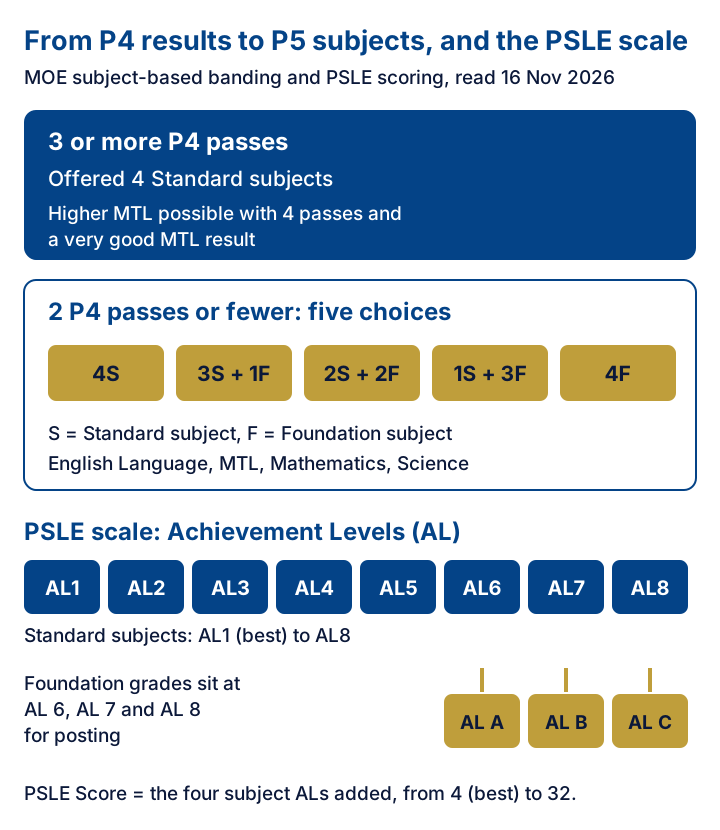
- 05The PSLE Score adds four subject ALs, running from 4 at best to 32.
- 06P6 learners in 2027 sit the PSLE in 2027; P1 learners, in 2032.
P1 in 2027 to S1
When does each primary class sit the PSLE?
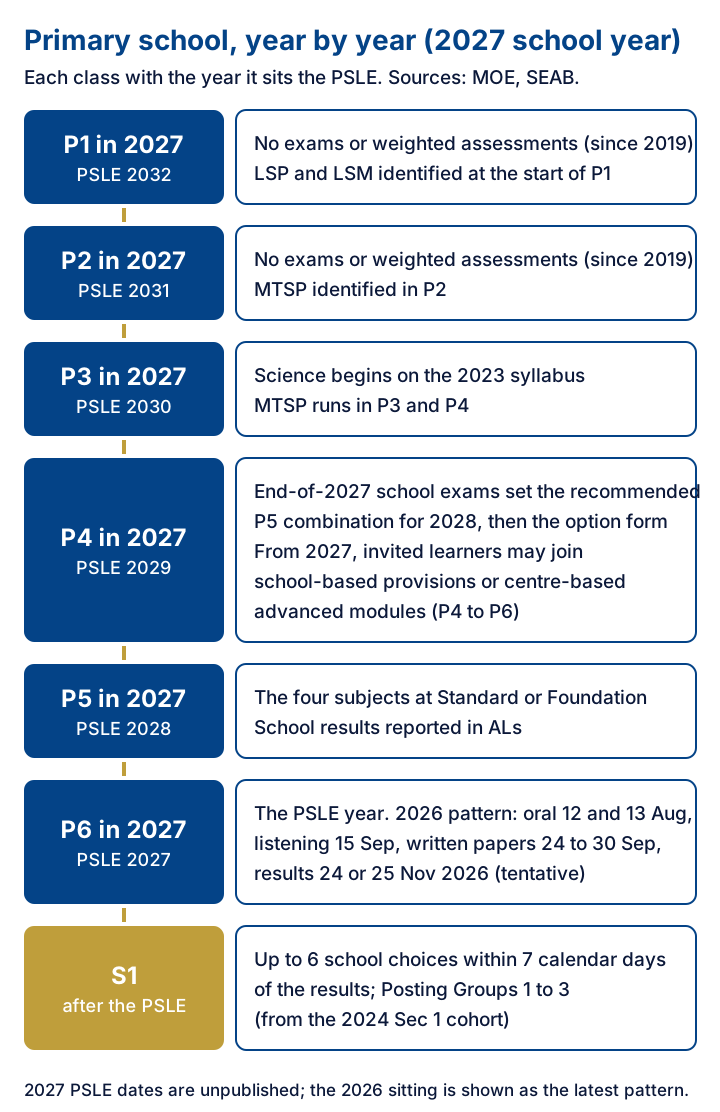
Primary year groups in 2027 each carry their own PSLE year, counted from MOE's six primary years, with the PSLE closing Primary 6.
- 1
P1 in 2027
PSLE in 2032. No exams or weighted assessments; reading, number and Mother Tongue habits, with LSP and LSM support identified at the start of the year.
- 2
P2 in 2027
PSLE in 2031. Still exam-free; the school may identify the learner for the Mother Tongue Support Programme, which this class meets in P3 and P4 in 2028 and 2029.
- 3
P3 in 2027
PSLE in 2030. Science starts on the 2023 syllabus, and MTSP runs for learners who were identified in P2.
- 4
P4 in 2027
PSLE in 2029. End-of-2027 school exams lead to the recommended P5 combination for 2028 and the option form.
- 5
P5 and P6 in 2027
PSLE in 2028 for P5 and in 2027 for P6. The four PSLE subjects run at Standard or Foundation; school results come in ALs.
- 6
Secondary 1
Posting through Posting Groups 1, 2 and 3 after up to six school choices made within seven calendar days of the results.
Dates and rules to plan around
What should a primary learner's plan account for this year?
The 2026 results calendar sets the pattern
MOE lists the 2026 PSLE results for Tuesday 24 or Wednesday 25 November 2026 (tentative), with S1 posting results on Friday 18 December 2026 (tentative). The S1 choice window closes seven calendar days after the results, the pattern P6 learners in 2027 will follow.
Read the P4 recommendation with the results beside it
For P4 learners in 2027, the school's recommendation at the end of 2027 comes from the school exam results. Three or more passes lead to four Standard subjects; two or fewer open five combinations. The option form records the combination the learner prefers.
P5 coping is checked again at the end of 2027
A combination taken up in P5 in 2027 is still reviewed. MOE's banding page says the school assesses how each P5 learner copes at the end of the year. For P5 learners in 2027, that review falls at the end of 2027. Subject levels are adjusted where needed, so P5 learners in 2027 keep working steadily into 2028.
High-ability provision changes from 2027
From 2027, MOE discontinues the GEP in its current form, with school-based provisions and centre-based advanced modules for invited learners in P4 to P6. GEP classes already running continue until 2028 for learners who entered at P4 in 2026 or earlier.
From P6 in 2027 to Secondary 1 in 2028
MOE reported that about 65% of 2025 P6 learners eligible for Posting Group 1 or 2 could take at least one subject at a more demanding level. Under those rules, a Standard AL5 or better can open G3 or G2 in a subject, and a Standard AL6 or Foundation AL A opens G2.
One learner across the primary years
What changes in each primary school year for one learner?
Primary school years change in assessment, subjects and decisions; the table follows one learner who starts P1 in 2027 through each stage to the PSLE.
| What changes | P1 to P2 (2027 and 2028) | P3 to P4 (2029 and 2030) | P5 (2031) | P6 (2032) |
|---|---|---|---|---|
| Subjects in school | English Language, MTL, Mathematics and non-exam subjects | Science joins in P3 on the 2023 syllabus | Four subjects at Standard or Foundation | The same four subjects, in the PSLE year |
| How school assesses | No exams or weighted assessments, descriptors in place of marks | Termly weighted assessments may run; end-of-year exams in P4 | School results reported in ALs | The PSLE, with ALs summed into a PSLE Score |
| School support programmes | LSP and LSM from P1; MTSP identified in P2 | LSM continues up to P4; MTSP runs in P3 and P4 | Foundation MTL available in P5 and P6 | Learning continues in the combination set for P5 |
| Decision of the stage | Routines for reading, number and spoken MTL | The P4 school exams set the P5 combination | The school reviews coping at year end | Up to six S1 school choices after the results |
| What lessons work on | Reading stamina, number facts, oral confidence | Science explanations and the end-of-P4 exam papers | Paper routines in each Standard or Foundation subject | Timed papers, oral and listening routines |
| PSLE year in sight | PSLE in 2032, five and four years ahead | Three and two years ahead | One year ahead | The PSLE itself, in 2032 |
One learner across the primary years
Standard or Foundation: how does each PSLE subject count?
PSLE subjects at Foundation use a three-grade scale that MOE maps onto Standard ALs; for Posting Group 1 or 2 learners, a Foundation AL A can open G2 at S1.
| PSLE subject | Standard scale | Foundation scale and posting equivalent | S1 level a Foundation AL A can open |
|---|---|---|---|
| English Language | AL1 (90% and above) to AL8 (below 20%) | AL A, AL B, AL C, counted as AL 6, 7 and 8 | G2, when the learner's Posting Group is 1 or 2 |
| Mathematics | AL1 to AL8 on the same percentage bands | AL A (75 to 100), AL B (30 to 74), AL C (below 30) | G2, when the learner's Posting Group is 1 or 2 |
| Science | AL1 to AL8, taken from P3 on the 2023 syllabus | Same three grades, same posting equivalents | G2, when the learner's Posting Group is 1 or 2 |
| Mother Tongue Language | AL1 to AL8 in Chinese, Malay or Tamil | Foundation MTL from P5, same three grades | G2, when the learner's Posting Group is 1 or 2 |
The P4 decision, 2027
What do the P4 year-end exams decide for P5?
P4 school exams at the end of 2027 set the P5 combination the school recommends for 2028, with MOE's subject-based banding rules covering four subjects.
The P4 year in 2027, rule by rule
MOE's subject-based banding page lays out the P4 year as a chain, and each link tells a P4 learner in 2027 what the next term should build.
Termly weighted assessments
Mid-year exams ended at every primary level by 2023; P4 learners in 2027 meet termly weighted assessments where the school runs them.
End-of-2027 school exams
Year-end papers in English Language, MTL, Mathematics and Science give the results the recommendation rests on.
Three or more passes
A P4 learner in 2027 with three or more passes is offered four Standard subjects for P5 in 2028.
Two passes or fewer
Five combinations open: 4S, 3S + 1F, 2S + 2F, 1S + 3F or 4F, for P5 in 2028.
Higher MTL
Four passes plus a very good MTL result can open Higher MTL.
The option form
At the end of 2027 the option form records the preferred combination.
How lessons prepare a P4 learner in 2027
The four-term P4 plan gives each school term one job, so a P4 learner in 2027 reaches the year-end exams with the registered subject practised under exam conditions.
- 1
Term 1: the subject map
The tutor lists the topics the registered subject has covered since P3 in 2026 and marks the ones that cost marks in class work.
- 2
Term 2: method before speed
Model drawing for Maths, cause and effect for Science, planning for composition, each practised slowly first.
- 3
Term 3: weighted assessment feedback
Corrections from termly work become a short list of repeat slips, and each lesson opens on one of them.
- 4
Term 4: full papers
Timed practice papers in the registered subject, then a check routine for the last ten minutes, ahead of the year-end exams.
Combinations and one learner's path
From a P4 combination to an S1 subject level
Subject combinations chosen after P4 feed the PSLE Score in 2027 or later; one worked path shows how a Foundation subject still opens G2 at S1.
The P5 combinations a P4 result opens
MOE's banding rules give P4 learners in 2027 one offer after three or more passes and five choices after two or fewer, for P5 in 2028. Higher MTL is a possible addition beside 4S. The rows run from the most Standard subjects to the most Foundation.
- 4S with Higher MTL
4 P4 passes plus a very good MTL result
Four Standard subjects plus Higher MTL, which sits outside the four-subject PSLE Score.
- 4S
3 or more P4 passes, or a choice after 2 or fewer
Four Standard subjects; every PSLE subject scores on AL1 to AL8.
- 3S + 1F
Open after 2 P4 passes or fewer
One Foundation subject, graded on the AL A to AL C scale and counted as AL 6 to 8.
- 2S + 2F
Open after 2 P4 passes or fewer
Two subjects on the Foundation scale; the other two stay on Standard ALs.
- 1S + 3F
Open after 2 P4 passes or fewer
Three Foundation subjects build fundamentals, in MOE's words, with one Standard subject kept.
- 4F
Open after 2 P4 passes or fewer
All four subjects at Foundation; for a Posting Group 1 or 2 learner, each AL A can open G2 for that subject at S1.
One P6 candidate in 2027, from P4 choice to S1 levels
The problem
A learner took 3S + 1F after P4 in 2025, with Foundation MTL. At the 2027 PSLE the learner scores AL7 in English Language, AL7 in Mathematics, AL6 in Science and AL A in Foundation MTL. Find the PSLE Score, the Posting Group, and the S1 level open in each subject.
Worked solution
- 1Convert the Foundation grade first: MOE counts Foundation AL A as AL 6 for posting.
- 2Add the four ALs: 7 + 7 + 6 + 6 = 26, a PSLE Score of 26.
- 3Check the Posting Group band. Posting Group 1, with G1 as the indicative S1 level, takes scores from 26 up to 30 when English Language and Mathematics each sit at AL7 or better.
- 4Apply the more demanding level rule for Posting Group 1: a Standard AL6 or a Foundation AL A opens G2 in that subject.
- 5Read the result subject by subject: English Language and Mathematics at G1, Science at G2 through its AL6, MTL at G2 through its Foundation AL A.
Answer: PSLE Score 26, Posting Group 1, with Science and MTL open at G2 in S1 and English Language and Mathematics at G1.
A Foundation AL A carries the same G2 opening as a Standard AL6. Treating Foundation as the end of a subject, the pitfall listed below, gives that option away.
Planning slips across the primary years
Primary plans lose ground through a few repeat slips, each with a fix that starts in the next lesson.
Treating P1 and P2 in 2027 as a rest because there are no exams.
Use the exam-free years for daily reading and number facts.
Meeting P3 Science in 2027 with memorised definitions only.
Write every answer as idea plus explanation from the first Science lesson.
Waiting for term 4 of P4 in 2027 to start revising.
Start the slip list in term 2, so the year-end exams test practised routines.
Treating a Foundation subject as the end of that subject.
Aim for AL A: in Posting Group 1 or 2, that grade can open G2 at S1.
Reading P5 results in 2027 as final.
Plan for the year-end coping review, which can still adjust subject levels for 2028.
Leaving the S1 school list for P6 learners in 2027 until results day.
Draft the six choices early, since the window closes seven calendar days after the results.
Syllabus by year group
Which syllabus is each primary year group on?
Primary syllabuses change at different times: in 2027 Mathematics and Science each run one syllabus for every class that takes them, while Mother Tongue splits between two.
The four PSLE subjects and the syllabus each class learns in 2027
The PSLE Score sums four subjects, so a primary plan tracks four syllabuses, each read from its MOE or SEAB document.
English Language
English Language Teaching and Learning Syllabus 2020 (Primary), assessed by the PSLE from 2025, so P6 learners in 2025, 2026, 2027 and later sit it on that syllabus.
Mathematics
The 2021 syllabus, begun by the 2021 P1 cohort, reached P6 in 2026. Every class from P1 to P6 in 2027 learns Number and Algebra, Measurement and Geometry, and Statistics on it.
Science
The 2023 syllabus for P3 to P6, started by the 2023 P3 cohort, so every P3 to P6 class in 2027 works through its five themes.
Mother Tongue Language
The 2024 syllabus covers P1 to P4 in 2027. P5 and P6 in 2027 stay on the earlier MTL syllabus, and the 2029 PSLE is the first on the 2024 one.
Where P6 learners in 2027 find the PSLE papers and dates
This page maps the syllabus each class learns in 2027. The PSLE sitting itself, with its papers and dates, has two pages of its own, and lessons for P6 learners in 2027 start from the syllabus map above.
PSLE tuition Singapore
For P5 learners in 2027 and P6 learners in 2027, who sit the PSLE in 2028 and 2027: PSLE Score strategy, mock papers and prelims, and oral and listening preparation.
The PSLE guide
Each paper format, the full AL tables, the PSLE dates for each year and the S1 posting steps, reached from the primary level hub.
Accountability
How is a primary learner's progress seen?
Primary progress shows up in the learner's own work and school results, read by the tutor against the year's next checkpoint.
Marked worksheets the learner keeps
Worksheets and lesson plans come with the service, and each marked sheet stays with the learner to show what changed.
Lessons that open on last week's slip
Each lesson starts with one correction from the week before, so repeat errors shrink in a way the learner can see.
School results read beside the plan
When the learner shares a school result, from P5 ALs to P4 exam marks, the tutor re-aims the next lessons at it.
Progress conversations on request
A parent, guardian or other registrant can raise a learner's progress with Eduprime whenever they wish, and a tutor change stays free on the learner's request.
The scope of a primary plan
What does a primary plan cover?
Primary results rest on reading stamina, method in Maths and Science, and steady MTL practice; the lessons build each of these against the learner's year in 2027.
- 6
- primary years, each planned with its own PSLE year
- 4
- PSLE subjects tracked across their syllabuses
- 5
- P5 choices after two P4 passes or fewer, for P4 learners in 2027
- 148+
- Eduprime programmes, from phonics to secondary
Primary tuition questions, answered by year
Primary school tuition in Singapore: questions by year
Primary tuition questions below come from learners and registrants planning the 2027 school year, each answered with the year group and its PSLE year.
Year first, subject second
Primary tuition from this year to the S1 choice
Name the learner's year group in 2027 and the first subject, with the P4 combination or the P6 PSLE year in view.
- One subject per registration
- Tutor matched to year
- Home or online lessons
Eduprime · Primary school tuition, at home or online
Beside the primary years