Primary Maths Tuition Singapore for P1 to P6
Primary maths tuition in Singapore with Eduprime follows the 2021 MOE syllabus from P1 to P6, which reaches P6 classrooms from 2026. After P4 results, each P5 and P6 learner sits in either Standard or Foundation Mathematics, and one tutor teaches one learner, at home or online.
Last updated
At a glance
- Who it's for
- Lower primary learners, P1 and P2 · P3 and P4 learners
- Format
- 12,000+ tutors across 148+ programmes, with primary maths taught one-to-one from P1 to P6
- Why Eduprime
- Lessons mapped to the learner's exact year
Learners by stage
Which primary maths learner is this tuition for?
Primary maths learners arrive at three stages, and each stage asks for a different kind of lesson from P1 counting to P6 ratio and algebra.
Lower primary learners, P1 and P2
A P1 learner meets whole numbers to 100 and first picture graphs, and P2 stretches to numbers up to 1000 and a fraction of a whole. With no weighted assessments at these levels, lessons build counting habits and careful reading at a calm pace.
- Counts on fingers for facts that should feel automatic
- Mixes up the two steps in a take away then add story
P3 and P4 learners
From P3 the first weighted assessments arrive, at most one per subject per term. P3 brings equivalent fractions and area, P4 adds factors, decimals and nets, and P4 school results then set the P5 Standard or Foundation recommendation.
- Finds equivalent fractions by guessing a denominator
- Swaps the area and perimeter formulas under time pressure
P5 and P6 learners, Standard or Foundation
A P5 learner moves into percentage, rate and the area of a triangle, and P6 adds ratio, algebra, circles and average before the PSLE paper. Foundation learners revisit key P1 to P4 ideas while meeting new content drawn from the Standard list.
- Takes the percentage of the whole when the question means the remainder
- Leaves out the working steps that structured questions ask to be shown
Why Eduprime
Why learners choose Eduprime for primary maths
Primary maths tuition at Eduprime is built on the 2021 syllabus by year, with one tutor and one learner in every session.
Lessons mapped to the learner's exact year
Each lesson plan follows the 2021 syllabus topics for the learner's year, from P1 to P6.
Standard and Foundation taught as two paths
Upper primary lessons are pitched at the child's Standard or Foundation track, and Foundation work loops back to P1 to P4 ideas by design.
Written working trained for the PSLE paper
On a one-part 2-mark short answer the correct method earns 1 mark when the answer slips, and structured questions ask for working shown, so tutors train both habits.
Experienced, skilled tutors
Our primary maths tutors know bar models and heuristics from long practice, and our team picks for each child from a bench of 12,000+ tutors.
A different maths tutor on request
Swapping maths tutors costs the child nothing, however often the child or the registrant asks.
Notes after every session
After each maths lesson the tutor leaves a short note on the work covered, and every month a progress report goes to the adult who registered the child.
P1 to P6 topics
What does primary maths cover from P1 to P6?
Primary maths on the 2021 syllabus runs from numbers to 100 at P1 to ratio and algebra at P6, with one question per stage solved in full.
P1 and P2: numbers to 1000 and the first stories
P1 works with whole numbers up to 100 and addition and subtraction within 100, and P2 stretches to 1000 with a fraction of a whole. Sample question: a shelf holds 46 books. 18 books are taken away, then 25 books are put on. How many books are on the shelf now? Solution: 46 take away 18 leaves 28 books, and 28 add 25 gives 53. Answer: 53 books. Saying each action aloud keeps both steps in the working.
Whole numbers to 1000 · addition and subtraction within 100 · multiplication and division · fraction of a whole · length, mass, volume, time · picture graphs
P3: fractions that match and the first angles
P3 takes numbers up to 10 000 and brings the first equivalent fractions, angles and area. Sample question: rename 2/3 and 5/6 so they share a denominator, then say which is greater. Solution: 6 is a multiple of 3, so 6 is the common denominator. Multiplying the top and bottom of 2/3 by 2 gives 4/6, and 5/6 stays as it is. Answer: 4/6 and 5/6, so 5/6 is greater. Drawing both fractions on one strip shows why the bottom number matches first.
Numbers to 10 000 · equivalent fractions · area and perimeter · angles · perpendicular and parallel lines · bar graphs
P4: factors, decimals and the shapes behind area
P4 brings factors, decimals to three places, nets and pie charts in the year before banding. Sample question: a rectangle has a perimeter of 36 cm, and its length is twice its breadth. Find its area. Solution: half the perimeter, 18 cm, is one length plus one breadth, which is 2 units plus 1 unit. So 3 units make 18 cm and 1 unit is 6 cm. The breadth is 6 cm, the length is 12 cm, and the area is 12 times 6, or 72 square centimetres.
Numbers to 100 000 · factors and multiples · mixed numbers and improper fractions · decimals to 3 places · rectangle and square · nets and symmetry · line graphs and pie charts
P5 Standard: percentage, rate and triangles
P5 Standard reaches numbers up to 10 million and opens percentage, rate and the area of a triangle. Sample question: 800 learners attend a school, and 35% of them travel by bus. How many learners use another way to get to school? Solution: the other group makes up 100% minus 35%, which is 65%. 65% of 800 is 520. Answer: 520 learners. A check through the bus group gives the same: 35% of 800 is 280, and 800 minus 280 is 520.
Numbers to 10 million · fraction and division · four operations on fractions and decimals · percentage · rate · area of triangle · volume of cube and cuboid · angles in triangles and quadrilaterals
P6 Standard: ratio, algebra and circles
P6 Standard adds ratio with whole numbers, simple linear equations, circles and average. Sample question: find the area of a semicircle with a diameter of 14 cm, taking pi as 22/7. Solution: the radius is half of 14 cm, which is 7 cm. A full circle has area 22/7 times 7 times 7, which is 154 square centimetres, and half of that is 77. Answer: 77 square centimetres. Halving the diameter before squaring is the step to check.
Dividing fractions · percentage increase and decrease · ratio with whole numbers · algebra and simple linear equations · circles and composite figures · special quadrilaterals · average
P5 and P6 Foundation Mathematics
Foundation Mathematics revisits key P1 to P4 ideas and adds rate, percentage and average from the Standard list. Sample question: the average mass of 4 parcels is 2.5 kg. A fifth parcel is added, and the average becomes 2.8 kg. Find the mass of the fifth parcel. Solution: 4 parcels at 2.5 kg weigh 10 kg in total, and 5 parcels at 2.8 kg weigh 14 kg. Answer: the fifth parcel weighs 14 kg minus 10 kg, which is 4 kg.
Four operations · fractions and decimals · rate · percentage · area of triangle · volume of cube and cuboid · pie charts · average
Lesson formats
Home or online: where does primary maths tuition take place?
Primary maths tuition runs both ways: one tutor at the learner's home desk or online, chosen with one box on the registration form.
Home lessons in the learner's own town
A maths tutor travels to the learner's home, chosen for the learner's town and school timetable. A parent or guardian registers, consents to the home lessons and arranges who is at home with the young learner.
- One-to-one, 60-minute sessions
- Tutor matched by town and timetable
- Maths worksheets and a lesson plan
- Tutor notes after every session
Online lessons from home
Online maths lessons suit a learner at ease on a screen, picked on that same form.
- One-to-one, 60-minute sessions
- Tutor notes after every session
- Same registration form, mode online
- Monthly progress report
From form to first lesson
How does primary maths tuition start?
Primary maths tuition opens with one form, a talk with our team about the child's gaps, and a maths tutor near home or online.
- 1
Register on the form
A parent or guardian registers the primary learner, naming the year, the level where it applies and home or online lessons, and gives consent for the lessons.
- 2
First consultation with our team
Our team talks through recent weighted assessments, shaky topics and the school timetable. This first consultation is free and shapes the tutor brief.
- 3
A maths tutor matched to town and timetable
For home lessons, our team picks a maths tutor who reaches the learner's town and fits the school timetable; online lessons just fit that timetable.
- 4
Starter package of 4 lessons
The Starter gives the child four one-hour maths lessons, each built on a lesson plan and worksheets for that school year, with tutor notes after every session.
- 5
Monthly report and the next package
Each month a progress report measures the maths covered against the next weighted assessment, or, in P4, against the school examinations that inform the P5 recommendation. The next step is to continue with a new package or adjust the lesson plan with our team.
Our tutors
The primary maths tutors we match
Eduprime primary maths tutors bring years of practice with bar models, heuristics and PSLE-style working; the four profiles below are illustrative composites.
- Experienced and skilled in primary maths
- Confident with bar diagrams, heuristics and written working
- Teaches to the 2021 syllabus for the learner's year
- Writes tutor notes after every session
Ms Lim H.
7 to 9 years of one-to-one P1 and P2 lessons
Number bonds, place value and the first story sums
“At P1 I listen to how a learner counts.”
Mr Tan K.
10 to 12 years teaching primary maths
Equivalent fractions, area and perimeter, the P4 year before banding
“P4 learners need fractions they can picture.”
Ms Nur A.
8 to 10 years with upper primary learners
Ratio, percentage, algebra and the structured questions of Paper 2
“I ask every P6 learner one question first: what stays the same?”
Mr Ravi S.
9 to 11 years teaching Foundation and Standard learners
Foundation P5 and P6, average, rate and calculator-free Paper 1 skills
“Foundation learners often already know more than they think.”
In their words
What primary maths learners say
Primary maths learners describe their lessons below; names follow a privacy style and these accounts are illustrative.
I used to count on my fingers for every take away sum. Now my number bonds to 20 come quickly.
Hana L.
P2 learner · Home lessons · Lower primary maths
My tutor made me draw every fraction on a strip. When the term test came, I got every fraction question right.
Wei Jie T.
P3 learner · Online lessons · P3 maths
Area and perimeter kept swapping in my head. Now I check my formula card before every question.
Arjun P.
P4 learner · Home lessons · P4 maths
Percentage questions about the rest of the group always caught me. Now I underline who is being counted first.
Siti R.
P5 learner, Standard Maths · Home lessons · P5 Standard maths
Ratio with a transfer used to scare me. Now I start every ratio question by finding what stays the same.
Ethan C.
P6 learner, Standard Maths · Online lessons · P6 Standard maths
Average questions with a new parcel are my favourite now. I work out both totals and the answer follows.
Divya K.
P6 learner, Foundation Maths · Home lessons · P6 Foundation maths
Fees
What does primary maths tuition cost?
Every primary maths fee, by school year and by home or online format, is printed in the price table further down; the Starter covers four one-hour maths lessons, and a child joining for the first time adds a one-off registration fee.
- Widest availability
Online International Tutor
fromS$17/ session
60-minute session
The widest bench of tutors across time zones, so a slot is open at almost any hour. Lessons run online over a shared screen.
Online Local Tutor
fromS$28.90/ session
60-minute session
A tutor based here who knows our schools, syllabuses and exams, teaching online.
Home Tutor
fromS$34/ session
60-minute session
A local tutor who comes to the learner, at home or at a nearby study spot, matched to their town and timetable.
Minimum 4 sessions. Larger packages lower the per-session price. One-time S$15 registration fee for new learners.
Should the learner, or whoever signed them up, want another maths tutor, we arrange one at no charge, whenever asked and as often as needed.
Student journeys
Three primary maths journeys, one per stage
Primary maths progress looks different at P2, P4 and P6; these three illustrative journeys show what changed and how.
Two-step story sums with numbers to 100 often ended with one step left out, and counting by ones took most of each worksheet.
- Number bonds to 20 recalled without fingers
- Took away tens first in mental subtraction
- Retold each story sum before writing a number
Two-step story sums now come with one short sentence per step, and worksheets finish with time to check.
A P2 learner · One school term
Fractions, decimals and area questions with two unknowns lost marks on each weighted assessment in P4.
- Drew fraction strips for mixed numbers
- Used units to link length and breadth
- Checked perimeter answers by adding all sides
P4 results rose across the year, and the learner entered P5 with Standard Mathematics in the chosen combination.
A P4 learner · Two school terms
Structured questions in Paper 2 were left with a bare answer, and ratio and percentage of a remainder caused repeated slips.
- Wrote out the working steps on each structured question
- Found the constant before each ratio diagram
- Practised written fraction work without a calculator
Working now shows clearly on long questions, as the paper asks, and the learner kept steadier stamina through both PSLE papers.
A P6 learner · P5 and P6
The 2021 syllabus
What the 2021 primary maths syllabus changes
The 2021 primary mathematics syllabus is the MOE syllabus that began with the 2021 Primary One cohort and covers P1 to P6 in three content strands. It reached P1 to P5 by 2025 and P6 from 2026, so learners in MOE primary schools now study it, with the document last updated in October 2025.
- 01Three content strands: Number and Algebra, Measurement and Geometry, Statistics.
- 02Mathematical Problem Solving sits at the centre of the MOE framework.
- 03P1 to P4 content is common to every learner.
- 04From P5, maths splits into a Standard track and a Foundation track.
- 05Foundation revisits key P1 to P4 ideas and adds a subset of Standard.
- 06Speed has left the P6 list and now begins in Sec 1.
P1 to Sec 1
How does P1 maths lead to a Sec 1 maths level?
Primary maths runs on one common path to P4, splits at P5 into Standard or Foundation, and ends in a Sec 1 maths level set partly by the maths AL.
- 1
P1 to P4: one common syllabus
Every learner covers the same P1 to P4 content, so lessons secure place value, fractions and diagram habits.
- 2
End of P4: school results
P4 school examination results lead the school to recommend a subject combination for P5. A parent or guardian then returns the option form with the preferred combination.
- 3
P5: Standard or Foundation
Within the five subject combinations a school can offer, which run from all four subjects at Standard to all four at Foundation, maths sits at one of the two levels. P5 school results are reported in ALs.
- 4
P6: ratio, algebra and circles
Standard learners meet ratio, algebra and circles; Foundation learners meet percentage, pie charts and average. P6 is on the 2021 syllabus from 2026.
- 5
PSLE Mathematics
The Standard paper 0008 or the Foundation paper 0038 gives the maths AL. Four subject ALs add up to the PSLE Score, from 4 to 32.
- 6
Sec 1 maths level
Any PSLE Score between 4 and 20 leads to Posting Group 3 at Sec 1. Learners placed in Posting Group 1 or 2 still reach G3 or G2 Maths with Standard Maths at AL5 or above.
Before P5 and P6
Four primary maths facts to check this year
Read the maths AL for its Sec 1 options
In its PSLE results release of 25 Nov 2025, MOE set out the subject-level rule for learners in Posting Group 1 or 2. Standard Maths at AL5 or above opens G3 or G2 Maths. Standard Maths at AL6 or above, or Foundation Maths at AL A, opens G2 Maths.
P6 meets the 2021 syllabus from 2026
P1 to P5 were on the 2021 syllabus by 2025, and P6 joins from 2026 with ratio, simple linear equations and circles. Rate stays at P5, and speed now begins in Sec 1, in both G2 and G3 Mathematics.
Paper 1 is written without a calculator
In PSLE Mathematics 0008, Paper 1 allows no calculator, and the syllabus marks order of operations and fraction division as calculator-free. Lessons keep written methods sharp from P5.
No mid-year exams, so weighted assessments carry the feedback
With mid-year examinations gone, P3 to P6 maths now has at most one weighted assessment a term. Each maths assessment becomes a clear checkpoint for lessons.
Standard or Foundation
How do Standard and Foundation Mathematics differ at P5 and P6?
Standard and Foundation Mathematics differ in content, PSLE paper and AL range, and the table sets the four decisive facts side by side.
| Aspect | Standard Mathematics | Foundation Mathematics |
|---|---|---|
| Who takes it | Learners whose option form chooses Standard, after the school's recommendation from P4 results | Learners whose option form chooses Foundation, after the school's recommendation from P4 results |
| PSLE paper from 2026 | Mathematics 0008: 45 questions, 100 marks, 2 h 30 min over two papers | Foundation Mathematics 0038: two papers, 42 questions, 1 h 45 min for 80 marks |
| Achievement Levels | AL1 to AL8, with AL1 at a percentage score of 90% and above | AL A to AL C, read from a percentage score on the 80-mark paper and counted as AL6, AL7 and AL8 |
| New content at P5 and P6 | Percentage, rate, ratio, algebra with simple linear equations, circles and average | A subset of the Standard list, including rate, percentage, area of triangle, pie charts and average |
Standard or Foundation
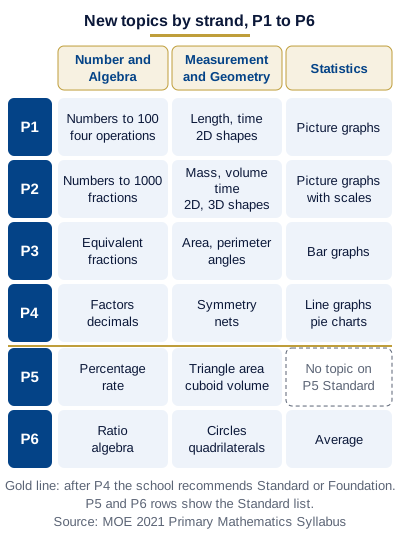
Which topics are new in each year, strand by strand?
Primary maths topics on the MOE 2021 syllabus, sorted into its three content strands; P5 and P6 rows show the Standard list.
| Year | Number and Algebra | Measurement and Geometry | Statistics |
|---|---|---|---|
| P1 | Numbers up to 100; addition, subtraction, multiplication and division; money | Length; time; 2D shapes | Picture graphs |
| P2 | Numbers up to 1000; fraction of a whole; money | Length, mass and volume; time; 2D and 3D shapes | Picture graphs with scales |
| P3 | Numbers up to 10 000; equivalent fractions; money | Area and perimeter; angles; perpendicular and parallel lines | Bar graphs |
| P4 | Numbers up to 100 000; factors and multiples; mixed numbers; fraction of a set; decimals | Area and perimeter; rectangle and square; line symmetry; nets | Tables, line graphs and pie charts |
| P5 Standard | Numbers up to 10 million; fraction and division; percentage; rate | Area of triangle; volume of cube and cuboid; parallelogram, rhombus and trapezium | No topic on the P5 Standard list |
| P6 Standard | Percentage increase and decrease; ratio with whole numbers; algebra | Circles and composite figures; special quadrilaterals | Average of a set of data |
Syllabus, paper and AL bands
The primary maths syllabus and the PSLE paper it leads to
Primary maths follows three strands to P6, then the PSLE Mathematics 0008 paper of 45 questions and 100 marks turns the year's work into an AL.
Three strands from P1 to P6
The 2021 syllabus groups primary maths into three content strands. Number and Algebra and Measurement and Geometry add topics every year, while the P5 Standard list carries no Statistics topic and average returns to Statistics at P6.
Number and Algebra
Whole numbers from 100 at P1 to 10 million at P5; the four operations; factors and multiples; fractions, mixed numbers and fraction of a set; decimals to three places; percentage, including percentage increase and decrease; rate; ratio with whole numbers; algebra up to simple linear equations
Measurement and Geometry
Length, mass, volume and time; area and perimeter; angles, perpendicular and parallel lines; rectangle, square, triangle, parallelogram, rhombus and trapezium; nets and line symmetry; volume of cube and cuboid; area and circumference of circle, semicircle, quarter circle and composite figures
Statistics
Picture graphs at P1, then with scales at P2; bar graphs at P3; tables, line graphs and pie charts at P4; average at P6
PSLE Mathematics from 2026, Standard and Foundation
Both papers are sat on one day with a break. Paper 1 is calculator-free and worth half the Standard marks, so written methods decide a large share of the AL.
| Component | What it covers | Marks / weight | Time |
|---|---|---|---|
| 0008 Paper 1 | Booklet A: 10 multiple-choice questions of 1 mark and 8 of 2 marks. Booklet B: 12 short-answer questions of 2 marks. No calculator. | 50 marks | 1 h 10 min |
| 0008 Paper 2 | 5 short-answer questions of 2 marks, then 10 structured or long-answer questions of 3, 4 or 5 marks. Calculator allowed; working must be shown. | 50 marks | 1 h 20 min |
| 0038 Foundation Paper 1 | Booklet A: 10 multiple-choice questions of 1 mark and 10 of 2 marks. Booklet B: 8 short-answer questions of 2 marks. No calculator. | 46 marks | 1 h |
| 0038 Foundation Paper 2 | 10 short-answer questions of 2 marks and 4 structured questions of 3 or 4 marks. Calculator allowed. | 34 marks | 45 min |
Which percentage score gives which maths AL?
MOE reports each PSLE subject as an Achievement Level read from a percentage score range: AL1 to AL8 for Standard, AL A to AL C for Foundation, whose paper is out of 80 marks.
- AL1
90% and above
The top Standard band.
- AL2
85% to 89%
AL2 on the Standard paper.
- AL3
80% to 84%
AL3 on the Standard paper.
- AL4
75% to 79%
AL4 on the Standard paper.
- AL5
65% to 74%
In Posting Group 1 or 2, this band or higher opens G3 or G2 Maths.
- AL6
45% to 64%
The floor for G2 Maths when the learner sits in Posting Group 1 or 2.
- AL7
20% to 44%
AL7 on the Standard paper.
- AL8
Below 20%
AL8 on the Standard paper.
- AL A
Foundation score of 75% to 100%
Counts as AL6 in the PSLE Score; in Posting Group 1 or 2 it also opens G2 Maths.
- AL B
Foundation score of 30% to 74%
Counts as AL7 in the PSLE Score.
- AL C
Foundation score below 30%
Counts as AL8 in the PSLE Score.
A P6 question, solved
Primary maths worked example: ratio after a transfer
Primary maths ratio at P6 uses whole numbers only, and a 3 : 5 transfer question shows how the unit method keeps the total steady.
P6 ratio: one gives, both end equal
The problem
The ratio of the number of marbles Aiman has to the number Ben has is 3 : 5. Ben gives Aiman 12 marbles, and then both boys have the same number. How many marbles did Aiman have at first?
Worked solution
- 1The total stays the same because marbles only move between the two boys. 3 units plus 5 units gives 8 units in total.
- 2At the end both have the same number, so the 8 units split into 4 units each.
- 3Aiman goes from 3 units to 4 units, so he gains 1 unit. That 1 unit is the 12 marbles Ben gave him.
- 4So 1 unit is 12 marbles, and Aiman had 3 units at first, which is 3 times 12, or 36 marbles.
- 5Check: Ben had 5 times 12, or 60 marbles. After the transfer Aiman has 48 and Ben has 48, so both match.
Answer: Aiman had 36 marbles at first.
Find what stays the same before drawing anything. Here it is the total, so both ratios share 8 units, which is the habit the pitfall on ratio scope builds.
Where primary maths marks leak, and the routine that fixes each
Each pitfall below ties to a rule in the 2021 syllabus or the PSLE 0008 paper, so each fix is a routine a learner can rehearse.
A wrong final answer on a one-part 2-mark short answer, with no working written down.
The method earns 1 mark when the answer slips, so lessons train a learner to write the key line for every one-part 2-mark question.
An answer given in a different unit from the one printed in the answer space.
The unit is printed in the answer space, so the learner converts the answer into that unit before writing it.
Paper 1 order of operations and fraction division done slowly, as if a calculator were coming.
These skills are marked calculator-free in the syllabus, so the learner rehearses fraction division and order of operations by hand from P5.
Hours spent on ratios with fractions and decimals that sit outside the P6 syllabus.
P6 ratio uses whole numbers in a:b and a:b:c, so practice time goes to unit changes, transfers and constant totals.
Taking the percentage of the whole when the question asks about the remainder.
The learner underlines who is being counted, writes the matching percentage first, and then multiplies once.
Averaging the averages when a new item joins a group.
Average questions go through totals: average times count gives each total, and the difference between totals gives the new item.
Method and school rhythm
How a primary maths lesson builds problem solving
Primary maths lessons follow Polya's 4 steps, which the MOE framework names, and plan around a school year with no mid-year exams.
Polya's four steps in a one-to-one lesson
The 2021 syllabus places Mathematical Problem Solving at the centre of its framework and names Polya's four steps. One-to-one, the tutor hears each step, so a gap shows where it starts.
- 1
Understand the problem
The learner retells the question in their own words and circles what is known and what is asked. A misread question shows here, before any working begins.
- 2
Devise a plan
The learner picks a heuristic such as drawing a diagram, listing systematically or working backwards, and says why it suits the question.
- 3
Carry out the plan
Working goes down line by line, since PSLE structured questions ask the learner to show the method of solution clearly. A stall shows the exact line where help is needed, and one guiding question moves it on.
- 4
Look back
The learner checks the answer against the question, as in the marble check, and notes the heuristic for the next similar problem.
How the Singapore school year shapes primary maths tuition
MOE has reshaped primary assessment since 2019, and the school calendar decides when lessons push and when they consolidate.
P1 and P2 without weighted assessments
Weighted assessments and exams at P1 and P2 were removed from 2019, and schools report with qualitative descriptors. Lessons use these two years to secure number sense at an even pace.
A single graded maths checkpoint each term from P3
From P3, each subject carries at most one weighted assessment a term, so tuition plans each term around that single maths checkpoint.
No mid-year examinations
Mid-year exams have been removed, so feedback comes from weighted assessments and classroom assignments. Tutor notes after every session fill in the weeks between.
P4 results inform the P5 recommendation
The school recommends Standard or Foundation from P4 school examination results, and the option form states the preferred combination. That makes P4 the year where a steady maths base pays off most directly.
Accountability
How is primary maths progress reported?
A parent or guardian follows each child's maths through notes written after each lesson and a fuller report once a month.
Tutor notes after every session
Names the topic, the questions worked and the step where the learner paused.
Monthly progress report
Sums up topics secured and planned next, by syllabus strand.
Weighted assessment checkpoints
From P3, the plan names the next weighted assessment and its likely maths topics.
Worksheets kept with the notes
Lesson worksheets stay with the learner, so revision starts from real work.
Scope of lessons
Primary maths tuition in numbers
Primary maths results rest on number sense, written method and steady practice; lessons build each of these and track them in the monthly report.
- 6
- year levels taught, P1 to P6, on the 2021 syllabus
- 3
- content strands in the 2021 syllabus, with Statistics absent from the P5 Standard list
- 2
- P5 and P6 levels, Standard and Foundation Mathematics
- 12,000+
- tutors we draw on for each maths pairing
Primary maths FAQ
Primary maths tuition questions, answered
Primary maths tuition questions a learner or the registrant asks before the first lesson, each answered in full.
Register for primary maths
P4 results shape the P5 maths recommendation, so plan now
Register for a first consultation with our team, who plan primary maths lessons around P4 banding or the step from P5 percentage to P6 ratio.
- One-to-one, home or online
- Tutor matched by town
- Starter package of 4 sessions
- Notes after every session
Eduprime · Primary maths tuition, home or online
Other maths and primary pages