Secondary Science Tuition Singapore from Five Themes to the SEC
Secondary science tuition in Singapore at Eduprime gives every learner a personal science tutor, at home or on screen, on MOE's 2021 lower secondary syllabus: 16 topics in five themes at G2 and G3, or an introductory topic plus three modules at G1. From Sec 3, lessons follow the chosen science toward the SEC, first held in 2027.
Last updated
At a glance
- Who it's for
- Learners new to lower secondary science · Learners meeting electricity, forces and body systems
- Format
- Science tutors drawn from 12,000+ on Eduprime, covering the five lower sec themes and the K-coded papers at every G-level
- Why Eduprime
- Theme map before topic drill
Who the lessons serve
Which secondary science learners do we teach?
Four science needs bring Sec 1 to Sec 4 learners to tuition, and the need a learner arrives with decides where the lessons begin.
Learners new to lower secondary science
The G2/G3 syllabus numbers the Scientific Endeavour topic first: SI units, accuracy and precision, zero error and parallax error. Lessons build those measuring habits early, because density and every later quantity rest on them.
- Readings taken off-angle from a measuring cylinder
- Mass mistaken for density
- Answers written without units
Learners meeting electricity, forces and body systems
The Interactions and Systems themes bring energy transfer, heat, circuits and transport in living things, whenever the school's scheme reaches them. A G3 learner also meets the starred outcomes, such as pressure as force over area and kilowatt-hour cost, that are optional for G2.
- Current, potential difference and resistance units mixed up
- Watts left unconverted in energy sums
- Organ lists learnt without the model behind them
Upper secondary learners on pure or combined science papers
From Sec 3 the learner sits an SEC science at the learner's own level: pure Physics, Chemistry or Biology or a combined pair at G3, a combined pair at G2, or Science at G1. Lessons follow that exact syllabus code and its paper structure.
- Data-based questions worth 8 to 12 marks
- Practical skills tested under time
- Two sciences sharing one multiple-choice paper
Learners working toward a more demanding science level
Beyond the start of Secondary One, Full SBB lets a learner take science at a more demanding level once the school has weighed the learner's secondary-school science results alongside its own holistic assessment. Lessons build steady understanding across the five themes, and the decision itself rests with the school.
- Moving from G1 modules to G2 themes
- Starred outcomes met for the first time
- Performance in science built term by term
Why Eduprime
How do our secondary science lessons work?
Secondary science lessons at Eduprime follow six teaching moves, each drawn from the lower secondary syllabus or the SEC papers.
Theme map before topic drill
Every learner sees where a topic sits among the five themes, so Interactions and Systems read as links between ideas.
Measurement habits from the first lesson
Parallax, zero error and SI units are practised with the instruments the syllabus names, from metre rule to measuring cylinder.
Starred outcomes tracked by level
G3 learners cover every starred outcome; a G2 learner may add some of them by choice.
Units written on every line
Electricity and energy sums carry their units from kW and h to kWh, which removes the conversion slips that cost marks.
Practical skills for the SEC papers
From Sec 3, practical work is rehearsed for the paper the learner sits, such as the Physics practical or Combined Science Paper 5.
A written record of each science lesson
Each lesson ends with notes on the topic covered and the next step, and every month those notes feed a progress report across the five themes.
Syllabus themes
What is in the lower secondary science syllabus?
MOE's lower secondary science syllabus for G2 and G3, in use from the 2021 Sec 1 cohort, groups its 16 topics under five themes aligned to the Primary Science Syllabus.
Scientific Endeavour
Topic 1 sets the habits of the whole course: how scientists work, and how a learner measures with accuracy and precision while spotting zero error and parallax error.
1 The Scientific Endeavour; SI units; accuracy and precision; zero and parallax error
Diversity
Matter sorted three ways: by physical properties such as density, by chemical composition, and by the separation techniques that pull mixtures apart.
2 Exploring Diversity of Matter by its Physical Properties; 3 Exploring Diversity of Matter by its Chemical Composition; 4 Exploring Diversity of Matter using Separation Techniques
Models
The Models theme gives the learner four pictures of things no eye can watch directly: rays for light, cells as life's basic unit, particles for matter, and atoms combining into molecules.
5 Ray Model of Light; 6 Model of Cells (the Basic Unit of Life); 7 Model of Matter (The Particulate Nature of Matter); 8 Model of Matter (Atoms and Molecules)
Interactions
Forces and energy transfer, heat and its effects, chemical change and the links inside an ecosystem, with the joule as the unit of energy. Pressure as force divided by area is a starred outcome, optional for G2.
9 Application of Forces and Transfer of Energy; 10 Transfer of Heat Energy and its Effects; 11 Chemical Changes; 12 Interactions within Ecosystems
Systems
Electrical systems with ammeters, voltmeters and power, then the digestive, transport and reproductive systems of living things, each taught as a working model.
13 Electrical Systems; 14 Human Digestive System; 15 Transport Systems in Living Things; 16 Human Sexual Reproductive System
Upper secondary science choice
From Sec 3 the five themes feed one of the SEC science syllabuses: a pure science at G3, a combined pair at G2 or G3, or G1 Science.
G3 K323 to K328; G2 K223 to K225; G1 K123
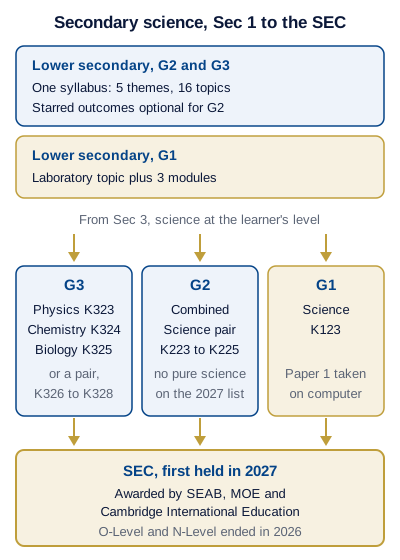
Lesson formats
Where do secondary science lessons take place?
Secondary science lessons pair one tutor with one learner, either at a desk at home or live on screen, and a single registration form books both.
Home lessons in Singapore
Our team picks a home science tutor who can reach the learner's part of Singapore at hours the school week leaves open. A kitchen scale and a measuring jug from the learner's own kitchen turn density and volume into something to weigh and pour, alongside the practice sheets each lesson brings.
- Tutor beside the learner at home
- Fits the learner's area and evenings
- Practice sheets with every lesson
Online lessons
Lessons run live on screen, with circuit diagrams, speed-time graphs and model drawings shared on a whiteboard. Learners choose online in the registration form under mode online.
- Live one-to-one on screen
- Shared whiteboard for diagrams and graphs
- Same registration form, mode online
From registration to lessons
How does a learner start secondary science tuition?
Secondary science tuition moves through six steps, opening with one registration form and settling into a school term of lessons, tutor notes and monthly reports.
- 1
Register for tuition
The form records the Sec level, which science sits on the school timetable, home or online lessons, and where the learner lives; the learner fills it in, or anyone signing the learner up does.
- 2
Free consultation with our team
In the free consultation, our team walks through the school's order of science topics, the learner's G-level and the papers still to come, and sets out what the match needs.
- 3
Tutor matched to the science
Our team looks for a tutor experienced and skilled in that exact science, be it physics, chemistry or biology, and for a home lesson also checks the learner's neighbourhood and open evenings.
- 4
First lessons map the syllabus
The tutor places the school's work on the five-theme map and starts the measurement routine.
- 5
Term rhythm before the end-of-year exam
End-of-year examinations sample topics across the two lower secondary years, so revision can cycle back through earlier themes before the paper.
- 6
Notes and a monthly report
Tutor notes follow every lesson and a progress report arrives monthly, so the learner can see which themes are secure and plan the Sec 3 science choice with the school.
Our tutors
Who teaches secondary science at Eduprime?
Secondary science tutors on Eduprime are experienced and skilled in the physics, chemistry and biology they teach; each profile here is an illustrative sketch blending several tutors we match.
- Experience teaching the 2021 lower secondary syllabus at G1, G2 or G3
- Working knowledge of the SEAB 2027 science syllabus codes
- Practical skills for Sec 3 and Sec 4 practical papers
Ms Lim H.
Nine years of secondary physics and science tutoring
G3 Physics practicals and electricity
“I ask for the unit before the number in every sum.”
Mr Ong K.
Seven years with lower secondary and combined science
Diversity theme and chemical changes
Ms Rahman N.
Six years teaching biology topics
Body systems drawn as models
“A labelled diagram that moves is worth ten organ lists.”
Mr Kumar S.
Eight years of science tutoring at G2 and G3
Circuits, power and kilowatt-hour cost
Ms Chua Y.
Ten years teaching lower secondary science
G1 to G2 bridging and starred outcomes
Mr Tan J.
Five years guiding upper secondary learners through physics papers
Speed-time graphs and data-based questions
In their words
What do secondary science learners say?
Comments from science learners across Secondary 1 to 4 here are illustrative, carry privacy-style names, and report results that vary from one learner to the next.
I used to lose marks on every reading. My tutor made me crouch to eye level at the cylinder every lesson, and now I spot parallax on my own.
Wei Jie T.
Sec 1 learner · Home lessons · Lower secondary science
Electricity finally made sense once every line carried kW or h beside it. My end-of-year paper still had slips in ecology, which we are working on now.
Aisyah R.
Sec 2 learner · Home lessons · Lower secondary science
Drawing the transport system as a loop helped me more than any list. I can explain it in my own words now.
Priya S.
Sec 2 learner · Home lessons · Lower secondary science
We planned for physics and chemistry at Sec 3 from early on. The practical drills made the timed paper feel ordinary.
Marcus L.
Sec 3 learner · Home lessons · Upper secondary science
My aim was to move up a science level. The starred outcomes were new to me, and my tutor added them one by one.
Hui Min C.
Sec 2 learner · Home lessons · Lower secondary science
Online lessons suited my CCA days. Sharing speed-time graphs on the whiteboard was faster than I expected.
Daniel K.
Sec 4 learner · Online lessons · Upper secondary science
Fees
How much does secondary science tuition cost?
Secondary science fees sit in the tutor-lane fee table here, per 60-minute lesson; a Starter is four such lessons, and newcomers to Eduprime add a one-off registration fee.
- Widest availability
Online International Tutor
fromS$21.50/ session
60-minute session
The widest bench of tutors across time zones, so a slot is open at almost any hour. Lessons run online over a shared screen.
Online Local Tutor
fromS$36.55/ session
60-minute session
A tutor based here who knows our schools, syllabuses and exams, teaching online.
Home Tutor
fromS$43/ session
60-minute session
A local tutor who comes to the learner, at home or at a nearby study spot, matched to their town and timetable.
Minimum 4 sessions. Larger packages lower the per-session price. One-time S$15 registration fee for new learners.
At any point, a learner in secondary science may request a fresh physics, chemistry or biology tutor, and Eduprime makes the switch free of charge.
Student journeys
How have secondary science learners progressed?
Two illustrative journeys show how secondary science lessons change method first and marks after.
Careless measurement and missing units cost marks in every practical worksheet during the first term.
- Measurement routine opened every lesson for six weeks
- Units written on every line of each sum
- Density questions answered with the comparison step
By the end-of-year examination the learner's practical write-ups carried units throughout, and the learner explained density answers without prompting.
Sec 1 learner, home lessons · Two terms
A G2 learner wanted a more demanding science level at upper secondary and had never practised the starred outcomes.
- Starred outcomes listed and scheduled across two terms
- Kilowatt-hour and resistor circuits practised weekly
- Monthly progress reports kept as a record of the work
The learner covered every starred outcome before Sec 3 and could show a clear record of the work done when the school made its decision.
Sec 2 learner, online lessons · Three terms
What the tuition covers
Secondary science tuition in plain words
Secondary science tuition is personal coaching that follows a secondary learner's school science from Sec 1 through Sec 4 step by step: two years on the 2021 lower secondary syllabus at G1, G2 or G3, then from Sec 3 the SEC science at that learner's level, with pure sciences offered at G3 only.
- 01Lower secondary G2 and G3 share one syllabus of five themes.
- 02That syllabus holds 16 numbered topics, from Scientific Endeavour to reproduction.
- 03G1 science runs an introductory laboratory topic plus three modules.
- 04Outcomes marked with a star are optional for G2 learners.
- 05Science stays compulsory for every upper secondary learner.
- 06From 2027 the SEC combines and renames the N(T), N(A) and O-Level examinations.
PSLE to the SEC
How does science run from the PSLE to the SEC?
Science under Full SBB runs as a six-stage path, where the PSLE result sets the Sec 1 starting level and the SEC certificate records each subject's final level.
- 1
PSLE Science
The G2/G3 lower secondary syllabus groups its topics under five themes aligned to the Primary Science Syllabus.
- 2
Sec 1 starting level
A learner may take a PSLE subject at a more demanding level based on its AL score. A learner with Foundation-level PSLE Science who offers most subjects at G3 may study science one level lower, after talking it through with the secondary school.
- 3
Sec 1 and Sec 2
The G2 and G3 syllabus spans the two years of study with no fixed year split, and end-of-year examinations cover a representative sample of it.
- 4
Sec 3 science choice
Science follows the learner's Full SBB level: pure sciences or a combined pair at G3, a combined pair at G2, or Science at G1.
- 5
Sec 4 or Sec 5 and the SEC
Science practical examinations sit ahead of the written papers, and the SEC certificate shows the level at which each subject was taken.
- 6
Post-secondary
Grading bands, L1R5 and admission routes sit in our o level singapore guide, which covers the old and the new certificate.
Science notes
Four facts to check before Sec 3
Four facts every Sec 3 science choice rests on
Science is compulsory at upper secondary, its starting level may follow the PSLE AL, and beyond the start of Sec 1 a learner may move on performance and on the holistic view the school forms, G2 learners take a combined pair, and the SEC certificate from 2027 prints the level of every subject. Those four MOE and SEAB facts frame each conversation about the Sec 3 choice.
Read the star before revising a topic
In the G2/G3 syllabus a star marks outcomes that are optional for G2. A G3 learner revises them in full. A G2 learner may leave them out, or work through some, such as volume displacement and kilowatt-hour cost, to see the wider G3 picture.
The 2027 exam is called the SEC
The first science candidates for the Singapore-Cambridge Secondary Education Certificate sit their papers in 2027, and Cambridge International Education awards it together with MOE and SEAB. The O-Level and N-Level ended with the 2026 sitting, so codes such as 6091 and 5086 now serve only as reference.
From lower secondary themes to upper secondary papers
Density from the Diversity theme returns in physics, chemical change returns in chemistry, and transport systems return in biology. A tutor can tag each lower secondary topic with the upper secondary science it feeds, so the Sec 3 choice rests on known ground.
G1, G2 and G3 science
What is the difference between G1, G2 and G3 science?
G1, G2 and G3 science differ in syllabus document, topic set and optional outcomes at lower secondary, then in SEC subjects and codes from Sec 3.
| Feature | G3 science | G2 science | G1 science |
|---|---|---|---|
| Syllabus document | Lower Secondary Science G2/G3, from the 2021 Sec 1 cohort | The same G2/G3 document as G3 | Lower Secondary Science G1, from the 2021 Sec 1 cohort |
| Structure | Five themes, 16 numbered topics | Five themes, 16 numbered topics | Laboratory Measurements and Procedures plus three modules |
| Topic set | Every learning outcome, starred ones included | Every unstarred outcome; starred outcomes optional | Machines Around Us (I), Our Environment, Our Body and Health (I) |
| Optional outcomes | None: starred outcomes are taught | Starred items such as kilowatt-hour cost and series and parallel resistors | No starred set; MOE sets no particular order for the modules |
| SEC science from Sec 3 | Physics, Chemistry, Biology, or a combined pair | A combined pair: Physics with Chemistry or Biology, or Chemistry with Biology | Science |
| SEC code 2027 (reference 2026 and earlier) | K323 to K325 (6091 to 6093); K326 to K328 (5086 to 5088) | K223 to K225 (5105 to 5107) | K123 (5148) |
G1, G2 and G3 science
Which lower secondary science outcomes are optional for G2?
Starred outcomes in MOE's G2/G3 syllabus are taught to G3 learners and optional for G2; the unstarred rules below them apply to both levels.
| Outcome in the G2/G3 syllabus | Theme | G3 learners | G2 learners |
|---|---|---|---|
| Density as mass divided by volume, in g/cm3 or kg/m3 | Diversity | Taught | Taught |
| Sink or float, by comparing density with the surrounding medium | Diversity | Taught | Taught |
| Volume displacement for the volume of irregular objects | Diversity | Taught (starred) | Optional |
| Pressure as force divided by area | Interactions | Taught (starred) | Optional |
| Work done as an example of energy transfer | Interactions | Taught (starred) | Optional |
| Current, potential difference and resistance with SI units | Systems | Taught | Taught |
| Series or parallel fixed resistors and the current | Systems | Taught (starred) | Optional |
| Cost of electrical appliances in kilowatt-hours | Systems | Taught (starred) | Optional |
| The formula V = IR | Systems | Not required | Not required |
Lower secondary syllabus
Secondary science themes and Full SBB levels
MOE's G2/G3 syllabus links five themes to 16 topics, and Full SBB sets the level each learner starts at and moves to.
Five themes of lower secondary science
The syllabus holds 16 topics under five themes and sets no fixed year split, so the school decides the order. Tuition follows that order and keeps the theme map in view, because an end-of-year paper can pull from any topic taught so far.
Scientific Endeavour
The nature of science and the scientific practices the syllabus names under Scientific Endeavour
Diversity
Physical properties including density in g/cm3 or kg/m3, chemical composition, and separation techniques for mixtures
Models
Light traced as rays, the cell as the building unit of living things, matter pictured as particles, and atoms joining into molecules
Interactions
Forces and energy transfer, heat transfer and its effects, chemical changes and ecosystems, with pressure as force over area starred as optional for G2
Systems
Electrical circuits with ammeters and voltmeters, power, digestion, transport in living things, human reproduction
How Full SBB places a learner in science
Full Subject-Based Banding took over with the 2024 Secondary 1 cohort, retiring the Express, Normal (Academic) and Normal (Technical) streams, so Sec 1 learners now enter through three Posting Groups, numbered 1 to 3. Science level now moves subject by subject.
Starting level from the PSLE
A learner may take a PSLE subject at a more demanding level based on the AL score in it. MOE's own example is a PSLE score of 23 with AL5 in Maths, posted in Group 2, taking Maths at G3.
Moving up beyond the start of Sec 1
Beyond the start of Secondary One, a learner may move a subject up to a more demanding level when the learner's own secondary-school results in it, together with the school's holistic assessment, support the move.
Foundation PSLE Science
At the start of Secondary One, a learner who sat PSLE Science at Foundation level yet takes G3 in most subjects may sit science one level lower, once the secondary school agrees after a consultation.
The SEC from 2027
The SEC combines and renames the N(T), N(A) and O-Level examinations, and the G1, G2 and G3 subjects keep the grading structure of those three examinations respectively.
Upper secondary SEC papers
Secondary science papers and lower secondary pitfalls
SEAB's 2027 syllabuses give each upper secondary science its own paper load, and the lower secondary errors below can carry into the papers that build on those topics.
Upper secondary science options under the SEC
The paper load depends on the option the learner takes, so tuition plans revision around the papers the learner actually sits. Pure Physics carries a separate practical paper worth 20%, while G2 Science tests experimental skills inside its theory papers.
| Component | What it covers |
|---|---|
| G3 Physics K323 | Paper 1, 40 multiple-choice questions in 1 hour for 30%; Paper 2, lasting 1 hour 45 minutes for 50%, holds structured and free-response questions, with a data-based question of 8 to 12 marks; Paper 3, a practical in 1 hour 50 minutes for 20%. |
| G3 Combined Science K326 to K328 | Paper 1 plus Paper 5 plus two of Papers 2, 3 and 4. Paper 1 has 40 compulsory multiple-choice questions for 20%; each science paper runs 1 hour 15 minutes for 32.5%; the Paper 5 practical runs 1 hour 30 minutes for 15%. |
| G2 Science K223 to K225 | Four of six papers: per science, a multiple-choice paper of 20 marks for 20% and a structured paper of 30 marks for 30%, each pair taken in one 1 hour 15 minute session. Experimental skills carry about 10% of marks. |
| G1 Science K123 | Paper 1 is an e-Examination of 1 hour 15 minutes for 50 marks, answered on computer; Paper 2 runs 1 hour for 50 marks and includes a data-response question of 8 to 12 marks. |
| Practical timing | In the national examinations, science practical papers are scheduled ahead of the written papers, so a Sec 4 revision plan can take practical skills first. |
Six secondary science errors and their fixes
Each error below ties to a named syllabus outcome, so each fix comes from the syllabus itself.
Reading a measuring cylinder or metre rule from above or below the mark.
Bring the eye level with the meniscus or the mark every time, and name the parallax error the habit removes.
Treating accuracy and precision as the same word.
Define accuracy as closeness to the true value and precision as closeness of repeated readings, then sort five sample readings into each.
Calling a heavy object dense without dividing mass by volume.
Write density as mass over volume with units first, then compare the result with the surrounding medium to predict sinking or floating.
Mixing up the units of current, potential difference and resistance.
Pair each quantity with its SI unit and its meter on a circuit diagram: ammeter in series, voltmeter in parallel.
Using watts or minutes in a kilowatt-hour cost sum.
Convert power to kilowatts and time to hours before multiplying, and write the units beside every line.
Learning the digestive or transport system as a list of organs.
Draw the model first, tracing what moves where and why, then attach each organ to its job in that model.
Lower secondary worked example: density and floating
The problem
A solid block has a mass of 54 g and a volume of 20 cm3. Find its density, then state whether it sinks or floats in water of density 1.0 g/cm3, giving a reason.
Worked solution
- 1Write the relationship from the Diversity theme: density = mass / volume.
- 2Substitute with units: density = 54 g / 20 cm3.
- 3Calculate: density = 2.7 g/cm3.
- 4Compare with the surrounding medium: 2.7 g/cm3 is greater than 1.0 g/cm3.
- 5Conclude: the block sinks, because its density is greater than the density of water.
Answer: Density 2.7 g/cm3; the block sinks in water.
The comparison with water decides the answer, and it rests on dividing mass by volume, the habit the third pitfall above builds.
Lower secondary electricity
Secondary science electricity and measurement routine
The kilowatt-hour outcome, starred as optional for G2 in MOE's syllabus, asks for units handled in the right order, and a measurement routine supports it.
G3 worked example: energy used by a heater
The problem
A 2,000 W heater is switched on for 3 hours a day for 30 days. Electricity costs c cents per kWh. Find the energy used in kWh, and the cost in terms of c.
Worked solution
- 1Convert power to kilowatts: 2,000 W = 2 kW.
- 2Find the total time in hours: 3 h per day x 30 days = 90 h.
- 3Energy used = power x time = 2 kW x 90 h = 180 kWh.
- 4Cost = energy x rate = 180 kWh x c cents per kWh.
- 5Cost = 180c cents, with the units checked on every line.
Answer: 180 kWh; the cost is 180c cents.
Converting watts to kilowatts in the first line guards against the fifth pitfall above.
A measurement-first routine for every topic
The Scientific Endeavour outcomes set four habits that carry into every later topic, so the routine travels with the learner from density to circuits.
- 1
Measure
Choose the instrument the syllabus names for the quantity, such as digital calipers for small lengths or an electronic balance for mass, and read it at eye level.
- 2
Record
Write every value with its SI unit and a sensible number of decimal places, as a table a marker can follow.
- 3
Check
Look for zero error before the reading and parallax error during it, then repeat the reading to judge precision.
- 4
Explain
State in one sentence what the result shows, and tie it to the theme it belongs to, the step a learner practises at home between lessons.
Accountability
How can a learner see progress in science?
Progress in secondary science shows in four records: notes after each science lesson, a progress report every month, topics covered by theme and named slips.
Notes after each science lesson
The topic covered, the error seen and the next practice task, written after each lesson.
Monthly progress report
A summary across themes, with strengths, gaps and the plan for the coming month.
Topics covered, theme by theme
The tutor notes name each topic taught, so the learner can tick the 16 topics off against the five themes.
Unit and reading slips named
Slips with units or instrument readings are named in the tutor notes, so a repeated one is easy to spot.
Coverage in numbers
What does secondary science tuition cover?
Results in science rest on syllabus coverage, accurate units and practised paper technique, and the lessons work on all three.
- 5
- themes in the lower secondary G2/G3 syllabus
- 16
- numbered topics across the two lower secondary years
- 3
- science levels under Full SBB: G1, G2 and G3
- 12,000+
- tutors teaching across Eduprime's 148+ programmes
Secondary science questions
Secondary science tuition questions, answered
Secondary science questions below cover the syllabus, the G-levels, the SEC, lessons, fees and the pages that serve narrower needs.
Next step
Plan the Sec 3 science choice with a tutor
Lower secondary themes lead into the Sec 3 choice of G-level and pure or combined science, and a tutor maps that route with the learner.
- Register, then a consultation
- Tutor matched by town
- Notes after each lesson
Eduprime · Secondary science, lower secondary themes to SEC papers, home or online
Narrower science needs