Eduprime Singapore
Enrichment Classes Singapore: What Each Programme Builds and When to Start
Enrichment classes in Singapore build skills that sit beside the school syllabus: reading and writing for young learners, number sense through abacus, strategy through chess, steadier attention through mindfulness and yoga, and careful hands through origami. Eduprime teaches each skill one to one, at home or by video call, opening with a Starter package of four 60-minute lessons.
4.8 average from 1,207 reviews across these programmes
What a lesson costs
Fees
What a lesson costs
Every programme is priced per 60-minute session in three formats. These are the lowest figures among the programmes on this page; each programme page shows its own.
- Widest availability
Online International Tutor
fromS$16.50/ session
60-minute session
The widest bench of tutors across time zones, so a slot is open at almost any hour. Lessons run online over a shared screen.
Online Local Tutor
fromS$28.05/ session
60-minute session
A tutor based here who knows our schools, syllabuses and exams, teaching online.
Home Tutor
fromS$33/ session
60-minute session
A local tutor who comes to the learner, at home or at a nearby study spot, matched to their town and timetable.
Minimum 4 sessions. Larger packages lower the per-session price. One-time S$15 registration fee for new learners.
Last updated
Which ten enrichment programmes can a learner take with Eduprime in Singapore?
Eduprime runs ten enrichment programmes in Singapore: phonics, English reading, creative writing, handwriting, abacus mental arithmetic, chess, mindfulness, mindful yoga, origami and e-sports. Every one of the ten runs with a single learner, on an online screen or as a home visit from a tutor we pick for the learner's own town and the days the learner keeps free each week.
Five of the ten belong to the early years of reading, writing and number, from preschool through primary. The other five welcome learners of every age, so a P2 learner and a working adult can both start chess or mindful yoga with a tutor who plans each session around them.
The ten programmes draw on a bench of 12,000+ tutors, each experienced and skilled in the enrichment skill they teach. They also sit inside a catalogue of 148+ programmes, so a learner who finishes an abacus level or masters chess endings always has a next skill waiting. The sections below take the questions people ask before they register, one at a time: which programme fits which age, what each one builds, how many fit a school week and how lessons are paid.
How is an enrichment class different from tuition?
Tuition follows a school subject towards its exam. An enrichment class builds a skill on its own track, at the learner's pace, and is judged by what the learner can now do. Many learners take both, because the two feed each other.
Take PSLE English as an example. In the writing paper SEAB sets for P6, Paper 1, a candidate has 70 minutes (1 hour 10 minutes) to produce a Continuous Writing piece and a Situational Writing piece, and our PSLE English tuition plans each term backwards from those two pieces. A creative writing programme starts years earlier and further from the exam: it grows the habit of planning a story, choosing words and revising a draft, and that habit later serves the paper well. Schools run enrichment of their own too. MOE lists Co-Curricular Activities and, for strongly motivated high-ability students, the out-of-school GEB Special Programmes. A private enrichment class adds one-to-one attention to whichever skill the learner picks.
| Point of comparison | Enrichment class | Tuition |
|---|---|---|
| Goal | A skill the learner chooses, such as reading fluency, chess or mindful breathing | Marks in a school subject and its national exam |
| Link to the school syllabus | Runs beside it; some skills feed school subjects later | Follows the MOE syllabus topic by topic |
| How progress is measured | What the learner can now do, recorded in tutor notes after every session | School tests, then the national paper |
| Pace | Set by the learner's readiness and interest | Set by the school term and the exam calendar |
| Length of commitment | Open-ended; many learners keep a skill going across school levels | Usually tied to a level, such as P5 to P6 |
Which enrichment programme suits which age?
Phonics, English reading, handwriting, creative writing and abacus usually start in the preschool or primary years, because they lay the base for reading, writing and number. Chess, mindfulness, mindful yoga, origami and e-sports welcome learners of any age, adults included.
Treat the starting stage as the usual point of entry. A learner who missed phonics at five can still learn it at eight, and the tutor simply begins where the learner is today. The free consultation with our team settles the right starting point, and each programme's own page goes deeper into lesson content by age.
| Programme | Usual starting stage | What it builds | Adults join too |
|---|---|---|---|
| Phonics | Preschool and lower primary | Linking letters to sounds so new words can be sounded out | No, built for young readers |
| English reading | Preschool and primary | Accuracy, fluency and understanding of longer texts | No, built for young readers |
| Creative writing | Primary | Planning, word choice and revising a story | No, built for primary writers |
| Handwriting | Preschool and lower primary | Grip, letter formation and spacing | No, built for early writers |
| Abacus mental arithmetic | Preschool and primary | Bead calculation, then picturing the beads in the mind | No, built for young learners |
| Chess | Any age | Planning ahead, calculation and reviewing decisions | Yes |
| Mindfulness | Any age | Noticing attention and returning it to a chosen focus | Yes |
| Mindful yoga | Any age | Breath-led movement and body awareness | Yes |
| Origami | Any age | Following a sequence of folds with precision and patience | Yes |
| E-sports | Any age | Game sense, decision speed, teamwork and healthy screen habits | Yes |
Phonics, reading, handwriting or creative writing: where does a young learner start?
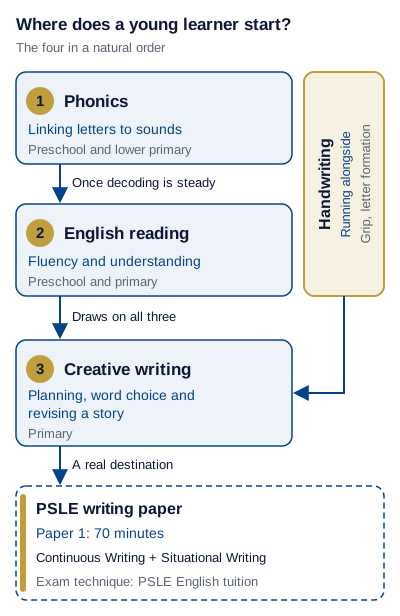
Most young learners move through the four in a natural order. Sounds come first through phonics, then reading for fluency and meaning, with handwriting running alongside, and creative writing arrives once the learner reads and forms letters with ease.
Phonics teaches the learner which letters stand for which sounds and how to blend them, so an unfamiliar word on the page becomes something the learner can work out alone. Once decoding is steady, English reading lessons move the weight to fluency, expression and understanding what a longer passage says. A learner who reads accurately but slowly, or who reads aloud well and then struggles to retell the story, usually belongs in reading lessons.
Handwriting deserves its own place in that order. In a 2012 study in Trends in Neuroscience and Education, James and Engelhardt of Indiana University worked with 15 pre-literate children aged four to five. The children printed letters freely by hand, typed them or traced them, and then looked at letters during a brain scan. The brain's reading circuit became active during letter viewing only after free-form printing; typing and tracing left no such pattern. The authors concluded that handwriting may help young children learn to read, which is why our handwriting lessons have the learner form each letter freely and keep tracing sheets in a supporting role.
Creative writing comes last because it draws on all three. It also points at a real destination, because the PSLE writing paper described in the comparison above fits both of its writing pieces into 70 minutes. Creative writing lessons build the storytelling habits early, and exam technique for that paper belongs to PSLE English tuition.
What do abacus and chess build?
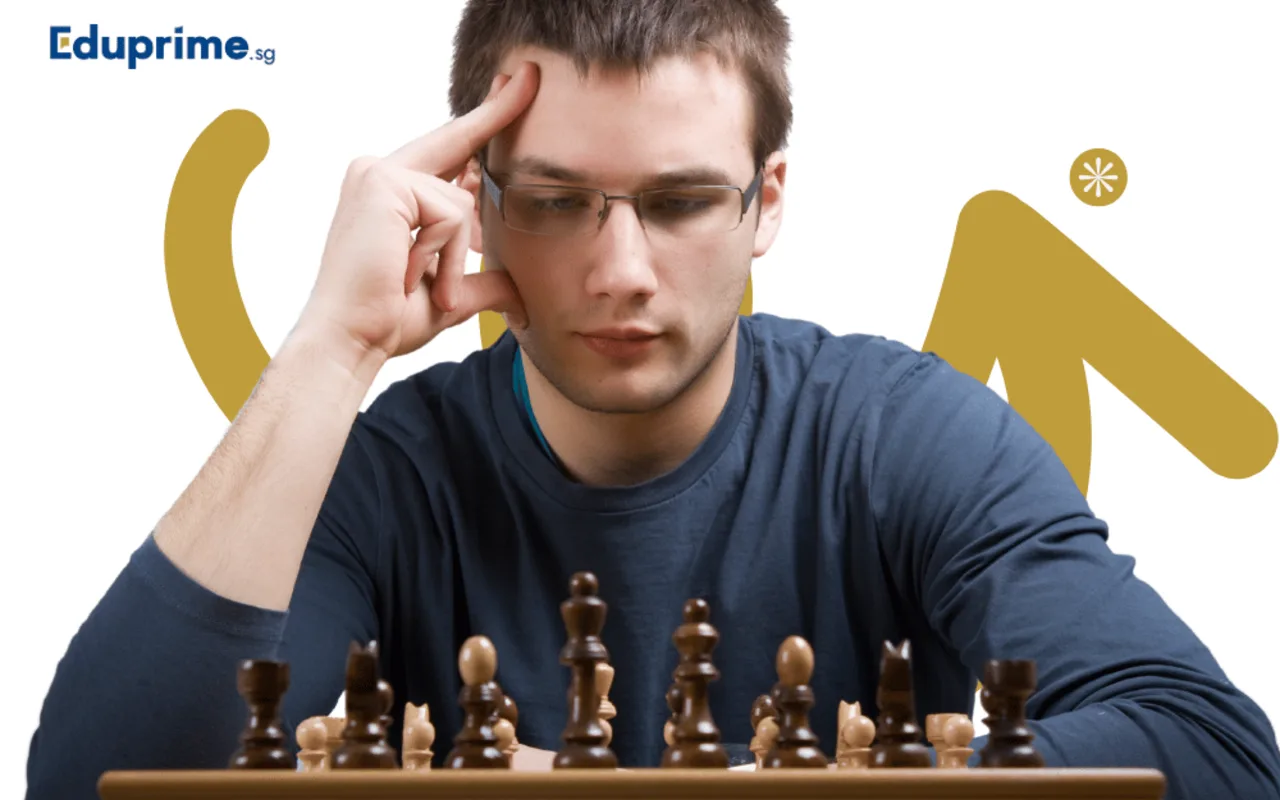
Abacus trains calculation by moving beads and, later, by picturing them. Chess trains planning, calculation and the habit of checking a move before playing it. Research on chess instruction reports moderate average gains, with the largest pooled effect on mathematics.
Abacus lessons begin with the learner's hands on the beads: setting numbers, then adding and subtracting by rule. As accuracy grows, the tutor takes the frame away and the learner works the same moves in the mind, the skill known as mental arithmetic. At the end of each abacus lesson the tutor logs how fast and how accurately the learner worked through that day's bead drills, so progress can be read line by line. The learner owns the abacus, and the tutor brings the worksheets and drills.
For chess, the clearest evidence is a 2016 meta-analysis by Sala and Gobet in Educational Research Review, which pooled 24 studies and 40 effect sizes. The overall effect of chess instruction was g = 0.338, with g = 0.382 for mathematics and g = 0.248 for reading. Those figures are averages across many school programmes, so a single learner's gain depends on how often the learner plays and how carefully each game is reviewed afterwards.
| Programme | What the learner practises | What the record shows | How to read it |
|---|---|---|---|
| Abacus | Bead calculation, then mental arithmetic | Speed and accuracy on the learner's own drills, kept in tutor notes | Read the trend across the tutor's notes, lesson after lesson |
| Chess | Opening principles, tactics, endgames and review of played games | Sala and Gobet 2016: overall g = 0.338; mathematics 0.382; reading 0.248 | Averages across 24 studies; one learner's gain may differ |
What do mindfulness and mindful yoga offer a learner?
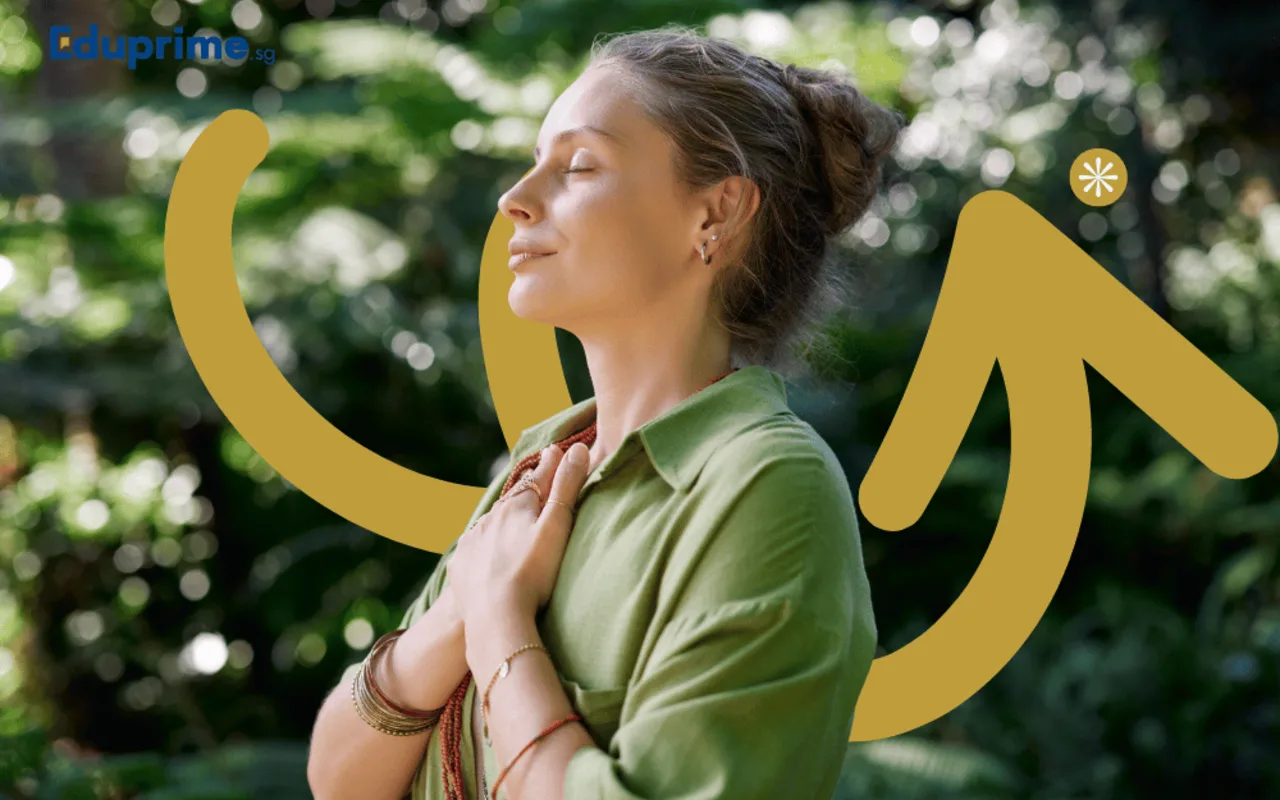
Mindfulness lessons train the learner to notice where attention has drifted and bring it back; mindful yoga does the same through breath and movement. A large review of school-age studies found small positive effects, and the practice sits comfortably beside MOE's social-emotional competencies.
The review is by Dunning and colleagues, published in 2019 in the Journal of Child Psychology and Psychiatry. It pooled 33 randomised controlled trials covering 3,666 children and adolescents and found small positive effects on measures of mindfulness, executive functioning, attention, depression, anxiety or stress, and negative behaviours. Against an active comparison activity, in 17 trials with 1,762 learners, the effects that held were on mindfulness itself, depression, and anxiety or stress. Read plainly, the studies show modest, measurable change, and the strictest comparison narrows the list.
Among the five social-emotional competencies in MOE's 21st Century Competencies framework, two sit closest to mindfulness, Self-Management and Self-Awareness; the framework names the other three as Relationship Management, Responsible Decision-Making and Social Awareness. Mindfulness lessons give the first two a daily routine, such as a breathing count before homework, a body scan before sleep or a pause before replying to a heated message.
Health questions belong with a doctor or counsellor, and our lessons teach the practice itself. After each mindfulness or yoga lesson, the tutor's note logs the exercises practised and how long the learner held each one. For mindful yoga, the learner prepares a mat and a clear patch of floor.
Origami and e-sports: what does a lesson look like, and how does screen time fit?
An origami lesson works through a model fold by fold, from simple bases to multi-step designs. An e-sports lesson reviews the learner's own play, decisions and communication, and Singapore's 24-hour activity guidelines set the screen-time frame around it.
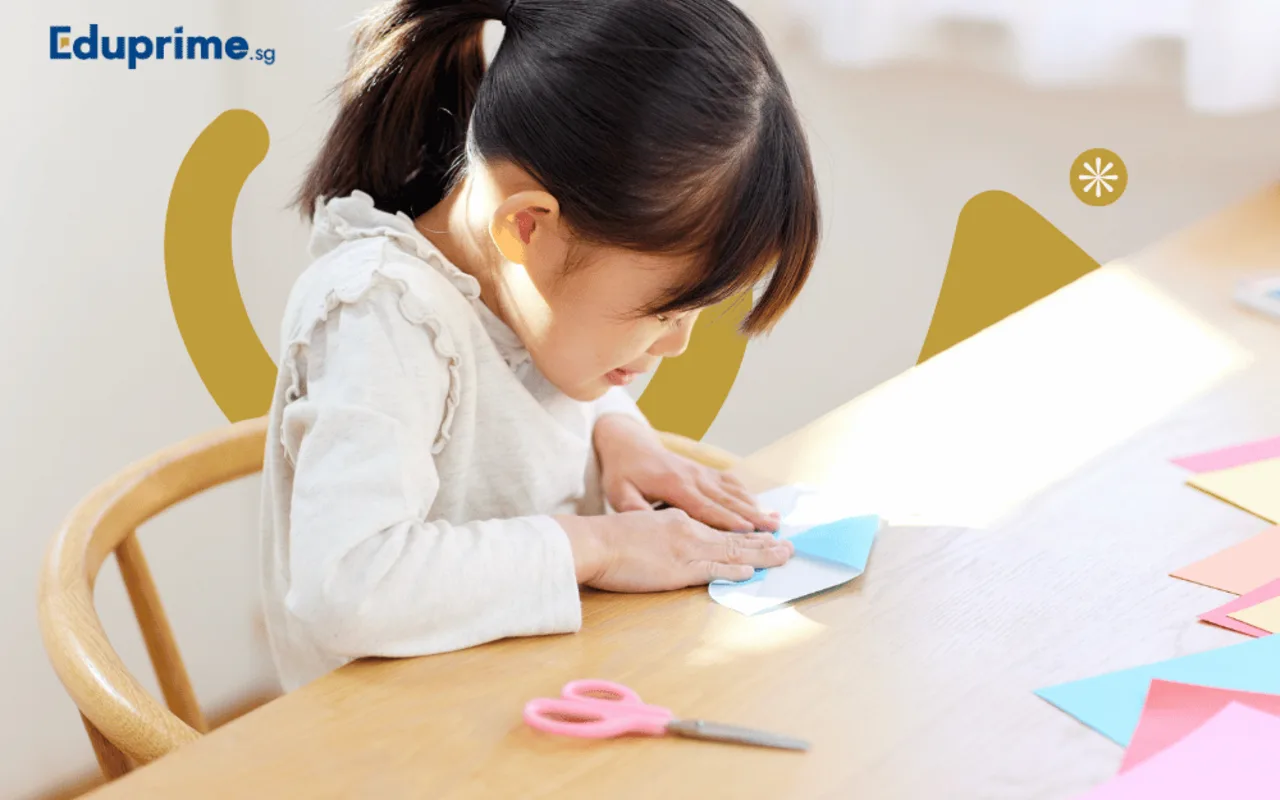
Origami asks for patience and precision, because a careless crease at step three shows up again at step twelve. The tutor plans a sequence of models that grows in difficulty, and the learner keeps a supply of paper at home. Teens and adults often take it up as a calm hobby away from screens.
For e-sports, the learner plays on the gaming PC or console, and the accessories, that the learner already owns. A session might replay a recent match, pick out two decisions to change and drill one mechanic until it holds. The guidelines published in January 2021 by the Academy of Medicine Singapore with the College of Paediatrics and Child Health count physically inactive video games as recreational screen time, advise limiting it as much as possible for ages 7 to 18, and link two hours or more a day with the most negative health effects. They also ask for a three to five minute movement break for every 30 to 60 minutes of sitting. Both lines are worth reading before an e-sports timetable is set, together with MOE's Cyber Wellness aim of a responsible digital learner.
How does enrichment sit beside what school teaches?
Enrichment fills the space the school timetable leaves open. MOE's own programmes cover cyber wellness, mental health, holistic health, co-curricular activities and out-of-school programmes for high-ability students, and a private enrichment class adds one-to-one depth in one chosen skill.
MOE's Our Programmes page, last updated on 30 October 2026, lists these school programmes that share ground with our enrichment range:
MOE's 21st Century Competencies framework adds a set of emerging competencies. A chess learner exercises Critical, Adaptive and Inventive Thinking with every move weighed over the board; an e-sports team exercises Communication, Collaboration and Information Skills in each match; and Civic, Global and Cross-Cultural Literacy completes the set of three.
A learner nearing the end of primary school may be hoping to enter a secondary school through Direct School Admission. The DSA-Sec talent areas include visual, literary and performing arts; science, mathematics and engineering; and debate and public speaking. Shortlisted P6 applicants attend interviews or auditions, and the methods vary by school, so our lessons build the skill itself and selection stays with each school.
- Cyber Wellness, which helps the learner become a responsible digital learner, an aim that matters to every learner who games
- Mental Health Education, close in spirit to the attention habits that mindfulness practises
- The Holistic Health Framework, which pairs naturally with mindful yoga and the activity guidelines
- Co-Curricular Activities, which MOE describes as playing a key role in students' holistic development
- GEB Special Programmes, out-of-school enrichment for strongly motivated high-ability students
How do I choose the right enrichment class?
Start from what the learner already enjoys or finds hard, then match it to the skill a programme builds. Five questions settle most choices, and the free consultation with our team settles the rest.
Interest carries a programme further than any plan made on the learner's behalf, so ask the learner first and listen to the answer. If that interest fades a few months in, free tutor replacement and a change of programme keep the effort going without starting from nothing.
| Question to ask | If yes | If no | Programme to look at |
|---|---|---|---|
| Does the learner stumble when sounding out a new word? | Start with sounds and blending | Check fluency and understanding next | Phonics, then English reading |
| Does the learner write slowly, grip awkwardly or reverse letters? | Work on letter formation first | Look at what the learner writes about | Handwriting, then creative writing |
| Does the learner enjoy puzzles, numbers or board games? | Build on calculation or strategy | Try a craft that uses the hands | Abacus or chess |
| Does the learner find it hard to settle before study or sleep? | Practise attention and breath | Keep the week lighter | Mindfulness or mindful yoga |
| Does the learner already spend free time gaming? | Give that time structure and breaks | Pick an option away from screens | E-sports, or origami |
How many enrichment classes a week fit a learner's day?
One or two enrichment lessons a week fit most school-age learners, provided the week still holds an average of at least 60 minutes of moderate-to-vigorous activity a day and enough sleep. Singapore's 24-hour activity guidelines give the yardstick.
Here is one P3 learner's week, checked against the guidelines for ages 7 to 13. The learner takes chess on a weekday afternoon and mindful yoga on Saturday, each a 60-minute one-to-one session at home.
If a second lesson would push out play or sleep, the second lesson waits for a lighter term. That one rule keeps an enrichment week healthy at any age.
| Guideline (ages 7 to 13) | What it asks | How this week meets it |
|---|---|---|
| Moderate-to-vigorous activity | An average of at least 60 minutes a day across the week | Play, PE and weekend cycling supply it; yoga adds gentle movement on top |
| Muscle and bone strengthening | At least three times a week | Climbing and jumping games at the playground three afternoons a week |
| Movement breaks | Three to five minutes of movement for every 30 to 60 minutes sitting | The chess tutor builds a stretch break into the hour |
| Recreational screen time | Limit it as much as possible | Chess is played on a physical board, so the lesson adds no screen time |
| Sleep | At least 9 hours | Both lessons end well before bedtime |
Worked example
Checking one week's activity average
A P3 learner's week holds 50 minutes of play and PE on each of the five school days, 90 minutes of cycling on Saturday and 80 minutes of climbing games and cycling on Sunday. Does the week meet the guideline of an average of at least 60 minutes of moderate-to-vigorous activity a day?
- Add the five school days: 5 × 50 = 250 minutes.
- Add the weekend: 250 + 90 + 80 = 420 minutes for the week.
- Divide by the seven days of the week: 420 ÷ 7 = 60 minutes a day.
- Count the mindful yoga lesson separately, as gentle movement on top of those minutes.
Yes. The week averages exactly 60 minutes a day, so it meets the guideline, and a second enrichment lesson fits only if it leaves those play minutes and sleep in place.
Can adults join enrichment programmes?
Yes. Chess, mindfulness, mindful yoga, origami and e-sports take learners of any age, and adults learn in the same one-to-one format, at home or online.
Adults usually arrive with a clear reason. A manager wants a steadier mind before meetings and starts mindfulness. A retiree returns to chess after decades away and wants an opponent who explains as well as plays. A university student takes up origami to keep one evening a week away from a screen. Each one learns with a tutor who plans the sessions around that reason.
The habits the guidelines set out for younger learners carry over well. At 18 they ask for at least 7 hours of sleep, and a movement break every 30 to 60 minutes of sitting serves someone at an office desk as much as someone at a school desk.
Some adults register themselves; others are registered by an employer funding a wellbeing plan or by a relative giving lessons as a gift. Whoever fills in the form, the adult learner decides what the lessons aim at and reads the tutor's notes after each lesson.
Which enrichment programmes work best at home and which online?
Hands-on programmes such as handwriting, abacus and origami suit lessons at home, where the tutor sees the learner's hands up close. E-sports suits online by its nature, and the rest work well either way.
For a lesson at home, we choose a tutor whose travel suits the learner's town and whose hours suit the learner's week. The tutor brings worksheets and lesson plans, and the learner keeps the equipment listed below.
| Programme | At home | Online | What the learner prepares |
|---|---|---|---|
| Phonics | Suits well | Works with a parent or guardian nearby for a preschool learner | Books and a quiet table |
| English reading | Suits well | Suits well | The book being read |
| Creative writing | Suits well | Suits well, with drafts shared on screen | A notebook or laptop |
| Handwriting | Best fit, as the tutor watches grip and pressure | Possible with a camera on the page | Pencils and lined paper |
| Abacus | Best fit | Possible with a camera on the frame | The learner's own abacus |
| Chess | Suits well | Suits well on an online board | A chess set or an online board account |
| Mindfulness | Suits well | Suits well | A quiet space |
| Mindful yoga | Suits well | Suits well with room in camera view | The learner's own mat and clear floor |
| Origami | Best fit | Possible with a camera on the hands | Origami paper |
| E-sports | Possible | Best fit | The gaming PC or console and accessories the learner owns |
What will a chess, abacus or yoga programme cost, and how can payment be split?
Each of the ten programmes, from phonics to e-sports, carries its own figure in the price table on this page, calculated by our pricing engine separately for home and online lessons. Whatever the skill, the learner begins with the Starter package, a block of four lessons that each last 60 minutes.
Payment for the Starter, and for each package that follows it, comes either as one sum at the opening lesson or as two equal halves: 50% at that opening lesson and the remaining 50% once the package reaches its midpoint. First-time learners at Eduprime add a single registration fee, which that table also prints; someone already on our books does not pay it again when starting a second enrichment skill.
To see how tuition and enrichment rates compare across subjects and levels in Singapore, our tuition rates guide goes into detail. The free consultation can also walk through the price table with the learner or with whoever is paying.
How does an enrichment programme get started, and where does a learner sign up?
Pressing Register Now brings up the registration form; our team then talks the goal through in a free consultation, and the first chess, abacus or phonics lesson goes into the diary once a tutor for that skill fits where the learner lives and when the learner is free. Anyone still torn between two of the ten programmes can press Ask a question, which leads to the contact form instead.
Tutor matching happens after registration and through our team, so the learner meets the tutor at the first session. For a child learner, a parent or guardian completes the registration, gives consent for lessons at home or online, and receives the tutor notes, the monthly progress report and the payment details.
- The form behind Register Now starts with the enrichment programme, then asks about the learner, including age or school level and a preference for home visits or online lessons.
- Our team holds a free consultation to confirm the goal, the starting point and the timetable.
- Our team then picks a tutor with real experience and skill in that exact programme, be it origami folds or abacus bead work.
- Lessons open with the Starter package, four 60-minute lessons in the chosen skill, paid in one sum or in two halves.
- After every session the tutor writes notes, and a progress report follows each month.
What can a learner, or whoever registers a child, check along the way?
From the first week of chess, abacus or any other programme, three things are kept on record for the learner: the tutor's notes on each lesson, a monthly progress report, and a free right to ask for a different tutor whenever the learner wishes.
Interest in an enrichment skill rises and falls, especially in young learners. When it dips, the tutor notes usually show why: the material became too hard, too easy or too repetitive. The fix is often a new angle, a new tutor or a new programme, and all three are open to the learner.
- After each lesson, a short tutor note on what was practised, what moved forward and what comes next.
- Once a month, a progress report that measures the month's enrichment work against the goal agreed at the consultation.
- A change of tutor, free and open at any point however many lessons have passed, whenever the fit feels wrong.
- A change of programme, arranged with our team, when interest moves to a different skill.
- Matching by programme, town and timetable, so a house move or a new school schedule is handled through us.
Which page covers my enrichment programme in depth?
Every programme on this hub has its own page that goes deeper by age and level. For early literacy, the phonics classes page covers sounds and blending, the English reading tuition page covers fluency and understanding, the handwriting classes page covers letter formation, and the creative writing tuition page covers planning and revising stories.
For numbers, strategy and calm, turn to the abacus mental arithmetic classes page, the chess tuition page, the mindfulness course page and the mindful yoga course page. Origami and e-sports each have a course page of their own. When the goal turns to school marks, PSLE English tuition covers the writing paper and math tuition covers the school maths syllabus. The coding for kids course and speech and drama classes sit in their own categories, and public speaking and debate live with life and professional skills.
Learners with special educational needs have a page of their own under special needs tuition, and the tuition rates guide lays rates for every subject side by side. When the choice is clear, choose Register Now; while it is still open, choose Ask a question and our team will help the learner decide.
- phonics classes singapore
- english reading tuition singapore
- creative writing tuition singapore
- handwriting classes singapore
- abacus mental arithmetic classes singapore
- chess tuition singapore
- mindfulness course singapore
- mindful yoga course singapore
- origami course singapore
- e-sports tuition singapore
- psle english tuition singapore
- math tuition singapore
- coding for kids course singapore
- speech and drama classes singapore
- special needs tuition singapore
- tuition rates singapore
- life skills classes singapore
Sources
- MOE, Our programmes (updated 30 Oct 2026)
- MOE, 21st Century Competencies (updated 6 Jan 2026)
- Singapore Integrated 24-Hour Activity Guidelines for Children and Adolescents, summary (KKH, January 2021)
- SEAB, media replies 17 July 2026
- Sala and Gobet 2016, Educational Research Review 18 (LSE Research Online)
- Dunning et al. 2019, Journal of Child Psychology and Psychiatry (White Rose eprint)
- James and Engelhardt 2012, Trends in Neuroscience and Education (Indiana University)
- MOE, Direct School Admission to secondary school (updated 23 Oct 2026)
Enrichment that builds focus, curiosity and calm
 4.7from S$22/session
Chess Tuition Singapore, from First Move to FIDE-Rated Play
Chess tuition in Singapore for beginners, school-club players and FIDE-rated players. Trusted by thousands of learners. Home or online.
 4.8from S$24.50/session
E-Sports Tuition Singapore for Keen Student Players
E-sports tuition in Singapore for student gamers: mechanics, game sense and VOD review. Thousands of players on board. Online or home.
 4.7from S$22/session
Mindful Yoga Course Singapore, Private and Paced to Your Body
Mindful yoga course in Singapore for beginners and professionals: breath-led asana, deeper sleep. Thousands of classes run. Home or online.
 4.8from S$22/session
Mindfulness Course Singapore: Short Daily Practices That Stick
Mindfulness course in Singapore for workers and exam-stressed students: MBSR breath, body scan, focus. Trusted by thousands. 1-to-1.
- 4.9from S$16.50/session
Origami Course Singapore: From First Crane to Modular Design
Origami course in Singapore for kids and adults: core folds, diagrams, modular models. Loved by thousands of learners. Home or online.
 4.7from S$16.50/session
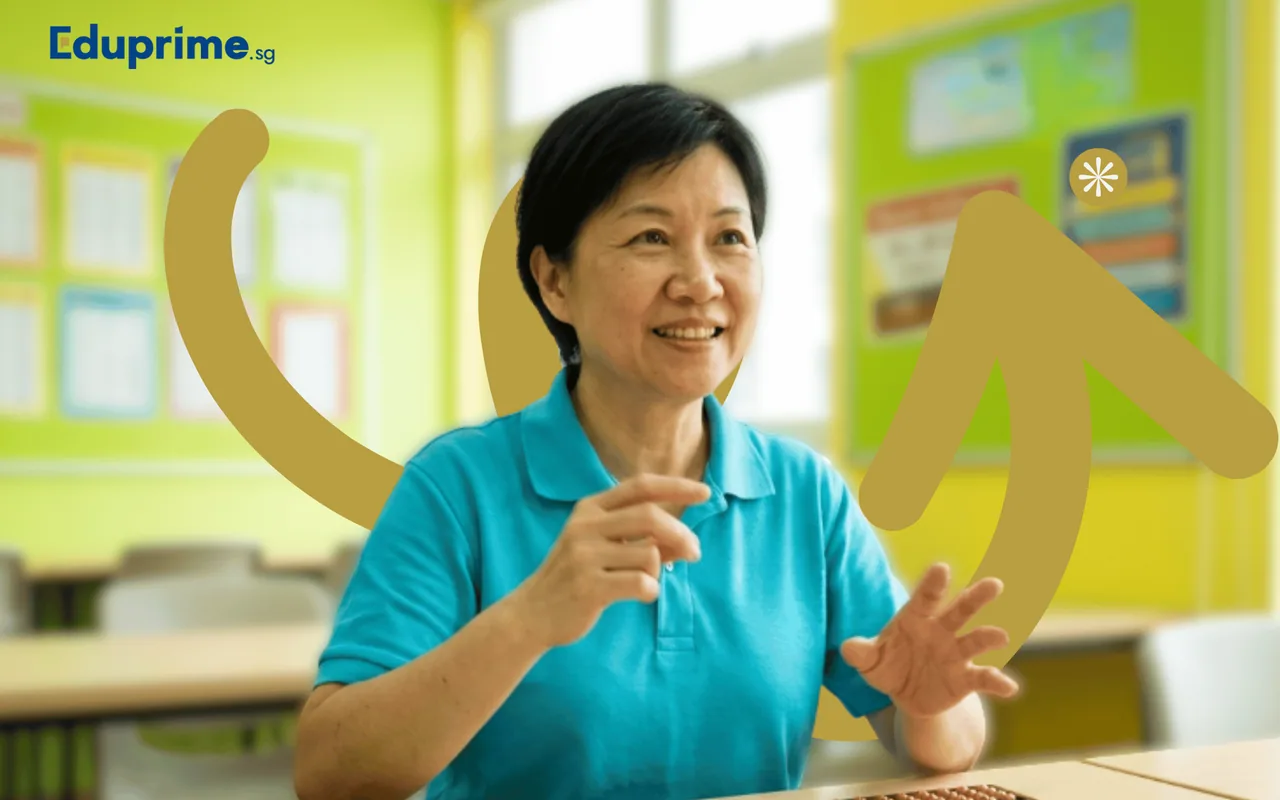
Abacus Mental Arithmetic Classes Singapore, from Soroban to Anzan
Abacus mental arithmetic classes in Singapore from age 5: soroban beads, then anzan speed. Loved by thousands of young learners. Home or online.
 4.9from S$24.50/session
Creative Writing Classes Singapore for P1 to Sec 4 and Adults
Creative writing classes Singapore: one-to-one story and composition lessons for P1 to Sec 4 writers in 2027 and adults, home or online, from 12,000+ tutors.
 4.7from S$16.50/session
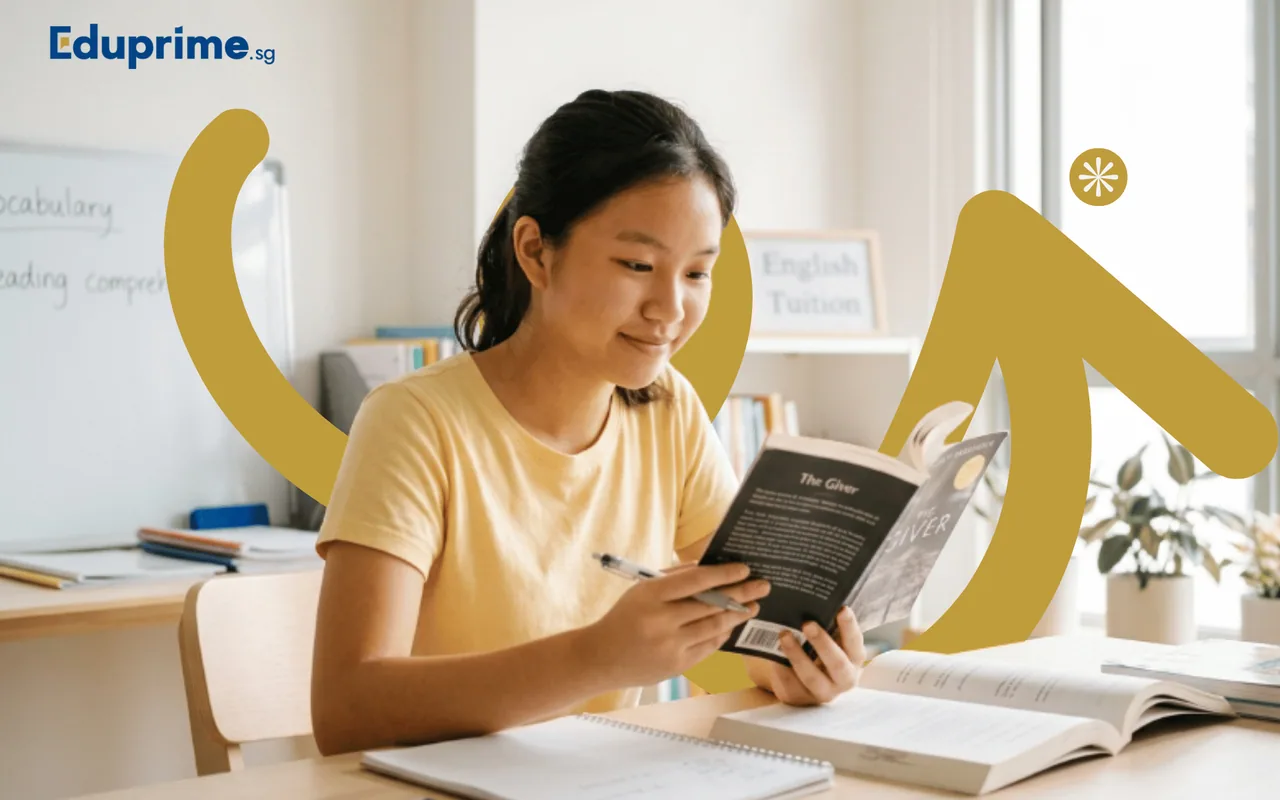
English Reading Tuition Singapore, Preschool to PSLE
English reading tuition in Singapore from preschool to PSLE: decoding to comprehension. Thousands of young readers have grown with us. Home or online.
 4.9from S$24.50/session
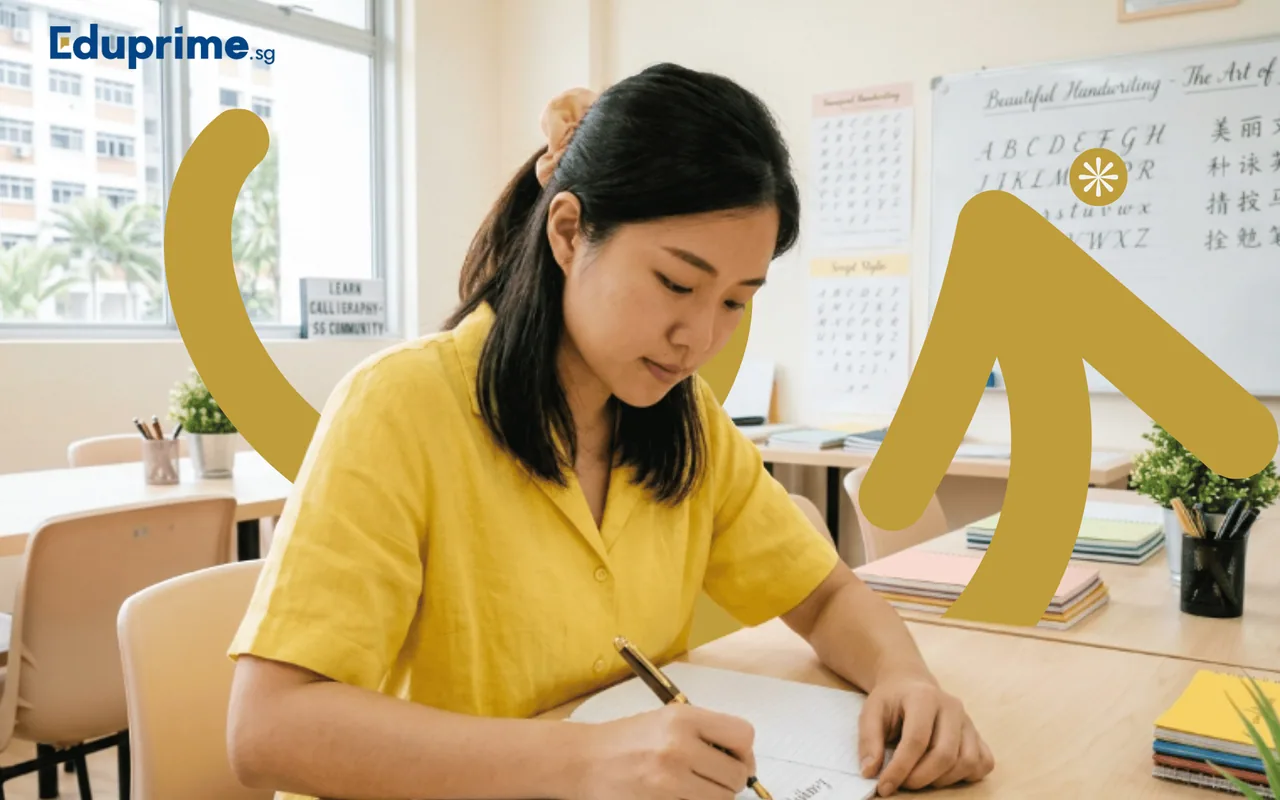
Handwriting Classes Singapore: Neat, Legible Writing from K1 to P6
Handwriting classes in Singapore that fix pencil grip, b/d reversals and slow writing, K1 to Primary 6. Thousands taught. Home or online.
 4.7from S$16.50/session
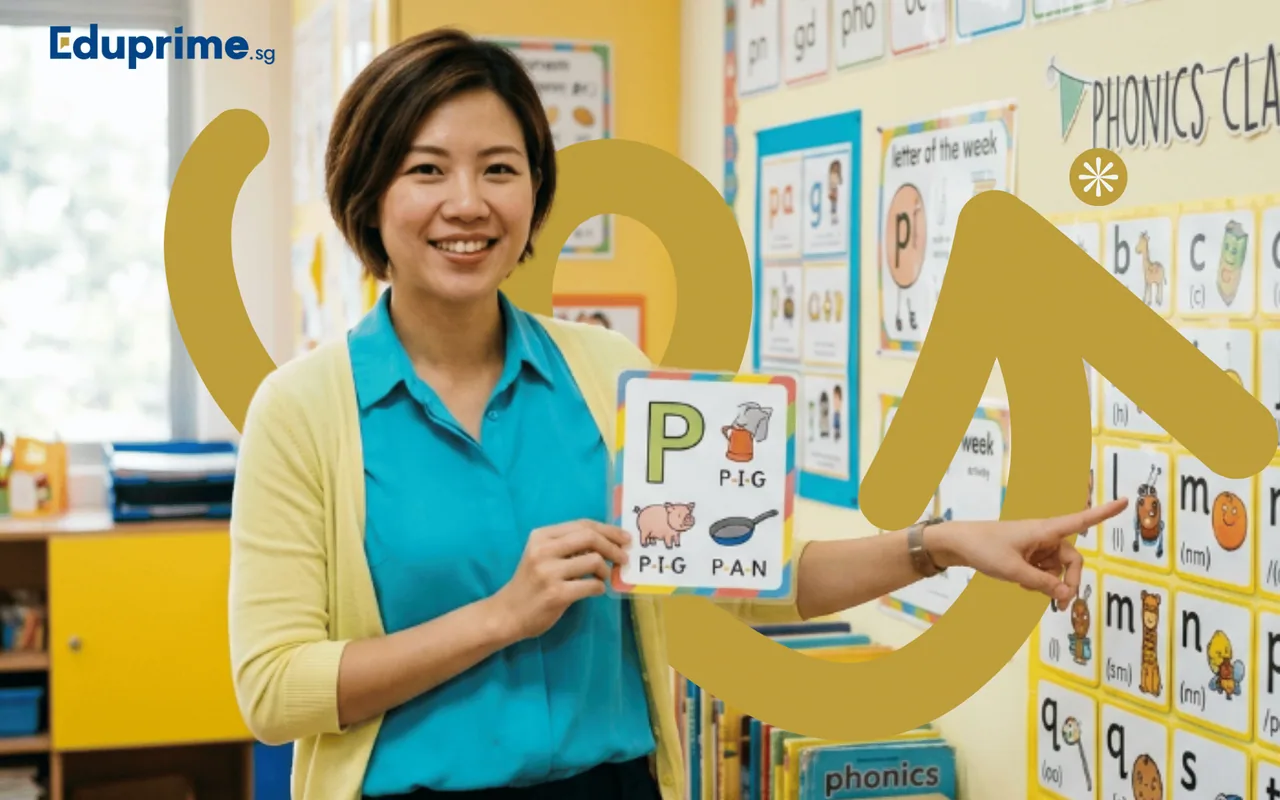
Phonics Classes Singapore for Preschool and Early Primary
Phonics classes in Singapore for N2 to Primary 2, from letter sounds to blending. Thousands of young readers started here. Home or online.