Eduprime Singapore
Life Skills Classes Singapore for Students and Working Adults
Life skills classes in Singapore at Eduprime cover eight skills: public speaking, speaking for young leaders, debate, copywriting, entrepreneurship, financial literacy, psychology and critical thinking, and customer service. Each skill is coached one to one, face to face in the learner's own home or over a video call, and the learners range from primary pupils and secondary and JC students to undergraduates and working adults.
4.7 average from 723 reviews across these programmes
What a lesson costs
Fees
What a lesson costs
Every programme is priced per 60-minute session in three formats. These are the lowest figures among the programmes on this page; each programme page shows its own.
- Widest availability
Online International Tutor
fromS$28.50/ session
60-minute session
The widest bench of tutors across time zones, so a slot is open at almost any hour. Lessons run online over a shared screen.
Online Local Tutor
fromS$48.45/ session
60-minute session
A tutor based here who knows our schools, syllabuses and exams, teaching online.
Home Tutor
fromS$57/ session
60-minute session
A local tutor who comes to the learner, at home or at a nearby study spot, matched to their town and timetable.
Minimum 4 sessions. Larger packages lower the per-session price. One-time S$15 registration fee for new learners.
Last updated
Which eight life skills can a learner train with Eduprime, and who takes them?
Eduprime runs life skills classes in eight skills, from public speaking and debate to money sense and client service, and every class is taught one to one. The learner might be a primary pupil about to lead a class project, a secondary student with an oral coming up, or a working adult stepping into a client-facing role.
Lessons in debate, copywriting or any of the other six skills run face to face in the learner's own home, with the coach picked for that town and for the slots the learner's week leaves open, or they run live over video. Our bench of more than 12,000 tutors lets each learner meet a coach who is experienced and skilled in that exact skill, so every lesson stays on the speech, pitch or money question the learner actually faces.
These eight skills are part of the 148+ programmes Eduprime teaches, and the sections below show how each skill lines up with what schools and employers in Singapore call it, which one to start with for a given goal, and how lessons, notes and payment work.
What counts as a life skill, and how do schools and employers in Singapore name it?
A life skill is a capability a learner uses outside any one exam: speaking to a room, reasoning through a choice, writing to persuade, handling money, serving a client. In Singapore, MOE groups them under its 21st Century Competencies framework, while SkillsFuture Singapore (SSG) follows which of them employers request when they advertise jobs.
MOE's page on the framework, last updated on 6 January 2026, sets six core values at its heart, namely Integrity, Care, Harmony, Respect, Responsibility and Resilience; five social-emotional competencies ring those values; and the outer ring holds three emerging competencies, which ask a learner to think in ways that are critical, adaptive and inventive, to handle communication, collaboration and information well, and to read the world with a civic, global and cross-cultural eye. Employers describe the same ground in their own words: in a November 2023 speech at the launch of SSG's Skills Demand for the Future Economy report, a Minister of State reported that Micron sees Critical Thinking, Trans-disciplinary Thinking and effective Communication as Critical Core Skills its engineers need.
The table is our own matching, since neither MOE nor SSG maps these courses: it lines up each of our eight skills with the closest school term and job-data term a learner is likely to meet.
| Skill we teach | Closest MOE 21CC or social-emotional term | Closest SSG term in 2025 job data | Page on our site |
|---|---|---|---|
| Public speaking | Communication, Collaboration and Information Skills | Staff Communication and Engagement | Public speaking course |
| Speaking for young leaders | Self-Management; Relationship Management | Leadership Development | Young leaders course |
| Debate | Critical, Adaptive and Inventive Thinking | Problem-solving and communication, named as essential | Debate classes |
| Copywriting | Communication, Collaboration and Information Skills | Effective Client Communication | Copywriting tuition |
| Entrepreneurship | Responsible Decision-Making | Business Needs Analysis; Sales Management | Business skills course |
| Financial literacy | Self-Management; Responsible Decision-Making | Led nationally by MoneySense | Financial literacy course |
| Psychology and critical thinking | Self-Awareness; Social Awareness | Decision making; self management; learning agility | Critical thinking course |
| Customer service | Social Awareness; Relationship Management | Customer Service Excellence; Customer Orientation | Customer service training |
Which life skill should I learn first for my goal?
Start with the skill your next real task demands. A learner with a school oral or a DSA interview ahead starts with speaking, one moving into sales or service starts with client communication, and one running a small shop starts with business skills.
For a pupil eyeing DSA-Sec, Debate and public speaking counts as a talent area in its own right, alongside Leadership, Languages and humanities, and the arts (visual, literary and performing). Shortlisted P6 applicants then attend interviews, auditions or trials that each school runs its own way, so the skill a pupil builds should match the talent area they apply under. Our PSLE guide explains how the exercise works.
For working adults the job data points the same way: SSG's 2025 factsheet places Effective Client Communication among the top in-demand Service Excellence skills and Leadership Development among the top people management skills.
| Goal | Skill to start with | Page to read next |
|---|---|---|
| DSA application under Debate and public speaking | Debate, or public speaking | Debate classes; public speaking course |
| Class presentations and orals in primary school | Speaking for young leaders | Young leaders course |
| First job interview | Public speaking, then critical thinking | Public speaking course |
| Client-facing role in retail, hospitality or banking | Customer service | Customer service training |
| First team-lead post | Public speaking and critical thinking | Critical thinking course |
| Running a small business | Entrepreneurship, then copywriting | Business skills course |
| Managing an allowance or a first salary | Financial literacy | Financial literacy course |
How do public speaking, young-leaders speaking and debate classes differ?
All three train a learner to speak with purpose in front of others, and they differ in audience and pressure. Public speaking builds a prepared talk for teens and adults, young-leaders speaking builds a primary pupil's confidence to lead a group, and debate trains a learner to argue a side and answer an opponent on the spot.
Public speaking suits a secondary student with an oral, an undergraduate with a seminar presentation or an adult with a pitch. The learner brings the real talk, and the tutor works on structure, voice and that first sentence which decides whether the room listens.
The young leaders course is the one built for primary pupils. It starts with small, real moments from the school day, such as introducing a group project or leading classmates through a task, so a pupil learns to stand up before they learn to persuade.
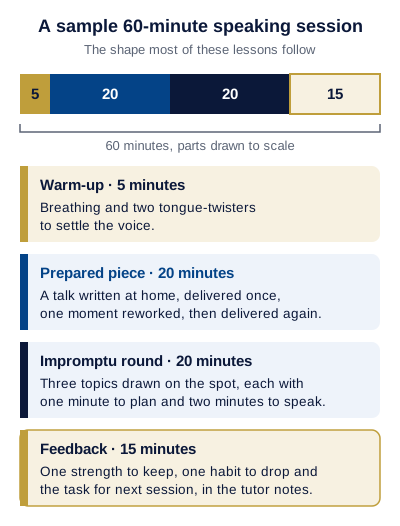
Debate adds rebuttal. The learner prepares both sides of a motion, since the side is often assigned, and practises answering points they did not see coming. DSA-Sec lists debate and public speaking together as one talent area. Here is a sample 60-minute speaking session, the shape most of these lessons follow:
- Warm-up, 5 minutes: breathing and two tongue-twisters to settle the voice.
- Prepared piece, 20 minutes: the learner delivers a talk written at home, the tutor marks one moment to rework, and the learner delivers it again.
- Impromptu round, 20 minutes: three topics drawn on the spot, one minute to plan, two minutes to speak.
- Feedback, 15 minutes: one strength to keep, one habit to drop and the task for next session, all written into the tutor notes.
Worked example
Timing the impromptu round at home
A learner wants to rehearse the impromptu round between lessons with a timer. Three topics are drawn on the spot, and each gets one minute to plan and two minutes to speak. How many minutes does the drill itself take?
- Each topic takes one minute of planning plus two minutes of speaking, so 3 minutes per topic.
- Three topics at 3 minutes each come to 9 minutes on the timer.
- Of those 9 minutes, 6 are spent speaking and 3 are spent planning.
The drill takes 9 minutes, 6 of them on their feet, so it fits inside the 20-minute impromptu round with room left over.
What does a copywriting learner practise?
A copywriting learner practises writing that makes a reader act: a headline, a product description, a sales email, a page that asks for a sign-up. Each piece is judged by one question, whether the reader would do what the writer wants.
Most copywriting learners are adults: a small-business owner writing their own shop page, a marketing executive, an undergraduate gathering samples of their work. Lessons start from the learner's own drafts. The tutor marks where a reader would stop and asks the learner to fix it, so the skill stays with the writer. SSG's 2025 data lists Effective Client Communication and Customer Orientation among the top in-demand service skills, and a clear sales email draws on both.
A typical lesson takes one live piece of work. The learner reads it aloud, the tutor asks who the reader is and what they should do next, and the learner rewrites the opening and the closing line on the spot. The rewrite goes into the tutor notes beside the original, so the learner can see the change.
School learners usually need a different kind of writing. At PSLE, a pupil has 1 hour 10 minutes in English Language Paper 1 to produce both a Situational Writing piece and a Continuous Writing piece, so pacing between the two is part of the test. That is composition, and our creative writing tuition page covers it in depth.
Financial literacy or entrepreneurship: which course fits, and from what age?
Financial literacy fits a student learning to manage their own money; entrepreneurship fits a learner who wants to sell something and run the numbers behind it. Both take students, and entrepreneurship also takes working adults and small-business owners.
Money sense has a national home in Singapore. MoneySense is the national financial education programme, on a Singapore Government agency website, and its outreach arm, the Institute for Financial Literacy, offers free and unbiased financial education to the public. Our financial literacy lessons sit beside that programme: the tutor works through a budget, a savings goal or a first payslip with the learner, one to one and at the learner's pace. Lessons give no investment advice and recommend no financial product.
A learner unsure which to choose can begin with financial literacy, since any business plan rests on the same budgeting habit, then move to entrepreneurship once there is something to sell.
| Question | Financial literacy for students | Business and entrepreneurship skills |
|---|---|---|
| Who it suits | Secondary, JC and university students handling an allowance or first part-time pay | Students with a business idea; adults running or starting a small business |
| What a learner builds | A monthly budget, a savings plan, habits for spending decisions | A business needs analysis, a pricing logic, a simple sales plan |
| Sample task | Plan a month on a fixed allowance and review it at the next session | Price a product, then pitch it in two minutes to the tutor playing the customer |
| Page to read | Financial literacy course | Business skills course |
What does a psychology and critical thinking course build?
It builds the habit of checking a claim before acting on it, and of understanding why people, the learner included, decide the way they do.
MOE places Critical, Adaptive and Inventive Thinking among its three emerging 21st century competencies, and lists Self-Awareness and Social Awareness among the social-emotional ones. A psychology and critical thinking course works across both: the learner reads an argument, names its hidden assumption, tests the evidence, then looks at the biases that made it persuasive in the first place.
The same capacities appear in SSG's study of about 37,000 work tasks across 2,000 job roles, which names decision making, self management and learning agility as enduring skills. A learner who can spot a weak argument in a news piece today is practising for the meeting where a real decision rests on the same kind of reasoning.
A typical exercise takes a short persuasive text, such as an advert or an opinion column, and asks the learner three things: what would have to be true for it to hold, what evidence is missing, and what would change their own mind. Over a few weeks the questions become a habit the learner applies without being asked, in a class discussion, a group project or a work email.
Why do customer service skills keep appearing in Singapore job postings?
Client contact is where most jobs meet the public. SSG's 2025 factsheet, built on online job posting data, lists five Service Excellence skills among those employers sought most in the past year.
Those five are Customer Service Excellence, Effective Client Communication, Customer Orientation, Customer Feedback and Relationship Management, and Customer Service Delivery. SSG also describes a role archetype it calls Human Connectors, with the Customer Service Executive as its example, where interpersonal skills are essential and relationship-building remains critical.
Our customer service training works on the moments a learner actually meets: the first greeting, a complaint that turns heated, a request that has to be refused politely, the follow-up message. The tutor plays the customer, the learner handles the exchange, and the tutor notes record what changed between attempts. It suits a student starting a part-time job as well as an adult moving into a frontline role.
Each session ends with a short script the learner keeps for their own job: an opening line, a way to acknowledge a complaint, a way to close. By the end of a package the learner has a small set of phrases they have rehearsed under pressure and adjusted to their own voice.
What does school already teach, and what do one-to-one lessons add?
Singapore schools already run character and life skills programmes, including Co-Curricular Activities, Values in Action, Social and Emotional Learning and Education and Career Guidance. One-to-one lessons add what a full class rarely gives every pupil: many repetitions of one skill, with feedback on each.
MOE's programmes page, updated 30 October 2026, lists these beside Cyber Wellness, Mental Health Education and National Education. School gives a learner the frame and a first experience. A tutor then takes one skill from that frame and practises it with the learner until it holds under pressure.
A pupil applying through DSA-Sec under Leadership, for example, may already hold a CCA post at school. One-to-one lessons then rehearse how to speak about that post clearly and honestly at the interview each school runs in its own way, while the selection itself stays with the school.
| School programme | What MOE says it does | What one-to-one practice adds |
|---|---|---|
| Co-Curricular Activities | Listed among MOE's school programmes | Extra rehearsal for a CCA debate, a speech or a leadership post |
| Values in Action | A key student development experience in schools | Help planning and presenting a VIA project to an audience |
| Social and Emotional Learning | Builds positive relationships, helps students live out values and grow character | Practice of self-management and relationship skills in situations the learner names |
| Education and Career Guidance | Resources supporting students from school to further education or work | Interview and pitch rehearsal for the next step the learner has chosen |
Which life skills matter most for working adults in Singapore now?
In SSG's 2025 job posting data, communication, client service and leadership each rank among the top in-demand skills of their own clusters, and the same factsheet names problem-solving, collaboration and communication as essential skills that complement AI.
SSG reads demand from online job postings: a skill is in demand if employers sought it in the past year, and growing if that demand rose between 2022 and 2025. Its Organisation and People Management cluster lists Staff Communication and Engagement, Leadership Development and Staff Management among the top in-demand skills, and Resilience and Self-care among the top five growth skills. Demand for AI capability more than doubled across sectors over the same period.
The human skills hold their place beside that. SSG's task study found that about 24% of key work tasks can be significantly aided by AI with today's technology, and it names decision making, self management and learning agility as the skills that endure. These are SSG findings about the job market, and they show where employer demand is heading.
For an adult, that usually points to one of three starting points: public speaking for meetings and pitches, customer service for a client-facing role, or critical thinking for a first management post. Lessons are timed around the working week, online or at home. An adult who sees Resilience and Self-care among those growth skills will find it closest to the psychology and critical thinking course, which works on self-awareness and decisions made under strain.
Should I choose one-to-one coaching or a group workshop?
Choose one to one when the learner needs to practise a specific talk, interview or client situation many times, with feedback on each attempt. A group workshop suits a first taste of a skill in company. Eduprime teaches one to one.
A group gives a ready audience, and that has value. A one-to-one tutor plays the audience on purpose: the tough interview panel, the impatient client, the opponent with a sharp rebuttal. For a learner with a fixed date ahead, that targeted repetition is what one to one is for.
| Factor | One-to-one lesson | Group workshop |
|---|---|---|
| Speaking time per learner | Most of the 60 minutes | A share of the session, split across the group |
| Feedback | On every attempt, written into the tutor notes | General points to the room, individual notes when time allows |
| Pace | Adjusted to how fast the learner improves | Set by the group plan |
| Schedule | Matched to the learner's timetable | Fixed date and venue |
| Topic choice | The learner's own oral, pitch or client case | Topics chosen for the whole group |
| Privacy | Mistakes stay between learner and tutor | Practice happens in front of others, which some learners enjoy |
How does a learner see progress in a soft skill?
Through written notes after every lesson and a fuller review each month, both measured against a real task the learner names at the start.
Soft skills feel hard to measure, so we make them concrete. At the first lesson the learner and tutor agree one or two milestones taken from the learner's own calendar, and every note after that points back to them. A learner preparing for a pitch in six weeks can read, session by session, how close the pitch is to ready.
- A written record from the coach once each lesson ends, naming the drill the learner rehearsed, one gain in delivery or argument, and the piece the learner rehearses next.
- A monthly progress report that reads the month against the agreed milestones.
- Real-task milestones such as a school oral, a DSA interview, a business pitch, a job interview or a first client call.
- The learner's own account of how the real task went, which shapes the next month's plan.
How is a life skills package priced and paid for?
The price table on this page shows one starting rate per lesson format for the whole life skills category. A learner's first package is the Starter, the smallest block we sell, holding four 60-minute lessons in which one speech, pitch or sales email can be rehearsed several times.
A debate, copywriting or money-sense package is settled in one payment, or split so that 50% falls due at the first lesson and the other 50% at the package's midpoint. First-time learners at Eduprime carry one extra item, a registration fee charged once, and its amount appears in that same price table, so the full cost of a first public speaking or business skills package is visible before the learner signs up.
A learner weighing a life skill against school tuition can read our tuition rates guide, which compares rates for private lessons in Singapore across subjects and levels. Tutor replacement carries no charge at any point in a package.
How does a learner sign up for a life skills course, and what happens next?
Signing up for a life skill starts at Register Now. Our team then talks the learner's goal through at a free first consultation, and the coaching opens with a Starter of four 60-minute lessons, face to face in the learner's home or live over video.
For a primary pupil, a parent or guardian gives consent, receives the progress notes and handles payment. A question before registering goes through Ask a question, which opens our contact form.
- Step 1: the Register Now button opens our registration form, where the learner names the skill, their current level and the real task ahead, such as a school oral, an interview or a sales role.
- Step 2: at a free first consultation our team agrees the goal with the learner (or with a parent or guardian, if the learner is still in primary school), along with the town where lessons will happen and the weekly slots that suit.
- Step 3: we pick a coach who is experienced and skilled in that exact discipline. The match comes from the consultation, before any profiles are shown.
- Step 4: the first lesson starts, either face to face in the learner's home with a tutor chosen to suit that town and weekly schedule, or over video. The tutor brings the lesson plan, worksheets and practice tasks.
- Step 5: once each lesson ends the coach sends a short written note, and every month a progress report measures the distance left between the learner and the real task.
What should a life skills learner be able to see and verify along the way?
Four things: how the match was made, what each lesson covered, how the month went, and the right to a new tutor at no cost.
Each coach is experienced and skilled at the particular skill they teach, whether that is debate, sales writing or client service. With more than 12,000 tutors on our bench, we keep re-matching until learner and coach work well together.
The first consultation is with our team, so the learner explains the goal once to the people who run the matching, and the match follows from that conversation.
- How the match was made: the consultation notes the skill, the goal, the learner's town and free hours, and the coach is picked to fit every one of them.
- A written note after each lesson, so a learner rehearsing a pitch or an oral knows what the hour covered and what to practise before the next one.
- A monthly progress report that reads the month against the milestones agreed at the start.
- A new tutor at no cost whenever the learner asks, at any point in a package and as often as needed.
Which page covers my life skill in depth?
Each skill has its own page with the full course detail; this hub is the map that points to them.
Use the list to jump straight to the skill, the school subject or the guide that fits the goal.
- Public speaking course singapore: prepared talks, orals, pitches and presentations for teens and adults.
- Public speaking for young leaders course singapore: first speeches and group leadership for primary pupils.
- Debate classes singapore: motions, rebuttal and persuasive communication.
- Copywriting tuition singapore: headlines, product pages and sales emails from the learner's own drafts.
- Business entrepreneurship skills course singapore: needs analysis, pricing and a first sales plan.
- Financial literacy for students course singapore: budgets, savings goals and spending decisions.
- Psychology critical thinking course singapore: assumptions, evidence and bias.
- Customer service training singapore: greetings, complaints and follow-up for frontline roles.
- Speech and drama classes singapore: voice and performance on stage.
- Creative writing tuition singapore: school composition and story writing.
- Economics tuition singapore: economics as an exam subject.
- Digital marketing seo mastery singapore: search and online marketing skills.
- Psle guide singapore: how PSLE and DSA-Sec work.
- Tuition rates singapore: how private lesson fees compare.
Pick the skill, then go deeper
This hub maps the skills; each course page carries the full detail. Speaking goals go to the public speaking course, or to the young leaders course for a primary pupil, and an argument to win goes to debate classes. Writing that sells goes to copywriting tuition, and school composition goes to creative writing tuition.
Money and business questions go to the financial literacy and entrepreneurship courses, economics as a school subject goes to economics tuition, and online marketing goes to the digital marketing course. Thinking skills, client service and stage performance each have their own page. For DSA-Sec basics, read the PSLE guide; for fees across subjects, read the tuition rates guide. Ready to begin? Register Now opens the registration form.
- public speaking course singapore
- public speaking for young leaders course singapore
- debate classes singapore
- copywriting tuition singapore
- business entrepreneurship skills course singapore
- financial literacy for students course singapore
- psychology critical thinking course singapore
- customer service training singapore
- speech and drama classes singapore
- creative writing tuition singapore
- economics tuition singapore
- digital marketing seo mastery singapore
- psle guide singapore
- tuition rates singapore
- dsa sec guide
Sources
- MOE, 21st Century Competencies (updated 06 Jan 2026)
- MOE, Our programmes (updated 30 Oct 2026)
- MOE, Direct School Admission for Secondary Schools (updated 23 Oct 2026)
- SkillsFuture Singapore, Factsheet 2: Top Skills Trends in 2025
- MOE speech, launch of the Skills Demand for the Future Economy report (17 Nov 2023)
- MoneySense, Singapore's national financial education programme
- SEAB, media replies (17 July 2026)
Skills for speaking up, writing well and leading
 4.6from S$33/session
Business & Entrepreneurship Singapore: Skills Coaching for Students and Founders
Business and entrepreneurship coaching in Singapore for students and founders: validation, canvas, finance, pitch decks.
 4.8from S$33/session
Copywriting Tuition Singapore with Working Copywriters
Copywriting tuition Singapore for students, career switchers and SME owners: headlines, PAS, AIDA, web, ads, email.
 4.9from S$33/session
Customer Service Training Singapore for Frontline Staff and Small Teams
Customer service training in Singapore for frontline teams: complaints, calls, service recovery. Thousands trained. In person or online.
 4.8from S$33/session
Debate Classes in Singapore: WSDC, Asian Parliamentary & School Orals
Debate classes in Singapore for secondary and JC students and adults: one-to-one debate coaching in WSDC and Asian Parliamentary, plus orals, home or online.
 4.8from S$28.50/session
Financial Literacy for Students Singapore: Money Habits for Life
Financial literacy for students in Singapore, P4 to JC: budgets, saving, scam defence. Chosen by thousands of students. Home or online.
 4.7from S$33/session
Psychology & Critical Thinking Course Singapore for JC, IB and University Students
Psychology & critical thinking course in Singapore for JC, IB and uni students: bias, evidence, GP essays. Thousands taught. Home or online.
- 4.6from S$28.50/session
Public Speaking Course Singapore for Students and Adults
Public speaking course Singapore for students and adults: orals, DSA interviews and pitches. Stage-tested coaches. Home or online 1-to-1.
 4.8from S$28.50/session
Public Speaking for Young Leaders Singapore: Prefects and CCA Captains
Public speaking for young leaders in Singapore: prefects and CCA captains for assembly, panels and DSA. Scenario coaches, home or online.