IELTS Test Singapore: Formats, Band Scores and How to Book the Right Test
The IELTS test in Singapore comes in two main versions: Academic for university study and professional registration, and General Training for migration, work or study below degree level. Listening and Speaking are the same in both. Each section earns a band from 0 to 9 and the overall band is their rounded mean. Since end June 2026 the British Council and IDP offer these tests on computer in Singapore, with IELTS Life Skills staying on paper, and computer results arrive in 1 to 5 days.
Which IELTS test should a candidate in Singapore book?
Book IELTS Academic for a university place or professional registration, IELTS General Training for migration to Australia, Canada, New Zealand or the UK and for work or training below degree level, and IELTS for UKVI when a UK visa application names it. IELTS for UKVI Life Skills tests Speaking and Listening only.
The test name on the booking decides which organisations will read the score. The safest order of work is to open the exact page of the university, employer or visa route first, copy the test name it gives, and only then book.
For a Singapore university, the IELTS directory entry for the National University of Singapore lists IELTS Academic, and General Training does not appear in that entry. A candidate aiming at NUS therefore books Academic. UK Visas and Immigration accepts IELTS for UKVI as its Secure English Language Test, and that test now runs only in a fully digital format.
| Goal | Test to book | What to check first |
|---|---|---|
| Degree study at a Singapore university | IELTS Academic | NUS lists Academic in the IELTS directory, with indicative bands |
| Degree or postgraduate study overseas | IELTS Academic | The admissions page of each university |
| UK visa: Skilled Worker, Student, Health and Care Worker, Family extension, British citizenship | IELTS for UKVI | The visa route; the test is digital only |
| Migration to Australia, Canada, New Zealand or the UK | IELTS General Training | The band the immigration authority asks for |
| Work experience, training or study below degree level | IELTS General Training | The employer or course provider |
| Professional registration | IELTS Academic | The test the registering body names |
| Proof of Speaking and Listening only | IELTS for UKVI Life Skills | Two skills tested, no Reading or Writing |
How do IELTS Academic and General Training differ?
Listening and Speaking are identical in both versions, and Reading and Writing differ. Academic Reading runs to as many as 2,750 words and Academic Writing Task 1 describes a graph, chart, table or diagram; General Training Reading runs to 2,375 words of everyday and workplace texts and its Task 1 is a letter.
That split shapes preparation. A candidate who changes version late keeps all the Listening and Speaking work and retrains two things: the reading diet and the first writing task. Academic Writing Task 1 asks for a description of a graph, chart, table, or a diagram of an object, process or event. General Training Writing Task 1 asks for a letter in a personal, semi-formal or formal style, and choosing the right register is part of the task.
Task 2 looks alike on both versions: an essay of at least 250 words in about 40 minutes. It carries twice the weight of Task 1 in either version, which makes Task 2 the single task most worth practising whichever version the learner books.
| Section | IELTS Academic | IELTS General Training |
|---|---|---|
| Listening | About 30 minutes, 4 parts, 40 questions | The same test |
| Reading | 60 minutes, 3 sections, 2,150 to 2,750 words, 40 questions | 60 minutes, 3 sections of rising difficulty, 2,150 to 2,375 words, 40 questions |
| Writing Task 1 | At least 150 words in about 20 minutes: describe a graph, chart, table or diagram | At least 150 words in about 20 minutes: a letter |
| Writing Task 2 | At least 250 words in about 40 minutes: an essay | At least 250 words in about 40 minutes: a discursive essay |
| Speaking | 11 to 14 minutes, face to face, three parts | The same test |
What is in the IELTS Listening test?
IELTS Listening takes about 30 minutes and holds 40 questions in four parts of ten questions each. Every correct answer earns one mark, and the raw score out of 40 is converted to a band.
The paper is the same for Academic and General Training, so every candidate in Singapore meets the same Listening format, answered on screen on IELTS on Computer. The owner sorts the questions into six types. Practising type by type shows quickly which format costs marks, whether that is following a map label by label or catching a number in a form.
Raw marks put the job in plain numbers. On the owner's approximate table, band 6 sits at around 23 correct answers and band 7 at around 30, with small shifts between test versions. Seven more correct answers separate the two bands, just under two per part.
- Multiple choice
- Matching
- Plan, map or diagram labelling
- Form, note, table or flow-chart completion
- Sentence completion
- Short-answer questions
What is in the IELTS Reading test?
IELTS Reading lasts 60 minutes and holds 40 one-mark questions in three sections in both versions. Academic Reading totals 2,150 to 2,750 words; General Training Reading totals 2,150 to 2,375 words, built from notices, workplace texts and one long general-interest text.
General Training Reading opens with everyday material such as notices, advertisements and timetables. Section 2 carries two texts about work, and Section 3 is one long text of general interest. The difficulty climbs with the order, so minutes saved on Section 1 are the minutes Section 3 needs.
Academic Reading uses 11 question types. Two of them, True/False/Not given and Yes/No/Not given, ask the candidate to decide whether the passage supports a statement, contradicts it, or says nothing on it at all. The third answer is the one that takes discipline, because it asks the reader to stop at what the text states and add nothing from general knowledge.
The scale is set per version. On the owner's approximate tables, Academic Reading needs about 30 correct answers for band 7, and General Training Reading needs about 35 for the same band. A candidate comparing practice scores across the two versions reads each score against its own column.
| Version | Sections | Total words | Questions |
|---|---|---|---|
| Academic | 3 | 2,150 to 2,750 | 40, one mark each |
| General Training | 3, rising in difficulty | 2,150 to 2,375 | 40, one mark each |
What do IELTS Writing Task 1 and Task 2 ask for?
IELTS Writing gives 60 minutes for two tasks. Task 1 needs at least 150 words in about 20 minutes, Task 2 needs at least 250 words in about 40 minutes, and Task 2 counts twice as much as Task 1 in the Writing band.
The weighting decides how the hour is spent. Because Task 2 counts double, ten extra minutes polishing Task 1 are paid for in the task that matters more. The suggested split of 20 and 40 minutes follows the weighting, and holding to it in timed practice is the first habit worth building.
Both tasks are marked on four equally weighted criteria: Task achievement for Task 1 or Task response for Task 2, Coherence and cohesion, Lexical resource, and Grammatical range and accuracy. The word counts are minimums, so a script is planned to reach at least 150 and 250 words inside the suggested 20 and 40 minutes.
On IELTS on Computer, both Writing tasks are typed. Learners who wrote every school essay by hand gain from drafting on a keyboard under the clock, since cutting and moving sentences on screen changes how a paragraph is built.
| Task | Version | Minimum words | Suggested minutes | What it asks |
|---|---|---|---|---|
| Task 1 | Academic | 150 | About 20 | Describe a graph, chart, table, or a diagram of an object, process or event |
| Task 1 | General Training | 150 | About 20 | A letter in a personal, semi-formal or formal style |
| Task 2 | Academic | 250 | About 40 | An essay that proposes a solution, gives an opinion, compares or evaluates |
| Task 2 | General Training | 250 | About 40 | A discursive essay |
How does the IELTS Speaking test run?
IELTS Speaking is a recorded face-to-face interview with an examiner, lasting 11 to 14 minutes in three parts. It is the same test for Academic and General Training candidates.
On IELTS on Computer, Speaking stays face to face with a human examiner. It usually takes place on the same day as Listening, Reading and Writing, before or after them, and some centres schedule it up to seven days either side. A candidate confirms the Speaking slot at booking and plans the week around both dates.
Four criteria carry equal weight: Fluency and coherence, Lexical resource, Grammatical range and accuracy, and Pronunciation. Each part calls on them in its own way. Part 2 rewards using the single minute of preparation to plan an answer that fills about two minutes, and Part 3 asks the candidate to hold a longer two-way discussion that builds on the Part 2 topic.
- Part 1, interview, 4 to 5 minutes: general questions on familiar topics such as home, family, work, studies or interests.
- Part 2, long turn, 3 to 4 minutes: one minute to prepare, then about two minutes of speaking alone on one topic.
- Part 3, discussion, 4 to 5 minutes: a longer two-way exchange with the examiner that builds on Part 2.
How is the IELTS band score calculated?
IELTS reports bands on a scale from 0 to 9, and Listening and Reading scores are reported in whole and half bands. The overall band is the mean of the four section bands, rounded to the nearest half band: a mean ending in .25 rounds up to the next half band, and a mean ending in .75 rounds up to the next whole band.
Listening and Reading bands come from raw scores out of 40. Writing and Speaking bands come from examiners applying four equally weighted criteria to each. So the overall band moves in two ways: more correct answers in the two receptive skills, and stronger evidence against named criteria in the two productive ones.
A receiving organisation may set a minimum for each section as well as an overall band, so the full request is read before any plan is drawn. The NUS entry in the IELTS directory gives indicative overall bands of 6.5 for undergraduate and 6.0 for postgraduate admissions, and directs candidates to NUS for the exact requirement. Lessons aimed at those criteria are described on our IELTS preparation tuition page.
| Band | Descriptor |
|---|---|
| 9 | Expert |
| 8 | Very good |
| 7 | Good |
| 6 | Competent |
| 5 | Modest |
| 4 | Limited |
| 3 | Extremely limited |
| 2 | Intermittent |
| 1 | Non-user |
| 0 | Did not attempt the test |
Worked example
Overall band for one set of section scores
A candidate scores 7.0 in Listening, 6.5 in Reading, 6.0 in Writing and 6.0 in Speaking. What overall band does the Test Report Form show?
- Add the four section bands: 7.0 + 6.5 + 6.0 + 6.0 = 25.5.
- Divide by four: 25.5 / 4 = 6.375.
- Find the two nearest half bands: 6.375 sits 0.375 above 6.0 and 0.125 below 6.5.
- Round to the nearer one, which is 6.5.
The overall band is 6.5, even though two of the four sections sit at 6.0.
How does IELTS band rounding work on a real set of scores?
Add the four section bands, divide by four, then apply the half-band rule. The IELTS owner publishes three cases, traced here step by step, followed by one raw-mark conversion.
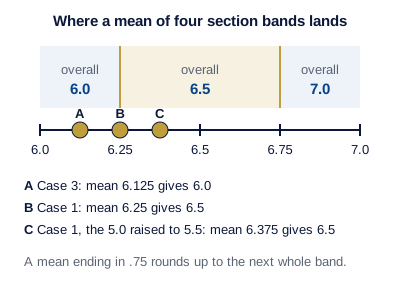
Case 1 carries the practical lesson. One section at 5.0 pulls the mean to 6.25, and the rounding rule lifts it to 6.5. Raising that 5.0 to 5.5 gives a sum of 25.5 and a mean of 6.375, which still rounds to 6.5, so the overall band holds. Where an organisation sets a per-section minimum, that 5.0 is the score that decides the application.
Case 3 sits on the other edge. A mean of 6.125 rounds down to 6.0, so a candidate asked for 6.5 overall needs one more half band somewhere. Raising the 5.5 to 6.0 gives 25.0 and a mean of 6.25, which rounds up to 6.5.
- Case 1: 6.5 + 6.5 + 5.0 + 7.0 = 25.0. Divided by 4, the mean is 6.25. A mean ending in .25 rounds up to the next half band, so the overall band is 6.5.
- Case 2: 4.0 + 3.5 + 4.0 + 4.0 = 15.5. Divided by 4, the mean is 3.875. The nearest half band is 4.0, so the overall band is 4.0.
- Case 3: 6.5 + 6.5 + 5.5 + 6.0 = 24.5. Divided by 4, the mean is 6.125. The nearest half band is 6.0, so the overall band is 6.0.
- Listening: 30 correct answers out of 40 sit at about band 7 on the owner's approximate table, and 23 sit at about band 6.
How many correct answers give IELTS band 6, 7 or 8?
On the owner's approximate tables, Listening needs about 23 correct answers out of 40 for band 6, 30 for band 7 and 35 for band 8, and Academic Reading needs the same counts. General Training Reading asks for more: about 30 for band 6 and 35 for band 7.
The owner calls these figures approximate because they vary slightly from one test version to another. They are still precise enough to plan with. A learner scoring 27 out of 40 in timed Listening practice sits between band 6 and band 7, three correct answers short of the band 7 line.
The General Training column needs the most care. The 30 correct answers that sit at band 7 in Academic Reading sit at band 6 in General Training Reading, so every practice score is read against the column of the version actually booked.
| Band | Listening | Academic Reading | General Training Reading |
|---|---|---|---|
| 4 | Not in the owner's sample | Not in the owner's sample | About 15 |
| 5 | About 16 | About 15 | About 23 |
| 6 | About 23 | About 23 | About 30 |
| 7 | About 30 | About 30 | About 35 |
| 8 | About 35 | About 35 | Not in the owner's sample |
Is IELTS on paper or on computer in Singapore now?
On computer, with one exception. From end June 2026 the British Council and IDP no longer offer IELTS on paper in Singapore, so IELTS Academic, General Training and IELTS for UKVI are booked as computer-delivered tests, and IELTS Life Skills continues on paper.
The change is global. The IELTS owner announced that paper-based IELTS ends from mid-2026 and every test moves to computer, with timelines that vary by market. The owner also keeps a handwritten Writing on Paper option in selected markets, so a candidate reads the booking page of the chosen centre to see which Writing format is offered.
On IELTS on Computer, Listening, Reading and Writing are answered on screen, and Speaking stays face to face with an examiner. For most candidates the real shift lies in Writing: drafting, trimming and checking a 250-word essay at a keyboard is its own skill, and practice works best when it matches the format of the day.
- Moved to computer: IELTS Academic, IELTS General Training and IELTS for UKVI.
- Fully digital: IELTS for UKVI, the Secure English Language Test of UK Visas and Immigration.
- Still on paper in Singapore: IELTS Life Skills.
- Unchanged: results from earlier paper tests, valid to the end of the recommended two-year period.
- Continuing: access arrangements such as large print, braille and lip reading.
How fast do IELTS results come and how long are they used?
IELTS on Computer results arrive in 1 to 5 days, typically after one day, and the Test Report Form is mailed 3 to 5 days after the test. The IELTS owner recommends that results are considered valid for two years.
Fast results change how a booking is timed. A candidate with an application deadline can sit later in the cycle and still hold a score in time. A sound plan also leaves room for a One Skill Retake after the first result, which adds 3 to 5 days for the new score.
Two years is the owner's recommendation, and each receiving organisation states how recent a result it accepts. A score taken this year for a university application next year sits well inside that window, while a result kept for a migration plan several years away may need a fresh sitting.
After a One Skill Retake the candidate holds two Test Report Forms. The second shows the retaken skill marked as a retake, the other three original scores, the updated overall band and the original test date, and both forms stay valid.
What is IELTS One Skill Retake and who can use it?
One Skill Retake lets a candidate resit one skill of a complete IELTS Academic or General Training test, whether Listening, Reading, Writing or Speaking, once, in the 60 days after the original test.
The retake is a repair tool, and it works best on a known gap. A candidate whose overall band meets the request while Writing sits half a band under a per-section minimum can resit Writing alone and keep the other three scores.
It works as a second chance at one skill, so the preparation still has to happen. One retake, one window of 60 days and one skill mean the second attempt carries the same demands as the first, with less time to meet them. Organisations also choose whether to accept retake results, so the candidate reads the university, employer or authority page before relying on one.
In Singapore, both test centres listed by the official partner IDP offer One Skill Retake.
- One retake per original test.
- The original test was IELTS on Computer at a centre that offers the retake; IELTS Online tests are excluded.
- The retake result arrives in 3 to 5 days.
- Both Test Report Forms stay valid, and the second carries the updated overall band.
- Receiving organisations opt in, so acceptance is checked before booking.
Worked example
Does a Writing retake lift the overall band?
Say an organisation asks for 6.5 overall with no section below 6.0. A candidate holds Listening 7.0, Reading 7.0, Writing 5.5 and Speaking 6.5, then retakes Writing within 60 days and scores 6.5. What does the second Test Report Form show?
- First form: 7.0 + 7.0 + 5.5 + 6.5 = 26.0, and 26.0 / 4 = 6.5, so the overall band already meets 6.5.
- The Writing band of 5.5 sits under the 6.0 section minimum, so the first form falls short on Writing alone.
- Second form: the three original scores stay, and Writing shows 6.5 marked as a retake.
- New sum: 7.0 + 7.0 + 6.5 + 6.5 = 27.0, and 27.0 / 4 = 6.75.
- A mean ending in .75 rounds up to the next whole band, so the updated overall band is 7.0.
The second form shows Writing 6.5 as a retake and an overall band of 7.0, and it meets both conditions, provided the organisation accepts retake results.
Where and how is the IELTS test taken in Singapore?
IELTS in Singapore is offered by the British Council and IDP, both official IELTS test partners. IDP lists two test centres, its own IDP IELTS Test Centre at Raffles Place and a second centre on Middle Road, and IELTS on Computer sessions run throughout the week.
Book in a fixed order. Confirm the test type the receiving organisation names, then pick a date that leaves room for results and, if the plan includes one, a retake before the deadline. Keep the Test Report Form details to hand for every application that asks for them.
- Tests offered: IELTS Academic, IELTS General Training, IELTS for UKVI, One Skill Retake and IELTS Life Skills.
- Centres listed by IDP: Raffles Place and Middle Road, both offering One Skill Retake; British Council venues are shown on its own booking pages.
- Schedule: computer-delivered sessions throughout the week.
- Speaking: the same day as the other parts, before or after them, or up to seven days either side at some centres.
- Fees and dates: shown on each partner's booking pages at the time of booking.
How long should IELTS preparation take for a given band gap?
The length follows the gap, measured skill by skill from a timed practice result. A gap counted in correct answers in Listening or Reading is a short, countable job; a gap in Writing or Speaking takes longer, because those bands move through four criteria each.
Read the weeks as an order of work, stretched or shortened to fit the gap. A learner seven correct answers short in Listening has a counted target. A learner half a band short in Writing has four criteria to move, and the plan takes them one at a time.
What decides the band is the evidence on test day: correct answers in Listening and Reading, and performance against the criteria in Writing and Speaking. The plan gives practice time to each of those four, in proportion to its gap.
- Week 1: one timed practice of each skill; Listening and Reading converted with the approximate tables, Writing and Speaking read against the four criteria.
- Weeks 2 to 4: Writing Task 2 first, since it counts double, with one timed essay a week reviewed criterion by criterion.
- Weeks 2 to 4, alongside: Listening and Reading by question type, aimed at the raw-mark line for the target band.
- Weeks 5 and 6: Speaking Part 3 discussion and Part 2 one-minute planning, recorded and reviewed.
- Final week: full timed tests on screen, and the booking date checked against the 60-day retake window.
How are Eduprime IELTS lessons arranged and paid for?
Eduprime prepares IELTS candidates one to one, online or at the candidate's own home, with the tutor matched to the candidate's town and timetable. A Starter package opens with four IELTS lessons of 60 minutes each, and the engine table on our IELTS preparation tuition page prints its price.
A candidate settles the Starter package either at once or in two equal parts, half when the IELTS lessons begin and half at the package midpoint. Anyone joining us for the first time also carries a one-time registration fee, which that same engine table prints. The first consultation costs nothing: our team asks whether the candidate sits Academic or General Training and which of the four skills needs most work, then pairs a tutor with those answers. Should the pairing stop suiting the preparation, we change the IELTS tutor free of charge at any point in the package, however many lessons have already run.
IELTS practice worksheets and the plan for each lesson are part of the package, and a lesson can be moved or cancelled free with 24 hours' notice. A candidate who already knows which test to sit registers for tuition; one still weighing Academic against General Training asks our team a question first.
How does an IELTS candidate see whether the band is rising?
Tutor notes close every IELTS lesson and a progress report arrives each month, so the candidate can lay each Listening and Reading raw score and each marked Writing script beside the band an organisation asks for.
The surest check is the learner's own numbers: Listening and Reading raw scores counted against the owner's tables, and Writing scripts read against the four criteria. The monthly progress report puts those numbers in front of the learner.
- Tutor notes after every session.
- A monthly progress report.
- IELTS tutors who are experienced and skilled in English test preparation, chosen from more than 12,000 tutors.
- A change of IELTS tutor at no charge whenever the candidate asks, at any stage of the package.
- Raw marks out of 40 in Listening and Reading, which make progress countable from week to week.
Where should an IELTS candidate go next?
For lessons that close the gap between a practice band and the band an organisation asks for, often in Writing Task 2 and Speaking Part 3, go to IELTS preparation tuition in Singapore. A candidate whose employer asks for a workplace English test reads the TOEIC preparation page, and one heading for an overseas undergraduate place may also need SAT preparation.
Postgraduate applicants facing an admissions test go to GMAT preparation. Once admitted, university tuition in Singapore supports the modules themselves, and the public speaking course builds the confidence that Speaking Part 3 rewards. Every other test we coach candidates for, from workplace English to admissions exams, sits on the test prep hub.
Sources
- IELTS: test types (read 10 Nov 2026)
- IELTS: Academic Writing format (read 10 Nov 2026)
- IELTS: Academic Listening format (read 10 Nov 2026)
- IELTS: Academic Reading format (read 10 Nov 2026)
- IELTS: Academic Speaking format (read 10 Nov 2026)
- IELTS: General Training Writing format (read 10 Nov 2026)
- IELTS: General Training Reading format (read 10 Nov 2026)
- IELTS: scoring in detail (read 10 Nov 2026)
- IELTS: updates to IELTS test delivery, March 2026 (read 10 Nov 2026)
- IELTS for organisations: One Skill Retake (read 10 Nov 2026)
- IDP IELTS Singapore: computer-based IELTS (read 10 Nov 2026)
- IDP IELTS Singapore: test dates and centres (read 10 Nov 2026)
- IELTS receiving organisations: National University of Singapore (read 10 Nov 2026)
One-to-one lessons with Eduprime
At home in Singapore or online. The first consultation is free, and a tutor can be changed whenever the learner asks.