Eduprime Singapore
Test Preparation Singapore: Choose Your Test and Plan Your Prep
Test preparation in Singapore with Eduprime spans eight exams, from IELTS and TOEIC to the SAT, ACT, GRE, GMAT, JLPT and AEIS, each prepared with one tutor at home or online. Each test has its own owner, score scale and rules, so the first step is matching the test to the goal: a university degree, a graduate programme, a job, a Japanese level or a place in a mainstream school.
4.8 average from 1,019 reviews across these programmes
What a lesson costs
Fees
What a lesson costs
Every programme is priced per 60-minute session in three formats. These are the lowest figures among the programmes on this page; each programme page shows its own.
- Widest availability
Online International Tutor
fromS$28.50/ session
60-minute session
The widest bench of tutors across time zones, so a slot is open at almost any hour. Lessons run online over a shared screen.
Online Local Tutor
fromS$48.45/ session
60-minute session
A tutor based here who knows our schools, syllabuses and exams, teaching online.
Home Tutor
fromS$57/ session
60-minute session
A local tutor who comes to the learner, at home or at a nearby study spot, matched to their town and timetable.
Minimum 4 sessions. Larger packages lower the per-session price. One-time S$15 registration fee for new learners.
Last updated
What does test preparation in Singapore cover at Eduprime?
Test preparation in Singapore at Eduprime covers eight tests: IELTS and TOEIC for English, JLPT for Japanese, SAT and ACT for undergraduate admission, GMAT and GRE for graduate study, and AEIS for international students entering a mainstream school. Whichever score a learner is chasing, from an IELTS band to an AEIS placement, a single tutor works on it with that learner alone, either at their own desk at home or across a video call.
Each of these tests answers a different question about the learner. IELTS Academic tells a university or a professional body, with doctors and nurses among the examples its owner gives, whether the learner's English is ready. JLPT places Japanese ability on five levels, from N5 up to N1, while AEIS decides which primary or secondary level an international student enters for the following academic year.
So we keep the preparation as personal as the test itself. The tutor we pair with the learner is skilled in that exam and experienced in teaching it, spends the lessons on the sections where the learner's marks are thinnest, and is chosen from more than 12,000 tutors whose teaching spans upwards of 148 programmes. The sections below help the learner choose a test, read its scores and plan the weeks before test day.
Which test should I take for my goal?
The goal picks the test, and the organisation receiving the score names it: universities and professional bodies usually ask for IELTS Academic, graduate programmes for GRE or GMAT, and Singapore's mainstream schools admit international students through AEIS.
Start with the admissions or registration page of the place the learner is applying to, write down the test and the score it names, and book only after that. Two learners with the same English can need different tests. One applying for a degree sits IELTS Academic; one moving to an English-speaking country sits IELTS General Training. Their Listening and Speaking papers are identical, and only Reading and Writing differ.
The table below lines the goals up against the tests that usually answer them, who owns each test, and where our own pages go further.
| Goal | Test usually asked for | Who sets the test | Where we go deeper |
|---|---|---|---|
| Undergraduate or postgraduate study in English; professional registration | IELTS Academic | IELTS | IELTS preparation tuition page |
| Migration to an English-speaking country; training or study below degree level | IELTS General Training | IELTS | IELTS preparation tuition page |
| An English score where the employer or school names TOEIC | TOEIC Listening and Reading | TOEIC programme | TOEIC preparation tuition page |
| Undergraduate admission where the university asks for SAT or ACT | SAT or ACT | College Board; ACT | SAT and ACT preparation pages |
| Graduate, business and law programmes; scholarships and fellowships | GRE General Test, or GMAT where the programme names it | ETS; GMAC | GRE and GMAT preparation pages |
| A recognised level of Japanese ability | JLPT, N5 to N1 | JLPT; The Japanese Cultural Society, Singapore is the local host | JLPT preparation page |
| Entry to a Singapore mainstream primary or secondary school as an international student | AEIS or S-AEIS | Ministry of Education, Singapore | AEIS preparation tuition page |
IELTS or TOEIC: which English test do I need?
The organisation reading the score decides, so the learner checks its page first. IELTS tests all four skills and is the usual ask for study, professional registration and migration, while TOEIC Listening and Reading tests two skills in a two-hour, 200-question paper.
The practical difference shows up in preparation. An IELTS learner trains speaking and writing as well as reading and listening, and those two productive skills improve fastest with one-to-one feedback on the learner's own scripts and answers. A TOEIC Listening and Reading learner works on pace: 100 reading questions in 75 minutes leave well under a minute per question, and the tutor's job is accuracy at that speed.
| Point | IELTS (Academic and General Training) | TOEIC Listening and Reading |
|---|---|---|
| Skills tested | Listening, Reading, Writing and Speaking; Listening and Speaking identical in both versions | Listening (100 questions) and Reading (100 questions) |
| Length | Listening about 30 minutes, Reading 60, Writing 60, Speaking 11 to 14; Academic 2 hours 45 minutes in total | Two hours: Listening about 45 minutes, Reading 75 minutes |
| Score | A band from 0 to 9 for each section; overall band is the average of the four, rounded to the nearest half band | Scaled score from 10 to 990 |
| Pass mark | None; the receiving organisation sets the band it needs | None; there is no pass or fail |
| Where it is taken | Academic: at a test centre or remotely online, in the same format; General Training: at a test centre | As listed on the test owner's booking page |
SAT or ACT for a student in a Singapore school?
The university decides first: a student in a Singapore school checks which of the two each university on the list accepts, and where both are open, picks the test whose pace and balance suit them.
The balance differs. Maths makes up 44 of the SAT's 98 questions, close to half, while the ACT builds its Composite from three scored sections, English, Math and Reading, so maths is one part in three. Delivery differs too: the SAT is digital and adaptive, with the first module setting the difficulty of the second, while the ACT keeps Science and Writing optional and outside the Composite. A student strong in Secondary or JC maths often leans towards the SAT; a learner who likes one fixed paper may prefer the ACT. Working through official material from both owners settles it.
| Point | SAT | ACT |
|---|---|---|
| Scored sections | Reading and Writing; Math | English; Math; Reading |
| Questions and time | Reading and Writing 54 questions in 64 minutes; Math 44 questions in 70 minutes; 10-minute break | English, Math and Reading, each its own section |
| Delivery | Digital and adaptive by module: the first module sets the difficulty of the second | Three scored sections at a fixed length |
| Optional parts | Two sections only | Science and Writing; neither counts toward the Composite |
| Score | 400 to 1600 total; each section 200 to 800 | Composite from 1 to 36 |
GMAT or GRE for business school or a master's?
The programme's admissions page decides. ETS describes the GRE General Test as used for graduate, business and other professional programmes such as law, and for scholarships and fellowships, so a learner applying to a mix of programmes often finds the GRE covers all of them.
The GRE General Test is short and predictable in shape. Analytical Writing always comes first, and the whole test runs 1 hour 58 minutes. It is offered continuously, at test centres in 160 countries or at home, and ETS reports scores as good for five years, which helps a learner who sits it now and applies in a later cycle.
GMAT is set by GMAC, and a business school that wants it says so on its admissions page. Its format and score scale have changed across editions, so a learner reads the current version on GMAC's own site before planning, and our GMAT preparation page takes that planning further.
The GRE sections, as ETS sets them out:
- Analytical Writing: one essay task, 30 minutes, always first.
- Quantitative Reasoning: two parts, 12 questions in 21 minutes and 15 questions in 26 minutes.
- Verbal Reasoning: two parts, 12 questions in 18 minutes and 15 questions in 23 minutes.
- Total: 1 hour 58 minutes, sat at a centre or at home.
Which JLPT level should I sit, and when is it held in Singapore?
Aim for the highest JLPT level where the total and every section can clear their pass marks, because Singapore offers two sittings a year, in July and December, and The Japanese Cultural Society, Singapore hosts both.
Every level is scored from 0 to 180, and the learner must clear the overall pass mark and each section's own pass mark. One section below its line fails the level, even when the total is comfortable. N3 asks for 95 overall, a higher bar than N2 or N4, so a learner moving up from N4 trains for the step deliberately.
The levels, easiest first:
- N5: some basic Japanese, common kana and simple kanji, key details from short, slow conversations; pass mark 80. Vocabulary 20 minutes, Grammar and Reading 40, Listening 30.
- N4: overall pass mark 90.
- N3: overall pass mark 95.
- N2: overall pass mark 90.
- N1: Japanese across a broad range of circumstances, complex and abstract texts, speech at natural speed; pass mark 100. Language Knowledge and Reading 110 minutes, Listening 55.
Worked example
Reading a JLPT N3 result
A learner sits N3 and scores 110 out of 180 in total. One section falls below its own pass mark. Is N3 passed?
- Check the overall pass mark for N3: 95 out of 180.
- Compare the total: 110 clears 95.
- Check every section against its own pass mark: one section sits below its line.
- Apply the rule: one section below its line fails the level, even when the total is comfortable.
N3 is failed at this sitting, so the next plan lifts that one section before the July or December sitting.
How is AEIS different from the other tests?
AEIS is an admission exercise run by Singapore's Ministry of Education. It decides entry to Primary 2 to 5 or Secondary 1 to 3 for the following academic year, and it tests topics taught in mainstream schools.
Every other test on this page produces a score that a learner carries to a university, employer or other organisation. AEIS works the other way round: an international student sits it in Singapore to enter Singapore's own schools. AEIS-Primary tests Mathematics only. Before applying, a primary candidate needs a minimum Cambridge English Qualifications score, which MOE shows in its eligibility checker. AEIS-Secondary tests English and Mathematics.
The exercise typically starts in July, and the 2026 test ran in September in Singapore. A learner who misses it has S-AEIS, set by MOE for the end of February or early March 2027 (tentative), with the same subjects: Mathematics at primary level, English and Mathematics at secondary.
Preparation therefore follows the mainstream syllabus of the level the learner is entering. Our AEIS preparation page covers that path, and once the learner is in school, English tuition and maths tuition keep the new routine steady.
What do the scores mean across tests?
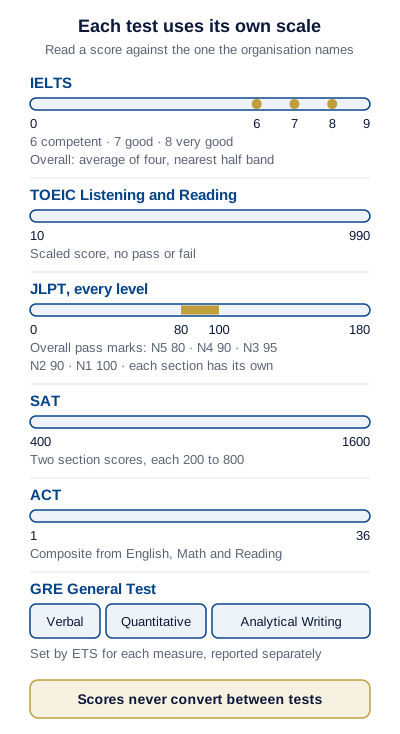
Each test uses its own scale, so scores never convert from one test to another. A learner reads each one against the score the receiving organisation names.
Two habits help. First, note how the overall score is built: an IELTS overall band is an average, so one weak section can be lifted by strong ones, while JLPT fails a level if any single section falls short. Second, note how long the result is used, so the test date fits the application date: IELTS recommends two years after the test, with some organisations accepting older results, and ETS counts GRE scores as good for five years.
The diagram draws each scale on its own line, so a learner sees why a score is read only against its own test.
| Test | Scale | How it is reported |
|---|---|---|
| IELTS | Bands 0 to 9 (6 competent, 7 good, 8 very good) | A band per section; overall is the average, rounded to the nearest half band |
| TOEIC Listening and Reading | 10 to 990 | Scaled score, no pass or fail |
| JLPT | 0 to 180 at every level | Pass or fail by level, with overall and sectional pass marks |
| SAT | 400 to 1600 | Two section scores, each 200 to 800 |
| ACT | 1 to 36 | Composite from English, Math and Reading; Science and Writing sit outside the Composite |
| GRE General Test | Set by ETS for each measure | Verbal, Quantitative and Analytical Writing reported separately |
Worked example
Working out an IELTS overall band
A learner's IELTS report reads Listening 6, Reading 7, Writing 6.5 and Speaking 6. The receiving organisation names an overall band of 6.5. Does the learner meet it?
- Add the four section bands: 6 + 7 + 6.5 + 6 = 25.5.
- Divide by four for the average: 25.5 / 4 = 6.375.
- Round to the nearest half band: 6.375 sits closer to 6.5 than to 6, so the overall band is 6.5.
- The Reading band of 7 lifts the two sections at 6, which is how an average works.
The overall band is 6.5, which meets the 6.5 the organisation names.
How long does a learner need to prepare?
The time depends on four things: the gap between the learner's current score and the target, the test date, how many sections need work, and how many hours a week the learner can give.
The gap comes first. A learner whose latest IELTS report sits half a band below the target in one skill needs a narrower plan than one a full band short in three. The test date comes next, and on this page it bites hardest for JLPT, held in Singapore in July and December, and AEIS, whose 2026 test ran in September. Missing a sitting adds months.
Sections matter because of how tests are scored. A JLPT candidate with one weak section must lift that section even with a strong total; an IELTS candidate can lean on the average. Weekly hours are the last lever. Our packages run in blocks of four 60-minute sessions, so the learner and tutor agree how many sessions a week fit the timetable, and each tutor note shows whether the pace is enough.
How is a one-to-one prep plan built?
The plan starts from the learner's own recent score report or official practice material, finds the section that moves the overall score most, and spends the first four sessions there.
Here is a worked example with IELTS Academic. A learner's offer asks for an overall band of 7. The latest report reads Listening 7, Reading 7.5, Writing 5.5 and Speaking 6.5. The average is 6.625, which rounds to the nearest half band, 6.5. If Writing rises one band to 6.5, the average becomes 6.875 and rounds to 7. Writing is where the plan goes.
For a learner whose Writing must climb a band inside a 60-minute paper, the four Starter lessons could be spent this way:
- Session 1: the tutor reads the learner's own recent scripts and names the three errors that cost the most.
- Session 2: planning and paragraph structure, timed against the 60-minute limit.
- Session 3: a Speaking run-through of 11 to 14 minutes, since 6.5 sits close to the line there too.
- Session 4: a full Writing paper written at home under time and marked together in the lesson.
- After the Starter: tutor notes from every session and the monthly progress report set the next package.
Should prep lessons be at home or online?
Both work for every test on this page. For lessons at home, we pair the learner with a tutor near their town who fits their weekly hours, and online lessons fit anyone who will sit the real exam at a screen or from home.
A sensible rule is to rehearse in the setting of test day. IELTS Academic can be taken at a test centre or remotely online in the same format, General Training is taken at a test centre, and the GRE General Test can be sat at home, so a learner taking either from home gains from online lessons on a similar setup.
| Format | Suits | Tests often prepared this way | What the learner prepares |
|---|---|---|---|
| At home in Singapore | Learners who focus best at their own desk with paper scripts | IELTS at a centre; JLPT; AEIS and S-AEIS | A quiet table, stationery and the official materials for the test |
| Online | Busy timetables and learners sitting a test on screen or at home | IELTS Academic online; GRE at home; the digital SAT | A computer with camera and microphone, a steady connection and a quiet room |
Who prepares for tests with us?
Learners at every stage, from primary-age international students entering a mainstream school to working professionals applying to graduate school.
What they share is a fixed target set by someone else. The tutor's job is to read that target precisely and work back from it, whatever the learner's stage.
- Secondary and JC students applying to universities that ask for SAT, ACT or IELTS Academic.
- Undergraduates heading to postgraduate study who need IELTS Academic or the GRE General Test.
- Working professionals preparing for GRE or GMAT for business, law or other graduate programmes, or for TOEIC where an employer names it.
- Doctors, nurses and other professionals who need IELTS Academic for professional registration.
- Adults moving to an English-speaking country who sit IELTS General Training.
- Learners of Japanese working through JLPT from N5 towards N1.
- International students entering Primary 2 to 5 or Secondary 1 to 3 through AEIS or S-AEIS.
What does exam prep with a tutor cost, and how are the fees settled?
The price table on this page shows one row for the whole test-prep category: the starting rate per lesson for each lesson format. Our tuition rates guide explains how tuition prices are set across subjects.
Exam prep opens with the Starter: four lessons, each an hour long, which matches the IELTS Writing plan mapped out earlier on this page. It is settled in one payment, or in two halves, the first at the start and the second at the midpoint of the package. Learners new to Eduprime also pay a registration fee once, and the price table prints that amount too. Every worksheet and lesson plan the tutor builds for the exam is part of the package.
Two things sit outside our fees. Official test fees and test bookings are paid by the learner directly to the test owner, whether that is IELTS, College Board, ETS or another. The first consultation, booked through either form, costs nothing, and neither does moving to a different tutor, which the learner may request at any stage of exam prep with no cap on sessions.
What happens between registering and the first exam lesson?
Once the form is in, our team spends a first consultation on the learner's target score and test date; we then choose a tutor who knows that particular exam, someone close to the learner's town whose free hours fit theirs if lessons are at home, and the Starter gets under way.
Registration is the start, and anyone can do it for the learner: the learner, a parent, an employer or a sponsor. The steps from there:
- Register Now on our registration form, naming the test, the target score and the test date if it is booked.
- Set out the target score and test date with our team in an opening consultation that costs nothing.
- We pick a tutor seasoned in that exam, looking near the learner's town and within their week for home lessons, or setting the lessons up online.
- Four 60-minute Starter lessons open the prep, working from the learner's latest score report or the test owner's practice papers.
- Every lesson ends with the tutor recording which question types moved and which still cost marks, and a report each month sets those notes against the target score.
- For anything before registering, Ask a question through our contact form.
How does a learner see whether the score is moving?
Every lesson leaves a written record, so the learner can see progress against the target score without waiting for test day.
Test prep has a hard deadline, which makes visible progress worth more than in ordinary tuition. These are the checks built into every package:
- Notes from the tutor after each lesson, naming the skill covered, the mistakes still costing marks and the next step.
- A progress report each month that measures the work against the target band or score and the booked test date.
- Timed work under the test's own section lengths, so pace shows up in the notes.
- A change of tutor whenever the learner asks, at no charge and with no cap on sessions.
- Matching by our team after the first consultation, by test, town and timetable.
Which page covers my test in depth?
Each test has its own preparation page, and this hub sends the learner to it once the test is chosen.
This hub compares the tests at decision depth. Section strategy, worked papers and per-test planning live on the pages below, each named by the search its learners use.
- IELTS Academic or General Training: IELTS preparation tuition Singapore.
- TOEIC Listening and Reading: TOEIC preparation tuition Singapore.
- JLPT, N5 to N1: JLPT preparation Singapore.
- Learning Japanese from the beginning, without a test date: Japanese course Singapore.
- SAT: SAT preparation tuition Singapore.
- ACT: ACT preparation course Singapore.
- GMAT: GMAT preparation tuition Singapore.
- GRE General Test: GRE preparation tuition Singapore.
- AEIS and S-AEIS: AEIS preparation tuition Singapore.
- School English after entering a mainstream school: English tuition Singapore.
- School maths after entering a mainstream school: math tuition Singapore.
- How tuition is priced: tuition rates Singapore.
What do learners ask before starting test prep?
Four questions come up most often, and each has a short answer from the test owner's own pages.
Each answer below comes from the organisation that runs the test.
- How long is an IELTS result used? The recommended period is two years after the test, and some organisations accept results for longer.
- Can I sit the test at home? IELTS Academic can be taken remotely online in the same format as at a centre, while General Training is sat at a test centre, and the GRE General Test can be sat at home.
- When is JLPT held in Singapore? Twice a year, in July and December, with The Japanese Cultural Society, Singapore as the local host.
- Does AEIS-Primary test English? The primary test covers Mathematics; English is met before applying, through a minimum Cambridge English Qualifications score shown in MOE's checker.
- How long are GRE scores good for? Five years, according to ETS.
Pick your test, then go to its page
Once the goal points to one test, its own page carries the format, the strategy and the lesson plan for that test. The learner can Register Now from any of them, or Ask a question first.
Learners entering a mainstream school through AEIS often continue with school English and maths, and anyone comparing prices can read the tuition rates guide.
- ielts preparation tuition singapore
- toeic preparation tuition singapore
- jlpt preparation singapore
- act preparation course singapore
- sat preparation tuition singapore
- gmat preparation tuition singapore
- gre preparation tuition singapore
- aeis preparation tuition singapore
- japanese course singapore
- english tuition singapore
- math tuition singapore
- tuition rates singapore
- ielts test guide
- aeis exam guide
Sources
- IELTS Academic test page, IELTS
- IELTS scoring in detail, IELTS
- IELTS General Training test page, IELTS
- TOEIC Listening and Reading, IIBC (TOEIC programme operator, Japan)
- JLPT level summary
- JLPT test sections and times
- JLPT results and pass marks
- JLPT overseas test cities
- SAT structure, College Board
- SAT score report help, College Board
- ACT test enhancements, ACT
- GRE General Test at a glance, ETS
- AEIS overview, Ministry of Education Singapore
- AEIS test details, Ministry of Education Singapore
- AEIS eligibility criteria, Ministry of Education Singapore
- S-AEIS test details, Ministry of Education Singapore

Focused prep for SAT, IELTS, AEIS and other entrance tests
 4.8
ACT Preparation Course Singapore for US University Applicants
ACT preparation course in Singapore for US university applicants: composite, pacing and Writing. Chosen by thousands of students.
- 4.9
IELTS Preparation Tuition Singapore with Band-Targeted Coaching
IELTS preparation tuition in Singapore for Academic and General Training, aimed at university, PR or UKVI. Trusted by thousands.
 4.8
JLPT Preparation Singapore from N5 to N1
JLPT preparation in Singapore for N5 to N1: vocabulary, grammar, reading and listening. Loved by thousands. 1-to-1 home or online.
 4.7
TOEIC Preparation Tuition Singapore for Working Professionals
TOEIC preparation tuition in Singapore for professionals chasing a set L&R or S&W score. Thousands of lessons taught. 1-to-1 online or home.
 4.8
AEIS Preparation Tuition Singapore for International Students
AEIS preparation tuition in Singapore for international students seeking an MOE mainstream place: English and Maths. Trusted by thousands.
 4.8
GMAT Preparation Tuition Singapore for MBA Applicants
GMAT preparation tuition Singapore for MBA applicants: Quant, Verbal, Data Insights. Thousands of lessons taught.
 4.6
GRE Preparation Tuition Singapore for Graduate and Scholarship Applicants
GRE preparation tuition Singapore for graduate and scholarship applicants, 1h58m format. Chosen by thousands.
 4.8
SAT Preparation Tuition Singapore for US University Admission
SAT preparation tuition Singapore for US and international university applicants. Chosen by thousands of college-bound students, 1-to-1 home or online.