Retrieval practice: how to use active recall to remember what you revise
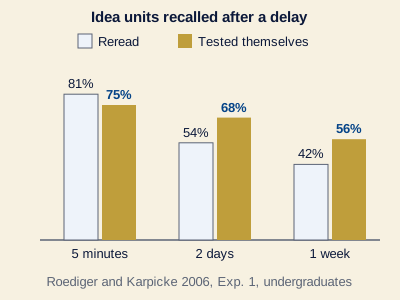
Retrieval practice is the habit of pulling what you have learned out of memory, with the book closed, and only then checking it against the source. A 2013 review of study techniques rated it high utility. In a 2006 experiment, university undergraduates reread one passage and tested themselves on another; a week later the same students recalled 56% of the tested passage against 42% of the reread one. Below is how to run it.
What is retrieval practice, and is it the same as active recall?
Retrieval practice means recalling material from memory without the source open, then checking what you produced against that source. Active recall is the everyday name for the same move, and researchers call the benefit it produces the testing effect.
The recall can take three shapes. Free recall is a blank page where you write everything you remember about a topic, the move many students call blurting or a brain dump. Cued recall gives you a prompt, such as one side of a flashcard or a question stem, and asks for the rest. Practice questions ask you to use what you remember to answer something new. All three count, because in each one memory does the work before the answer comes into view.
The check afterwards belongs to the technique. Recall that is never compared with the source can leave an error sitting quietly in place, so the second half of every round is opening the notes, marking what you got right and correcting what you missed.
In 2013, Dunlosky, Rawson, Marsh, Nathan and Willingham reviewed common study techniques and gave practice testing a high utility rating. Their reasons were that it benefits learners of different ages and abilities, and that it lifts performance across many kinds of test and in real educational settings. Rereading and highlighting, the two habits most students lean on, were rated low, and the review names practice testing in place of rereading as its example of a better use of the same time.
How do I run one retrieval practice session step by step?
Choose one topic, close every source, write or say all you can remember, check it against your notes, then answer questions on the parts you missed. Keep the missed items coming back until each one is right more than once.
The six steps below fit a single sitting. The 2013 review found the strongest results when items were practised until they were answered correctly more than once, both within a session and across sessions, with longer gaps between the sessions.
A sitting of 25 to 30 minutes is a sensible size for one secondary-school topic. That figure is our working rule, since no study sets a fixed duration. When the same topic should come round for its next recall sitting is a calendar decision, and the spaced revision timetable guide sets those gaps out week by week.
- Pick the topic. Take one syllabus topic or one chapter, small enough to cover in a sitting. A whole subject at once turns recall into guessing.
- Close the sources. Notes, textbook and phone go out of reach, so that whatever lands on the page comes from memory alone.
- Recall onto a blank page. Write every definition, formula, step and example you can, in any order, for a few minutes. Leave the gaps visible, because they tell you where to work.
- Check against the source. Open the notes and mark each point as correct, partly correct or missing. Write corrections in a second colour so the misses stand out.
- Answer questions on the misses. Turn each missed or half-right point into a question, answer it from memory, then check again. The 2013 review describes the advantage of testing with feedback over restudy as extremely robust.
- Log what returns. Every missed item goes on a short return list for the next session, and it stays there until you have answered it correctly twice.
What does one retrieval session look like on a real SEC Physics topic?
Here is one session for a Sec 3 or Sec 4 learner heading for SEC G3 Physics, syllabus K323, on two of its topics: Pressure, and the Turning Effect of Forces. It moves from a blank page, to the syllabus wording, to multiple choice in the style of Paper 1.
The topics were chosen with the paper in mind. From 2027, G3 Physics (K323) keeps the papers, weights and recall objectives of 6091, the O-Level Physics syllabus last sat in 2026. Knowledge with Understanding carries approximately 45% of the marks in Papers 1 and 2, and approximately 15% is allocated to recall. Knowledge questions use the command words define, state, name, describe, explain and outline, which is exactly what a blank page trains. Paper 1 holds 40 compulsory multiple-choice items in one hour, worth 40 marks and 30% of the subject.
The whole session runs about 25 to 30 minutes, our own planning figure. Its value shows up in the next one. The items that return are the ones most likely to cost marks, and they now sit on a short, named list. When the same learner later works through structured questions for Paper 2, worth 50%, the definitions are already in memory and the time can go into applying them.
| Step | What the learner does | What gets checked | Syllabus link |
|---|---|---|---|
| 1. Blank page on Pressure | Writes the definition of pressure, its unit and the formula linking force and area, with no notes open | Each line against the notes; anything missing or loosely worded is marked | Recall objective: define pressure in terms of force and area |
| 2. State the principle | States the principle of moments for a body in equilibrium from memory | The wording compared with the syllabus statement, phrase by phrase | Recall objective: state the principle of moments |
| 3. Multiple choice | Answers 10 items in Paper 1 style on the two topics | Each item marked, with the reason every wrong option fails written beside it | Paper 1 (K323): 40 multiple-choice items, 30% of the subject |
| 4. Return list | Copies every missed item onto the list for the next session | An item leaves the list only after two correct answers | Practice until correct more than once |
Is rereading your notes effective, and why does it feel like it works?
Rereading helps on a test a few minutes later and fades quickly after that. In a 2006 study, the students who had reread the most were the most confident about next week, and a week later they recalled the least.
Roediger and Karpicke showed this in 2006 with 180 university undergraduates. One group studied a prose passage four times. Another studied it once and then took three recall tests. The repeat readers went through the passage about 14.2 times on average, the tested group about 3.4 times. Five minutes after the last round, the readers recalled the most, 83% against 71%. One week later the order had flipped: 61% for the tested group and 40% for the readers.
Before the final test, each group rated how much it expected to remember a week later, on a 1 to 7 scale. The four-times readers were the most confident, with a mean of 4.8, against 4.2 and 4.0 for the two groups that had tested themselves. The group that went on to remember least expected to remember most.
A 2008 study by Karpicke and Roediger, also with university students, found the same blind spot. Students in four different study conditions all predicted roughly 50% recall, and their predictions were uncorrelated with what they actually recalled. The 2013 review rated rereading and highlighting low on its own grounds: these techniques do not consistently boost students' performance. Taken together, the safer guide to what you know is what you can write down with the page closed, since that is what an exam asks for.
What did the retrieval practice studies measure, and with which students?
The classic experiments tested university undergraduates on prose passages, word pairs and science texts, then measured what they remembered days or a week later. In each one, the learners who retrieved remembered more once time had passed.
Two details matter here. These participants were adults at university, so the figures describe memory in that group; the reviews in the next section bring in school pupils. The second detail is the forgetting gap. In Experiment 2 the authors compared the groups tested after five minutes with the groups tested a week later. Measured that way, recall fell by 52% in the four-readings condition, 28% with three readings and one test, and 14% with one reading and three tests. In Experiment 1, a passage the students had tested themselves on, with no feedback, was recalled at one week about as well as a reread passage after two days.
| Study | Who took part | What they compared | Result after the delay |
|---|---|---|---|
| Roediger and Karpicke 2006, Experiment 1 | 120 Washington University undergraduates aged 18 to 24, each rereading one TOEFL prose passage and testing on another; 30 idea units per passage | A second 7-minute reading against a 7-minute free-recall test with no feedback | After 5 minutes: reread 81%, tested 75%. After 2 days: tested 68%, reread 54%. After 1 week: tested 56%, reread 42% |
| Roediger and Karpicke 2006, Experiment 2 | 180 undergraduates | Four study periods, three studies plus one test, or one study plus three tests | After 1 week: one study plus three tests 61%, three studies plus one test 56%, four studies 40% |
| Karpicke and Roediger 2008 | University students learning 40 Swahili-English word pairs such as mashua-boat | Keeping pairs in testing after the first correct recall against dropping them | After 1 week: about 80% with continued retrieval; 36% and 33% where pairs were dropped |
| Karpicke and Blunt 2011 | Undergraduates reading science texts | Retrieval practice against elaborative studying with concept mapping | More learning from retrieval, including on comprehension and inference questions and on a final test of building a concept map |
Does retrieval practice work for primary, secondary and older learners?
Yes. A 2017 meta-analysis by Adesope, Trevisan and Sundararajan pooled studies with learners of mixed ages and found that practice tests helped at every school level, with the largest effect in secondary school.
The meta-analysis reports each result as g, the gap between the tested and comparison groups measured in standard deviations, so a larger g means a larger advantage for testing.
A 2021 systematic review by Agarwal, Nunes and Blunt looked only at schools and classrooms: 50 classroom experiments coded, 49 effect sizes and 5,374 learners in total. Of those effect sizes, 57% showed medium or large benefits, across education levels, content areas and test delays. The authors also flag a limit worth knowing. Only 6% of the experiments ran in non-WEIRD countries, the label for settings outside Western, educated, industrialised, rich and democratic societies, so the classrooms behind these numbers are mostly Western ones.
- All practice tests against no testing: g = 0.61, or 0.70 under a random-effects model
- Practice tests against restudying the same material: g = 0.51
- Primary school learners: g = 0.64
- Secondary school learners: g = 0.83
- Postsecondary learners: g = 0.60
- Classroom studies g = 0.67, laboratory studies g = 0.62
Which format should I use: flashcards, a blank page or practice questions?
Use the format that matches what the paper asks. A blank page suits define and state questions, flashcards suit single facts and terms, and practice questions suit applying what you know. Mixed formats gave g = 0.80 in the 2017 meta-analysis.
Do apps and online quizzes help? The studies on this page measured the act of retrieval itself. So an app or quiz counts as retrieval practice when it asks you to produce or choose an answer before showing one. Flipping a card before trying to recall skips the step the studies measured, so try first and flip second.
On feedback, the 2017 meta-analysis found nearly the same effect with it (g = 0.63) as without it (g = 0.60), and the 2013 review notes that when practice-test accuracy is low, testing alone can do no better than restudy. On format, Rowland 2014 found recall tests gave larger benefits than recognition tests such as multiple choice, while Adesope and colleagues still found g = 0.70 for multiple choice. One plan fits both: recall onto a blank page first, then use multiple choice for the finer distinctions.
| Format | What it trains | Best for which syllabus demand | Evidence note |
|---|---|---|---|
| Blank page (free recall, blurting) | Producing a whole topic from nothing, in your own order | Define, state, describe and outline questions; Paper 2 structured answers | Recall tests gave larger benefits than recognition tests (Rowland 2014 meta-analysis) |
| Flashcards (cued recall) | One prompt, one answer: terms, units, definitions, vocabulary | Name and state items; formulae and units | Keep each card in play until it is right twice (2013 review) |
| Multiple choice | Recognising the right option and rejecting the wrong ones | G3 Physics Paper 1 (K323): 40 items in one hour | g = 0.70 for multiple-choice practice tests (Adesope et al. 2017, mixed ages) |
| Structured practice questions | Using recalled knowledge to answer a new problem | G3 Physics Paper 2 (K323): structured and free response, 1 h 45 min, 50% | Closest to the real task; check each answer against a mark scheme or your notes |
| Mixed formats | Two or more of the above in one session | A full topic before a school test | g = 0.80, significantly above free-recall, cued-recall and short-answer tests (Adesope et al. 2017) |
How often should I test myself on the same item?
Keep testing an item until you have answered it correctly more than once, in the same session and again in later sessions. Retiring an item after one correct answer is a shortcut the research measured, and it costs a great deal.
Karpicke and Roediger tested this directly in 2008 with university students learning 40 Swahili-English word pairs. In some conditions, a pair kept being tested after the student first recalled it correctly. In others, it was dropped from testing. One week later, students recalled about 80% of the pairs in the conditions that kept testing, and 36% and 33% in the conditions that dropped them.
The same study checked the opposite habit as well. Once a pair had been recalled correctly, studying it again had no measurable effect on recall a week later. In that study, the gain came from continued retrieval of pairs the student already knew: about 80% recall a week later, against about a third.
The 2013 review turns this into a working dose: practise until each item is answered correctly more than once, within a session and across sessions, with longer intervals between sessions. The gap in days between those sessions belongs to our spaced revision timetable guide.
Worked example
Applying the correct-twice rule to a return list
On Monday a learner recalls eight Physics items, among them the definition of pressure, and gets five right. On Thursday all eight are recalled again: the definition of pressure is missed, and the other seven are right. Which items still need recalling at the next session?
- Monday: the three misses have zero correct recalls, and the five correct items have one each. All eight are recalled again on Thursday.
- One correct recall is too few to retire an item: in the 2008 word-pair study, items dropped after one success fell to about a third a week later.
- Thursday: four of Monday's five correct items are right again. With two correct recalls each, they are retired.
- The definition of pressure, right on Monday and missed on Thursday, goes on the return list with its count reset to zero.
- Monday's three misses were right on Thursday, so each has one correct recall and stays for the next session.
Four items still need recalling and go on the return list: the definition of pressure and the three items first recalled correctly on Thursday. The other four are retired after two correct recalls.
When does retrieval practice fail, and what if I cannot recall anything?
Retrieval practice falls short in a handful of situations: almost nothing comes back and no feedback follows, the final test comes only minutes after study, items are dropped after one success, or your own confidence is used as the guide. Each one has a fix.
If you blank out on a whole topic, shrink the unit. Recall three definitions in place of a chapter, check them, and build up from there. An empty page is useful information about what to study next.
- Blanking with no feedback. The 2013 review notes that when accuracy on a practice test is relatively low, restudy can match testing alone. The fix is feedback: check every attempt, and when a page stays blank, reread the section once, close it and try again.
- A test in five minutes. In the 2006 Roediger and Karpicke experiment with undergraduates and prose passages, rereading beat testing on a final test five minutes after study, 81% against 75%. Retrieval pulled ahead at two days and one week, so the early edge for rereading was gone within two days.
- Dropping items too early. Among the university students in the 2008 word-pair study, retiring an item after one correct recall cut recall a week later to 33 to 36%, against about 80% for items kept in testing.
- Trusting the feeling. In the same 2008 study, students' predictions of their own recall were uncorrelated with how much they actually recalled. A written return list is the better guide.
- Learning styles. A 2008 review by Pashler, McDaniel, Rohrer and Bjork found no adequate evidence base to justify learning-styles assessment in general educational practice.
How do I use retrieval practice for maths, science and languages?
The move is the same in every subject: recall first, check second. What you recall changes, with science leaning on definitions and command words, maths on methods and formulae, and languages on words and phrases recalled from a prompt.
Mixing problem types from several topics in one sitting is a related technique with its own guide, interleaved practice. On this page each session stays on one topic, which keeps the recall clean and the checking quick.
- Science. Recall definitions in the syllabus wording, because define and state questions reward the exact wording. In G3 Physics (K323), for example, write the definition of gravitational field strength g as gravitational force per unit mass, then check it word for word. The 2011 study by Karpicke and Blunt used science texts with undergraduates and found retrieval produced more learning than concept mapping, even on inference questions.
- Maths. Before solving, write the method from memory: the steps for that type of problem, the formula and the conditions under which it applies. Then attempt the question and compare your method with the worked solution. Recalling the method first turns a page of exercises into retrieval.
- Languages. Use cued recall. One side of the card shows the word, phrase or sentence frame, and the other holds the meaning or the target form. The 2008 word-pair study, with Swahili-English pairs such as mashua-boat, is the model, including its rule of keeping each pair in play after the first correct answer.
How does retrieval practice change from primary school to JC in Singapore?
The younger the learner, the shorter and more supported the recall. A primary pupil recalls a few items aloud or on paper with an adult checking, while a JC student runs recall alone on definitions, derivations and method steps before attempting full questions.
Secondary learners who sit their national papers from 2027 onwards earn a single Secondary Education Certificate, which combines and renames the GCE N(T), N(A) and O-Level, with every subject taken at G1, G2 or G3. The 2026 sitting was the last O-Level. Retrieval practice carries straight over, because it trains recall itself; each subject's syllabus sits on SEAB's own pages, and our O-Level guide covers what the SEC changes.
| Level | What to recall | Session length | Who checks |
|---|---|---|---|
| Primary | A few items at a time: a spelling, a number fact, a science term, spoken or written | Brief, a handful of items | An adult: a tutor, a teacher or someone at home |
| Lower secondary (Sec 1 to 2) | One topic on a blank page, then key terms on cards | One topic per sitting | The learner against the notes, with a tutor or teacher checking wording |
| Upper secondary (Sec 3 to 5, SEC G1, G2 or G3 from 2027) | Blank-page recall of one topic, then define and state questions, then past-paper multiple choice | About 25 to 30 minutes for one or two topics | The learner against syllabus wording and mark schemes; a tutor or teacher can check the misses |
| JC | Definitions, derivations and method steps, recalled before full questions | One topic block before a question set | Mostly self-run; a tutor checks method and reasoning |
Where does retrieval practice fit in the Singapore school year?
Where a school sets weighted assessments during the term, each one makes a natural checkpoint for a return list. By 2023 MOE had removed mid-year examinations from all primary and secondary levels, and said in its 2022 announcement that school assessments may include termly weighted assessments, alongside the end-of-year examinations.
Dropping those papers freed roughly three weeks of teaching time at each level, according to MOE's own estimate. Each school sets its own assessment plan, so the practical first step is to find out from the school which topics each assessment this year covers. Those topics then go on the return list in the weeks before it, and a short recall session a few times a week keeps them moving. Our weighted assessments guide explains how the system works.
Four terms make up the local school calendar, with short holidays in March and September, a June vacation, and the year-end break starting late in November. The 2026 sitting was the last GCE O-Level, with its components spread from June to November. From 2027, SEAB's SEC timetable places the non-written papers before the written ones, with English and Mother Tongue Language written papers in September and the other written papers from October. A June vacation return list built from the first two terms lets a learner enter that season with the gaps already named.
Every student in the national school system can also use MOE's Student Learning Space, which holds curriculum-aligned resources in major subjects from primary to pre-university. It is one more source of material to recall from and check against.
How can Eduprime lessons support a learner's retrieval practice, and how does a learner register?
A learner can bring the return list to one-to-one lessons with a tutor experienced in the subject, and the tutor writes notes after every session, with a monthly progress report on top. Before any lesson, a learner's first consultation with our team costs nothing.
Lessons run with one tutor and one learner, either online or at home, and a home lesson is arranged around where the learner lives and when the learner is free. Teaching materials such as worksheets, question sets and lesson plans are part of the service. Between lessons the learner runs the short sessions described on this page and keeps the return list up to date, and can bring it to the next lesson.
A learner holding a first return list can bring it straight to us: the Register Now button leads to registration, while Ask a question leads to our contact form for anything unclear.
- Consultation. Either form opens with a consultation, and that first conversation with our team is free. Tutor profiles are not chosen before registering, because our team does the matching.
- Matching. Whether the return list is full of Physics definitions or Chinese vocabulary, the tutor we choose is experienced and skilled in that subject; for home lessons we pick a tutor who can reach the learner's town at times that fit the learner's week, and online lessons suit learners who prefer them.
- Starter package. The first package, Starter, covers four 60-minute sessions. First-time learners also settle a one-time registration fee, charged only at that first enrolment.
- Payment and changes. A package is settled in one sum, or as two halves: 50% when it begins and 50% halfway through. A lesson can be moved or cancelled free with 24 hours' notice.
- Cost. Each tuition page shows the current figures in its own price table.
What records show a learner that the return list is shrinking?
Progress is written down. The tutor leaves notes at the end of each session, and a progress report arrives once a month; a learner who keeps a return list can set it beside those records and see which items still come back.
The return list stays the learner's own record of retrieval: the items that kept coming back, the ones that cleared after two correct answers, and the topics planned next. The tutor notes and the monthly report give the learner, and whoever registered or pays for the lessons, a written account of each month's lessons.
- Return list: the learner adds each missed item and crosses it off after two correct recalls, then compares the list with the tutor's notes from the same weeks.
- Tutor changes: the learner can ask for a different tutor whenever they want and as many times as they want, and each replacement is free.
- Tutors: the consultation tells our team what the learner must recall, and the tutor matched afterwards is experienced and skilled in that subject.
- Scale: once recall habits settle in one subject, 148+ programmes stay open to continue into, taught by a pool of more than 12,000 tutors.
Which page answers my next question?
For how the last O-Level was set and graded, and what the SEC brings from 2027, read our O-Level guide. Spacing recall sittings across the weeks has its own page, the spaced revision timetable guide. Mixing problem types inside one sitting is the work of the interleaved practice guide. How school assessments and the year-end examination fit together is set out in the weighted assessments guide.
For lessons, secondary school tuition in Singapore covers every subject at this stage, and the O-Level physics tuition, physics tuition, science tuition and O-Level tuition pages go deeper into the subject this page used for its worked example.
Sources
- Dunlosky et al. (2013), PSPI
- Roediger, Karpicke (2006). Test-Enhanced Learning: Taking Memory Tests Improves Long-Term Retention. Psychological Science 17(3), 249-255
- Karpicke, Roediger (2008). The Critical Importance of Retrieval for Learning. Science 319(5865), 966-968
- Karpicke, Blunt (2011). Retrieval Practice Produces More Learning than Elaborative Studying with Concept Mapping. Science 331(6018), 772-775
- Adesope, Trevisan, Sundararajan (2017). Rethinking the Use of Tests: A Meta-Analysis of Practice Testing. Review of Educational Research 87(3), 659-701
- Rowland (2014). The Effect of Testing Versus Restudy on Retention: A Meta-Analytic Review of the Testing Effect. Psychological Bulletin 140(6), 1432-1463
- Agarwal, Nunes, Blunt (2021). Retrieval Practice Consistently Benefits Student Learning: a Systematic Review of Applied Research in Schools and Classrooms. Educational Psychology Review 33(4), 1409-1453
- Pashler, McDaniel, Rohrer, Bjork (2008). Learning Styles: Concepts and Evidence. Psychological Science in the Public Interest 9(3), 105-119
- SEAB: 6091 Physics GCE O-Level Syllabus (2026)
- SEAB: K323 Physics, SEC G3 Syllabus (2027)
- MOE, 7 March 2022
- MOE: Student Learning Space
- SEAB: SEC page
- MOE school calendar
One-to-one lessons with Eduprime
At home in Singapore or online. The first consultation is free, and a tutor can be changed whenever the learner asks.