DSA-Sec Singapore: How Direct School Admission to Secondary Works
DSA-Sec, Direct School Admission for secondary schools, lets a Primary 6 student apply to a secondary school on the strength of interests, aptitude and potential, beyond PSLE performance alone. In the 2026 exercise, applications ran online from May to early June, shortlisted applicants met each school's own selection with outcomes by end August, and allocation results arrive with the PSLE results on 24 or 25 November 2026 (tentative). MOE has yet to publish the 2027 dates, and the PSLE Score must still qualify for a Posting Group the school offers.
What is DSA-Sec and who can apply?
DSA-Sec is Direct School Admission for secondary schools, an MOE route that lets Primary 6 students seek a Secondary 1 place through their interests, aptitude and potential, beyond PSLE performance alone. Primary 6 students can apply, with extra steps for non-mainstream and international applicants, and MOE states plainly that the route suits some students more than others.
The idea is easy to state. A student who has shown commitment to a sport, an art form, a field of science or a leadership role can ask a secondary school to weigh that record before the PSLE results are out. Schools publish what they look for under each talent area, and the student applies to those whose programme fits.
A track record helps, and MOE keeps the door open without one. Applicants with no prior experience in a talent area may apply, and schools may assess potential through their own selection. MOE says applicants may show their talent through their school track record and their online DSA application, and each school sets its own selection process.
Applying happens in the DSA-Sec Portal, online, and MOE charges no application fee. A student who is unable to apply online turns to their primary school for help. A parent or guardian who would like another adult to handle the application can nominate that person through MOE's optional proxy form.
Which talent areas can a Primary 6 student apply under?
MOE's DSA-Sec page names talent areas including the seven broad ones below. Each school decides which areas it recruits for and publishes its own selection process, criteria and timeline for each DSA category on its website, so the school's page is where the detail lives.
Two rules from MOE frame every area on this list. A student without prior experience may still apply, since schools may assess potential. And MOE says a student may show talent through the school track record and the online application, so a student with a certificate tucked in a drawer should make sure it reaches the application.
- Sports and games: each school names the sports it recruits for, and the Singapore Sports School runs its own school-based admission, covered further down.
- Visual, literary and performing arts: School of the Arts takes applications directly, in its own window outside the three portal choices.
- Debate and public speaking: schools offering it set out their criteria on their own pages, and our debate classes and public speaking course for young leaders build the skill.
- Science, mathematics and engineering: MOE SchoolFinder, filtered for DSA admission, shows which schools offer it as a category.
- Languages and humanities: listed by MOE as a talent area, with each school naming the languages or subjects it recruits for.
- Uniformed groups: a category some schools offer, each setting its own criteria on its website.
- Leadership: an area MOE names on its own, alongside the six above.
What happens month by month in the DSA-Sec year?
MOE's DSA-Sec year runs from exploring schools in January to allocation results released with the PSLE results. In the 2026 exercise, for Secondary 1 in 2027, every window has closed except allocation, due on 24 or 25 November 2026 (tentative). MOE has yet to publish dates for the 2027 exercise.
The 2026 calendar shows how the exercise sits on top of Primary 6. Applications closed in early June, and selection ran through the months when PSLE revision gathers pace, so applicants carried both workloads at once.
MOE marks the November release as tentative, and School of the Arts ran its own earlier window, covered further down this page. For the 2027 exercise, MOE's DSA-Sec overview is the page to watch: it will carry the new dates once MOE publishes them, and each school's own page adds its selection schedule.
Watch the October step closely. In 2026 MOE sent its preference instructions by SMS and email from postman.gov.sg, so the phone number and email address held for the student need to be correct well before that week opens.
| 2026 window | Stage | What the student did |
|---|---|---|
| January to May 2026 (closed) | Explore | Read school websites, which schools updated by late April, and searched MOE SchoolFinder filtered for DSA admission |
| May to early June 2026 (closed) | Apply | Submitted applications in the DSA-Sec Portal, with no fee; the primary school helped any student unable to apply online |
| Up to end August 2026 (closed) | Selection | If shortlisted, attended interviews, auditions or trials on each school's own schedule; schools sent outcomes by end August |
| October 2026, one week (closed) | School preference | With a Confirmed Offer or Wait List place, ranked up to 3 schools after instructions arrived by SMS and email from postman.gov.sg |
| 24 or 25 November 2026 (tentative) | Allocation | Receives the DSA-Sec allocation result together with the PSLE results |
How do schools shortlist and select?
Schools first shortlist applicants, then invite those on the shortlist to interviews, auditions or trials. The process, criteria and timeline differ by school and by DSA category, and each school publishes its own on its website.
MOE states one point that every applicant should hear early: the shortlist and the offer stay with the school even when every published criterion is met. A strong record earns a reading. The school's selection then decides.
Applying to several schools has a cost in time. MOE advises applicants to note the interview, audition and trial dates of each school, since every one of them takes the student's time in a Primary 6 calendar already full of PSLE preparation.
Because each school runs its own selection, the school's own DSA page is the only reliable account of what it asks for. Helping the student speak clearly about their own record is where lessons help, and our DSA preparation tuition page sets out how that work is arranged.
- Shortlisting: the school reads each application against its criteria for that DSA category.
- Interviews, auditions or trials: held for shortlisted applicants, in the form and on the dates each school sets.
- Criteria per school: published on each school's website, and they can differ between two schools offering the same talent area.
- The school's decision: the school alone sets the shortlist and makes the offer.
- Outcomes: each school returns a result to the applicant, by end August in the 2026 exercise.
What do Confirmed Offer, Wait List and Unsuccessful mean?
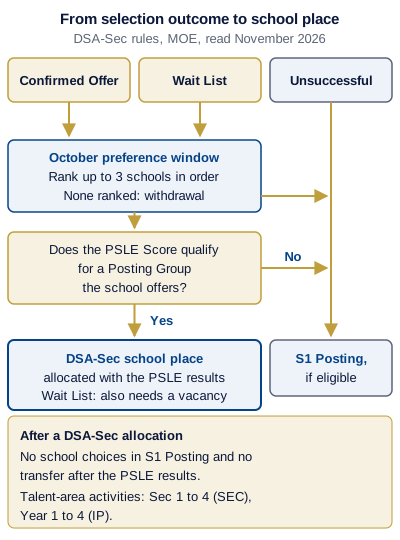
Each school returns one of three outcomes after selection: Confirmed Offer, Wait List or Unsuccessful. A Confirmed Offer reserves a place, a Wait List place may turn into one, and an Unsuccessful result leaves the student in S1 Posting, if eligible.
A student may receive offers from more than one school, and the October step is where those offers get ranked. MOE's Wait List figure describes past years as a whole; it says nothing about any one school or any one student, and each school's list moves with its own Confirmed Offer holders.
An Unsuccessful result closes that school for DSA-Sec this year and leaves the rest of the route intact. In S1 Posting the student may still choose schools they applied to under DSA-Sec, if eligible, with the exception of NUS High School of Mathematics and Science, School of Science and Technology and School of the Arts. So a school that said no in August can still appear on the list after the PSLE results.
| Outcome | What it means | Conditions to keep it | Next step |
|---|---|---|---|
| Confirmed Offer | A place is reserved at the school | The student lists the school in the October preference window, and the PSLE Score qualifies for a Posting Group the school offers | Rank the school in October, then receive the allocation result with the PSLE results |
| Wait List | A place may open, subject to vacancies, if Confirmed Offer holders do not take theirs; Confirmed Offer holders have priority | The same two conditions as a Confirmed Offer | Rank the school in October; in previous years about half of wait-listed students were eventually given a place, by MOE's count |
| Unsuccessful | The school has no place for the student through DSA-Sec | Nothing to keep | S1 Posting after the PSLE results, if eligible |
Does a DSA offer still need a PSLE Score?
Yes. A DSA-Sec offer leaves the PSLE requirement in place: to take up the place, the student's PSLE Score must qualify for a Posting Group the school offers. MOE's own example is a school offering only Posting Group 3, which needs a PSLE Score from 4 to 22.
The rule works the same way for every offer, so it is worth tracing once with MOE's example before results day. The worked example below follows two students who each hold a Confirmed Offer from the same school and both list it in the October window.
The difference between the two cases sits entirely in the PSLE result, which is why DSA preparation and PSLE preparation run side by side all year. How Posting Groups and score ranges work in full belongs to our PSLE guide, which covers scoring end to end.
Worked example
Applying MOE's Posting Group 3 example to two Confirmed Offers
A school offers only Posting Group 3. Two students each hold a Confirmed Offer from it and both rank it first in the October window. One student's PSLE Score is 18 and the other's is 24. Who is allocated to the school?
- Find the qualifying range: a school offering only Posting Group 3 needs a PSLE Score from 4 to 22, by MOE's example.
- Check the first condition: both students listed the school in the October preference window, so both meet it.
- First student: a PSLE Score of 18 sits inside 4 to 22, so the second condition holds as well.
- Second student: a PSLE Score of 24 sits outside 4 to 22, so the second condition fails and the DSA place cannot be taken up.
- Second student's next step: S1 Posting, if eligible, with school choices made in the normal way after the results.
The student with 18 is allocated to the school through DSA-Sec. The student with 24 keeps no DSA place there and moves to S1 Posting, if eligible.
How does the October preference step work, and how does a student withdraw?
Students holding a Confirmed Offer or a Wait List place rank up to 3 schools, in order of preference, during a one-week window in October; in the 2026 exercise that window has closed. Submitting no preference counts as withdrawing from DSA-Sec.
The order matters because the DSA-Sec place allocated from the ranked schools, at most one, becomes the school the student is committed to, with no switching afterwards. A Wait List school also needs a vacancy. That makes October the real decision point of the DSA year, more than the May application. A student should rank only schools they would be glad to attend for the whole of secondary school, and leave out any school listed simply because an offer arrived.
- 1. Instructions arrive by SMS and email from postman.gov.sg, so the contact details on record need to be current before the window opens.
- 2. Only students with a Confirmed Offer or a Wait List place submit preferences; an Unsuccessful result leaves nothing to rank.
- 3. The student ranks up to 3 schools in order of preference, with the school they most want to attend placed first.
- 4. To withdraw, the student submits no preference, or withdraws a submitted preference in the DSA-Sec Portal; both work only inside the preference window.
- 5. A student who submits nothing is treated as having withdrawn, whether or not that was the plan.
- 6. A student who is unsure about committing gets clear advice from MOE: submit no preference, and S1 Posting stays open if eligible.
- 7. A student holding a Singapore Sports School offer submits no DSA-Sec preference at all, since doing so voids that offer; the section on schools outside the portal explains why.
Can a DSA student change school, and how long is the commitment?
A student admitted through DSA-Sec takes no school choices in S1 Posting and cannot transfer to another school after the PSLE results. The commitment covers secondary education, and six years for an Integrated Programme place.
This is the clause that changes how a free application should be read. Applying costs nothing in fees, and accepting costs a great deal of flexibility: the student agrees to stay in the school and to take part in the talent-area activities for four years, alongside every academic subject.
The rule on S1 Posting follows from the same logic. Once the DSA-Sec allocation is confirmed, the student has no school choices to make in S1 Posting, because the place is already decided by the October ranking and the PSLE Score.
So the question to ask in May is a long one. Will this student still want to train, perform or compete in this area at fifteen? A student whose interest is real and steady finds the commitment natural. A student applying on a whim may find it heavy by Secondary 2. Our Integrated Programme guide explains the six-year IP track in full.
| Track | Commitment length | Talent-area activity years |
|---|---|---|
| SEC (Singapore-Cambridge Secondary Education Certificate) | Through secondary education | Secondary 1 to 4 |
| IP (Integrated Programme) | Six years, Year 1 to Year 6 | Year 1 to 4 |
How many places does each kind of school fill through DSA-Sec?
The share depends on the type of school. IP schools generally admit about 30% to 35% of their Secondary 1 IP intake through DSA-Sec and have autonomy over that share, non-IP schools admit up to 20% of their Secondary 1 intake, and specialised independent schools can admit up to 100%.
MOE lists four school types: government, government-aided, independent and specialised independent. The DSA share follows a different split, by IP, non-IP and specialised independent schools. The figure of 20% often quoted for every school applies only to non-IP schools, and even there it is an upper limit.
For a student, the share explains how competitive a DSA category can feel. A non-IP school admitting a fifth of its intake at most has a small number of DSA places spread across its talent areas, while a specialised independent school can admit its whole intake this way and reads every application with that in mind.
| School type | DSA-Sec share of S1 intake | Notes |
|---|---|---|
| IP schools | About 30% to 35% of the S1 IP intake | IP schools have autonomy over DSA admission to the IP track, and the share varies from year to year; SchoolFinder marks IP programmes with "- IP" |
| Non-IP schools | Up to 20% of the S1 intake | A ceiling, so the actual number of DSA places can be lower |
| Specialised independent schools | Can admit up to 100% of the S1 intake | These schools take no part in S1 Posting |
| Schools outside S1 Posting | DSA-Sec, then a Supplementary Intake Exercise if vacancies remain | NUS High School of Mathematics and Science, School of Science and Technology and School of the Arts; none is an S1 Posting choice, and each may take more students through a Supplementary Intake Exercise after the PSLE results, subject to vacancies |
Which schools admit outside the DSA-Sec portal?
Two schools take applications outside the three portal choices. School of the Arts takes them directly; its 2026 window ran from late March to early May and has closed. Singapore Sports School runs its own school-based admission, with direct application to the school.
School of the Arts is also one of the three schools that do not take part in S1 Posting, alongside NUS High School of Mathematics and Science and School of Science and Technology. In the 2026 exercise its window opened and closed earlier than the main portal, so a student considering an arts place watches the school's own page from early in the year.
Singapore Sports School needs both halves of MOE's rule read together. The school is not a choice in S1 Posting, and a student who accepts its offer must still take part in S1 Posting: the student submits S1 Posting choices, is posted to a secondary school, and then transfers to the Sports School after the S1 Posting results. That student submits no DSA-Sec school preferences, because submitting them voids the Sports School offer.
A student who misses the DSA route to one of these three schools has one further door. These schools may take more students through a Supplementary Intake Exercise after the PSLE results, subject to vacancies, so the school's own admissions page is the place to check.
How should a student choose DSA-Sec schools?
Start from the talent area, then test each school against the factors MOE lists: the selection process and schedule, the PSLE Score fit, the type of school, travel, and facilities for any special needs.
MOE's advice on several applications deserves a place on the checklist too. Each selection date takes the student's time in the busiest months of Primary 6, so a shorter list of well-matched schools often serves better than a long one. A school list built this way also makes the October ranking far easier.
- Talent-area match: does the school offer this area as a DSA category, and does its programme match what the student actually does?
- Selection process and schedule: what the school asks for, and when its interview, audition or trial falls against the other schools on the list.
- PSLE Score fit: which Posting Groups the school offers, since the PSLE Score still has to qualify for one of them.
- School type: government, government-aided, independent or specialised independent; the DSA share itself follows the IP, non-IP and specialised independent split.
- Travel: the daily journey across four years of talent-area activities on top of lessons.
- Facilities for special needs, where the student needs them.
- Financial help: Singapore citizens may be eligible for financial assistance and scholarships, worth checking before ruling a school out.
- Search tool: MOE SchoolFinder can be filtered for DSA-Sec, using its own talent categories.
Worked example
Counting choices in the DSA-Sec Portal
A student wants to apply to School of the Arts, to one secondary school under two talent areas, and to a second secondary school under one talent area. Does this fit MOE's application rules?
- School of the Arts: the application goes directly to the school and does not count toward the 3 portal choices.
- First secondary school, two talent areas: MOE allows at most 2 choices for the same school, each listed separately, so this uses 2 choices.
- Second secondary school, one talent area: this uses 1 choice, bringing the portal total to 3.
- Order: MOE states the order of choices at the application stage does not matter, so the student lists them in any order.
Yes. The plan uses all 3 portal choices plus a direct application to School of the Arts, which sits outside the 3.
Is DSA-Sec the right route, or is S1 Posting enough?
DSA-Sec suits a student with a steady interest in one talent area and a school whose programme matches it. MOE itself notes the route does not suit every student, and S1 Posting remains open to any student without a DSA allocation, if eligible.
The deciding question is how settled the student's interest is, since the commitment is fixed once the place is taken and no transfer follows the PSLE results.
| Situation | DSA-Sec fit | S1 Posting fit |
|---|---|---|
| Years of steady training or practice in one area | Strong: the record and the commitment line up | Still open if no offer is taken up |
| Interest is new or still changing | Weaker: four years of talent-area activities follow on either track | Keeps every school choice open |
| Wants a specialised independent school | The main route, since these schools skip S1 Posting | Not available for these schools |
| Holds an offer but feels unsure in October | MOE advises submitting no preference | Open, if eligible |
| Unsuccessful in DSA-Sec | Closed for this year | Open, and the student may still choose schools applied to under DSA-Sec, except NUS High School of Mathematics and Science, School of Science and Technology and School of the Arts |
| Submits no school choices in S1 Posting | Not relevant | Posting by registered address after those who chose, possibly far from home |
What applies to non-mainstream and international applicants?
Non-mainstream applicants apply online to MOE for an RG registration number before they apply; mainstream students need none. An international student can still enter DSA-Sec, and sits the AEIS alongside it.
Each of these steps has its own channel or date, and missing one can close a route for the year. A student in any of these groups gains most from reading MOE's pages as soon as the next exercise's dates are published.
- Non-mainstream applicants: in the 2026 exercise the online RG application opened in May, processing took 5 working days, and the request had to go in at least 5 working days before applications closed; the RG number arrives by email.
- International students: apply through DSA-Sec and sit the AEIS as well; our AEIS exam guide explains that test.
- AEIS-Secondary or S-AEIS-Secondary offer: applicants who received a school offer through either test are not eligible for later DSA-Sec exercises, which is why the two routes need planning in sequence.
- Registered address change: the primary school is informed by end October, since S1 Posting without school choices uses the registered address.
How should a Primary 6 student prepare across the DSA year alongside PSLE?
Plan the DSA year in stages that match MOE's windows, and keep PSLE preparation running through every one of them, since the PSLE Score decides whether any offer can be taken up. The 2026 months below are a guide; the 2027 dates come from MOE once published.
The plan works because it treats the two goals as one calendar. A student who practises speaking about their record during selection and keeps a steady PSLE routine at the same time reaches October with both conditions of an offer in reach. Our PSLE tuition page covers the academic side of that year.
- Explore (January to May in 2026): gather the record of the talent area, read school websites as they update, and settle a short list using SchoolFinder.
- Apply (May to early June in 2026): write the online application with care, making sure every piece of evidence from the talent area reaches it.
- Selection (up to end August in 2026, on each school's own dates): prepare for each interview, audition or trial on the list, and protect regular PSLE revision between them.
- After the outcomes arrive: return the full weight to PSLE preparation.
- Preference window (one week in October in 2026): rank up to 3 schools, or submit no preference if unsure.
- Allocation (with the PSLE results; 24 or 25 November in 2026, tentative): a student without a DSA place moves to S1 Posting, if eligible.
What does a DSA-Sec preparation package with Eduprime involve, and how is it paid?
A DSA-Sec tutor works one-to-one with the Primary 6 student, online or in person at home, matched to the learner's town and timetable. Starter, the opening package, gives four 60-minute lessons as a first block for the portfolio and interview answers; its price appears in the table on our DSA preparation page.
In a package, the tutor helps the student organise their record, practise explaining it clearly, and keep PSLE subjects moving through the selection months. Worksheets and lesson plans are part of the service. For sports or arts areas, the student trains with their own equipment at a venue they arrange themselves.
Payment, handled by whoever registers the student, is in full or 50% at the start and 50% mid-package. A student joining us for the first time carries a one-time registration fee, listed beside the package prices in that DSA table. The first consultation is free and held with our team, who then match the tutor.
Once the talent area and target schools are taking shape, Register for tuition opens the registration form, and Ask a question opens the contact form for anything about DSA-Sec still unsettled.
How does a DSA-Sec applicant see whether the preparation is working?
Each DSA-Sec student gets a monthly progress report and tutor notes after every session, so the record of portfolio and interview work starts with lesson one.
The notes give a Primary 6 student a running record of what was practised before each interview, audition or trial, and the monthly report shows how PSLE subjects held up through the same weeks. Whoever registered the student reads the same record, so nobody has to guess how the selection months are going.
- Monthly progress report and tutor notes after every session, readable by the student and by whoever registered them.
- Tutors with experience and skill in the student's talent area or subject, from a bench of more than 12,000 tutors who teach over 148 programmes.
- A new tutor at no charge whenever the student asks, however many lessons have already passed.
- A free first consultation with our team before any tutor is matched.
Where to go next for DSA preparation, PSLE, IP, AEIS and talent coaching
This guide covers how DSA-Sec works. For lessons that prepare a student for selection, go to the DSA preparation tuition page. PSLE scoring and Posting Groups sit in our PSLE guide, and PSLE tuition covers the academic year. The Integrated Programme guide explains the six-year track, the GEP preparation page covers academic talent, and international students start with the AEIS exam guide.
Students building a talent record can look at debate classes, public speaking for young leaders and speech and drama classes. Once the allocation is settled, the guide to starting Secondary One covers the move.
Sources
- MOE, DSA-Sec overview (read Nov 2026)
- MOE, DSA-Sec eligibility (read Nov 2026)
- MOE, Choose a DSA-Sec school (read Nov 2026)
- MOE, DSA-Sec selection overview (read Nov 2026)
- MOE, DSA-Sec selection outcomes (read Nov 2026)
- MOE, DSA-Sec allocation outcomes (read Nov 2026)
- MOE, Understand DSA-Sec commitment (read Nov 2026)
- MOE, Withdraw from DSA-Sec (read Nov 2026)
- MOE, DSA-Sec how to apply (read Nov 2026)
- Kent Ridge Secondary: DSA 2026
- MOE: AEIS outcome page
- Singapore Sports School, admissions (read Nov 2026)
- MOE FAQ, DSA-Sec category (read Nov 2026)
- MOE, S1 Posting participation question (read Nov 2026)
- MOE, S-AEIS release of outcome (read Nov 2026)
- Dunman High School, 2026 DSA-Sec Exercise (PDF)
- School of Science and Technology, Supplementary Intake Exercise (read Nov 2026)
One-to-one lessons with Eduprime
At home in Singapore or online. The first consultation is free, and a tutor can be changed whenever the learner asks.