Eduprime Singapore
Mother Tongue Languages Singapore: Choosing Your Route from P1 to University
Mother Tongue Languages in Singapore are Chinese, Malay and Tamil, the second language every primary learner studies in school, with some exceptions. Indian learners may take one of five Non-Tamil Indian Languages instead, Higher MTL in Secondary 1 takes AL1 or AL2 in PSLE MTL, or a Distinction or Merit in PSLE Higher MTL, and MOE considers exemption on two grounds. Eduprime arranges one-to-one lessons at home or online.
4.7 average from 1,223 reviews across these programmes
Last updated
What are the Mother Tongue Languages in Singapore and which one does a learner take?
Singapore has three official Mother Tongue Languages: Chinese, Malay and Tamil. A learner takes the one that matches their ethnicity, and MOE describes the MTL as the second language learnt in school, compulsory at primary level with some exceptions.
For most learners the rule is simple. A Chinese learner studies Chinese Language, a Malay learner Malay Language, an Indian learner Tamil Language. The questions begin when a learner's background sits across two of those lines, or outside all three.
A learner with a double-barrelled race, for example Chinese-Indian, is assigned the MTL of the first component, so Chinese in that case. The learner may then apply through the school to take the MTL of the second component. A Eurasian learner, or a learner of another race whose home language is none of the official three, can ask the school for an official MTL, subject to approval.
Indian learners who speak a language other than Tamil at home have a fourth door, the Non-Tamil Indian Languages. The sections below take each route in turn, so a learner can find their own case quickly and skip the rest.
- Chinese Language, with Higher Chinese as the more demanding option
- Malay Language, with Higher Malay
- Tamil Language, with Higher Tamil
- Non-Tamil Indian Languages: Bengali, Gujarati, Hindi, Punjabi and Urdu, usually taught outside school premises and hours
Which Mother Tongue route fits a learner?
Six routes cover every Mother Tongue situation in Singapore schools: Standard MTL, Higher MTL, Foundation MTL, a Non-Tamil Indian Language, an approved language in lieu, and exemption. The table sets them side by side.
Standard MTL is the default route, the language a learner takes by ethnicity. The other five routes each answer a specific situation, and a move between them is a school decision under MOE's rules. Read the table as a map for that conversation with the school, then open the page in the last column for the lesson detail.
| Route | Who it suits | Where it is taught | PSLE treatment | Next stage | Our page |
|---|---|---|---|---|---|
| Standard MTL | Most learners, by ethnicity | In school | One of four PSLE subjects, AL1 to AL8 | MTL at G1, G2 or G3 in secondary school | Chinese, Malay or Tamil tuition |
| Higher MTL | Learners strong in their MTL | In school, from Primary 3 | Graded Distinction, Merit or Pass | Higher MTL in Sec 1 with MTL AL1 or AL2, or HMTL Distinction or Merit | Higher Chinese tuition |
| Foundation MTL | Learners who need a gentler pace in the language | In school | Grade A, B or C, mapped to AL6, AL7 or AL8 for posting | MTL in secondary school | Mother tongue tuition |
| Non-Tamil Indian Language | Indian learners who do not speak Tamil | Usually outside school premises and hours, with BTTSAL | Own PSLE paper, codes 0010 to 0014 | Check with the school and BTTSAL | Hindi tuition |
| Language in lieu | Learners back from a long stay overseas with formal study of that language | Private study the learner arranges | No PSLE paper; an assigned MTL score for posting | Provider prepares for O-Level, A-Level or SEC where it applies | Japanese, French, Arabic or Thai courses |
| Exemption | Returning learners without an official MTL, or severe special educational needs | Applied for through the school | An assigned MTL score based on peers with similar results | Apply before the first quarter of the national exam year | The exemption section below |
What is Higher Mother Tongue and who can take it?
Higher Mother Tongue is the more demanding level of Chinese, Malay or Tamil for learners who are strong in the language. For Secondary 1, a learner qualifies with AL1 or AL2 in PSLE MTL, or a Distinction or Merit in PSLE Higher MTL.
Primary schools have widened the offer over the past few years. When MOE announced its plan to strengthen MTL learning on 9 April 2021, Higher Chinese was already taught from Primary 3, and Higher Malay and Higher Tamil were offered at Primary 5 and 6. MOE then extended Higher Malay and Higher Tamil downwards, after a lower-primary pilot that grew from 35 schools in 2020 to 54 in 2021.
Higher MTL keeps paying off after secondary school. Under MOE's JC admission rules from 2028, a G3 English grade combined with Higher MTL is computed as a separate aggregate, and the better of the two scores is used. A learner who takes MTL and Higher MTL in the same language counts one score only, so the benefit comes from the higher subject itself.
- Primary 3 and 4: Higher Chinese already offered by April 2021
- Primary 3: Higher Malay and Higher Tamil from 2022
- Primary 4: Higher Malay and Higher Tamil from 2023
- Primary 5 and 6: Higher Chinese, Higher Malay and Higher Tamil offered
- Secondary 1: PSLE MTL at AL1 or AL2, or PSLE Higher MTL at Distinction or Merit
Worked example
Does a learner qualify for Higher MTL in Secondary 1?
Mei has AL4 in PSLE Chinese and a Merit in PSLE Higher Chinese. Can she take Higher Chinese in Secondary 1?
- Check the first condition: PSLE MTL at AL1 or AL2. Her Chinese is AL4, so this one does not apply.
- Check the second condition: PSLE Higher MTL at Distinction or Merit. Her Higher Chinese is a Merit, so this one is met.
- One condition is enough, so she qualifies.
Yes. Her Merit in PSLE Higher Chinese qualifies her for Higher Chinese in Secondary 1.
How does Mother Tongue count in the PSLE?
Mother Tongue is one of four subjects in the PSLE Score, beside English, Mathematics and Science. Each earns an Achievement Level from 1 to 8, and the four ALs add up to a score from 4 to 32, where 4 is the best.
That makes MTL a full quarter of the score behind Secondary 1 posting. A learner who is comfortable in Mathematics and Science yet shaky in Chinese, Malay or Tamil feels it directly, since one AL lost in MTL weighs exactly as much as one lost in Science.
Foundation MTL is graded A, B or C, and for posting those grades map to AL6, AL7 and AL8. Higher Chinese sits outside the score with its own grades of Distinction, Merit and Pass. Those grades matter at Special Assistance Plan schools: a learner with any HCL grade and a PSLE Score of 14 or better gets a posting advantage there, and HCL also acts as a priority factor between two learners with the same score choosing the same SAP school.
SEAB lists every 2026 MTL paper by code: Chinese 0005, Higher Chinese 0015 and Foundation Chinese 0025; Malay 0006, 0016 and 0026; Tamil 0007, 0017 and 0027. The PSLE guide on our site covers the AL bands and posting in full.
Worked example
A PSLE Score with Higher Chinese
Mei finishes the PSLE with AL2 in English, AL3 in Mathematics, AL3 in Science and AL4 in Chinese, and a Merit in Higher Chinese. What is her PSLE Score, and does Higher Chinese help her at a SAP school?
- Add the four Achievement Levels: 2 + 3 + 3 + 4 = 12.
- Check the range: PSLE Scores run from 4 to 32, and 4 is the best, so 12 is a strong result.
- Higher Chinese sits outside the score, so her Merit leaves the 12 unchanged.
- Apply the SAP rule: a learner with any HCL grade and a PSLE Score of 14 or better gets a posting advantage at SAP schools, and 12 meets that bar.
Mei's PSLE Score is 12, and her HCL Merit gives her a posting advantage at Special Assistance Plan schools.
What are the Non-Tamil Indian Languages and how are they learnt?
The Non-Tamil Indian Languages are Bengali, Gujarati, Hindi, Punjabi and Urdu, open to learners of Indian ethnicity who do not speak Tamil. MOE does not provide the classes; they usually run outside school premises and hours.
The provider MOE names is the Board for the Teaching and Testing of South Asian Languages, BTTSAL, at bttsal.com. A learner on this route studies the language with that provider and sits it at PSLE as the Mother Tongue paper. SEAB gives each language a standard paper and a Foundation paper, listed below with the 2026 codes.
Hindi also has its own one-to-one lesson page on our site, for learners who want more speaking, reading and writing time in the language at home or online. For questions about NTIL enrolment and exams, the school and BTTSAL are the first contacts.
- Panjabi (SEAB spelling): 0010, Foundation 0020
- Hindi: 0011, Foundation 0021
- Gujarati: 0012, Foundation 0022
- Bengali: 0013, Foundation 0023
- Urdu: 0014, Foundation 0024
Who can be exempted from Mother Tongue in Singapore?
Two situations open the door to an MTL exemption, and MOE weighs each one case by case: a learner back in Singapore after years abroad with no chance there to study an official Mother Tongue Language, or a learner whose special educational needs make learning as a whole severely difficult.
Each case is assessed on its own facts. For returning learners, MOE looks at the length of the overseas stay, the MTL exposure there, and what the curriculum demands at the level of entry. For special educational needs, it looks at learning ability and the school's own assessment. MOE told Parliament on 3 March 2026 that exemption in such cases is reserved for exceptional circumstances, follows a holistic review across every subject, and comes after alternative support has been considered.
MOE also advises trying an official MTL for at least one semester first, and states that the attempt does not prejudice the application. An exempted learner receives an assigned MTL score for Secondary 1 posting, based on the MTL scores of peers with similar English, Mathematics and Science results.
- Check the ground: return from overseas without an official MTL, or severe special educational needs.
- Try an official MTL for a semester, as MOE advises.
- Apply through the school: primary, secondary, junior college or Millennia Institute.
- Apply before the first quarter of the year of the national MTL exam: PSLE, O-Level or N-Level, SEC from 2027, A-Level or the IB Diploma.
- MOE assesses the case on its overseas stay, MTL exposure and curriculum demand, or on learning ability and school assessment.
What help is there if a learner struggles with Mother Tongue?
Schools run the Mother Tongue Support Programme at Primary 3 and 4, and from Primary 5 a learner can take a less demanding MTL curriculum. MOE weighs this support before it considers exemption.
Most learners who find MTL hard sit in a wide middle. They follow the lesson, then freeze in oral; they understand a passage, then run out of words when they write. School support is built for that middle, and it starts in Primary 3, three years before the PSLE year.
One-to-one lessons add an hour in which the learner does most of the speaking. The tutor hears which tones, sounds, characters or sentence patterns slip, then plans the next session around them. After each lesson the tutor writes down which tones or characters held and which slipped, and once a month a progress report gathers those notes into one view of the language that the learner and whoever stands behind them both read.
Lessons take place at home, with the tutor chosen for the learner's town and free evenings, or online, which suits a learner who wants a short extra session on a school night. The goal is steady confidence in the language the learner already studies, which keeps every school route open, Higher MTL included.
Can a learner take a foreign language instead of Mother Tongue?
Yes, in specific cases. Six languages carry MOE approval as a substitute for MTL: three Foreign Languages (French, German, Japanese) and three Asian Languages (Arabic, Burmese, Thai).
The route suits a learner who lived overseas for a long time, had no chance to keep up an MTL there, and had formal learning in one of these six languages. The learner's side arranges the teaching as private study, and whoever provides it has to bring the learner up to the GCE O-Level or A-Level paper in that language, or the SEC paper where one applies.
There is no Foreign or Asian Language paper at PSLE, so a primary learner on this route receives an assigned MTL score for Secondary 1 posting.
Japanese, French, Arabic and Thai each have a one-to-one course page in our languages section, taught at home or online. A learner on the in-lieu route should confirm with the school how the chosen provider meets the exam requirement before lessons begin.
- Foreign Languages: French, German, Japanese
- Asian Languages: Arabic, Burmese, Thai
- Japanese and French: one-to-one courses in our languages section
- Arabic and Thai: one-to-one lessons in our languages section
How is Mother Tongue taken in secondary school and junior college?
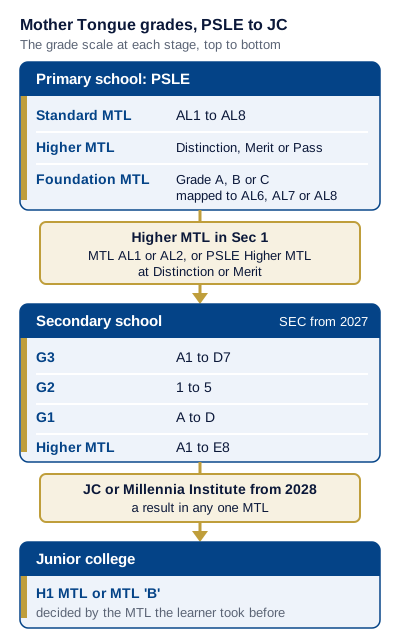
In secondary school a learner takes MTL at G1, G2 or G3, or Higher MTL, and from 2027 the national exam is the SEC. At junior college the MTL subject is H1 MTL or MTL 'B', depending on the MTL taken in secondary school.
The subject levels carry different grade scales, and those scales matter again at JC admission. G3 is graded A1 to D7, G2 from 1 to 5, G1 from A to D, and Higher MTL from A1 to E8. MOE lists all four as acceptable MTL results for admission to a junior college or Millennia Institute from 2028. The diagram stacks those scales stage by stage, from the PSLE grades through secondary school to the MTL subject at junior college.
MOE's exemption page names the SEC as one of the national MTL exams from 2027, so the exemption deadline in the earlier section applies to SEC candidates too. A learner moving between subject levels in secondary school works that out with the school, since placement follows the school's own process.
At JC, the admission rules from 2028 name H1 MTL or MTL 'B' as the MTL subject, decided by the MTL the learner took before. The O-Level guide on our site follows the SEC change and JC admission in full, and the A-Level guide covers H1 MTL and MTL 'B' at junior college.
Does Mother Tongue affect JC and university admission?
Yes. Admission to a JC or Millennia Institute from 2028 asks for a result in any one MTL, and NTU sets an MTL requirement for Singapore Citizens and Permanent Residents on its A-Level, O-Level and IB routes.
From 2028 the L1R4 aggregate threshold is 16 for a junior college and 20 for Millennia Institute. Bonus points are capped at 3, and selection into a JC language elective programme in Chinese, Malay or Tamil brings an additional 2 points. At NTU, a learner who has yet to meet the MTL requirement may still apply, and must meet it before graduating.
| Route | What counts | Result needed | Source |
|---|---|---|---|
| JC or Millennia Institute from 2028 | Any one MTL: G3, G2, G1 or Higher MTL | G3 A1 to D7, G2 1 to 5, G1 A to D, Higher MTL A1 to E8 | MOE, JAE changes from 2028 |
| NTU via O-Level | Higher MTL | Grade D7 | NTU general admission requirements |
| NTU via A-Level | MTL 'B', H1 MTL, H2 MTL Language and Literature, or General Studies in Chinese | A pass in MTL 'B', or grade S in the H1 or H2 subject; or a language in lieu approved by MOE | NTU general admission requirements |
| NTU via IB | MTL Language A or Language B, at SL or HL | A pass; or a language in lieu approved by MOE | NTU general admission requirements |
| NTU, any route | MTL exemption approved by MOE | Exemption approved by MOE | NTU general admission requirements |
How can an overseas or returning learner keep up Mother Tongue?
MOE gives overseas learners MTL digital resources on the Student Learning Space and an LOA package with an MTL checklist, and states that programmes are in place to support returning learners' MTL readiness.
The checklist deserves attention, because the length of the stay abroad and the MTL exposure there are exactly what MOE weighs if exemption is ever requested. A learner who kept the language alive overseas comes home with every option intact: Standard MTL, Higher MTL, or, after formal study of French, German, Japanese, Arabic, Burmese or Thai abroad, a language in lieu.
Online one-to-one lessons suit this situation, since tutor and learner can begin while the learner is still overseas and carry on after the move, with the same tutor notes and monthly report. After the move home, Chinese, Malay or Tamil practice can shift to the learner's own living room, with a tutor based near the new town and free at hours that suit the new school week.
Adults use the same lessons too. Someone returning to a Mother Tongue they let slip, for work or to talk with grandparents, learns outside any exam track, at a pace set around their week.
Can a learner study Chinese or Malay as an extra language after the PSLE?
Yes. The MOE Language Centre runs a Malay Special Programme and a Chinese Special Programme for learners with a PSLE Score of 24 or better who did not take that language as their MTL at PSLE.
So a Chinese learner can add Malay, and a Malay or Tamil learner can add Chinese, as a third language beside English and their own MTL. Students from government, government-aided and independent schools attend MOELC without paying fees, and the details sit on the centre's own course page.
A third language widens a learner's world in a very Singaporean way: market conversations, neighbours, colleagues later in working life. For the wider picture of third languages, from French and Japanese to Arabic and Thai, the language classes hub on our site lists every course we run, each with one-to-one lessons at home or online.
What does a learner practise for Mother Tongue: speaking, listening, reading and writing?
A Mother Tongue learner works on four skill areas: speaking, listening, reading with comprehension, and writing. For PSLE 2026, SEAB conducts the Standard and Foundation MTL oral in e-Examination format.
The e-Examination format makes it sensible to practise speaking to recorded prompts on a screen as well as to a person, so the format itself feels familiar on the day.
Paper weightings and marks vary by level and year, and SEAB's syllabus documents are where to read them. In lessons, the tutor finds where the learner loses ground among the four areas and spends the hour there.
- Speaking: pronunciation, tones or sounds, and fluency in full sentences, plus the confidence to keep talking when a word goes missing.
- Listening: following natural speech at normal speed and catching the detail a question asks for.
- Reading and comprehension: vocabulary, idiom and the inference a passage expects at the learner's level.
- Writing: turning ideas into paragraphs with accurate characters, spelling or script, and the sentence patterns the level expects.
Which Mother Tongue page should a learner open next?
The next page depends on the language and the stage. Each line below names a learner's situation and the page on our site that answers it in full.
Each language page carries its own lesson detail and the price for that subject, so a learner reading about Malay never wades through Chinese to find it.
Some learners cannot yet tell whether Standard, Higher, exemption or an in-lieu language fits, often after years overseas, and the Ask a question button on the contact form brings that doubt straight to our team. Our team talks the route through in the free first consultation.
- One-to-one help in Chinese, Malay or Tamil in general: the mother tongue tuition page.
- Chinese at any level: the Chinese tuition page.
- Higher Chinese at primary or secondary, including the SAP school question: the Higher Chinese tuition page.
- Malay or Higher Malay: the Malay tuition page.
- Tamil or Higher Tamil: the Tamil tuition page.
- Hindi as a Non-Tamil Indian Language, or Hindi for adult learners: the Hindi tuition page.
- PSLE and the full AL scoring: the PSLE guide.
- Secondary school, the SEC and JC admission from 2028: the O-Level guide.
- Junior college with H1 MTL or MTL 'B': the A-Level guide.
How do one-to-one Mother Tongue lessons work and how does a learner register?
Signing up starts on the form; our team then spends a free first consultation on the Mother Tongue route the learner is aiming for, and pairs that learner with a tutor who teaches online or visits homes near the learner's town at hours that fit the week. The first four 60-minute lessons in Chinese, Malay, Tamil or Hindi make up the Starter package.
A parent or guardian registers and pays for a learner who is a minor; adult learners register for themselves. Anyone still deciding between Standard and Higher, or between two of the four languages, can press Ask a question first; that button leads to the contact form.
- Register Now: the registration form wants three answers, namely the language (Chinese, Malay, Tamil or Hindi), the school level, and lessons at home or lessons online.
- First consultation with our team, free of charge, covering the route (Standard, Higher, Foundation or another) and what the learner wants from the lessons.
- Tutor match: our team picks a tutor with real experience and skill in Chinese, Malay, Tamil or Hindi, teaching at home in a slot that fits the learner's town and week, or online.
- Starter package: four hour-long Mother Tongue lessons, paid in one sum on day one or in two halves, 50% ahead of the first lesson and 50% once half the package is done.
- Sessions: the worksheets and lesson plans behind each oral, composition or comprehension drill are part of the service, and a note from the tutor follows every lesson.
- Monthly progress report on the four language skills, plus a swap to another Mother Tongue tutor at no cost the moment the learner requests one.
How much do Mother Tongue lessons cost?
The price table on this page shows the rate per 60-minute session for Mother Tongue lessons, by the language, level and format the learner chooses. Packages are how these lessons are bought, and the Starter opens with four hour-long sessions of Chinese, Malay, Tamil or Hindi.
Payment for the Starter comes either as one sum or as two halves: 50% when the lessons begin and the remaining 50% at the package's halfway lesson. A learner new to Eduprime adds a one-time registration fee, shown in the price table.
Prices differ by level and by format, home or online, so the table is the place to compare them. The first consultation and tutor replacement are free at every point of the package.
How does a learner see progress in Mother Tongue from month to month?
Progress in oral, listening, reading and writing goes on paper from the first week: the tutor writes notes after each lesson, and a monthly progress report gathers them into one view.
Three things decide most Mother Tongue results: the time spent actually using the language, the learner's comfort speaking it aloud, and steady vocabulary building. The lessons work on each one, with more speaking time per hour, vocabulary targeted from the notes, and practice in the formats the learner will meet in school.
- Tutor notes after every lesson: the tones, vocabulary and sentence patterns that held, the ones that wobbled, and what the following lesson will drill.
- Monthly progress report: movement across speaking, listening, reading and writing.
- Switching to another Mother Tongue tutor costs nothing and can happen as often as the learner asks.
- Matching by our team: the first consultation pins down the language, the route (Standard, Higher, Foundation or another) and the goal, and the tutor is picked to fit all three.
- Depth: more than 12,000 tutors teach with us, and Chinese, Malay, Tamil and Hindi sit among our 148+ programmes, so each learner is matched from a wide bench.
Where should a learner go from here?
Each language and level has its own page, listed below with the search phrase it answers. For the exam itself, the PSLE, O-Level or A-Level guide carries the scoring in full; for a learner on an in-lieu route or picking up a third language, the languages hub lists French, Japanese, Arabic and Thai.
Ready to start? Register Now leads to the registration form; for any doubt left about the Standard, Higher or Foundation route, Ask a question leads to the contact form.
- mother tongue tuition singapore
- chinese tuition singapore
- higher chinese tuition singapore
- malay tuition singapore
- tamil tuition singapore
- hindi tuition singapore
- psle guide singapore
- o level singapore guide
- a level guide singapore
- language classes singapore
- japanese course singapore
- french course singapore
- arabic language tuition singapore
- thai language course singapore
Sources
- MOE, Mother Tongue Languages (primary)
- MOE, Learning a Mother Tongue Language in school
- MOE, Mother Tongue Language exemption
- MOE, Mother Tongue Language while living overseas
- MOE, PSLE scoring system
- SEAB, PSLE formats examined in 2026
- MOE, JAE changes from 2028
- MOE parliamentary reply, 3 March 2026, MTL exemption or replacement for students with conditions such as ASD or dyslexia
- MOE press release, Strengthening learning of Mother Tongue Languages, 9 April 2021
- NTU, General admission requirements
- MOE Language Centre, Courses
What a lesson costs
The rate for this programme is confirmed at the free consultation. Eduprime prices every programme per 60-minute session in three formats: an online international tutor, an online local tutor and a home tutor.
Register Now
Mother Tongue lessons that keep home languages strong
- 4.6
Chinese Tuition Singapore for Foundation to Higher Chinese
Chinese tuition Singapore for PSLE oral, composition and Higher Chinese 1116. Bilingual tutors with 11+ years in MTL. Home or online.
 4.7
Hindi Tuition Singapore for BTTSAL Mother Tongue Papers
Hindi tuition Singapore for BTTSAL Mother Tongue papers: PSLE, O-Level 3194 and H1 8829. Tutors with 10+ years in Hindi. Home or online.
 4.7
Malay Tuition Singapore from PSLE to A-Level H1
Malay tuition Singapore for karangan, e-oral and Higher Malay 1117, PSLE to A-Level. Experienced Malay tutors matched to the learner's level. Home or online.
 4.7
Tamil Tuition Singapore, Primary to A-Level
Tamil tuition Singapore for PSLE oral, composition and Higher Tamil 1147 for the L1R5 bonus. Experienced Tamil tutors matched to the learner's level. Home or online.
 4.6
Higher Chinese Tuition Singapore for the 高级华文 Track
Higher Chinese tuition in Singapore for PSLE, O-Level 1116 and H1. Chosen by thousands of learners. 1-to-1 home or online.
 4.7
Mother Tongue Tuition Singapore with Higher MTL Coaching
Mother Tongue tuition Singapore in Chinese, Malay or Tamil, plus Higher MTL for 2 bonus points. Specialists with up to 11 years. 1-to-1.