Eduprime Singapore
Language Classes Singapore: Choose Your Language, Level and Goal
Language classes in Singapore with Eduprime seat a single learner of Arabic, Bahasa Indonesia, French, Japanese, Korean, Russian, Thai or Turkish beside a single tutor, in the learner’s own home or on a video call. Set a CEFR target from A1 to C2, pick the test that proves it, and open with the Starter of four 60-minute lessons.
4.7 average from 888 reviews across these programmes
What a lesson costs
Fees
What a lesson costs
Every programme is priced per 60-minute session in three formats. These are the lowest figures among the programmes on this page; each programme page shows its own.
- Widest availability
Online International Tutor
fromS$19/ session
60-minute session
The widest bench of tutors across time zones, so a slot is open at almost any hour. Lessons run online over a shared screen.
Online Local Tutor
fromS$32.30/ session
60-minute session
A tutor based here who knows our schools, syllabuses and exams, teaching online.
Home Tutor
fromS$38/ session
60-minute session
A local tutor who comes to the learner, at home or at a nearby study spot, matched to their town and timetable.
Minimum 4 sessions. Larger packages lower the per-session price. One-time S$15 registration fee for new learners.
Last updated
Which languages can I learn one to one in Singapore?
With Eduprime you can learn eight world languages one to one: Japanese, Korean, French, Arabic, Russian, Thai, Turkish and Bahasa Indonesia. Every language keeps a page of its own with a course plan written for it, and the lessons happen face to face where you live or on a video call.
The eight share one way of working and very little else. Japanese asks for three scripts, Korean for its own alphabet, Arabic for right-to-left writing, Thai for tones. So the tutor plans each course around the language itself, and around why you came to it.
Home lessons are matched to your town and your timetable, so the tutor travels to you. Online lessons suit a learner who studies late, travels for work, or simply prefers a screen.
- Japanese: the language and culture course, with kanji and polite speech built in from the start
- Korean: Hangul first, then everyday speech and the Korean proficiency test
- French: speaking and writing, with the French diplomas as a target
- Arabic: reading the script, then the language for study, work or faith
- Russian: Cyrillic, cases and conversation for work or travel
- Thai: tones, script and the phrases a learner uses on the street in Bangkok
- Turkish: grammar by suffix, built up one ending at a time
- Bahasa Indonesia: a fast start for work in Indonesia, with clear grammar
Which language should I learn for work, study, travel or heritage?
Choose the language your goal points to, then set a CEFR level to aim for. A job in Tokyo, a degree taught in French and family in Bangkok each lead to a different language, a different target level and a different test.
The Ministry of Education says the same thing about its own third languages. In a parliamentary reply on 26 February 2026, MOE explained that the European third languages aim to build a pool of Singaporeans able to use opportunities in economies that speak them, and that they prepare students for undergraduate courses taught in those languages. The Asian third languages aim at understanding the language and cultural heritage of communities in Singapore and the region, and at everyday conversation.
That split is a good test for an adult too. If the goal is a career or a degree, plan for an intensive course and an exam at the end. If the goal is heritage, friendship or travel, plan for conversation first and add a test later only if you want proof of your level. The table puts each goal next to the languages that fit it.
| Your goal | Languages that fit | Level to aim for | Test to consider | Our page |
|---|---|---|---|---|
| Work with a company in the region | Japanese, Korean, Thai, Bahasa Indonesia | B1 or B2 for meetings and email | JLPT for Japanese | Japanese, Korean, Thai, Bahasa Indonesia pages |
| Study abroad in the language | French, Japanese, Korean | The level the university sets | DELF or DALF for French, JLPT for Japanese | French and Japanese pages |
| Travel and daily life | Thai, Turkish, Japanese, Korean | A1 to A2 | Usually none | Thai, Turkish, Japanese, Korean pages |
| Heritage, faith or family | Arabic, Bahasa Indonesia, Russian | A2 to B1 for real conversation | Optional | Arabic, Bahasa Indonesia, Russian pages |
| Proof of level for a job application | Japanese, French | The level the employer names | JLPT N5 to N1, DELF | JLPT preparation page, French page |
What do the A1 to C2 language levels mean?
A1 to C2 are the six levels of the Common European Framework of Reference (CEFR), running from A1 for beginners to C2 for mastery. Cambridge English describes the scale as the international standard for describing language ability.
The value of the scale is that it is shared. Cambridge English notes that it helps teachers, learners, employers and institutions compare qualifications, so a learner who says B1 in French and a learner who says B1 in Spanish are describing the same stage of ability in two different languages. An employer in Singapore reading a CV can place both on the same ladder.
For lessons, the scale does a second job. It turns a vague wish into a target. A learner who says they want to be good at Japanese gets a fuzzy plan. A learner who says they want to reach A2 by the time they travel gets a plan with chapters, vocabulary counts and a review point, and the tutor can show progress against it every month.
The Spanish diploma, DELE, is built directly on the six letters, which makes it a clear example of a test that maps one to one onto the scale.
- A1: the first level, the one CEFR calls beginners; DELE offers an A1 diploma
- A2: the second level; DELE offers A2, and its school version pairs A2 with B1
- B1: the third level; DELE offers B1
- B2: the fourth level; DELE offers B2, and the school version pairs B2 with C1
- C1: the fifth level; DELE offers C1
- C2: the top level, the one CEFR calls mastery; DELE offers C2
Which test proves my level in each language?
Each language has its own proficiency test run by its own body: JLPT for Japanese, DELE for Spanish, DELF and DALF for French, Fit für Deutsch and TestDAF for German, and HSK for Chinese. Korean has its own test too, covered on the Korean page.
The MOE Language Centre lists DELF and DALF, Fit für Deutsch, TestDAF, JLPT and DELE as optional external exams for its French, German, Japanese and Spanish students. That list doubles as a sound starting point for anyone outside school, since the same exams serve adults.
For Chinese, the official HSK site, chinesetest.cn, runs the HSK family: HSK for general proficiency, HSKK for speaking and YCT for young learners, and its own site now offers a trial of HSK 3.0. A learner taking Chinese as a school subject in Singapore will find that pathway on the Chinese tuition page.
The table keeps to what the exam owners publish. Where a level structure has changed or could not be confirmed from the owner, the cell sends you to the language page.
| Language | Test | Run by | Levels | Sitting it in Singapore |
|---|---|---|---|---|
| Japanese | JLPT | Japan Foundation and JEES | N5 (easiest) to N1 (hardest) | The Japanese Cultural Society, Singapore runs the local sittings, in the months it names: July and December |
| Spanish | DELE | Instituto Cervantes | A1 to C2; school version A1, A2/B1, B2/C1 | Check with Instituto Cervantes |
| French | DELF and DALF | Listed by MOELC as the French external exams | See the French page | See the French page |
| German | Fit für Deutsch, TestDAF | Listed by MOELC as the German external exams | Check with the exam owner | Check with the exam owner |
| Chinese | HSK, HSKK, YCT | chinesetest.cn (CTI) | See the Chinese tuition page | See the Chinese tuition page |
| Korean | Korean proficiency test | See the Korean page | See the Korean page | See the Korean page |
How do JLPT levels work from N5 to N1?
The Japanese-Language Proficiency Test has five levels: N5 is the easiest and N1 the most difficult. A learner chooses one level per sitting and climbs from there.
The test checks reading and listening, and both draw on language knowledge, which means the vocabulary and grammar a learner needs to understand what they read and hear. That shapes how a tutor plans: conversation practice keeps the language alive between sittings, and the exam weeks lean hard on reading speed, kanji recognition and listening under time.
Candidates here sit the JLPT through The Japanese Cultural Society, Singapore, and the society names July and December as the months the test runs. Check the host's own page for each year's sessions and registration window before you plan your lessons backwards from a sitting.
Our Japanese course page covers the language from the first kana, and the JLPT preparation page takes a learner through one chosen level with timed practice on each section. Read both if Japanese is your language, then pick the one that matches the goal you wrote down.
What third languages can secondary students take at the MOE Language Centre?
The MOE Language Centre offers eight third languages in three groups: French, German, Japanese and Spanish as Foreign Languages; Arabic and Bahasa Indonesia as Asian Languages; and Malay and Chinese as Special Programmes. Chinese (Special Programme) was added in January 2022.
Classes meet once a week. Each week holds 3 hours 15 minutes in class plus 45 minutes of online independent learning, so a student carries roughly four hours of language a week on top of a full secondary timetable. The centre has two campuses, at 11 Bishan Street 14 in Bishan and at 136 Cairnhill Road in Newton.
MOE describes the two groups differently. The European languages carry an intensive curriculum and make a high demand on students, which is why the entry bar is set higher. The Asian languages are less intensive and lean towards everyday conversation and cultural understanding.
Selection, timetabling and teaching at the centre belong to MOE and the student's school. Eduprime lessons sit outside that system as private study, and the next two sections set out who qualifies and which exams follow.
- Foreign Languages: French, German, Japanese, Spanish
- Asian Languages: Arabic, Bahasa Indonesia
- Special Programmes: Malay, Chinese (added January 2022)
- Pattern: once a week, 3 h 15 min in class and 45 min online
- Campuses: Bishan and Newton
Who is eligible for a third language at secondary school?
An applicant must meet every criterion the centre lists for the chosen language. Foreign Languages ask for a PSLE Score of 8 or better; Arabic, Bahasa Indonesia and the Special Programmes ask for 24 or better. The Foreign and Asian Languages also ask the student to be a Singapore Citizen, a Singapore Permanent Resident or the child of one.
The extra rules matter as much as the score. Japanese needs Chinese or Higher Chinese taken at PSLE. Bahasa Indonesia is closed to students who took Malay or Higher Malay as their Mother Tongue at PSLE, and the Malay and Chinese Special Programmes are closed to students who took that same language, at either the standard or the Higher level, as their Mother Tongue. Enrolment at the centre is fee-free for a learner whose school is a government, government-aided or independent one.
| Language | PSLE Score needed | Extra rule | Citizenship rule | Fee |
|---|---|---|---|---|
| French, German, Spanish | 8 or better | None listed | SC, SPR or child of SC/SPR | None at government, aided or independent schools |
| Japanese | 8 or better | Chinese or Higher Chinese at PSLE | SC, SPR or child of SC/SPR | None at government, aided or independent schools |
| Arabic | 24 or better | None listed | SC, SPR or child of SC/SPR | None at government, aided or independent schools |
| Bahasa Indonesia | 24 or better | Malay or Higher Malay not taken as MTL at PSLE | SC, SPR or child of SC/SPR | None at government, aided or independent schools |
| Malay (Special Programme) | 24 or better | Malay or Higher Malay not taken as MTL at PSLE | None listed | None at government, aided or independent schools |
| Chinese (Special Programme) | 24 or better | Chinese or Higher Chinese not taken as MTL at PSLE | None listed | None at government, aided or independent schools |
Worked example
Which third languages can Wei Ling apply for?
Wei Ling is a Singapore Citizen at a government school. Her PSLE Score is 14, and she took Chinese as her Mother Tongue at PSLE. Which MOE Language Centre languages are open to her?
- Citizenship: as a Singapore Citizen she meets the rule the Foreign and Asian Languages set, and the Special Programmes list no citizenship rule.
- Score: the Foreign Languages ask for 8 or better, the higher bar, and Arabic, Bahasa Indonesia and the Special Programmes ask for 24 or better. A score of 14 misses the first bar and clears the second.
- Extra rules: Bahasa Indonesia is closed only to students who took Malay or Higher Malay at PSLE, so it stays open. The Chinese Special Programme is closed to her because Chinese was her Mother Tongue, and the Malay Special Programme stays open.
- Fee: her school is a government school, so enrolment at the centre is fee-free.
Arabic, Bahasa Indonesia and the Malay Special Programme are open to Wei Ling; French, German, Japanese, Spanish and the Chinese Special Programme are closed to her at a score of 14.
What exams does a third-language student sit?
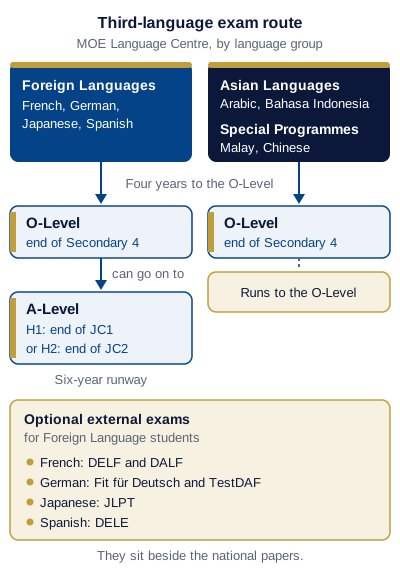
Every third-language student at the MOE Language Centre sits the O-Level at the end of Secondary 4. Students of the Foreign Languages can go on to the A-Level, with H1 at the end of JC1 and H2 at the end of JC2.
So a French, German, Japanese or Spanish student who continues into junior college has a six-year runway: four years to the O-Level, then one or two more to an A-Level paper. The A-Level route is listed for the Foreign Languages, so the Asian Languages and the Special Programmes run to the O-Level. The diagram sets the two routes side by side, from each language group to the last national paper it reaches.
Alongside the national papers, the centre names optional external exams for its Foreign Language students: DELF and DALF for French, Fit für Deutsch and TestDAF for German, JLPT for Japanese and DELE for Spanish. They are external certificates, each set by its own language's exam body, and they sit beside the national papers.
A student preparing for any of these meets one exam board's paper at a time. Private lessons can add speaking time and timed practice on the external tests, and our Japanese and French pages show how that runs for those two languages.
Can a world language replace Mother Tongue?
Yes, as an alternative to exemption. MOE names three grounds for taking an approved Foreign or Asian Language in lieu of Mother Tongue: a long period overseas, not keeping up with Mother Tongue, and formal learning in that language. MOE's approved lists include Japanese, French and German among the Foreign Languages, and Thai, Burmese and Arabic among the Asian Languages.
The condition attached to that list decides how the lessons run: MOE leaves the in-lieu language to private study that the learner's side arranges, and expects the provider to carry the student to a GCE O-Level or A-Level paper or, for a student on that track, the Singapore-Cambridge Secondary Education Certificate. So the plan runs to a national paper from the first lesson, and the tutor writes the course backwards from it.
The rules on exemption itself, how an application is assessed and what changes at each school stage sit with the Mother Tongue Languages page. Read that page first, then come back here or to the Japanese, French, Arabic or Thai page once the language is settled.
How does an adult or working learner start a new language?
Put the reason for the language into one sentence, translate it into a CEFR level (A2 suits a trip, B1 suits the office), decide between lessons at home and lessons on video, then choose Register Now to talk the plan through with us in a free first consultation. The tutor builds the course from that target.
Adults bring something school students rarely have: a reason with a date on it. A posting to Seoul in spring, a partner's family in Osaka, a master's degree in Lyon. That date sets the pace, and the CEFR scale sets the finish line, so the first conversation with us is about both.
Many adults are also returning learners. Someone who took Japanese at the MOE Language Centre ten years ago still has kana and a few hundred words somewhere, and a good tutor finds them in the first lesson and builds from there. The steps below are the same for a beginner and for someone picking up an old language again.
- Write down the goal: work, study, travel, heritage or a test
- Set a CEFR target and, where it helps, the test that proves it
- Choose lessons at home in your town or online around your working hours
- Choose Register Now to talk the goal over with our team; the language then opens with the Starter, four lessons of 60 minutes each
How can a student fit a language beside school?
Plan around one weekly slot of about an hour at first, and build up only when the school load allows. The MOE Language Centre gives a useful yardstick: its third-language students carry about four hours a week, once a week.
That four-hour week, 3 hours 15 minutes in class plus 45 minutes of online independent learning, is the centre's pattern for every third language it offers. A teenager learning Korean for interest, or Thai for a family trip, rarely needs that much. One 60-minute lesson a week with short daily review keeps a language growing without squeezing out schoolwork.
A secondary student already enrolled at the centre, which charges nothing to pupils of government, government-aided and independent schools, may still book private lessons for more speaking time or to aim at an outside test like the JLPT. Others are outside the centre's criteria and want the language anyway. Both can start the same way, with a first consultation.
For a student under 18, a parent or guardian handles consent and payment, and receives the monthly progress report alongside the learner.
Home or online language lessons: which fits?
Home lessons suit a learner who studies best face to face with a fixed weekly slot in their own town. Online lessons suit a learner whose hours move, who travels, or who wants a language with fewer home lessons on offer near them.
Both formats run the same course, with the same worksheets, lesson plans, tutor notes and monthly report. The difference is the room. Writing practice in Arabic or Japanese is easier with paper on a shared table, while listening drills and screen-shared reading suit an online lesson well. Some learners switch between the two as their months change, and that is simple to arrange.
| Format | Where it happens | Who it suits | What the learner prepares | What the tutor brings |
|---|---|---|---|---|
| At home | In the learner's own home, with the tutor chosen to suit their town and weekly hours | Learners who like a fixed slot and paper-based writing practice | A quiet table and space to write | Worksheets and the lesson plan |
| Online | A video lesson from wherever the learner is | Working adults, frequent travellers, late-evening learners | Their own device, a headset and a quiet space | Worksheets, screen-shared material and the lesson plan |
Which language page should I open next?
Open the page of the language you chose, and go to the test-preparation or Mother Tongue pages if your goal is a test or a school language. Each page answers the questions for its own language in full.
This page compares; the language pages go deep. The Japanese page covers kana, kanji and keigo, the Korean page covers Hangul and the Korean test, and the French page covers the French diplomas. Every one of them shows the same lesson model you read about here.
Chinese, Malay and Tamil as school subjects belong to the Mother Tongue pages, and so does HSK for learners of Chinese.
- Korean course Singapore: Hangul, everyday Korean and the Korean proficiency test
- Japanese course Singapore: language and culture, kana to keigo
- JLPT preparation Singapore: one level, timed practice per section
- French course Singapore: conversation, writing and the French diplomas
- Arabic language tuition Singapore: script, reading and speaking
- Russian language course Singapore: Cyrillic, cases and conversation
- Thai language course Singapore: tones, script and daily speech
- Turkish language tuition Singapore: suffix by suffix
- Bahasa Indonesia tuition Singapore: a quick start for work and family
- Mother Tongue languages Singapore: Chinese, Malay, Tamil and in-lieu rules
- Chinese tuition Singapore: school Chinese and HSK
- Test preparation: the hub for language and entrance tests
What happens between registering and the first lesson in a new language?
Registering opens a free first consultation in which our team hears the language, the goal and the timetable, then pairs the learner with a tutor whose experience and skill lie in that very language. Lessons are bought in packages, and the opening one, called the Starter, gives the new language four lessons of 60 minutes each.
Learners do not browse tutor profiles before registering. The consultation is how we learn what the tutor has to deliver, whether that is JLPT N4 by summer or enough Thai to bargain at a market, and it is the reason the first lesson already has a plan behind it.
If the match does not feel right at any point, the tutor is replaced free of charge, as many times as needed. A language package can be settled in one payment, or split with half due as the package begins and half at its midpoint.
- Register Now opens the registration form; Ask a question opens the contact form for anything to check about a language first
- A free first consultation in which our team asks about the language, your level today and the hours you can spare
- Tutor matched by language, goal, and your town or online hours
- Starter: the first four 60-minute language lessons, worksheets and lesson plans included
- Tutor notes after every session and a monthly progress report
How much do language lessons cost in Singapore?
Each language format and level carries its own figure, and our pricing engine prints those figures in the table further down this page. No package is smaller than the Starter's four 60-minute lessons.
Learners new to Eduprime also meet a one-time registration fee, and the engine prints that line in the same table. The money for a package goes in all at once or in two equal parts, the first as lessons start and the second once the package is half done. The first consultation and any tutor replacement are free. For a learner under 18, a parent or guardian makes the payment.
What moves the total is the number of packages a goal needs. A traveller aiming at A1 Thai and a graduate aiming at B2 French for a degree start from the same Starter package, and the consultation is where the two plans part ways.
How can a learner check the lessons are working?
Measure against the CEFR target set at the start. Tutor notes after every session and a monthly progress report show where the learner stands against that target, and what the next month covers.
A learner feels a new language growing long before anyone can point to the growth, so we write that growth down. The notes record what was covered and what needs review; the report steps back and compares the month with the goal. If the target was A2 before a trip, the report says how close the learner is.
What decides the result is steady practice between lessons, a clear target and a tutor who fits. The lessons cover the first with set review work, the second through the CEFR plan, and the third through free tutor replacement.
- Tutor notes after every session
- A monthly progress report against the CEFR target
- A target review whenever the goal changes
- A new tutor, free of charge, whenever the match stops working
- A bench of 12,000+ tutors, wide enough to find a fit for each of the eight languages
Where to go from here
Pick your language and open its page: Korean, Japanese, French, Arabic, Russian, Thai, Turkish or Bahasa Indonesia. Each one carries the full course plan for that language. If your goal is a Japanese test, go to JLPT preparation. If the language is a school Mother Tongue or an in-lieu subject, start with the Mother Tongue Languages page, and for Chinese as a subject, the Chinese tuition page.
Once your CEFR target and its test are clear, Register Now and the first consultation with our team, which costs nothing, starts from that language and level; a quick question about a script, a certificate or a level goes through Ask a question.
- korean course singapore
- japanese course singapore
- french course singapore
- arabic language tuition singapore
- russian language course singapore
- thai language course singapore
- turkish language tuition singapore
- bahasa indonesia tuition singapore
- jlpt preparation singapore
- mother tongue languages singapore
- chinese tuition singapore
- test preparation singapore
Sources
- MOE Language Centre, Courses
- MOE Language Centre, Third languages
- MOE parliamentary reply, 26 Feb 2026, European and Asian third-language requirements
- MOE, Mother Tongue Language exemption
- Cambridge English, CEFR
- JLPT, level summary
- JLPT, overseas test sites
- The Japanese Cultural Society, Singapore
- Instituto Cervantes, DELE
- HSK official site (chinesetest.cn)

World languages taught by fluent tutors, from Korean to French
 4.7from S$19/session
Arabic Language Tuition Singapore for Children and Adults
Arabic language tuition in Singapore for all ages: script, Modern Standard Arabic, Quranic reading and conversation. Thousands of tutors.
 4.9from S$24.50/session
French Course Singapore, from A1 Basics to DALF C1
French course in Singapore for MOE third-language, IB and IGCSE students and adults moving to France. Thousands of lessons taught yearly.
 4.7from S$28.50/session
Japanese Course Singapore with the Culture Built In
Japanese course in Singapore for MOE third-language, IB and IGCSE students and JLPT adults. Thousands of learners started kana with us.
- 4.7from S$28.50/session
Korean Course Singapore, from First Hangul to TOPIK 6
Korean course in Singapore for Hangul beginners, K-drama fans and TOPIK candidates. A tutor bench thousands strong. 1-to-1 home or online.
 4.7from S$33/session
Bahasa Indonesia Tuition Singapore with Native and Fluent Tutors
Bahasa Indonesia tuition in Singapore for professionals, expats and Malay speakers. Thousands of learners rely on us. 1-to-1 home or online.
 4.7from S$28.50/session
Russian Language Course Singapore, Cyrillic to Fluency
Russian language course in Singapore for hobby learners, expats, heritage speakers and TORFL candidates. Thousands of vetted tutors. 1-to-1.
 4.7from S$24.50/session
Thai Language Course Singapore for Travel, Work and Heritage
Thai language course in Singapore for travellers, professionals with Thai partners and heritage learners. Thousands of learners served.
 4.7from S$33/session
Turkish Language Tuition Singapore for Beginners to Fluent Speakers
Turkish language tuition in Singapore for travellers, heritage learners and TYS takers. Trusted by thousands. Home or online 1-to-1.