Eduprime Singapore
Performing Arts Classes Singapore with a Personal Arts Tutor
Performing arts classes in Singapore with Eduprime give each pianist, singer, actor or filmmaker a tutor of their own, who comes to the learner's home or teaches by video call. A learner of any age can work towards an ABRSM or Trinity graded exam, a school music route, a stage role or a portfolio, and each discipline has its own page below.
4.8 average from 2,212 reviews across these programmes
What a lesson costs
Fees
What a lesson costs
Every programme is priced per 60-minute session in three formats. These are the lowest figures among the programmes on this page; each programme page shows its own.
- Widest availability
Online International Tutor
fromS$19/ session
60-minute session
The widest bench of tutors across time zones, so a slot is open at almost any hour. Lessons run online over a shared screen.
Online Local Tutor
fromS$32.30/ session
60-minute session
A tutor based here who knows our schools, syllabuses and exams, teaching online.
Home Tutor
fromS$38/ session
60-minute session
A local tutor who comes to the learner, at home or at a nearby study spot, matched to their town and timetable.
Minimum 4 sessions. Larger packages lower the per-session price. One-time S$15 registration fee for new learners.
Last updated
What performing arts classes can a learner take one to one?
A learner can take one-to-one lessons in eight instruments plus voice, in speech and drama, acting, musical theatre, voice acting and MC work, and in filmmaking, photography, makeup artistry and modelling.
Every lesson has one tutor and one learner. A piano or a drum kit rarely moves, so for home lessons our team matches a tutor to the learner's town and timetable; an online lesson needs only a steady connection and a microphone that catches the voice or instrument clearly.
Our arts tutors are experienced and skilled in the art they teach. Eduprime draws them from the 12,000-plus tutors who teach with us, so a cellist, a wedding host and a photographer can each be paired with someone who practises that exact craft. Music, drama and the screen arts fill one corner of a catalogue that runs past 148 programmes.
Which performing art fits the learner's goal?
Start from the result the learner wants to show at the end of a term: a played piece, a sung song, a scene on stage, a hosted event, a finished clip or a set of photographs. The goal picks the art, and the art picks the page.
Read the table across one row at a time. The middle columns describe what a Starter package of four 60-minute sessions usually builds and what the learner can show for it, which is a fair way to test whether an art suits a person before buying more lessons.
| Goal | Programmes | What the first 4 sessions build | Visible output | Our page |
|---|---|---|---|---|
| Play an instrument | Piano, keyboard, violin, cello, guitar, ukulele, drums, flute | Posture, hand position, reading or chord shapes, one short piece | A short piece played start to finish | The page for each instrument |
| Sing | Singing and vocal lessons | Breathing, warm-up routine, pitch matching, one song in a comfortable key | One song sung with a recorded warm-up | Singing lessons |
| Act on stage | Speech and drama, acting, musical theatre | Voice projection, text reading, a short monologue or scene | A rehearsed monologue | Speech and drama, acting, musical theatre |
| Speak and host | MC lessons, voice acting | Script structure, pacing, microphone habits, a timed run sheet | A recorded opening segment or read | MC course, voice acting |
| Create for screen | Filmmaking, photography | Framing, light, a shot list, basic editing | A short edited sequence or a small photo set | Filmmaking, photography |
| Look and pose for camera | Makeup artistry, modelling | Skin preparation and face charts, or posing, walk and expression | Face charts or a first set of test shots | Makeup artist course, modelling |
Which instrument should a beginner start with?
The best first instrument is the one the learner wants to hear every day and can keep at home. Piano, keyboard and ukulele give the quickest first tune, violin and cello reward patience, and drums need a plan for noise.
The learner owns or rents the instrument before the first lesson, because our tutors never bring, lend or buy one. Renting first is a sensible move for violin, cello and flute, where a learner may move up a size or a model within a year. A learner without an instrument yet can begin with voice or music theory and choose an instrument a few weeks later.
| Instrument | What the learner needs at home | Space and noise | Graded exam route | Our page |
|---|---|---|---|---|
| Piano | Acoustic or digital piano, own or rented | Fixed corner; digital takes headphones | Classical boards on the piano page | Piano lessons |
| Keyboard | Keyboard with full-size keys and a stand | Small; headphones | Board choice on the keyboard page | Keyboard lessons |
| Violin | Correctly sized violin and bow, rosin | Small; a practice mute softens it | Classical boards on the violin page | Violin lessons |
| Cello | Correctly sized cello, endpin stop, chair | Floor space; moderate volume | Classical boards on the cello page | Cello course |
| Guitar | Acoustic, classical or electric guitar, tuner | Small; electric with headphone amp | Board choice on the guitar page | Guitar lessons |
| Ukulele | Soprano or concert ukulele | Very small; quiet | Board choice on the ukulele page | Ukulele lessons |
| Drums | Electronic or acoustic kit, sticks | Electronic kit with headphones suits flats | Board choice on the drum page | Drum lessons |
| Flute | Flute, cleaning rod | Small; moderate volume | Classical boards on the flute page | Flute lessons |
| Voice | Water, a mirror, a phone to record | Any quiet room | Board choice on the singing page | Singing lessons |
ABRSM or Trinity: which graded music exam suits the learner?
Both boards examine learners in Singapore. ABRSM suits a learner who wants practical grades alongside theory, backed by its published syllabuses and past papers, and Trinity covers classical, jazz, rock and pop and drama on fixed exam months.
ABRSM was founded in London in 1889, and in Singapore its local office is run by the Singapore Symphony Group, which handles enrolment, venues and dates for about 30,000 candidates a year, most of them school students.
A simple way to choose: keep the board the learner's school ensemble or future teacher uses, and pick Trinity when the music is pop, rock or jazz, since its Rock & Pop grades sit beside its Classical & Jazz grades. Trinity's drama grades also cover acting, musical theatre and speech and drama, so a singer who acts can stay with one board. The learner, or the registrant for a minor, enters the exam directly with the board; our tutors prepare the playing, the scales, the aural work and the nerves. Theory grades have their own page, ABRSM music theory tuition.
| Point | ABRSM | Trinity College London |
|---|---|---|
| How it runs in Singapore | Local office run by the Singapore Symphony Group | Trinity College London Singapore, on set exam months |
| Exam families | Graded practical and theory exams; diplomas in theory and practical music | Classical & Jazz, Rock & Pop and Theory grades and diplomas; teaching diplomas |
| When or where | Dates and venues set by the local office | Music and Rock & Pop: May to June, November to December; Drama and Communication Skills: May to June, August to September, November |
| Instruments and styles | Practical and theory exams, with published syllabuses, scores and past papers | Classical, jazz, rock and pop, plus drama |
How much should a learner practise, and how?
Short, focused daily practice on the exact problem from the last lesson beats long, aimless sessions. Plan five or six days a week, each with one target the tutor wrote down.
The research points the same way. A meta-analysis by Platz and colleagues, reported in Frontiers in Psychology in 2014, pooled 13 studies and found a correlation of 0.61 between deliberate practice and musical achievement after correcting for unreliability. Deliberate practice is slow, effortful repetition aimed at one named weakness and checked by feedback, which is why the note a tutor writes after each lesson doubles as the learner's practice plan for the coming week.
Worked example. A learner preparing a first graded piano piece, with the hard bars in the middle section, might plan a week like this. Monday, 20 minutes: hands separately on bars 9 to 16 at half speed. Tuesday, 20 minutes: the same bars hands together, slow. Wednesday, 15 minutes: scales from the exam list, then one clean run of the opening. Thursday, 25 minutes: bars 9 to 16 at three-quarter speed with a metronome, then a full play-through. Friday: rest. Saturday, 25 minutes: record the whole piece on a phone and mark two bars to fix. Sunday, 15 minutes: those two bars only. The recording goes to the next lesson, and the tutor's note sets next week's target.
Worked example
Adding up a week of piano practice
A learner follows the week planned above: Monday 20 minutes, Tuesday 20, Wednesday 15, Thursday 25, Friday rest, Saturday 25 and Sunday 15. How many days does the learner practise, how many minutes does the week add up to, and does it fit a plan of five or six days a week?
- Count the practice days: Monday, Tuesday, Wednesday, Thursday, Saturday and Sunday make six, with Friday as the rest day.
- Add the minutes: 20 + 20 + 15 + 25 + 25 + 15 = 120 minutes.
- Share them across the six days: 120 divided by 6 gives 20 minutes a day on average.
- Check the focus: the hard bars 9 to 16 come back on Monday, Tuesday and Thursday, so the named weakness gets half of the practice days.
Six practice days and 120 minutes in total, about 20 minutes a day, which sits inside the plan of five or six short, focused days a week aimed at one named weakness.
How does music work in Singapore schools after primary?
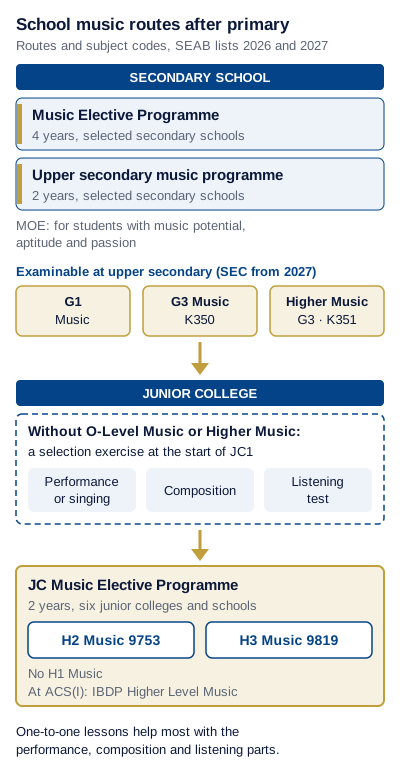
Music runs as a programme or as an exam subject. Selected secondary schools offer the four-year Music Elective Programme or the two-year upper secondary programme, upper secondary music is examinable as G1 or G3 Music, and six junior colleges and schools run a JC Music Elective Programme leading to H2 and H3 Music.
MOE describes the secondary programmes as being for students with music potential, aptitude and passion. At JC level the colleges are Anglo-Chinese Junior College, Anglo-Chinese School (Independent), Dunman High School, Eunoia Junior College, Raffles Institution and Temasek Junior College; at ACS(I) the route is IBDP Higher Level Music. One-to-one lessons help most with the performance, composition and listening parts a classroom has little time to drill.
The diagram traces each route from the secondary programmes and their exam codes to the JC Music Elective Programme.
| Route | Length or level | Entry | Where one-to-one lessons help |
|---|---|---|---|
| Music Elective Programme (secondary) | 4 years, selected secondary schools | Students with music potential, aptitude and passion | Instrument or voice, listening, composing |
| Upper secondary music programme | 2 years, selected secondary schools | As above | Performance pieces and coursework drafts |
| G1 or G3 Music | Upper secondary examinable options | School subject choice | Performance and listening practice |
| G3 Music K350 and G3 Higher Music K351 | SEC from 2027; O-Level 6085 and 6086 until 2026 | School candidates | Performance, composition, aural |
| JC Music Elective Programme | 2 years; H2 Music 9753, H3 Music 9819; no H1 Music | Learners without O-Level Music or Higher Music sit a selection exercise at the start of JC1: performance or singing, composition, listening test | Preparing all three parts of that selection exercise |
How do arts DSA and the Singapore Youth Festival fit in?
Through Direct School Admission, a P6 student can seek a secondary school place on the strength of talent in the visual, literary or performing arts, while the Singapore Youth Festival Arts Presentation puts school groups on stage before professional adjudicators who give feedback.
For a P6 musician, singer or actor, DSA-Sec applications in 2026 open in May and close in early June, according to MOE. A yes to an arts DSA offer is final: the young performer leaves the S1 Posting choices behind, and the arrival of the PSLE results reopens no switch of school. So a performing arts DSA works best for a P6 learner who already loves rehearsing and would choose that school's arts programme anyway. Audition and portfolio work for it sits on our DSA preparation tuition page.
The Singapore Youth Festival is organised by the Arts Education Branch of MOE, and at its Arts Presentation school groups perform before professional adjudicators who give feedback. That feedback is written for the group, and private lessons sharpen the individual part each learner brings to it: the tuning, the timing, the solo bar, the line delivered clearly to the back row. A learner who walks into the group rehearsal with the part secure lifts the whole ensemble.
What do drama, acting, MC and voice lessons cover?
Drama and voice lessons train the body, the breath and the text, and each branch aims at a different stage: a recital room, an audition panel, a musical, a recording booth or an event floor.
Trinity College London grades drama across Acting, Communication Skills, Musical Theatre, Performance Arts, and Speech and Drama, and its Singapore drama exams run in May to June, August to September, and November. In school, Drama becomes the G3 subject K352 under the SEC from 2027, after O-Level Drama 2299 in 2026, and A-Level H2 Theatre Studies and Drama carries the code 9519.
Drama lessons online work well for text work, voice and review of recorded scenes, while blocking and stage movement need floor space at home. The five branches below each have a dedicated page; in brief:
- Speech and drama classes: diction, poetry and prose speaking, mime and graded drama work for young and older learners.
- Acting tuition: monologues, scene study, cold reading and audition preparation.
- Musical theatre: singing, acting and movement joined in one song-and-scene.
- Voice acting: microphone technique, character voices, dubbing timing and reading copy cleanly.
- MC course: hosting structure, crowd reading, bilingual links and handling a run sheet when the event slips.
What about film, photography, makeup and modelling lessons?
These four crafts sit in this hub because they all serve a performance in front of a lens, and each one ends in a piece of work the learner can show.
The learner uses their own camera, phone, editing software, makeup kit or wardrobe; our tutors teach with them and never supply cameras, lights, makeup kits or costumes, nor book a studio. Lesson plans and practice sheets come with the service.
Online lessons suit editing, review of shoots and critique of face charts, and home lessons suit hands-on lighting, posing and makeup practice. The output each learner builds:
- Filmmaking: a short film planned from a shot list, filmed and edited by the learner.
- Photography: a portfolio set around one theme, with notes on light and exposure for each frame.
- Makeup artistry: a book of face charts and photographed looks, from daytime to stage.
- Modelling: a comp card and a set of test shots that show walk, pose and expression.
Can an adult start performing arts lessons from zero?
Yes. Adults start from zero all the time, and one-to-one lessons set the pace around the learner's own week.
The practice research above points to steady, focused work on a named weakness, and an adult can plan the week around exactly that. For an adult who plays or sings after work, the monthly progress report and tutor notes after every session become a logbook to reread on the weeks when the voice or the fingers seem stuck. An adult also decides the goal: a graded exam, a song at a wedding, a scene for a community production, or simply playing well for themselves. Three typical starting points:
- The returning pianist, who stopped at school age: the first month rebuilds reading speed and finger independence and brings back one piece they once played.
- The first-time singer, who sings only in the car: the first month sets a warm-up, finds a comfortable range and records one song from start to end.
- The career host, who has been asked to MC a company event: the first month writes the run sheet, drills the opening two minutes and rehearses recovering from a late speaker.
One to one at home, online or a group class: which suits the learner?
Home lessons suit instruments that stay at home and young learners; online suits theory, voice, acting text work, editing and review; a group class suits learners who mainly want company. Every Eduprime arts lesson is one tutor with one learner, either in the learner's home or on a video call.
Online music lessons work when the acoustic instrument is heard clearly, so set up a working microphone and place the camera to show hands and posture. For a home lesson the instrument stays where it lives, and the tutor comes to it.
| Point | One to one at home | One to one online | Group class |
|---|---|---|---|
| Attention | The full lesson on one learner | The full lesson on one learner | Shared across the group |
| Repertoire | Chosen for the learner | Chosen for the learner | Set for the group |
| Pace | Moves when the learner is ready | Moves when the learner is ready | Moves with the group |
| Exam preparation | Pieces, scales and aural for one candidate | Strong for theory and aural; recorded exam practice | General |
| Equipment | Learner's own instrument at home | Learner's own instrument, camera and microphone | Often the venue's |
| Progress record | Tutor notes after every session and a monthly report | Tutor notes after every session and a monthly report | Varies by class |
| Cost logic | Paid per package for one learner's time | Paid per package; no travel | Cost shared, attention shared |
How is progress in performing arts shown?
An arts learner's progress leaves four kinds of evidence: the tutor's written note from each lesson, the monthly report, a milestone such as a graded exam or a recorded performance, and a real audience.
A cleaner phrase or a steadier bow arm is felt long before it can be shown, so each of these layers produces something on paper or on file that the learner can set beside last term's.
- Lesson notes from the tutor, written each time: the passage or scene covered, what got better, and a single practice target for the coming week.
- Monthly progress report: pieces or scenes completed, technique gains, and the plan for next month.
- Milestones: a graded exam with ABRSM or Trinity, or a recorded performance the learner files and compares with last term's.
- A stage: a school concert, a Singapore Youth Festival Arts Presentation with the school group, a recital or a hosted event.
How much do performing arts classes cost in Singapore?
The price table on this page gives the current rate for each lesson format, calculated by our pricing engine on a 60-minute lesson.
Every pianist, singer or actor opens with the Starter, made of four hour-long lessons at the instrument or on the script. The Starter is settled in one payment before the first lesson, or in two halves, 50% before lesson one and 50% at its midpoint. First-time learners also meet a one-off registration fee, which the same table prints.
Some costs sit with the learner and never pass through us: the instrument, bought or rented; exam entry, paid to the board; and costumes, cameras or makeup kits. Renting an instrument for the first term keeps the starting outlay small while the learner finds out whether the art sticks.
What are the steps from sign-up to a learner's first music, drama or screen lesson?
Register Now on the registration form, tell our team about the goal in the free first consultation, and begin with a tutor who teaches that art and fits the learner's location and week.
Each step, in order:
- 1. Register Now: name the art or instrument, the level and whether lessons are at home or online. Anyone can register the learner, including the learner themselves.
- 2. First consultation, free: our team asks about the goal (an exam, a school route, a role, a portfolio or pure enjoyment) and the equipment already at home.
- 3. Matching: for home lessons our team matches the art with a tutor by the learner's town and timetable; online, only the art and the hours need to line up. Tutor profiles are chosen with our team after registering.
- 4. Starter package: four hour-long lessons at the instrument, script or camera, settled as one payment or as two halves of 50%, the second due midway through.
- 5. Lessons begin, with tutor notes after every session and a monthly progress report.
- Still weighing violin against voice, or acting against MC work? Use Ask a question on the contact form, and talk it over with our team before signing up.
What stays in the learner's hands once arts lessons begin?
From the first lesson the learner holds the weekly practice targets and every lesson record, decides whether the tutor truly knows that instrument or stage craft, and can have the tutor changed free of charge each time the pairing stops working.
These are the points we stand behind for every performing arts learner:
- Tutor notes after every session and a monthly progress report, kept for the learner to compare across terms.
- A replacement tutor whenever the learner asks, free of charge and as often as needed.
- Matching that starts from the art or instrument, then the learner's town and timetable, so a flautist meets a tutor who plays the flute and a drummer meets one who plays drums.
- Tutors experienced and skilled in the art they teach, chosen from a bench of more than 12,000.
- Teaching materials, lesson plans and practice sheets included in the package.
Which page covers the learner's art or instrument?
Every instrument and art in this hub has a dedicated page with its method and examples, and the table below names it.
Public speaking for work and school presentations lives in our life skills range; stage hosting stays here under MC.
| Discipline | Scope | Page |
|---|---|---|
| General music | Several instruments, musicianship and styles | Music lessons Singapore |
| Piano and keyboard | Classical piano, digital keyboard, chords | Piano lessons, keyboard lessons |
| Strings | Violin and cello technique, repertoire, grades | Violin lessons, cello course |
| Guitar and ukulele | Acoustic, classical, electric, ukulele | Guitar lessons, ukulele lessons |
| Drums and flute | Kit drumming, flute tone and repertoire | Drum lessons, flute lessons |
| Voice | Singing technique and repertoire | Singing lessons |
| Theory | Theory grades and written work | ABRSM music theory tuition |
| Drama | Speech and drama, acting, musical theatre | Speech and drama classes, acting tuition, musical theatre course |
| Voice and hosting | Voice acting, MC work | Voice acting tuition, MC course |
| Screen and image | Film, photography, makeup, modelling | Filmmaking tuition, photography course, makeup artist course, modelling course |
| Public speaking | Presentations and speeches off stage | Public speaking course |
Where should a learner go next?
A learner who has chosen an art still needs three decisions: the instrument or branch, the exam board if any, and a weekly practice plan. Each page below settles the first, and the first consultation settles the other two.
An arts DSA needs its audition pieces and portfolio ready, and that work belongs on the DSA preparation tuition page; our O-Level and A-Level guides set out those two exams from start to end. When the instrument or branch is settled, Register Now takes the pianist, singer or actor to the registration form, and Ask a question carries any open doubt to the contact form.
- music lessons singapore
- piano lessons singapore
- keyboard lessons singapore
- violin lessons singapore
- cello course singapore
- guitar lessons singapore
- ukulele lessons singapore
- drum lessons singapore
- flute lessons singapore
- singing lessons singapore
- abrsm music theory tuition singapore
- speech and drama classes singapore
- acting tuition singapore
- musical theatre course singapore
- voice acting tuition singapore
- mc course singapore
- filmmaking tuition singapore
- photography course singapore
- makeup artist course singapore
- modelling course singapore
- public speaking course singapore
- dsa preparation tuition singapore
- o level singapore guide
- a level guide singapore
- dsa sec guide
Sources
- Singapore Symphony Orchestra, ABRSM in Singapore
- Trinity College London, Singapore exam information
- Trinity College London, music qualifications
- Trinity College London, drama grades
- MOE, music programmes and subjects
- MOE, Music Elective Programme at JC
- MOE, Direct School Admission for secondary schools
- SEAB, 2026 GCE O-Level syllabuses examined for school candidates
- SEAB, 2026 GCE A-Level syllabuses examined for school candidates
- Ngee Ann Primary School (MOE), SYF Arts Presentation 2026
- Hambrick et al., Facing facts about deliberate practice, Frontiers in Psychology (2014)

Music, stage and screen lessons, paced to each learner
 4.9from S$33/session
Acting Tuition Singapore for Stage, Screen and Auditions
Acting tuition in Singapore for school drama, screen auditions and LASALLE or NAFA hopefuls. Trusted by thousands. 1-to-1, home or online.
 4.9from S$22/session
Cello Course Singapore with One-to-One Teachers
Cello course Singapore for beginners, orchestra players and ABRSM or Trinity candidates, Initial to Grade 8. Tens of thousands of lessons.
 4.8from S$38/session
Filmmaking Tuition Singapore for Young Directors and Creators
Filmmaking tuition Singapore for teens and creators: script, camera, directing, editing. Chosen by thousands of young directors and creators. 1-to-1 on set.
 4.7from S$28.50/session
Makeup Artist Course Singapore for Freelance and Bridal Careers
Makeup artist course Singapore for beginners and aspiring freelancers: skin prep, colour, bridal, editorial and SFX. Hundreds of coaches.
- 4.8from S$28.50/session
MC Course Singapore: Master of Ceremony Coaching for Every Stage
MC course in Singapore for students, corporate hosts and wedding emcees. Thousands of lessons delivered. In person or online 1-to-1.
 4.6from S$19/session
Modelling Course Singapore for Runway and Camera Confidence
Modelling course Singapore for teens and adults: runway walk, posing, camera presence and a casting comp card. Chosen by thousands.
 4.8from S$19/session
Music Lessons Singapore: A Mastery Course from First Notes to Stage
Music lessons Singapore for all ages: instrument, voice, theory, ABRSM and Trinity grades. Thousands of learners coached.
 4.9from S$24.50/session
Musical Theatre Course Singapore for Singers, Actors and Dancers
Musical theatre course in Singapore for Drama CCA kids, teens and hobbyists. Thousands of performers coached. 1-to-1, online or ensemble.
 4.6from S$28.50/session
Photography Course Singapore for Hobbyists and Aspiring Pros
Photography course Singapore for beginners and aspiring pros: manual exposure, light, editing, portfolio. Hundreds of vetted coaches.
 4.9from S$24.50/session
Voice Acting Tuition Singapore for Hobbyists and Aspiring Pros
Voice acting tuition in Singapore for hobbyists and aspiring pros, from mic to demo reel. Thousands coached. In person or online.
 4.8from S$22/session
ABRSM Music Theory Tuition Singapore for Grades 1 to 8
ABRSM music theory tuition Singapore for Grades 1 to 8 and the Grade 5 pass. Hundreds of vetted music tutors on call.
 4.9from S$19/session
Drum Lessons Singapore for Beginners, Band and CCA Drummers
Drum lessons in Singapore for first-timers, band and CCA drummers and Rock & Pop grades. Drummers teaching 9 to 12+ years. Home or online.
 4.7from S$28.50/session
Flute Lessons Singapore, Tone and Breath from the First Note
Flute lessons in Singapore for beginners, school band players and ABRSM or Trinity grades. Teachers with 7 to 12 years. Home or online.
 4.6from S$19/session
Guitar Lessons Singapore for Songs, Fingerstyle and Grades
Guitar lessons in Singapore on acoustic, classical or electric, for kids and adults. Teachers with 7 to 10+ years. Home or online.
 4.9from S$19/session
Keyboard Lessons Singapore from First Chords to Grade 8
Keyboard lessons Singapore for children, hobby adults and Trinity candidates to Grade 8. Thousands learned chords with us.
 4.8from S$19/session
Piano Lessons Singapore, from First Keys to Grade 8
Piano lessons in Singapore for kids, adults and ABRSM Grade 1 to 8. Teachers with up to 12 years at the keys. Home or online 1-to-1.
 4.6from S$19/session
Singing Lessons Singapore and Vocal Coaching
Singing lessons in Singapore for choir and CCA singers, DSA or SOTA hopefuls and adults. Coaches with up to 11 years.
 4.7from S$22/session
Speech and Drama Classes Singapore for Children and Teens
Speech and drama classes Singapore for kids and teens: oral exams, stage presence and LAMDA grades. Chosen by thousands of young speakers.
 4.7from S$19/session
Ukulele Lessons Singapore for Kids and Adults
Ukulele lessons Singapore for kids and adults, from first chords to RSL grades. Thousands of learners play with us.
 4.9from S$19/session
Violin Lessons Singapore with Setup and Intonation First
Violin lessons in Singapore for young starters, school orchestra players and ABRSM exams. Teachers with 8 to 12 years.