P2 Maths Tuition Singapore for the Year Before P3
P2 maths tuition Singapore means one-to-one lessons for a Primary 2 learner, at home or online, on MOE's 2021 primary maths syllabus. Lessons lock in numbers to 1000, the 2, 3, 4, 5 and 10 times tables and like fractions to twelfths before P3 quickens. Singapore ops pick from 12,000+ tutors to fit this learner's town and weekly timetable.
Last updated
At a glance
- Who it's for
- P2 learners building place value and the tables · P2 learners ready to stretch inside the syllabus
- Format
- 12,000+ tutors on call, with Primary 2 maths among 148+ programmes
- Why Eduprime
- Place value built with hundreds, tens and ones
Who the lessons are for
Does a P2 learner need maths tuition?
A P2 learner needs maths tuition when class work shows a named gap: place value to 1000, the five tables, time to the minute or like fractions.
P2 learners building place value and the tables
Primary 2 asks a learner to read and write numbers to 1000 in numerals and in words. Multiplying and dividing stay inside the tables of 2, 3, 4, 5 and 10. A learner who still counts up in ones to find 7 × 5 has a clear, reachable target. Lessons begin there, with counting in tens and in hundreds.
- Writes three hundred and six as 3006
- Counts in ones to reach 6 × 4
- Unsure which number comes first after the ÷ sign
P2 learners ready to stretch inside the syllabus
Some learners finish class work early and want more to think about. The MOE syllabus links above-level testing to lost motivation and anxiety. So the stretch goes deeper into P2 itself: unfamiliar word problems, number patterns and bar models for two-step questions.
- Finishes class worksheets early and drifts off
- Gets the answer and skips the explanation
- Guesses when a word problem looks unfamiliar
P2 learners heading into the P3 jump
P3 brings numbers to 10 000, the tables of 6 to 9, division with remainder and equivalent fractions. From P3, MOE lets P3 school assessment include weighted assessments, no more than one per subject per term, and those scores count for the year. A learner who ends P2 sure of the five tables meets all of that with a working base.
- Recalls the tables of 2 and 5, hesitates on 3 and 4
- Reads the clock only to the nearest five minutes
- Counts pictures on a graph and ignores the scale
Why Eduprime
Why a P2 maths tutor from Eduprime
Primary 2 maths lessons move from objects to drawings to numbers, led by a tutor Singapore ops match to the learner's named gap.
Place value built with hundreds, tens and ones
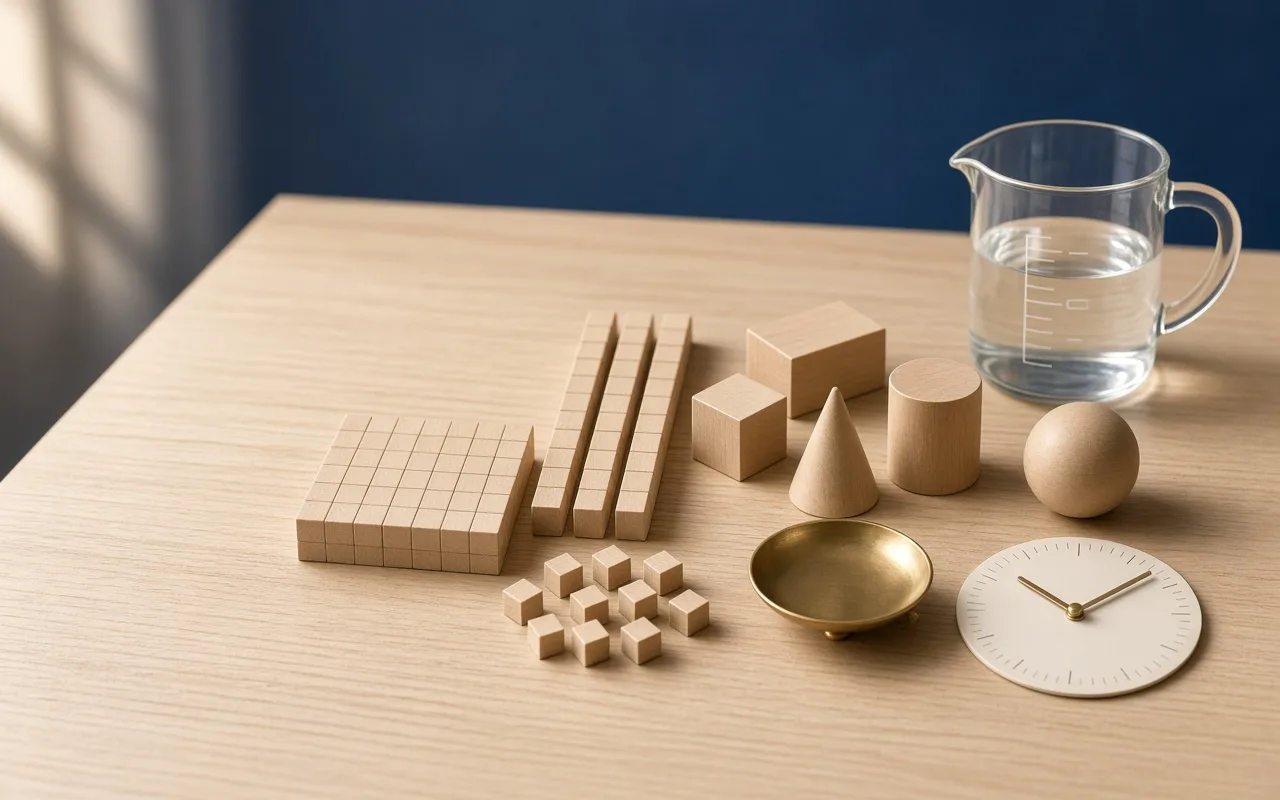
Bundles of ten and flats of a hundred come first, then a place value chart, then numerals and words. A learner who can build 406 with blocks writes it in numerals without the extra zero.
Times tables learnt as equal groups
The tables of 2, 3, 4, 5 and 10 grow out of equal groups and arrays before any recall drill. Seeing the array is how a learner works out why 4 × 5 and 5 × 4 give one total.
Division taught beside its multiplication partner
P2 is the year the ÷ sign first appears in the syllabus. Every division fact is checked against the multiplication fact it belongs to, the link MOE lists as its own learning outcome.
Bar models drawn from the words of the question
Tutor and learner read a word problem together, draw equal units or a part-whole bar, and mark the unknown with a question mark. The number sentence comes last, once the picture shows what to do.
Clock reading down to the single minute
P1 stopped at five-minute marks, and P2 asks for the exact minute. Lessons count the small marks after the last five, then turn hours and minutes into minutes and back again.
A P2 maths tutor matched to this learner
Singapore ops weigh the named P2 gap, the town and the timetable to choose a home or online tutor. Whenever this P2 learner asks for someone new, the replacement tutor comes free.
MOE 2021 syllabus, P2 lines
What is taught in P2 maths?
Primary 2 maths on the MOE 2021 syllabus spans six sub-strands in three strands, from whole numbers to 1000 through to picture graphs with scales.
Numbers to 1000 and place value
The number range grows tenfold from P1. A learner counts in tens and in hundreds, reads and writes numbers in numerals and in words, and sorts them by size.
Hundreds, tens and ones; comparing and ordering; patterns in number sequences; odd and even numbers
Adding, subtracting, multiplying and dividing
Written methods now reach three digits, and mental work adds ones, tens or hundreds to a 3-digit number. Multiplication and division stay inside five tables.
Algorithms up to 3 digits; tables of 2, 3, 4, 5 and 10; the ÷ sign; how multiplication and division relate; mental calculation within the tables
Fractions as parts of a whole
Fractions arrive with their notation and pictures. The primary 2 maths syllabus in Singapore lets denominators run up to 12, so twelfths sit beside halves and quarters.
Fraction notation and representations; comparing and ordering unit and like fractions; adding and subtracting like fractions within one whole
Money in dollars and cents
Coins and notes are counted, then written in decimal notation. Changing an amount such as $3.60 into 360 cents, and back, is the skill that later money questions lean on.
Counting money; reading and writing decimal notation; comparing two or three amounts; converting to cents only and back
Measurement and time
Beside the centimetres of P1, P2 brings metres, kilograms, grams and litres, with the short forms m, kg, g and ℓ. The clock is now read to the exact minute.
Length in metres; mass in kilograms and grams; liquid volume in litres; comparing and ordering measures; telling time to the minute; hours and minutes to minutes and back
Shapes and picture graphs
Flat shapes become pattern pieces sorted by one or two attributes, and five solids get their names. Graphs gain a scale, so one picture can stand for more than one item.
2D patterns by size, shape, colour or orientation; cube, cuboid, cone, cylinder and sphere; picture graphs with scales
Lesson formats
P2 maths home tuition or online lessons?
P2 maths home tuition sets up the lesson at the learner's own table, while the online format runs the identical one-to-one plan on a home screen.
One-to-one at home
The home tutor, chosen for the learner's town and school-week hours, sets blocks, counters and paper strips on the table. A seven- or eight-year-old holds each idea, sketches it, then writes it.
- Tutor matched to town and timetable
- Worksheets and teaching aids used in lessons come with the service
- One tutor and one learner on one P2 plan
One-to-one online
An online tutor proposed by Singapore ops follows the same P2 plan on screen. Tasks stay short, and the learner works on paper beside the screen, with household objects standing in as counters.
- Online tutor proposed by Singapore ops
- Working on paper, held up to the camera
- Same P2 syllabus lines as home lessons
Five steps to a P2 tutor
From the form to the first P2 maths lesson
Primary 2 maths lessons start in five steps, each run by Singapore ops, from the registration form to a tutor working on the named gap.
- 1
The form names the P2 topic
Whoever registers the learner fills in the registration form, picking Primary 2 maths and naming the part that needs work, such as the table of 4 or reading the clock.
- 2
A free initial consultation
Singapore ops talk through the learner's class work, the topic on the form, and whether home or online suits a learner of seven or eight.
- 3
Singapore ops propose a tutor
Ops seek a home tutor who fits the learner's timetable and town, or put forward an online tutor; lesson one opens on the P2 gap from the form.
- 4
Lessons set to the school terms
Term I opens in the first week of January. Terms I and II secure place value and the five tables, which leaves Terms III and IV for fractions, money and time before P3.
- 5
Next step: send the form
The registration form on this page is the next step. It names the P2 topic and the format, and Singapore ops then come back with a proposed tutor for this learner.
Our tutors
P2 maths tutors and the way they teach
Composite P2 maths tutor profiles below illustrate the years of practice and teaching style that Singapore ops weigh before putting a tutor forward.
Ms Lim H.
9 years teaching lower primary maths
Place value and number patterns to 1000
“I hand over ten bundles of ten before I ever say the word hundred.”
Mr Rahman S.
6 years with P1 to P3 learners
Multiplying and dividing inside the five P2 tables
“A table starts life as equal groups on the mat. Recall comes once the groups make sense.”
Mrs Nair P.
Eleven years tutoring primary maths one-to-one
Bar models for equal-groups and part-whole problems
“We draw the bar before we write the sum, every single time, until the learner reaches for the pencil first.”
Ms Chua W.
5 years teaching young learners online
Online lessons for seven- and eight-year-olds
“On screen I keep every task short and ask for the workbook to be held up to the camera.”
Mr Tan J.
8 years with lower primary learners
Money, measures and telling the time
“Cents and minutes feel real once a learner counts actual coins and reads an actual clock face.”
Ms Goh R.
7 years preparing learners for P3
Fractions and the move into P3
“Like fractions in P2 give the equivalent fractions of P3 something solid to stand on.”
In their words
P2 learners on their maths lessons
Primary 2 learners describe, in their own words, the one thing that changed in their maths after lessons began.
I used to write five hundred and two as 5002. Now I put it in the hundreds, tens and ones boxes first, and it comes out right.
Aiden L.
P2 learner · Home lessons · P2 maths
My tutor showed me the 4 times table with egg cartons. I can say it backwards now, and I check my sharing sums with it too.
Zara M.
P2 learner · Home lessons · P2 maths
The clock was hard when the long hand sat between the numbers. I count the little lines now and got 7:43 right the first time.
Ethan K.
P2 learner · Online lessons · P2 maths
I like drawing the boxes. When each bag has 5 marbles I draw the same size boxes, and then I know to times.
Mei Y.
P2 learner · Home lessons · P2 maths
I thought one eighth was bigger than one third because 8 is bigger. Folding paper strips showed me the pieces get smaller.
Arjun R.
P2 learner · Home lessons · P2 maths
My lessons are short jobs and then a stretch break. I hold my workbook up to the camera so my tutor can see each step.
Hana T.
P2 learner · Online lessons · P2 maths
Fees
P2 maths tuition fees by format
Primary 2 fees below come from the pricing engine behind the registration form, and every lesson stays on P2 content, the level MOE's syllabus says assessment should match.
- Widest availability
Online International Tutor
fromS$17/ session
60-minute session
The widest bench of tutors across time zones, so a slot is open at almost any hour. Lessons run online over a shared screen.
Online Local Tutor
fromS$28.90/ session
60-minute session
A tutor based here who knows our schools, syllabuses and exams, teaching online.
Home Tutor
fromS$34/ session
60-minute session
A local tutor who comes to the learner, at home or at a nearby study spot, matched to their town and timetable.
Minimum 4 sessions. Larger packages lower the per-session price. One-time S$15 registration fee for new learners.
| Level | Home tutor | Online, Singapore tutor | Online, international tutor |
|---|---|---|---|
| Primary 2 | S$34 | S$28.90 | S$17 |
A P2 learner taught by an Eduprime tutor gets a free tutor replacement whenever the learner asks.
Student journeys
Two Primary 2 maths journeys
Primary 2 learners in these illustrative stories began from different gaps, and each journey shows the steps lessons took.
Ryan counted to 100 with ease but wrote three-digit numbers by their sound, so six hundred and four came out as 6004.
- Built numbers to 1000 with bundles and flats
- Wrote numbers in numerals and words without slips
- Ordered four three-digit numbers on his own
- Added two 3-digit numbers with regrouping
By the end of P2, Ryan checks his place value before writing an answer, and his class worksheets on whole numbers come back clean.
Ryan C., P2 · Two school terms
Sofia knew the tables of 2 and 10 but added every pair of numbers she saw in a word problem.
- Drew equal units before choosing an operation
- Recalled the table of 3 without counting up
- Checked each division with its multiplication fact
Sofia now draws a bar for each new word problem and can say which operation it needs. The table of 4 still takes practice, so lessons keep a short drill on it.
Sofia N., P2 · One school term
Primary 2 maths, defined
What P2 maths tuition covers in one school year
P2 maths tuition is one-to-one teaching for a Primary 2 learner on that year's MOE syllabus. It covers whole numbers to 1000, five times tables, unit and like fractions, money, measures, time to the minute and picture graphs with scales. Each topic is made secure before P3 builds on it.
- 01Numbers grow from 100 in P1 to 1000 in P2.
- 02The ÷ sign arrives with the tables of 2, 3, 4, 5 and 10.
- 03Fractions cover unit and like fractions, denominators up to 12.
- 04Time is read to the minute; P1 stopped at 5 minutes.
- 05P2 has carried no weighted assessment or examination since 2019.
- 06P3 may add weighted assessments, at most one per subject per term.
From P1 to the PSLE
What changes from P2 to P3 maths?
P3 maths adds numbers to 10 000, tables of 6 to 9 and equivalent fractions; its school assessment may include one weighted assessment per subject per term at most.
- 1
P1
Numbers to 100, multiplying within 40 and dividing within 20, the clock to 5 minutes, money up to $100 and naming flat shapes.
- 2
P2 (this page)
Numbers to 1000, the tables of 2, 3, 4, 5 and 10, the ÷ sign, unit and like fractions, time to the minute and picture graphs with scales.
- 3
P3
An MOE transition year: numbers to 10 000, the tables of 6 to 9, division with remainder, equivalent fractions, area, perimeter and the 24-hour clock.
- 4
P4
The year whose school examination results decide whether P5 and P6 Mathematics is taken at Standard or Foundation level.
- 5
P5 and P6, Standard or Foundation
Mathematics at Standard or Foundation level, with P6 on the 2021 syllabus from 2026 onwards.
- 6
PSLE at the end of P6
A learner in P2 in 2026 reaches P6, and the PSLE, in 2030, on the same 2021 syllabus.
Before the first lesson
Four facts that shape a P2 maths plan
Above-level drills can cost a P2 learner's motivation
The MOE Mathematics Syllabus Primary One to Six cautions that testing above a learner's level may lead to loss of motivation, anxiety and work avoidance. So P2 maths lessons stretch inside P2 content, with harder problems on the same topics.
Primary 2 has no weighted assessment and no exam
MOE removed every weighted assessment and examination for P1 and P2 from 2019, the P2 year-end paper included. Teachers still run classroom checks for timely feedback, and learning is reported in qualitative descriptors in the Holistic Development Profile.
Term I sets the rhythm for the whole year
Term I opens in the first week of January. Securing the five tables and place value to 1000 across the first two terms leaves Terms III and IV for fractions, money and time ahead of P3.
P3 stands directly on P2
P3 is one of four MOE transition years, alongside P5, S1 and S3. Its tables of 6 to 9 rest on the P2 tables, its numbers to 10 000 on place value to 1000, and its equivalent fractions on P2 like fractions.
P1, P2 and P3 side by side
P1, P2 and P3 maths side by side
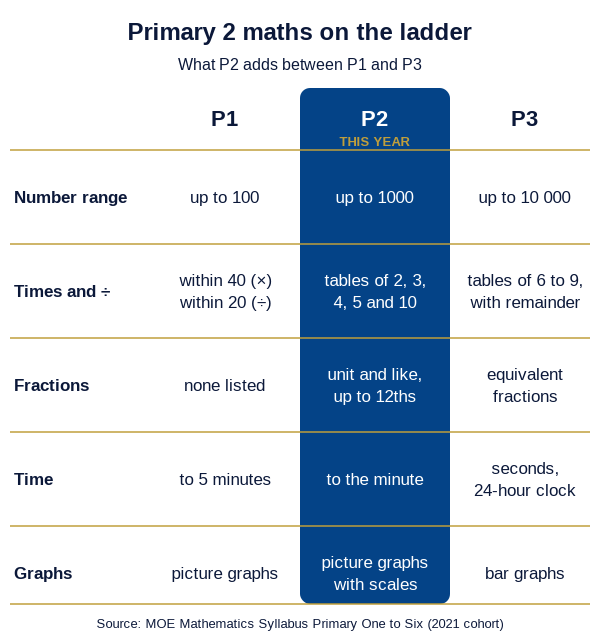
Primary 2 maths sits between P1 and P3 on six lines; the P2 column shows what this year adds and what P3 will build on next.
| Line of the syllabus | P2 (this year) | P1 (the year before) | P3 (the year after) |
|---|---|---|---|
| Number range | Numbers up to 1000 | Numbers up to 100 | Numbers up to 10 000 |
| Multiplication and division | Tables of 2, 3, 4, 5 and 10, with the ÷ sign | Multiplying within 40, dividing within 20 | Tables of 6, 7, 8 and 9, and division with remainder |
| Fractions | Unit and like fractions, denominators up to 12 | No fractions in the P1 list | Equivalent fractions, simplest form, unlike fractions |
| Money | Decimal notation; changing to cents and back | Cents up to $1 and dollars up to $100 | Adding and subtracting in decimal notation |
| Time | To the minute; hours and minutes to minutes | To 5 minutes; am and pm | Seconds, durations and the 24-hour clock |
| Graphs | Picture graphs with scales | Picture graphs | Bar graphs with different scales on an axis |
P1, P2 and P3 side by side
One-to-one at home or online for a P2 learner
One-to-one P2 maths runs at a home table or on a screen, and each row below shows what a seven- or eight-year-old gets from either.
| What a P2 learner gets | One-to-one at home | One-to-one online |
|---|---|---|
| Where the lesson happens | At the learner's own table at home | On a screen at home |
| How the tutor is found | Chosen by Singapore ops for the learner's town and school-week hours | Singapore ops propose an online tutor |
| Who is in the lesson | One tutor and one learner | One tutor and one learner, on screen |
| Changing tutor | Free tutor replacement whenever the learner asks | Free tutor replacement whenever the learner asks |
| Lesson materials | Worksheets and teaching aids used in the lesson come with the service | Worksheets used in the lesson come with the service |
Inside the P2 syllabus
The Primary 2 maths syllabus and the bar model
Primary 2 maths runs on three content strands of the MOE 2021 syllabus, and model drawing is one approach MOE recommends at primary level.
Primary 2 maths syllabus in Singapore: three strands, six sub-strands
MOE wrote the current Mathematics Syllabus Primary One to Six for the cohort that entered P1 in 2021, and it serves P2 in 2026 and 2027. Each P2 learning outcome sits under one of three strands.
Number and Algebra
Whole Numbers: place value to 1000, odd and even numbers, three-digit algorithms and the tables of 2, 3, 4, 5 and 10. Fractions: parts of a whole, unit and like, up to twelfths. Money: decimal notation, changed to cents and back.
Measurement and Geometry
Measurement: metres, kilograms, grams and litres, with time read to the minute. Geometry: 2D patterns by one or two attributes, and five named solids (cube, cuboid, cone, cylinder and sphere).
Statistics
Data Representation and Interpretation: reading picture graphs in which one picture stands for a stated number of items
The bar model, step by step for a P2 learner
Schoolbag, MOE's own publication, wrote on 14 July 2022 that model drawing is one recommended primary approach and that any mathematically sound method is accepted. The bar puts a problem's relationships into a picture, so the learner can plan the steps.
- 1
Read it, then retell it
The learner reads the problem aloud and retells it in their own words. That is the first of Pólya's four problem-solving steps, which the MOE syllabus names.
- 2
Handle it, then draw it
Counters or blocks show the groups before any drawing. The TIMSS 2015 Encyclopedia describes this Concrete-Pictorial-Abstract (CPA) order as central to Singapore's primary teaching.
- 3
Equal units and a question mark
Equal groups become equal boxes, with one box labelled by its value. A brace and a question mark then mark exactly what the question asks for.
- 4
Write the number sentence and check it
The bar turns into a number sentence, and the learner checks with the inverse operation. A P2 learner who checks this way stops losing working to sums that answer the wrong question.
Worked P2 maths
An equal-groups problem, solved and checked
An equal-groups word problem inside the five P2 tables (2, 3, 4, 5 and 10), solved here with the table of 5, a bar model and a division check.
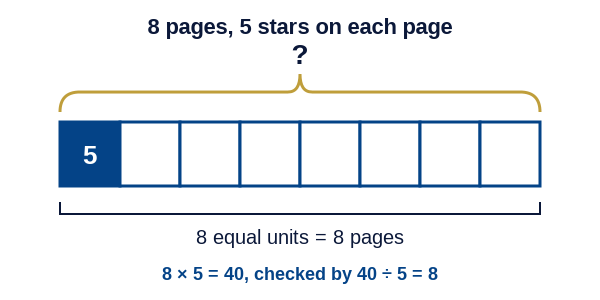
Worked example: stars on eight pages
The problem
Ravi sticks 5 stars on each page of his sticker book. He fills 8 pages. How many stars does Ravi use?
Worked solution
- 1Name the method: a bar model with equal units, because every page holds the same number of stars.
- 2Draw 8 equal boxes in a row, one for each page, and write 5 inside the first box.
- 3Draw a brace over all 8 boxes and write a question mark for the total.
- 4Write the number sentence: 8 groups of 5 gives 8 × 5 = 40.
- 5Check with division: 40 ÷ 5 = 8, which matches the 8 pages in the question.
Answer: Ravi uses 40 stars.
Equal boxes signal multiplication. Adding the two numbers in the question, 8 + 5, is the first slip in the list below.
Six slips that turn up in Primary 2 maths
Each slip below comes from a P2 line of the syllabus, and each fix is a short routine the tutor repeats until the learner uses it unprompted.
Adds the two numbers in an equal-groups problem, such as 8 + 5 for 8 pages of 5 stars.
Draw the equal units first and count the boxes. Same-size boxes mean multiplication.
Writes three hundred and five as 3005, copying the sound of the words.
Fill a hundreds, tens and ones chart first, then read the digits straight across.
Reads the clock to the nearest five minutes, the P1 habit, when the minute hand sits between marks.
Find the last five-minute mark, then count each small mark after it one by one.
Says one fifth is bigger than one third because 5 is bigger than 3.
Fold two equal paper strips into thirds and fifths. More parts make each part smaller.
Adds $4.35 and 290 cents as if both were the same unit.
Change both amounts to cents first, then add or compare the whole numbers.
Counts the pictures on a picture graph and ignores the scale in the key.
Read the key aloud first, then multiply each count by the value of one picture.
What strong P2 maths work looks like
The MOE syllabus names four assessment objectives. Each row below turns one of them into something a tutor can watch a P2 learner do.
| Criterion | What strong work shows |
|---|---|
| Understanding concepts beyond recall | Builds 4 × 5 as an array and explains why it shares its total with 5 × 4. |
| Reasoning, communicating and connecting ideas | Says which step comes next and why, and links each ÷ fact to a times table. |
| Formulating, representing, solving and interpreting | Draws a bar model from the words, solves it, and checks that the answer fits the story. |
| Strategies for non-routine problems | Tries a list, a pattern or a drawing on an unfamiliar question, the habit lessons build once the five tables are secure. |
Primary 2 in a Singapore school
P2 to P3 at school, and a money problem worked
P3 is one of four MOE transition years, and P3 school assessment may include up to one weighted assessment per subject per term.
How the P2 year leads into P3 at school
Two MOE policies shape the move: weighted assessments and examinations for P1 and P2 ended from 2019, and the transition years begin at P3.
P3 is a named transition year
MOE lists P3 with P5, S1 and S3 as years that bring new subjects or higher content rigour, so the step up in maths is planned for.
Schools may set up to one weighted assessment a term per subject from P3
From P3 through S4 or S5, a school may include weighted assessments, capped at one per subject each term, and a score from one counts towards the year's overall result.
P3 content rests on P2 content
The tables of 6 to 9 build on the five P2 tables, numbers to 10 000 build on place value to 1000, and equivalent fractions build on like fractions.
Learning Support for Mathematics
LSM, taught by trained teachers, may take in learners during P2, in groups of up to 8 for 4 to 8 periods a week at P1 and P2. One-to-one lessons can run beside it on the same P2 lines.
Worked example: dollars and cents into cents
The problem
Aisha has $4.35 in her coin pouch. Her brother Danial has 290 cents. Who has more money, and how many cents do they have altogether?
Worked solution
- 1Name the method: turn both amounts into cents first, so they become two whole numbers to compare and add.
- 2Change $4.35 to cents: 4 dollars is 400 cents, and 400 + 35 = 435 cents.
- 3Compare: 435 cents is more than 290 cents, so Aisha has more money.
- 4Add the cents: 435 + 290 = 725 cents.
- 5Change back to check: 725 cents is $7.25, the same total in decimal notation.
Answer: Aisha has more money. Together they have 725 cents, which is $7.25.
Mixing dollars and cents in one sum is the fifth slip in the list above. P3 adds money in decimal notation, so a learner who converts with ease in P2 meets that step ready.
Accountability
What keeps P2 maths lessons accountable
Primary 2 maths lessons run on four service rules that Eduprime states for every learner, from how tutors are paid to how a lesson moves.
Sessions validated before tutors are paid
Eduprime releases a P2 tutor's pay only for sessions that pass validation, and the tutor collects nothing from the learner side, so the lesson record shows teaching that happened.
A free tutor change on request
A P2 learner gets a free tutor replacement whenever the learner asks.
Tutor matching is on us
Eduprime owns the P2 tutor search. Should the search find no suitable tutor in the 14 days after registration, with no P2 lesson yet held, lesson payments come back within 30 business days of approval; Eduprime keeps the registration fee.
Lessons moved with notice
School outing on lesson day? With 24 hours' notice, the P2 lesson moves or is cancelled free.
The P2 year in numbers
The Primary 2 maths year in four numbers
Primary 2 results rest on daily class work, steady practice of the five tables and clear place value; lessons work on each, and schools report learning in descriptors.
- 1000
- the largest whole number in P2, up from 100 in P1
- 5
- times tables in P2: 2, 3, 4, 5 and 10
- 12
- the largest denominator in P2 fractions
- 0
- weighted assessments or examinations in P2 since 2019
Questions about Primary 2 maths
P2 maths tuition questions, answered
Primary 2 maths questions from learners and from those who register them, each answered from MOE sources and the way lessons run.
Primary 2 maths tutor
P2 maths tuition Singapore, at home or online
Tables of 6 to 9 arrive in P3, where weighted assessments may start; name the P2 gap on the form and ops suggest a tutor.
- Form names the P2 gap
- Singapore ops propose a tutor
- Home or online, one-to-one
Eduprime · Primary 2 maths, at home or online
Where P2 maths leads