Primary Science Tuition Singapore for P3 to P6
Primary science tuition Singapore at Eduprime coaches P3 to P6 learners one to one through the MOE 2023 Primary Science syllabus, at home or over live video. Science starts at P3, and the syllabus runs on five themes with topics fixed for each level. From P5 each learner follows Standard or Foundation Science, a level P4 school examination results decide.
Last updated
At a glance
- Who it's for
- P3 learners new to science · P4 and P5 learners before the Standard or Foundation split
- Format
- 12,000+ tutors · 5 science themes · P3 to P6
- Why Eduprime
- Topic order by level
Who it serves
Which primary science learners do our lessons serve?
Primary science learners at three points: meeting science at P3, nearing the P5 level split, and studying Foundation Science in P5.
P3 learners new to science
A P3 learner meets science as a subject for the first time, with new words such as magnetic material, life cycle and classification. Lessons turn each word into something the learner can sort, draw or test at the kitchen table, so the word sticks with its meaning.
- Names objects without the property that sorts them
- Treats every metal as magnetic
- Writes one-word answers to explain questions
P4 and P5 learners before the Standard or Foundation split
P4 school examination results set the P5 science level, and P5 brings five new topics, from reproduction to the electrical system. Lessons secure the P4 systems, matter, light and heat first, then preview circuits and the water cycle so the P5 topics arrive in familiar steps.
- Swaps heat and temperature in written answers
- Explains shadows without light travelling in straight lines
- Changes two variables in one investigation
P5 learners on Foundation Science
A P5 learner on Foundation Science works through most Standard topics at a pace built for steady practice. Lessons follow the Foundation topic list, build a word bank for each topic and practise the short-response and structured questions the Foundation Science paper uses.
- Leaves the key word out of short-response answers
- Mixes up the steps of the water cycle
- Reads a results table without stating the pattern
Why Eduprime
Why do primary science learners choose Eduprime?
Primary science lessons at Eduprime rest on six habits drawn from the 2023 syllabus, each aimed at a slip that shows up in a learner's written answers.
Topic order by level
Lessons follow the topic order the 2023 syllabus fixes for P3, P4, P5 and P6, so a P4 learner revises plant parts while school is teaching them.
Fair tests from P4
Investigation questions are planned with changed and unchanged variables, the fair test MOE expects learners to recognise by the end of P4 and design by the end of P6. Lessons add the measured variable so each plan says what is read.
Key ideas in every answer
Answers are rebuilt around the key idea: light travels in straight lines, heat flows from hotter to colder, a closed circuit carries current.
Home items as apparatus
Melting ice in a cup, a fridge magnet lifting paper clips and a torch beam on a wall let a P3 to P6 learner watch a syllabus idea happen, then put it into words.
Standard or Foundation tracked
Lessons track the learner's P5 level and its topic list, including the content Foundation Science leaves out, such as energy conversion and elastic spring force, so revision follows the learner's own course.
Notes after every session
After each science lesson the tutor writes up the topic and skill worked on, and once a month those lesson notes come together in a progress report for a parent or guardian.
Five themes
What does each primary science theme cover from P3 to P6?
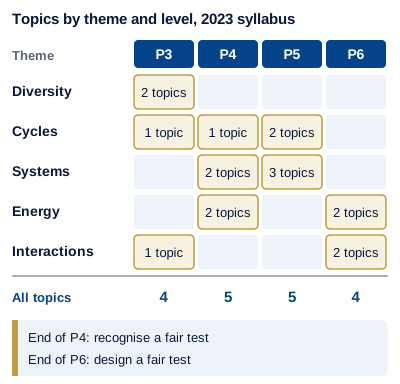
The five themes of the 2023 Primary Science syllabus, each shown with the levels where its topics appear and the habit lessons build for it.
Diversity
Diversity opens science at P3. Learners sort living and non-living things by their general characteristics, then compare materials by their properties. Classification becomes the first scientific habit, and lessons build sorting tables from household objects within the learner's reach.
P3 only: living and non-living things sorted by characteristics; materials compared by property
Cycles
Cycles runs through three levels. P3 learners trace life cycles, P4 learners describe matter in three states, and P5 learners link reproduction in plants and animals with water changing state. P5 Standard learners also recognise that a cell is a basic unit of life. Lessons draw each cycle as a loop the learner labels from memory.
P3: life cycles · P4: matter · P5: reproduction; water
Systems
Systems is the P4 and P5 theme where parts work together. Plant parts and the digestive system come first. At P5 the respiratory and circulatory systems of plants and humans follow, together with the electrical circuit of battery, wire, bulb and switch.
P4: plant parts and functions; digestive system · P5: respiratory and circulatory systems; electrical system
Energy
Energy starts with light and heat at P4 and returns at P6 with photosynthesis and energy conversion. Lessons separate heat from temperature early: heat is energy that flows from hotter to colder, temperature measures how hot something is, and an answer that swaps the two states the wrong idea.
P4: light; heat · P6: photosynthesis; energy conversion (Standard)
Interactions
Interactions bookends the syllabus. Magnets open it at P3, and at P6 learners study frictional and gravitational forces, with elastic spring force on the Standard path, and how living things interact within their environment. Lessons test each force with a spring, a slope or a magnet at home.
P3: magnets · P6: forces; interactions within the environment
Lesson formats
Where do primary science lessons take place?
Primary science lessons for one P3 to P6 learner happen at home with a tutor at the table or live on screen, and the registration form asks which suits.
Home lessons
For home lessons, our team matches a primary science tutor to the town where the learner lives and to the learner's timetable, around school, CCA and homework. A parent or guardian gives consent at registration and arranges the home setting. Hands-on checks use simple items the learner already has, such as a torch, magnets or a cup of ice.
- Science lessons at the learner's own table
- Matched to town and timetable
- Topic worksheets supplied
Online lessons
Lessons run live over video with the same syllabus plan, worksheets shared on screen and diagrams drawn together. Live video fits a learner whose science lessons must move around shifting school activities, and online lessons carry the same session notes and monthly report.
- Live one-to-one video lessons
- Shared worksheets and diagrams
- Same registration form, mode online
Getting started
How does a primary science learner start lessons with Eduprime?
Primary science learners go from the registration form to their first monthly report in five steps, each named below.
- 1
Register through the form
The registration form asks for the learner's level, the science topics in class now, and whether lessons happen at home or online. A parent or guardian registering a primary learner gives consent at this step.
- 2
Free consultation with our team
Our team talks through the learner's current topics, recent school tests and the P5 level if it is already known. The consultation sets out what the first package will cover.
- 3
Tutor matched to the learner
For home lessons our team matches the learner with a primary science tutor by town and timetable; for online lessons the timetable guides the pairing. The match also weighs the topics the learner is working on.
- 4
The Starter package begins
The Starter package runs 4 sessions of 60 minutes. After each session the tutor leaves notes naming what the learner got right and what to revise.
- 5
Monthly report and next package
The monthly progress report lists topics covered and skills practised. The learner and the registrant use it to plan the next package, including the P5 level once P4 results are known.
Our tutors
Who teaches primary science at Eduprime?
Primary science tutors at Eduprime know P3 to P6 science well from years at the table with young learners; each profile here is a composite sketch drawn from the tutors learners work with.
- Experience teaching P3 to P6 science one-to-one
- Working knowledge of the 2023 Primary Science syllabus
- Clear, patient explanation for young learners
Ms Tan W.
8 years teaching primary science
P5 systems: respiratory and circulatory systems in plants and humans
“A learner who can trace one breath from the nose to the blood can answer most circulation questions.”
Mr Rahman S.
6 years teaching primary science
P5 electrical system and circuit diagrams
“I ask for the closed path first, then the number of batteries, then the bulbs.”
Ms Priya K.
5 years teaching primary science
P4 matter and P5 water: states and changes of state
“A learner who says ice gains heat to melt has the water topic in hand.”
Mr Lim J.
9 years teaching primary science
P6 forces and fair-test planning
“A spring and a few coins teach more about fair tests than any definition.”
Ms Wong H.
4 years teaching primary science
P3 diversity, life cycles and magnets
“Sorting a drawer of everyday objects is a P3 learner's first real experiment.”
In their words
What do primary science learners say about their lessons?
Primary science learners describe lessons in their own words; the quotes are illustrative and shared with privacy-style names.
My tutor made me hold a torch closer to my pencil case and watch the shadow grow. Now I write that light travels in straight lines in every shadow answer.
Aisyah R.
P4 learner · Home lessons · Primary science
I kept saying there was no battery when the bulb was off. My tutor drew the switch open on the screen, and I finally saw the gap in the circuit.
Ethan L.
P5 learner · Online lessons · Primary science
I thought every metal sticks to magnets. We tested a nail, a paper clip and a piece of copper wire at my table, and only the nail and the clip moved.
Mei Xin C.
P3 learner · Home lessons · Primary science
Planning the spring experiment was hard until I wrote three headings first: change, measure, keep the same. I use them for every investigation now.
Darren O.
P6 learner · Home lessons · Primary science
My short answers used to miss the key word. My tutor gives me a word bank for each topic, and I practise fitting the words into two sentences.
Nur Hidayah A.
P5 learner, Foundation Science · Online lessons · Primary science
After every lesson I get the tutor's notes naming the science topic covered and what to revise before the next one. The monthly report showed when heat and temperature finally made sense to my son.
Mrs Goh S.
Parent of a P4 learner · Online lessons · Primary science
Fees
How much does primary science tuition cost?
Primary science fees for each 60-minute lesson, home or online, are calculated by our pricing engine and listed in the fee table below, together with the single registration charge a first-time P3 to P6 learner pays once.
- Widest availability
Online International Tutor
fromS$17/ session
60-minute session
The widest bench of tutors across time zones, so a slot is open at almost any hour. Lessons run online over a shared screen.
Online Local Tutor
fromS$28.90/ session
60-minute session
A tutor based here who knows our schools, syllabuses and exams, teaching online.
Home Tutor
fromS$34/ session
60-minute session
A local tutor who comes to the learner, at home or at a nearby study spot, matched to their town and timetable.
Minimum 4 sessions. Larger packages lower the per-session price. One-time S$15 registration fee for new learners.
Any primary science learner can ask for a different tutor, free of charge, whenever they like and with no limit on requests.
Student journeys
How have primary science learners progressed over a term?
Primary science journeys, illustrative and shared with privacy-style names, show what changed for three learners at three levels.
Ryan wrote that things get hotter for every heat question and muddled answers that asked about temperature.
- Read a thermometer at home in warm and cold water
- Wrote heat flows from hotter to colder in answers
- Explained a melting ice cube in two sentences
By the end of the term Ryan's heat answers named both ideas in the right places, and he carried the habit into the matter topic.
Ryan T., P4 · One term
Sofia found circuit diagrams confusing and guessed which bulbs would light.
- Built circuits from diagrams with her tutor on video
- Traced the closed path before every answer
- Compared bulbs in series and in parallel
Sofia now traces the path before answering any circuit question, and her school topical test on the electrical system rose from 11 to 17 out of 20.
Sofia M., P5 · One term
Arjun changed two things at once in every investigation he planned, so his conclusions could not stand.
- Learned the changed, measured and unchanged routine
- Planned a spring test with coins at home
- Explained why one variable changes at a time
Arjun plans investigations with one changed variable and two kept unchanged, and he now finishes those questions with time to check his work.
Arjun P., P6 · Two terms
Primary science
What is primary science tuition?
Primary science tuition is one-to-one coaching that follows the MOE 2023 Primary Science syllabus from P3, when science first appears on the timetable, to P6. It teaches the key ideas of five themes, the inquiry skills the syllabus expects by the end of P4 and P6, and the habit of writing each key idea in syllabus words.
- 01Science starts at P3; the MOE syllabus covers P3 to P6.
- 02Five themes: Diversity, Cycles, Systems, Energy and Interactions.
- 03Topics are fixed for each level: P3, P4, P5 and P6.
- 04Standard or Foundation Science from P5, set by P4 school examination results.
- 05Fair tests: recognise one by the end of P4, design one by P6.
P3 to P6
How does primary science build from P3 to P6?
Primary science levels run P3, P4, P5 and P6, and each level adds topics and one step in how a learner investigates.
- 1
P3
Science begins. Diversity, life cycles and magnets come first, with practice in observing, sorting and comparing that prepares the learner for the P4 fair-test checkpoint.
- 2
P4
Plant and digestive systems, matter, light and heat. By the end of P4 a learner recognises a fair test, and the year's school examination results set the P5 level.
- 3
P5 (Standard or Foundation)
Reproduction, water, respiratory and circulatory systems and electricity: five topics taken at the level set by P4 results. Standard learners also meet the cell as a basic unit of life and bulbs arranged in parallel.
- 4
P6 and PSLE
Photosynthesis, energy conversion, forces and the environment, with fair tests designed by the learner. PSLE paper technique sits on our PSLE science tuition Singapore page.
Before P5
What should be checked before P5 science?
Check the P5 science level early
Science at P5 is offered at Standard or Foundation level, set by P4 school examination results. Knowing the level early lets lessons follow the right topic list, since Foundation Science leaves out energy conversion, elastic spring force and Standard-only outcomes such as bulbs in parallel.
The PSLE Science format changed in 2026
SEAB revised PSLE Science 0009 for examination from 2026. A single sitting of 1 hour 45 minutes opens with 30 multiple-choice items in Booklet A and closes with Booklet B's 10 or 11 structured questions. Paper technique for this format sits on our PSLE science tuition Singapore page.
A P4 learner ready for P5 science
A learner ready for P5 names the changed and unchanged variables in a light or heat experiment. The same learner explains a shadow with light travelling in straight lines and tells heat from temperature in one sentence. Those three habits carry straight into circuits and the water cycle.
Level by level
What changes in primary science between P3, P4, P5 and P6?
Primary science levels compared on four points: the themes met, the topics, the inquiry step expected, and how the year is assessed.
| Aspect | P3 | P4 | P5 | P6 |
|---|---|---|---|---|
| Themes met | Diversity, Cycles, Interactions | Systems, Cycles, Energy | Cycles, Systems | Energy, Interactions |
| Topics | Living and non-living things, materials, life cycles, magnets | Plant parts, digestive system, matter, light, heat | Reproduction, water, plant and human respiratory and circulatory systems, electrical system | Photosynthesis, energy conversion, forces, interactions within the environment |
| Inquiry step | Observing, sorting and comparing, building toward the P4 checkpoint | Recognise a fair test: which variable changed and which stayed unchanged | Plan investigations with batteries, bulbs and water as practice for P6 | Design a fair test (changed and unchanged variables) |
| How it is assessed | School-based written tests and performance tasks; no mid-year exam | School-based; P4 school examination results set the P5 level | School-based, at Standard or Foundation level | PSLE Science 0009 or Foundation Science 0039 |
Level by level
How do Standard and Foundation Science differ from P5?
Standard and Foundation Science share most topics; the 2023 syllabus and the 2026 PSLE formats set out these differences.
| Point | Standard Science | Foundation Science |
|---|---|---|
| What sets the level | P4 school examination results | P4 school examination results |
| Cell as a basic unit of life (P5) | Recognised in the reproduction topic | Not in the Foundation outcomes |
| Bulbs in a circuit (P5) | Number of bulbs in series and in parallel | Number of bulbs arranged in series |
| Energy conversion (P6) | Taught | Not required |
| Forces (P6) | Frictional, gravitational and elastic spring force | Frictional and gravitational force |
| PSLE paper | Science 0009, one paper of 1 hour 45 minutes | Foundation Science 0039, 1 hour 15 minutes, word list provided |
| Booklet A | 30 multiple-choice questions, 4 options, 60 marks | 20 multiple-choice questions, 3 options, 40 marks |
| Booklet B | 10 or 11 structured questions, 40 marks | 9 to 11 short-response and structured questions, 30 marks |
2023 syllabus
How is the primary science syllabus laid out?
The 2023 Primary Science syllabus groups P3 to P6 topics into 5 themes and sets inquiry checkpoints at the end of P4 and P6.
Which topics sit in each of the five themes?
Five themes organise the syllabus, and each topic is fixed to a level. No topic in the level table is titled cells, yet P5 Standard learners recognise that a cell is a basic unit of life within the reproduction topic, an outcome the Foundation course leaves out.
Diversity
P3: living and non-living things by general characteristics and classification; diversity of materials and their properties.
Cycles
P3: how plants and animals grow through their life cycles. P4: matter has mass and occupies space; solids, liquids and gases differ in shape and volume. P5: reproduction in plants and animals, where Standard learners recognise that a cell is a basic unit of life; water in three interchangeable states, with ice melting at 0 degrees Celsius.
Systems
P4: the job of each plant part, and the digestive system. P5: respiratory and circulatory systems in plants and humans; the electrical system of battery, wire, bulb and switch, with the number of batteries and bulbs in series, and bulbs in parallel for Standard Science.
Energy
P4: light, seen when an object reflects it or gives it off, travelling in straight lines and forming shadows; heat, temperature and heat flow from hotter to colder. P6: photosynthesis; energy conversion for Standard Science.
Interactions
P3: magnets, their two poles, attraction and repulsion, and making a magnet by stroking or with electricity. P6: frictional, gravitational and elastic spring forces (elastic spring force for Standard); interactions within the environment.
What should a learner show by the end of P4 and P6?
The syllabus names eight Ways of Thinking and Doing and marks progress at two points, the end of P4 and the end of P6. The first row gives the syllabus wording; the other rows show how lessons pace each practice toward those checkpoints.
| Criterion | By the end of P4 | By the end of P6 |
|---|---|---|
| Designing investigations | Recognise a fair test (changed and unchanged variables), in the syllabus wording | Design a fair test (changed and unchanged variables), in the syllabus wording |
| Analysing and interpreting data | Lessons practise reading a results table and stating the pattern in one sentence | Lessons practise reading bar and line graphs and linking the trend to the key idea |
| Constructing explanations | Lessons practise answers that state the key idea, such as light travelling in straight lines | Lessons practise cause-and-effect chains, such as how a closed circuit lets current flow |
| Communicating with evidence | Lessons practise naming the observation behind each claim | Lessons practise defending a conclusion with data from the learner's own fair test |
P4 light, worked
How does a P4 learner solve a shadow question?
P4 light questions turn on 1 key idea, light travelling in straight lines; this group works one problem, four common slips and two Singapore rules.
Worked example: moving the ball closer to the torch
The problem
A torch shines on a ball placed in front of a screen, and a shadow forms on the screen. The ball is moved closer to the torch while the torch and the screen stay where they are. What happens to the size of the shadow, and why? Name one variable kept unchanged so the test is fair.
Worked solution
- 1Recall the key idea: light travels in straight lines, and a shadow forms where the ball blocks the light.
- 2Picture the light from the torch spreading out in straight lines. Close to the torch, the ball blocks a wider part of that spread.
- 3The blocked region that reaches the screen is therefore wider, so the shadow becomes larger.
- 4For a fair test only the ball's distance from the torch changes; the ball's size and shape and the screen's position stay unchanged.
Answer: The shadow becomes larger, because the ball blocks a wider part of the light travelling in straight lines from the torch. One unchanged variable: the size of the ball (its shape or the screen's position also count).
Naming the unchanged variables is the P4 fair-test step, and it is also the fix for the two-variable slip listed below.
Which primary science slips can a learner fix at home?
Each slip below traces back to one syllabus outcome, so each has a precise fix a learner can practise at home.
P3: treating every metal as magnetic
Test a piece of copper wire, an aluminium can tab and a steel paper clip. Magnets attract iron and steel, so name a magnetic material by what it is made of.
P4: using heat and temperature as one word
Temperature measures how hot something is; heat is the energy that flows from hotter to colder. Write both words where each belongs in every heat answer.
P5: changing two variables in one investigation
Write three headings before planning: change, measure, keep the same. Only one item goes under change.
P5: saying an unlit bulb has no battery when the switch is open
Trace the path from one battery terminal back to the other. A gap anywhere means the circuit is open, so no current flows.
Two Singapore rules that shape P5 and Sec 1 science
Two MOE rules shape which science course a learner takes after P4 and after the PSLE.
P4 school examinations set the P5 level
In P5 and P6, Science, Mathematics, English and Mother Tongue are each taken at Standard or Foundation level, decided by the P4 school examination results. P4 lessons therefore cover the full year's topics, from plant parts to heat, with those examinations in view.
Foundation Science and Sec 1
Under Full Subject-Based Banding, a learner who sat Foundation Science at the PSLE and studies most subjects at G3 can take Science at a less demanding level, in consultation with the secondary school. Foundation Science at P5 builds the base for that choice.
P5 circuits, worked
How does a P5 learner compare two circuits?
P5 electrical system questions compare circuits with 1 or 2 batteries; this group works one problem, then sets out the six-step fair-test routine.
Worked example: one battery or two in series
The problem
Circuit A has one battery and one bulb. Circuit B has two batteries connected in series and one bulb identical to the bulb in A. Which bulb is brighter, and why? What happens to the bulb in circuit A if its switch is opened?
Worked solution
- 1Identify the variable that differs: the number of batteries in series. The bulbs are identical.
- 2Two batteries in series push more current through the closed circuit than one battery does.
- 3More current through an identical bulb makes it brighter, so the bulb in circuit B is brighter.
- 4Opening the switch in circuit A breaks the closed circuit, so no current flows and the bulb goes off.
Answer: The bulb in circuit B is brighter, because two batteries in series give more current. In circuit A, an open switch breaks the closed circuit, so no current flows and the bulb is off.
The open-switch part answers the no-battery slip listed above: the battery is still there, and the circuit path is broken.
How do lessons teach the fair test?
Lessons run every investigation question, from P4 shadows to P6 springs, through the same six steps, so recognising a fair test at P4 grows into designing one at P6.
- 1
Ask the question
Write the question as how one thing affects another, for example how the number of bulbs in series affects their brightness.
- 2
Choose what changes
Name one changed variable, the first thing in the question, and list the values to try.
- 3
Choose what is measured
Name the measured variable and how it is read: with a ruler, a thermometer or two bulbs compared side by side.
- 4
Keep the rest the same
List at least two unchanged variables, such as the same bulbs, the same wires or the same starting length of a spring.
- 5
Record and read the data
Fill a results table, then state the pattern in one sentence that names both the changed and the measured variable.
- 6
Conclude with evidence
State the conclusion and the key idea behind it, since a conclusion with no reason leaves the question half answered.
Accountability
How can progress in primary science be checked?
Primary science progress shows up in the tutor notes and the monthly report, so each step is visible between school tests.
Tutor notes after every session
Each primary science session ends with the tutor's written notes on the lesson.
Monthly progress report
Once a month the learner and a parent or guardian receive a progress report.
Free tutor replacement
Whenever another primary science tutor would serve better, the learner or whoever registered them can ask, and our team arranges the new match at no charge and with no cap on requests.
What lessons build
What does primary science tuition work on?
Primary science results rest on three factors: knowing each topic's key idea, writing it in syllabus words, and planning fair tests. Lessons drill all three.
- 5
- Syllabus themes taught, from Diversity to Interactions
- 4
- Levels mapped topic by topic: P3, P4, P5 and P6
- 8
- Ways of Thinking and Doing practised in lessons
- 12,000+
- Tutors across 148+ programmes on Eduprime
Questions
What do P3 to P6 science learners and their registrants ask us most?
Primary science questions on start age, levels, assessment, lessons, cost and tutors, each answered from the 2023 syllabus and our service.
P4 to P5
Ready for the step from P4 to P5 science?
P4 school examination results set Standard or Foundation Science at P5, where five topics arrive in one year.
- Home or online lessons
- Tutor notes every session
Eduprime · Primary science tuition, P3 to P6, at home or online
Related tuition