Secondary Maths Tuition in Singapore for G1 to G3
Secondary maths tuition in Singapore gives each learner from Sec 1 through Sec 4 a one-to-one Eduprime maths tutor who follows the MOE syllabus for their level, G1, G2 or G3. Home tutors are paired by neighbourhood and free evenings, online tutors by calendar, and both work towards the SEC papers that replace the O-Level from 2027.
Last updated
At a glance
- Who it's for
- G3 Mathematics learners, Sec 1 to Sec 4 · G2 Mathematics learners
- Format
- Every G1, G2 and G3 maths learner across Sec 1 to Sec 4 is paired from a 12,000+ tutor bench
- Why Eduprime
- Planned on the learner's subject level
Who it serves
Which secondary maths learners is this tuition for?
Secondary maths learners at all three subject levels, plus anyone changing level or returning after a break, each with a different gap in the work.
G3 Mathematics learners, Sec 1 to Sec 4
G3 learners meet linear equations in Sec 1 and quadratic factorisation in Sec 2, earlier than G2 learners meet it. Lessons aim to secure that algebra before set notation, matrices and vectors arrive in Sec 3/4.
- Algebraic fractions that collapse when the denominators differ
- Long Paper 2 questions where the method is clear and the setting-out is thin
G2 Mathematics learners
G2 learners share the three strands with G3 and meet some topics later, and AO1 carries 60% of the marks at G2 against 45% at G3. Lessons build that routine technique and prepare the Section B choice in Paper 2.
- Quadratic equations by formula and completing the square in Sec 3
- Unit conversion in rate and speed questions
G1 Mathematics learners
G1 Mathematics prepares learners for technical- or service-oriented education and puts weight on applying maths in real-world contexts. Lessons turn those contexts into short equations the learner can write and check alone.
- Forming an equation from a word problem in Sec 2
- Reading the longer contextual questions worth 6 to 8 marks
Learners changing level or returning
A learner moving from G2 to G3 Maths, joining from overseas or returning after time away needs the missing topics found and taught in order. The plan sets the new class's topic list beside the maths already covered and starts with the difference.
- Topics the new level covered a year earlier
- A different textbook sequence after a school change
Why Eduprime
What makes our secondary maths tuition fit each level?
Secondary maths lessons at Eduprime start from the learner's subject level and school scheme of work, and six choices follow from that.
Planned on the learner's subject level
The tutor follows the MOE syllabus for the learner's level, G1, G2 or G3. Quadratic factorisation therefore comes in Sec 2 at G3 and in Sec 3/4 at G2, in step with school.
Algebra secured in Sec 1
The plan gives linear and fractional equations early attention, because every later topic from simultaneous equations to vectors is written in that algebra.
Working set out the SEAB way
Worked solutions are written line by line, with the K310 accuracy rules of 3 significant figures and 1 decimal place for angles.
Ready for a change of level
When school opens a move from G2 to G3 Maths, the tutor teaches the topics the new class covered earlier, in the order the learner needs them.
Free tutor replacement
Any learner who would rather work with another maths tutor tells our team, and a free replacement follows at any time, however many sessions have gone by.
12,000+ tutors to match from
Whether the gap is G3 algebra or a G1 word-problem habit, our team picks from 12,000+ tutors, weighing where the learner lives and which evenings are open for home lessons, and the learner's calendar for online ones.
Topics and worked examples
Which maths topics come in Sec 1, Sec 2 and Sec 3/4, with a worked example for each?
Secondary maths topics by year and level, taken from the MOE syllabuses, each with one real question solved in full.
G3 Sec 1: equations with fractions
Worked example: solve x/3 + (x − 2)/4 = 3. The lowest common multiple of 3 and 4 is 12, so multiply every term by 12: 4x + 3(x − 2) = 36. Expand the bracket to get 4x + 3x − 6 = 36, so 7x = 42 and x = 6. Check: 6/3 + 4/4 = 2 + 1 = 3, which matches the right-hand side.
Negative and real numbers, reverse percentage, rate and speed, linear functions and gradient, linear and simple fractional equations, prisms and cylinders
G3 Sec 2: quadratics by factorisation
Worked example: solve x² − 5x − 14 = 0. Look for two numbers with a product of −14 and a sum of −5; they are −7 and 2. Factorise to (x − 7)(x + 2) = 0, so either x − 7 = 0 or x + 2 = 0. The solutions are x = 7 or x = −2. Check with x = 7: 49 − 35 − 14 = 0.
Direct and inverse proportion, algebraic fractions, changing the subject, simultaneous linear equations, quadratics by factorisation, Pythagoras and trigonometric ratios, probability of single events
G3 Sec 3/4: quadratics by formula
Worked example: solve 2x² − 3x − 4 = 0, giving answers to 2 decimal places. This one is solved in six steps in the exam section further down the page. The two roots are (3 + √41)/4 and (3 − √41)/4, which give x = 2.35 or x = −0.85.
Indices and standard form, quadratics by formula and completing the square, set language, matrices, circle properties, coordinate geometry, two-dimensional vectors
G2 Mathematics: rate and speed
Worked example: a car travels 150 km in 2 h 30 min; find its average speed in m/s. Write the time as 2.5 h, so the speed is 150 ÷ 2.5 = 60 km/h. One kilometre per hour is 1000 m per 3600 s, so 60 km/h = 60 000 ÷ 3600 = 16.666… m/s, which is 16.7 m/s to 3 significant figures.
Shares the three strands with G3; quadratic equations by factorisation, formula and completing the square sit in Sec 3/4; set language, matrices and two-dimensional vectors stay at G3 only
G1 Mathematics: forming an equation
Worked example: a triangle has sides of x cm, (x + 3) cm and (2x − 1) cm, and its perimeter is 30 cm. Find x. Add the sides: x + x + 3 + 2x − 1 = 4x + 2. Set 4x + 2 = 30, so 4x = 28 and x = 7. The sides are 7 cm, 10 cm and 13 cm, and they add to 30 cm.
All three strands with weight on real-world application; one-variable linear equations are formed and solved in Sec 2, a year after G3 learners meet them
Additional Mathematics: first differentiation
Worked example: find the gradient of y = x³ − 4x at the point where x = 2. Differentiate term by term: dy/dx = 3x² − 4. Substitute x = 2 to get 3(4) − 4 = 12 − 4 = 8. The gradient of the curve at x = 2 is 8, so the tangent there rises 8 units for every 1 unit across.
G3 K341 covers three strands, with Calculus alongside Algebra and alongside Geometry and Trigonometry, including binomial expansions, exponential and logarithmic functions and proofs in plane geometry; G2 K232 covers a shorter list
Lesson formats
Secondary maths tuition: home lessons or online?
Secondary maths lessons come in two one-to-one formats: home lessons, with the tutor matched to the learner's own town and weekly timetable, and online lessons, matched to the timetable alone.
Home lessons in Singapore
The home tutor, picked for where the learner lives and how the school week runs, works beside the learner at the study desk. Written algebra and geometry constructions happen on paper at the same table, so the tutor sees every line as it is written.
Online lessons
Lessons run live online with the same one-to-one attention, and the tutor is chosen around the learner's timetable. It fits learners whose CCA fills several evenings; the same registration form carries an online option.
From registration to lessons
How do secondary maths lessons start and run?
Secondary maths tuition follows six steps, from registration to the monthly progress report, with the first consultation handled by our team.
- 1
Register
The form asks for the programme and subject, the learner's level and home or online lessons; the learner may complete it, or anyone signing up on the learner's behalf.
- 2
First consultation with our team
The first consultation is free. There the learner, or whoever signed them up, talks through the latest weighted assessment, the school's maths topics and the ones that still feel unsteady.
- 3
Tutor matched
Our team picks the maths tutor for the learner's subject level; a home tutor must also suit the learner's area and school week, an online one the learner's calendar. Learners do not pick from tutor profiles before registering.
- 4
Starter package begins
Starter, the opening package, gives the learner 4 one-hour maths lessons; it is paid in one sum, or half at the start and half at the package midpoint.
- 5
Lessons planned around school
The lesson plan is built on the school's maths topics and the date of the next weighted assessment. In Sec 4 it counts back from the SEC written papers that start in October.
- 6
Notes, report, next package
Every session closes with the tutor's written notes, and a progress report arrives each month. The next step is the next package, with the plan adjusted from those notes.
Our tutors
Who teaches secondary maths at Eduprime?
Secondary maths tutors at Eduprime are seasoned and capable in school mathematics; five composite profiles follow, written for illustration, one for each level group.
- Experienced and skilled in secondary mathematics
- Fluent in the G1, G2 and G3 syllabus sequence
Mr Tan K.
9 years with lower secondary learners
G3 Sec 1 and Sec 2 algebra
Ms Nur F.
7 years teaching upper secondary
G3 Sec 3/4: vectors, matrices, circle properties
Ms Lee H.
6 years with G2 learners
G2 Mathematics and the Paper 2 Section B choice
Mr Rajan S.
8 years with applied maths
G1 Mathematics in real-world contexts
Wong P.
10 years with Additional Mathematics
G3 Additional Mathematics (K341)
In their words
How did G1, G2 and G3 learners describe their maths lessons?
Secondary maths learners at three levels describe what changed; the quotes are illustrative, written in a privacy style.
I kept losing the minus sign when I cleared fractions. Now I put brackets round each numerator before multiplying, and my last weighted assessment came back without a single algebra slip.
Jia Hui T.
Sec 1 learner, G3 Maths · Home lessons · G3 Mathematics
Quadratics by factorisation felt like guessing. Now I list the factor pairs on the side and check the sum, and I finish that part of the test with time left.
Arif M.
Sec 2 learner, G3 Maths · Home lessons · G3 Mathematics
We practised choosing my Section B question in the first two minutes. I pick statistics every time now and keep my time for Section A.
Shalini R.
Sec 4 learner, G2 Maths · Home lessons · G2 Mathematics
My tutor used my phone bill to teach me how to write an equation. Class word problems make more sense now that I write the unknown first.
Daniel L.
Sec 2 learner, G1 Maths · Home lessons · G1 Mathematics
I moved up to G3 Maths in Sec 2 and missed some Sec 1 topics. We covered fractional equations and gradient in four weeks before my class reached quadratics.
Wei Ling C.
Sec 2 learner, moved to G3 · Home lessons · G3 Mathematics
Online lessons fit around my CCA. My tutor goes through my working line by line, so I see exactly which step went wrong.
Kavin P.
Sec 3 learner, G3 Maths with A-Math · Online lessons · G3 Mathematics and Additional Mathematics
Fees
What does secondary maths tuition cost?
Secondary maths fees for G1, G2 and G3 lessons appear in the fee table here, beginning with Starter: 4 one-hour maths lessons, with a registration fee once for learners new to Eduprime.
- Widest availability
Online International Tutor
fromS$21.50/ session
60-minute session
The widest bench of tutors across time zones, so a slot is open at almost any hour. Lessons run online over a shared screen.
Online Local Tutor
fromS$36.55/ session
60-minute session
A tutor based here who knows our schools, syllabuses and exams, teaching online.
Home Tutor
fromS$43/ session
60-minute session
A local tutor who comes to the learner, at home or at a nearby study spot, matched to their town and timetable.
Minimum 4 sessions. Larger packages lower the per-session price. One-time S$15 registration fee for new learners.
Whenever a learner wants a different maths tutor, our team finds a new one free, at any stage of the package.
Student journeys
How have secondary maths learners progressed?
Secondary maths journeys at two levels, written as illustrative composites with realistic and varied results.
Started Sec 1 at G2 Maths with AL 6 in Standard Maths and gaps in algebraic expressions and negative numbers.
- Negative numbers and expansion secured by the first weighted assessment
- Fractional equations solved with full working by Term 3
- Sec 1 G3 topics covered before the school's level review
The school moved her to G3 Maths for Sec 2, and she began quadratic factorisation alongside her new class.
Hui Min O., Sec 1 to Sec 2 · Two school terms
A G2 Maths learner who understood each topic in class and ran out of time on long Paper 2 questions.
- Timed practice on Section A real-world questions
- Section B choice fixed on Statistics and Probability
- Setting-out shortened without losing method marks
He finished full timed papers with ten minutes to check, and his school assessments rose by one grade band.
Farhan B., Sec 3 to Sec 4 · Three school terms
G1, G2, G3 explained
What do G1, G2 and G3 mean for secondary maths?
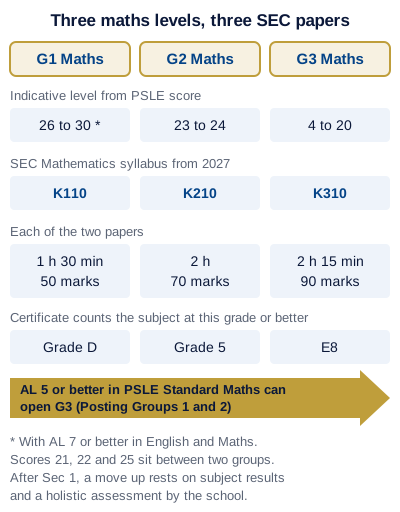
Secondary maths tuition under Full Subject-Based Banding is one-to-one teaching matched to the subject level a learner takes in school. MOE offers Mathematics at G1, G2 and G3. Each level has its own syllabus and its own pace through algebra and geometry, and each ends in its own SEC paper after Sec 4.
- 01Streams were removed for the cohort that entered Sec 1 in 2024.
- 02Mathematics is offered at G1, G2 and G3, each with its own syllabus.
- 03PSLE Standard Maths at AL 5 or better can open G3 Maths.
- 04A later move up rests on subject results and a holistic school assessment.
- 05The 2026 O-Level was the last; SEC codes K310, K210, K110 follow.
Moving up a level
How does a learner reach G3 Maths in secondary school?
Secondary maths levels are set in six stages, starting with the P6 PSLE score and ending with the G1, G2 or G3 SEC paper after Sec 4.
- 1
PSLE score and Maths AL
Scores from 4 to 20 lead to Posting Group 3, with G3 as the starting subject level; 23 and 24 lead to Posting Group 2 and G2. A score of 26 to 30 with AL7 or better in English and Mathematics points to Posting Group 1 and G1. Scores of 21, 22 and 25 sit on a boundary between two groups.
- 2
Posting Group at S1 entry
From the 2024 Sec 1 cohort onward, MOE's S1 posting sorts learners into Posting Group 1, 2 or 3 in place of the old streams. The group sets the indicative subject level each learner starts with.
- 3
Sec 1 Maths level
The PSLE results release MOE issued on 20 November 2024 sets the thresholds for learners in Posting Groups 1 and 2. AL 5 or better in Standard Maths opens Maths at G3 or at G2; AL A in Foundation Maths, or at least AL 6 in Standard Maths, opens it at G2.
- 4
Lower secondary assessment record
After Sec 1, a step up to a harder maths level rests on the learner's secondary-school maths results and on how the school assesses the learner as a whole.
- 5
Upper secondary Maths level
Sec 3 and Sec 4 cover the upper secondary topics of the learner's maths level. Additional Mathematics has its own SEC syllabuses at G3 (K341) and G2 (K232), and K341 assumes knowledge of G3 Mathematics.
- 6
G1, G2 or G3 SEC maths paper
Each level sits its own SEAB paper: K310 for G3, K210 for G2 and K110 for G1. The certificate counts the subject at E8 or better for G3, Grade 5 or better for G2 and Grade D or better for G1.
Secondary maths dates and rules
What should a secondary maths learner know about each school year?
The Sec 1 jump comes in the first year of G3 Maths
G3 Sec 1 maths covers negative numbers, algebraic expressions and linear and simple fractional equations. A learner who solved PSLE problems with model drawing now writes the unknown as x, and the bar diagram becomes an equation with letters on both sides.
JC entry reads G3 subjects from the 2028 PSE
MOE's admission criteria starting from the 2028 PSE set junior college entry at L1R4 ≤ 16, and the subjects counted must be taken at G3. A learner aiming for JC can weigh G3 Maths with that rule in view.
One weighted assessment per term, at most
MOE rules allow each subject no more than one weighted assessment in a school term, and the mid-year examination is gone from the calendar. Every maths assessment therefore counts, and the lessons before it let the learner revisit the topics the class has just covered.
SEC papers start in October
SEAB runs the written SEC papers for Mathematics in one common period that starts in October of Sec 4, and results arrive in January of the following year. The 2027 graduating cohort sits the SEC first.
Moving up a maths level is possible
After Sec 1, MOE decides a move to a harder maths level, such as G2 to G3, from the learner's secondary maths results and a holistic assessment by the school. Closing gap topics early gives that assessment secure work to read.
Level by level
How do G3, G2 and G1 secondary maths differ in papers and topics?
Secondary maths at each subject level, compared on facts from SEAB's 2027 syllabuses and its SEC page, with G3 Mathematics in the first column.
| What to compare | G3 Mathematics | G2 Mathematics | G1 Mathematics |
|---|---|---|---|
| SEC syllabus code | K310 | K210 | K110 |
| Paper 1 | 2 h 15 min, about 26 short-answer questions, 90 marks, 50% | 2 h, about 23 short-answer questions, 70 marks, 50% | 1 h 30 min, 50 marks, 50%; Number and Algebra with Geometry and Measurement |
| Paper 2 | 2 h 15 min, 9 to 10 questions, 90 marks, 50%; last question set in a real-world scenario | 2 h, 70 marks, 50%; Section A ends on a real-world question, Section B offers a choice of 1 from 2 | 1 h 30 min, 50 marks, 50%; Number and Algebra with Statistics and Probability |
| Assessment objectives AO1 / AO2 / AO3 | 45% / 40% / 15% | 60% / 30% / 10% | 65% / 30% / 5% |
| What sets the level apart | Set language and notation, matrices and vectors in two dimensions appear only here | Leaves out those three G3 topics | Aims at technical or service-oriented education, with real-world application |
| Grade scale on the SEC certificate | A1 to E8, then 9; counts at E8 or better | Grades 1 to 6; counts at Grade 5 or better | Grades A to E; counts at Grade D or better |
Level by level
Which Posting Group and maths level does each PSLE score point to?
PSLE score ranges from MOE's Posting Groups page, each with the indicative subject level a learner starts Sec 1 at.
| PSLE score | Posting Group | Indicative subject level |
|---|---|---|
| 4 to 20 | Posting Group 3 | G3 |
| 21 to 22 | Posting Group 2 or 3 | G2 or G3 |
| 23 to 24 | Posting Group 2 | G2 |
| 25 | Posting Group 1 or 2 | G1 or G2 |
| 26 to 30, with AL 7 or better in English and Mathematics | Posting Group 1 | G1 |
Level by level
How do the two Additional Mathematics syllabuses differ?
Additional Mathematics at G3 and G2, compared on SEAB's 2027 SEC syllabuses K341 and K232.
| What to compare | G3 Additional Mathematics | G2 Additional Mathematics |
|---|---|---|
| SEC syllabus code | K341 | K232 |
| Papers | Two papers of 2 h 15 min, 90 marks each, 50% each | Two papers of 1 h 45 min, 70 marks each |
| Topics found in K341 only | Binomial expansions, exponential and logarithmic functions, proofs in plane geometry | Leaves out those three topics |
Syllabus by strand
Secondary maths syllabus: three strands, four years
Secondary maths at G1, G2 and G3 follows 3 MOE strands, with the G2 and G3 syllabuses in force from the 2020 Sec 1 cohort.
What each strand teaches in Sec 1, Sec 2 and Sec 3/4
MOE organises every secondary maths level into the same three strands. The year labels below track G3 Maths. G2 meets some topics later, such as quadratic equations in Sec 3/4, and G1 forms linear equations in Sec 2, so the plan works from the syllabus for the learner's own level.
Number and Algebra
Sec 1: primes, HCF and LCM, negative numbers, ratio, reverse percentage, rate and speed, linear and simple fractional equations. Sec 2: map scales, direct and inverse proportion, factorising quadratic expressions, algebraic fractions, changing the subject, inequalities, simultaneous equations, quadratics by factorisation. Sec 3/4: standard form, indices, exponential graphs, quadratics by formula and completing the square, set language, matrices.
Geometry and Measurement
Sec 1: angles and polygons, area of parallelogram and trapezium, volume and surface area of prism and cylinder. Sec 2: congruence and similarity, Pythagoras, trigonometric ratios, pyramid, cone and sphere. Sec 3/4: properties of circles, coordinate geometry and two-dimensional vectors.
Statistics and Probability
Sec 1: collecting, organising and displaying data. Sec 2: histograms, stem-and-leaf diagrams, mean, median and mode, probability of single events. Sec 3/4: further statistics and probability.
Where secondary learners lose maths marks
SEAB's K310 notes state that essential working omitted loses marks, and four habits cost marks in secondary maths papers. Each fix below is one a learner can practise with the tutor until it holds under exam time.
Writing the final answer with no working on a multi-step question.
Write out each algebra step, so the marker can still award method marks when the final value goes wrong.
Rounding too early, or leaving a non-exact answer in the wrong form.
Carry full calculator values to the end, then give non-exact answers to 3 significant figures and angles to 1 decimal place, as the K310 notes require.
Multiplying only the first term of a fractional equation by the common denominator.
Multiply every term, keep (x − 2) in a bracket and expand after, as in the Sec 1 example x/3 + (x − 2)/4 = 3.
At G2, starting both Section B questions in Paper 2 and finishing neither.
Read both options first, then commit to the Geometry and Measurement or the Statistics and Probability question the learner has practised most.
SEC papers from 2027
Secondary maths exams: SEC papers and grades
Maths learners of the 2024 Sec 1 cohort sit the SEC in 2027, a paper MOE and SEAB set jointly with Cambridge International Education to take the place of the N-Level and O-Level.
Six SEC maths papers, two per level
Every level sits two papers worth 50% each, so Paper 1 alone decides half the grade. An approved calculator is allowed in both papers at all three levels. Paper-by-paper exam strategy for Sec 4 lives on our o-level math tuition singapore page.
| Component | What it covers | Marks / weight | Time |
|---|---|---|---|
| G3 Paper 1 (K310) | About 26 short-answer questions, 90 marks | 50% | 2 h 15 min |
| G3 Paper 2 (K310) | 9 to 10 structured questions, 90 marks; the last one applies maths to a real-world scenario | 50% | 2 h 15 min |
| G2 Paper 1 (K210) | About 23 short-answer questions, 70 marks | 50% | 2 h |
| G2 Paper 2 (K210) | Section A of 9 to 10 questions ending on a real-world task; Section B, one question chosen from two, 7 or 8 marks | 50% | 2 h |
| G1 Paper 1 (K110) | 11 to 13 short items at 2 to 4 marks and a pair of contextual items at 6 to 8 marks; strands: Number and Algebra with Geometry and Measurement | 50% | 1 h 30 min |
| G1 Paper 2 (K110) | Same shape as Paper 1; Number and Algebra, Statistics and Probability | 50% | 1 h 30 min |
SEC maths grades at each level
SEAB grades each subject level on its own scale, and the SEC states the overall standard matches the GCE N(A), N(T) and O-Level it replaces.
- G3
A1 through E8, plus grade 9
Counts on the certificate at E8 or better; from the 2028 PSE, JC admission subjects must be taken at G3.
- G2
Grades 1 to 6
Counts on the certificate at Grade 5 or better.
- G1
Grades A to E
Counts on the certificate at Grade D or better.
- Results
January after the papers
Written papers start in October of Sec 4 and results follow in January of the next year.
G3 Sec 3/4 worked example: the quadratic formula
The problem
Find the two roots of 2x² − 3x − 4 = 0, correct to 2 decimal places.
Worked solution
- 1Check whether the expression factorises: no pair of integers multiplies to 2 × (−4) = −8 and adds to −3, so use the formula.
- 2Read the coefficients from ax² + bx + c = 0: a = 2, b = −3, c = −4.
- 3Work out the discriminant: b² − 4ac = (−3)² − 4(2)(−4) = 9 + 32 = 41.
- 4Substitute into x = (−b ± √(b² − 4ac)) / 2a to get x = (3 ± √41) / 4.
- 5Use the calculator value √41 = 6.4031…, so x = 9.4031… / 4 = 2.3508… or x = −3.4031… / 4 = −0.8508….
- 6Round only now, as the question asks for 2 decimal places: x = 2.35 or x = −0.85.
Answer: x = 2.35 or x = −0.85
The question sets 2 decimal places, so it overrides the usual 3 significant figures rule. Rounding √41 early can push the second decimal the wrong way, so full calculator values are held to the last line.
School rhythm in Singapore
Secondary maths tuition around the school year
Secondary maths classes in Singapore face no more than 1 weighted assessment per subject a term, so each one is a clear date to plan revision around.
Six school facts that shape the lesson plan
These come from MOE and SEAB pages, and each one shapes when a learner revises and what comes next in the plan.
Streams removed from 2024
For the 2024 Sec 1 cohort onward, the old streams give way to Posting Group 1, 2 or 3, with Mathematics offered at G1, G2 and G3.
At most one weighted assessment
Since 2019, MOE has capped weighted assessments at one per subject in each school term, across P3 to Sec 4 or 5.
No mid-year examinations
Mid-year examinations were removed; feedback now comes through weighted assessments and classroom assignments.
SEC written papers in October
SEAB runs the Mathematics papers in one common period that starts in October of the exam year.
Results in January
SEC results are released in January of the year after the papers.
Last O-Level codes in 2026
The 2026 O-Level used 4052 for Mathematics and 4049 for Additional Mathematics; from 2027 the SEC codes K310 and K341 take over.
Three tools for SEC maths papers
SEAB names what a candidate may use, and a learner can practise with the same three tools from Sec 1.
Approved calculator
Allowed in both papers at K310, K210 and K110, so calculator checks belong in practice alongside written working.
Geometrical instruments
SEAB's K310 notes list geometrical instruments for both G3 papers, so accurate diagrams drawn with ruler, compasses and protractor are part of the practice.
Formula list
SEAB provides the formulae, so practice centres on choosing the right one and setting it out, the step a printed list leaves to the learner.
Accountability
How is secondary maths progress reported?
Secondary maths progress is written up twice over: session notes from the tutor each time they meet, and a monthly progress report, both read against the G1, G2 or G3 topic list.
Tutor notes after every session
After every session the tutor writes notes on the maths covered, so the learner and whoever registered them see the same record.
Monthly progress report
Once a month, the report sets the learner's progress against the three syllabus strands.
Assessment build-up
The notes give the learner a running record to revise from before each weighted assessment.
Level review evidence
For a learner aiming at G3 Maths, the reports show which higher-level topics are already secure.
In numbers
What does secondary maths tuition cover at a glance?
Secondary maths results rest on algebra secured early, complete working and timed practice at the right level, and the lesson plan works on each of those three factors.
- 3
- Subject levels taught: G1, G2 and G3 Mathematics
- 6
- Worked examples on this page, one per year group or level
- 2
- SEC maths papers per level, each worth 50%
- 12,000+
- Tutors available to match each learner
Questions
What do learners ask about secondary maths tuition?
Secondary maths answers on fees, tutor matching, home and online lessons, Additional Mathematics and moving between G1, G2 and G3.
Start with the right level
Secure Sec 1 algebra before Sec 2 quadratics
Secondary maths tuition that bridges Sec 1 algebra to Sec 2 quadratics and prepares the choice of G3 Maths or Additional Mathematics.
- First consultation with our team
- Tutor matched by town and timetable
- Home or online lessons
Eduprime · Secondary maths tuition, home or online
Other maths pages