Skip to content

AEIS Exam Guide for International Students Entering Singapore Schools

The AEIS exam is the Admissions Exercise for International Students, the MOE route into mainstream Primary 2 to 5 and Secondary 1 to 3 for the following January. Primary applicants sit Mathematics; secondary applicants sit English and Mathematics. The 2026 exercise has closed after its September tests, its results come out in December 2026, and the dates of the next exercise come on MOE's AEIS page once MOE publishes them. A place depends on test performance and the vacancies in MOE schools.

What is the AEIS exam and who is it for?

The AEIS exam is the Admissions Exercise for International Students, run by MOE with the tests conducted by SEAB, for international students who want a place in a mainstream Singapore primary or secondary school. It admits learners to Primary 2 to 5 and Secondary 1 to 3 for the academic year after the exercise.

MOE describes the exercise in three steps: apply for the relevant tests, sit them, then receive the admissions outcome. The exercise typically opens in July, and the school year it leads to starts in January. The 2026 exercise, for a January 2027 start, is now the latest one held: MOE states that its applications have closed, and its tests ran in September 2026. A learner aiming for a later January start watches MOE's AEIS page, where the dates of the next exercise appear once MOE publishes them.

Mainstream primary and secondary schools are two of the MOE entry points for international students; junior colleges and Millennia Institute have their own routes, which this guide leaves aside. Every AEIS test is held in Singapore only, so a learner overseas plans travel around the test window. MOE states that admission is subject to performance in the tests, so the preparation in this guide aims at that performance.

AEIS key facts, with the 2026 exercise as the latest held
ItemAEIS
Entry levelsPrimary 2 to 5; Secondary 1 to 3
Subjects testedPrimary: Mathematics. Secondary: English and Mathematics
Test monthSeptember in the 2026 exercise, held in Singapore
Results monthDecember 2026 for the 2026 exercise, for a January 2027 start
Next exerciseNot yet published; MOE posts them on its AEIS page

Which AEIS papers does each entry level sit?

Every AEIS applicant sits Mathematics, and secondary applicants add an English paper. Each paper tests the mainstream topics of the level just below the one applied for, so a Primary 3 applicant meets Primary 2 content and a Secondary 3 applicant meets Secondary 2 content.

The level a learner may sit for follows age. MOE runs an eligibility checker that takes the applicant's date of birth and returns the tests to sit, the level the applicant may be placed at and, for primary applicants, the minimum Cambridge English score needed. The checker is the place to confirm a level, and this guide gives no age table of its own.

Primary applicants show their English through a Cambridge English Qualifications statement of results uploaded with the application, which is why the primary column below lists Mathematics alone. A learner whose Mathematics feels strong at home still benefits from comparing it with the Singapore syllabus of the level below: the papers follow the MOE primary school syllabus and the O-Level syllabus, and SEAB asks candidates to show their working steps.

AEIS papers and content level by entry level
Entry level applied forSubjects satContent level testedSyllabus reference
Primary 2MathematicsPrimary 1MOE primary school syllabus
Primary 3MathematicsPrimary 2MOE primary school syllabus
Primary 4MathematicsPrimary 3MOE primary school syllabus
Primary 5MathematicsPrimary 4MOE primary school syllabus
Secondary 1English and MathematicsPrimary 6MOE primary school syllabus
Secondary 2English and MathematicsSecondary 1O-Level syllabus
Secondary 3English and MathematicsSecondary 2O-Level syllabus
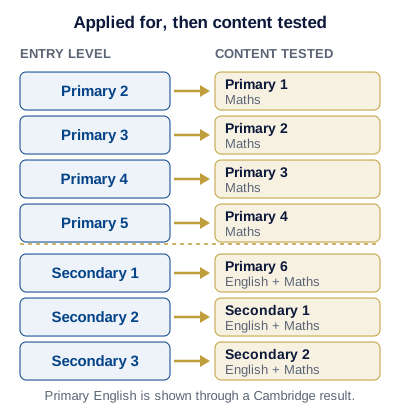
Diagram pairing each AEIS entry level with the level of content its papers test and the subjects sat: Primary 2 to 5 sit Mathematics on the content of Primary 1 to 4, Secondary 1 sits English and Mathematics on Primary 6 content, and Secondary 2 and 3 sit English and Mathematics on Secondary 1 and 2 content.
Each AEIS entry level is tested on the mainstream content of the level below it (MOE test details; SEAB test details).

What is in the AEIS Primary Maths paper?

The AEIS Primary Mathematics paper has two parts: a multiple-choice Part 1 and a written Part 2. Applicants for Primary 2 and 3 sit a 65-minute paper, and applicants for Primary 4 and 5 sit an 85-minute paper that adds open-ended problems.

SEAB publishes the number of items in each part, and the table sets them side by side. The jump from the younger paper to the older one sits mostly in Part 2: the Primary 2 and 3 paper asks 17 short-answer items, while the Primary 4 and 5 paper asks 8 short-answer items followed by 6 open-ended items that need longer working.

Working is shown for every short-answer and open-ended item at every level. A learner used to mental shortcuts, or to a method from another system, practises setting the steps down in order, with units and a clear final statement.

No calculator is allowed, so every computation is done by hand, and the printed time already includes reading time. Primary 2 and 3 candidates bring a ruler; Primary 4 and 5 candidates bring a ruler, set-square and protractor.

AEIS Primary Mathematics paper structure (SEAB)
PaperPartMinutesItem type and count
Primary 2 and 3Part 12529 multiple-choice items
Primary 2 and 3Part 24017 short-answer items
Primary 4 and 5Part 13530 multiple-choice items
Primary 4 and 5Part 2508 short-answer items and 6 open-ended items

Worked example

Pacing the Primary 4 and 5 paper

Applicant A wants a Primary 4 place. Which content is tested, which paper is sat, and how much time does each item allow?

  1. The content level is one below the level applied for, so Applicant A revises Primary 3 Mathematics on the MOE primary school syllabus.
  2. The paper is the Primary 4 and 5 Mathematics paper, with English shown through the Cambridge statement of results.
  3. Part 1 gives 35 minutes for 30 multiple-choice items: 35 × 60 ÷ 30 = 70 seconds per item.
  4. In Part 2, allowing 2 minutes for each of the 8 short-answer items uses 16 minutes, which leaves 50 − 16 = 34 minutes.
  5. 34 ÷ 6 gives about 5 minutes 40 seconds for each of the 6 open-ended items.

Primary 3 Mathematics, practised at about 70 seconds per Part 1 item, 2 minutes per short-answer item and 5 minutes 40 seconds per open-ended item.

What is in the AEIS Secondary Maths paper?

The AEIS Secondary Mathematics paper is one paper for Secondary 1 to 3 applicants, with a 30-minute multiple-choice Part 1 and a Part 2 of 1 hour 45 minutes. Part 2 carries 20 short-answer items and 10 to 15 open-ended items, all with working shown.

The format is shared across the three entry levels, while the content follows the level below: Primary 6 topics for a Secondary 1 applicant, Secondary 1 topics for Secondary 2, Secondary 2 topics for Secondary 3.

Part 1 moves quickly, at 34 items in 30 minutes. Part 2 rewards stamina and clear presentation, since the open-ended items need longer working and SEAB asks for the working steps to be shown. For Secondary 2 and 3 applicants, MOE's test page names the O-Level syllabus as the reference for the content.

The whole paper is done without a calculator, so written arithmetic, fast and accurate, becomes part of the preparation itself. The duration already includes reading time. Secondary 1 candidates bring a ruler, set-square and protractor, and Secondary 2 and 3 candidates add a pair of compasses for constructions.

AEIS Secondary Mathematics paper structure (SEAB)
PartDurationItem typeItems
Part 130 minutesMultiple choice34
Part 21 hour 45 minutesShort answer20
Part 2Same sittingOpen-ended10 to 15

What is in the AEIS Secondary English paper?

The AEIS Secondary English paper lasts 2 hours 10 minutes and has two parts. Part 1 is one composition chosen from a set of topics, and Part 2 is 50 compulsory multiple-choice items covering comprehension, comprehension cloze, vocabulary and grammar.

The composition choice widens with the level. Secondary 1 applicants pick one of 2 topics, while Secondary 2 and Secondary 3 applicants pick one of 4. The expected length rises with each level too, as the list below shows, so a learner practises writing to the word range of the exact level applied for.

Part 2 is entirely multiple choice and every item must be attempted. Its four components test different reading habits: following an argument across a passage, choosing the word that fits a gap in context, knowing word meanings and applying grammar rules precisely. The table gives SEAB's breakdown.

SEAB and MOE publish no marks or weighting for either part, so this guide gives none. On test day secondary candidates have a 60-minute lunch break before the English paper, which runs in the afternoon. No print or electronic dictionary is allowed, translation dictionaries included, so vocabulary has to be built well before the test.

  • Secondary 1 composition: 200 to 300 words, one of 2 topics
  • Secondary 2 composition: 250 to 350 words, one of 4 topics
  • Secondary 3 composition: 300 to 400 words, one of 4 topics
AEIS Secondary English Part 2 breakdown (SEAB)
ComponentPassagesItems
Comprehension215
Comprehension cloze215
VocabularyNone10
GrammarNone10

Which syllabus must a Primary 4 or Secondary 2 applicant revise?

A Primary 4 applicant revises Primary 3 Mathematics, and a Secondary 2 applicant revises Secondary 1 English and Mathematics. Working out the time per item then turns that syllabus into a pace the learner can practise.

The rule of the level below is the first step for every applicant, and the paper format is the second. The Primary 4 case is worked through under the Primary Mathematics paper above; the Secondary 2 case below adds the English paper, so the learner plans two subjects against two clocks.

Both splits are planning tools for practice papers. Each learner adjusts the minutes after a timed attempt shows where they actually go, and the content list of the level below stays the checklist throughout.

Worked example

Mapping and pacing a Secondary 2 application

Applicant B wants a Secondary 2 place. Which content is tested, and how much time does each Mathematics item allow?

  1. The content level is Secondary 1 in both English and Mathematics, with the O-Level syllabus named by MOE as the reference.
  2. Mathematics Part 1 gives 30 minutes for 34 items: 30 × 60 ÷ 34 is about 53 seconds per item.
  3. Part 2 runs 105 minutes. Allowing 2 minutes 30 seconds for each of the 20 short-answer items uses 50 minutes, which leaves 55 minutes.
  4. Those 55 minutes cover 10 to 15 open-ended items: between 55 ÷ 15, about 3 minutes 40 seconds, and 55 ÷ 10, 5 minutes 30 seconds per item.
  5. The English paper of 2 hours 10 minutes holds one composition of 250 to 350 words chosen from 4 topics, plus the 50 multiple-choice items of Part 2.

Applicant B revises Secondary 1 English and Mathematics and practises at about 53 seconds per Part 1 item, 2 minutes 30 seconds per short-answer item and 3 minutes 40 seconds to 5 minutes 30 seconds per open-ended item.

How does the Cambridge English requirement work for primary applicants?

Primary applicants sit no AEIS English paper. They upload a Cambridge English Qualifications (CEQ) statement of results that meets the minimum Cambridge English Scale score for their level, and MOE's eligibility checker names the Cambridge test and that minimum once the date of birth is entered.

For the 2026 exercise, the CEQ had to be taken from July 2025 onwards; MOE prints the window on its apply page for each exercise, so a learner reads it there for the next one. The statement of results is the document MOE asks for, and the certificate is unnecessary.

The checker names both the test and the score for each level. For Primary 2 it shows A2 Key for Schools with a required Cambridge English Scale score of 100 and above, and for Primary 5 it shows B1 Preliminary for Schools with 140 and above. Cambridge English places A2 Key for Schools at CEFR level A2, the band from 120 to 139 on its scale, and the test can be taken in digital or paper-based form.

Timing matters more than anything else here. The statement of results is uploaded with the application, and applications open around July, so a primary applicant plans the Cambridge test and its result in the months before. A learner who also wants to lift reading and writing for the Singapore classroom treats the Cambridge preparation as the first stretch of that work.

  • Date of birth entered in the MOE eligibility checker
  • Cambridge test and minimum Cambridge English Scale score read from the checker for that level
  • CEQ taken within the window MOE sets for the exercise
  • Statement of results uploaded with the AEIS application

What is the difference between AEIS and S-AEIS?

The S-AEIS, the Supplementary Admissions Exercise for International Students, is a second exercise early in the year for a narrower band of levels. It admits to Primary 2 to 4 and Secondary 1 to 2 for the same academic year, with school starting in April or May.

The two exercises differ in timing and reach. The AEIS opens around July and places learners for the following January across seven entry levels; its 2026 tests ran in September. The S-AEIS opens in January and tests in late February or early March, with the 2027 window stated by MOE as tentative. The 2026 S-AEIS ran in March, with close to 2,300 candidates registered, and secondary English and Mathematics sat on separate days.

For a learner arriving in Singapore partway through the year, the S-AEIS offers an earlier seat at the lower levels. A learner aiming for Primary 5 or Secondary 3 has only the AEIS route, since the S-AEIS stops at Primary 4 and Secondary 2. MOE's eligibility checker shows the level-below pattern for the S-AEIS as well: its Primary 4 Mathematics test covers Primary 3 Mathematics.

AEIS and S-AEIS compared (MOE and SEAB)
CriterionAEISS-AEIS
Entry levelsPrimary 2 to 5; Secondary 1 to 3Primary 2 to 4; Secondary 1 to 2
Exercise startsTypically JulyJanuary
Test monthSeptember in the 2026 exercise; next dates from MOELate February or early March (2027, tentative)
School startJanuaryApril or May
Admission yearThe academic year after the exerciseThe same academic year

How does the AEIS application work?

The AEIS application is made online through the SEAB Candidates Portal, where an account is created for the applicant. The guardian uploads the documents, pays the test fee, and later receives an entry proof by email from SEAB about two weeks before the test.

The order below follows MOE's how-to-apply page and SEAB's instructions to candidates. The fee amount is printed on MOE's apply page; this guide leaves the figure out and gives the terms that govern it. Those terms are strict: once paid, the fee stays paid even when the applicant withdraws or has already sat part of the test.

The entry proof is the document to check most carefully when it arrives, because it carries the admission level the learner is sitting for along with the schedule and venue.

  • 1. Confirm the tests and placement level in the MOE eligibility checker using the applicant's date of birth.
  • 2. Create the applicant's account on the SEAB Candidates Portal when the exercise opens, typically in July.
  • 3. Upload the birth certificate, with an English translation if it is in another language, and the passport bio-data page from a passport valid for at least 6 more months.
  • 4. For primary applicants, upload the CEQ statement of results; MOE may ask for other papers, such as a marriage certificate.
  • 5. Pay the fee by card or PayNow; it is non-refundable, GST at the prevailing rate applies, and no refund follows a withdrawal or any part of the test being taken.
  • 6. Watch for the entry proof email from SEAB about two weeks before the test, showing the index number, admission level, test schedule and test venue.

What happens on AEIS test day and what must a candidate bring?

Candidates report at least 45 minutes before the start, and the hall closes to entry 15 minutes before the test begins. Each candidate brings a printout of the entry proof, a photocopy of the passport data page and the mathematical instruments for their level.

SEAB's instructions list what comes into the hall and what stays out. The original passport stays at home, since the photocopy of its data page is what the candidate presents. No calculator and no dictionary of any kind, print or electronic, are allowed in any paper.

Every paper's printed duration includes its reading time, so the clock starts with the first page. Multiple-choice answers go on the Optical Answer Sheet with a 2B pencil, one oval shaded per question, and written answers in black or dark blue pen. SEAB warns that malpractice can cancel a test outcome, and MOE may rescind a place already offered.

  • Entry proof, printed
  • Photocopy of the passport data page
  • 2B pencil and eraser for the Optical Answer Sheet
  • Black or dark blue pen for answers in the booklet
  • Mathematical instruments for the entry level, as in the table
  • Secondary candidates: food or plans for the 60-minute lunch break before the afternoon English paper
Mathematical instruments by entry level (SEAB instructions to candidates)
Entry levelInstruments
Primary 2 and 3Ruler
Primary 4, Primary 5 and Secondary 1Ruler, set-square, protractor
Secondary 2 and 3Ruler, set-square, protractor, compasses

When do AEIS results come out and what happens after an offer?

AEIS 2026 results are released in December 2026 on the AEIS Internet System, where the applicant logs in with a passport number or FIN and date of birth. A successful applicant then reports to the offered school within the reporting period MOE sets for that level.

Results are released by level: Secondary 2 to 3 first, Primary 2 to 5 next and Secondary 1 last, and MOE marks only the Secondary 1 release dates as tentative. For the 2026 exercise, Secondary 2 to 3 applicants report from Friday 11 December 2026 to Wednesday 30 December 2026, and Primary 2 to 5 applicants from 18 December to 30 December 2026. Secondary 1 applicants report between late December and early January 2027. Missing the reporting period can cost the place.

MOE posts each successful applicant to a school based on available vacancies and, where possible, the residential area the applicant declared. The posting is final: requests to transfer and requests for the test results are not considered.

A learner then needs a Student's Pass, unless already holding a valid Long-Term Visit Pass, Dependant's Pass or Immigration Exemption Order. The school issues a Registration Acknowledgement Letter, and the application goes to ICA.

One consequence reaches further ahead. MOE states that applicants who had received school offers through the AEIS-Secondary or S-AEIS-Secondary are not eligible to apply for subsequent editions of the DSA-Sec. One school's DSA-Sec procedure page notes that an international student may apply for DSA-Sec and also takes the AEIS, so a secondary applicant eyeing a school's talent programme studies the DSA-Sec guide before AEIS results arrive.

  • September 2026: tests in Singapore
  • December 2026: results on the AEIS Internet System, Secondary 2 to 3 first
  • 11 to 30 December 2026 (Secondary 2 to 3) and 18 to 30 December 2026 (Primary 2 to 5): reporting to the offered school
  • Late December to early January 2027 (Secondary 1): reporting to the offered school
  • After reporting: Student's Pass application to ICA where needed
  • January 2027: school year begins

What decides a place, and what are the options after an unsuccessful attempt?

Three things decide an AEIS outcome: the applicant's performance in the tests, the vacancies available in MOE schools at that level, and, where possible, the declared residential area. Test performance is the one a learner can move, and preparation works on it directly.

MOE states that admission is subject to performance in the tests, and no primary source publishes a pass rate or a share of applicants placed, so this guide gives no figure. The vacancies in MOE schools sit outside a learner's hands. Test performance sits inside them: knowing the content of the level below, writing working the Singapore way, holding pace without a calculator and, at secondary, writing a composition to the exact word range.

After an unsuccessful attempt, MOE is the authority on which exercise and level remain open. Its eligibility checker, run with the date of birth, covers both the AEIS and the S-AEIS. The S-AEIS opens in January and tests in late February or early March, for Primary 2 to 4 and Secondary 1 to 2, with school starting in April or May, so a learner confirms the checker's answer before planning the next stretch of work.

Preparation after a first attempt can start from the papers the learner found hardest, using the format tables above as the checklist.

How should a candidate prepare month by month before the test?

Preparation for the AEIS exam runs best from the months before the application window to the test: content of the level below first, then paper format, then timed practice. Primary applicants fit the Cambridge English test into the earliest stretch.

The plan below follows the pattern of the 2026 exercise, which opened around July and tested in September; MOE confirms the dates of the next exercise. A learner who starts later compresses the early stages and keeps the timed practice, since every paper is sat without a calculator and its printed time already includes reading time.

For the S-AEIS route, the same order applies over a shorter run: the exercise opens in January and the test falls in late February or early March, so content, format and timed practice share a few weeks. A 4-session Starter package fits inside even that window, and further packages follow on as the learner needs.

  • Months before the application window: confirm the level in the MOE checker; primary applicants book and sit the Cambridge test the checker names; map the syllabus of the level below and find the gaps.
  • Application window (typically July): apply through the SEAB Candidates Portal; content work continues topic by topic.
  • The following month: format work on each part, written working for short-answer and open-ended items, composition practice to the level's word range for secondary.
  • The last weeks before the test: timed papers without a calculator, OAS shading practice, instrument check; the entry proof email arrives about two weeks before the test, so read it on arrival.
  • Test month: the tests in Singapore.
  • Until the January start: keep up the work of the level being entered, so the new school year feels familiar.

What does AEIS preparation with Eduprime look like, and how is it priced?

Eduprime pairs each AEIS candidate with one tutor, either in person at home, with the tutor chosen for the learner's town and weekly schedule, or online for applicants still abroad. Fees per format appear in the price table on our AEIS preparation page, and the entry Starter package covers the first four 60-minute lessons of AEIS work.

Payment is made in full or as 50% at the start and 50% mid-package. Anyone joining us for the first time also settles a single registration fee, and the AEIS preparation price table prints that amount too. The opening consultation costs nothing and is held with our team, who weigh the entry level being sought, the papers to be sat and the learner's weekly hours before choosing a tutor; the learner is introduced to that tutor once registration is done.

Lessons can cover the AEIS structure in this guide: Mathematics of the level below for every applicant, and English composition and the Part 2 components for secondary applicants. Practice sheets and lesson plans are part of the service. To start, use Register for tuition, which opens the registration form, or Ask a question to raise a query on the contact form first.

How does an AEIS candidate see whether the preparation is paying off?

Each AEIS candidate gets a monthly progress report and tutor notes after every session, so movement on the Mathematics and English papers can be tracked lesson by lesson.

The notes show which topics of the level below are secure and which need another pass, and the monthly report sets that against the test month. Our tutor bench runs past 12,000 people, and the AEIS candidate is paired with a tutor experienced and skilled in the Mathematics and English the papers test.

  • Monthly progress report and tutor notes after every session
  • A different tutor on request whenever the fit feels wrong, free and as often as needed
  • Tutor chosen by our team for the entry level, papers and weekly hours
  • Practice sheets and lesson plans shaped around the AEIS paper format

Where to go next for AEIS preparation, DSA-Sec, PSLE and school subjects?

This guide covers the AEIS exam itself. Lessons, formats and fees for AEIS candidates sit on our AEIS preparation tuition page, while the test prep hub gathers every other exam our tutors coach for. A secondary applicant weighing a talent route reads the DSA-Sec guide before AEIS results arrive, since receiving an AEIS-Secondary offer ends eligibility for later DSA-Sec exercises.

After placement, learners move into the school syllabus: the PSLE guide for those heading to Primary 6, the starting Secondary One guide and the O-Level guide for secondary entrants who want the syllabus MOE names for the secondary tests, and our primary maths, secondary maths and English tuition pages for subject support once lessons begin in January.

Sources

One-to-one lessons with Eduprime

At home in Singapore or online. The first consultation is free, and a tutor can be changed whenever the learner asks.