Interleaved practice: how to mix question types so you can pick the method in the exam
Interleaved practice means mixing different kinds of problems in one study session, so no two questions in a row need the same method and you choose the method from the problem itself. A 2013 review rated it of moderate utility. In a randomised trial across 54 seventh-grade maths classes, the interleaved classes scored 61% against 38% on a test one month later.
What does interleaving mean, and what makes a blocked worksheet different?
Interleaved practice mixes different kinds of problems within one study session. Blocked practice groups problems that all need the same strategy, so you already know the method before you read each question.
The difference comes down to one decision. In a blocked worksheet of integration by parts, the heading has already told you what to do, and the work becomes carrying out a procedure you were handed. In an interleaved set, each question arrives without that clue, so you first read the problem, recognise what kind it is, and pick the strategy. The researchers behind the classroom maths trials describe this as choosing the strategy on the basis of the problem itself, which is the position you are in during a comprehensive examination.
Interleaved practice earned a middle grade, moderate utility, when John Dunlosky and his co-authors weighed a set of study techniques for Psychological Science in the Public Interest in 2013. Their summary is careful: for the techniques in that middle band, evidence of their efficacy is limited, and the benefits of interleaving had only just begun to be explored systematically. That rating is the starting point for this page. Interleaving has strong results in maths classroom trials and a patchier record with other material, and the sections below show where each part of that record comes from.
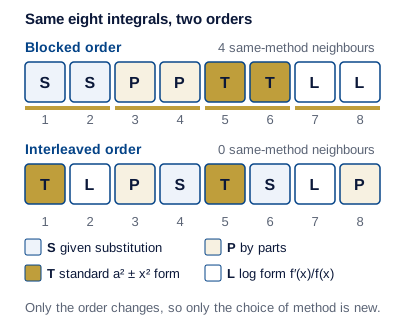
The same eight problems can be blocked or interleaved. Only their order changes, and the order decides whether the choice of method gets practised at all.
How do I interleave my practice step by step?
Learn each problem type on its own first, then build sets that mix those types so no two neighbouring questions need the same method, and write the method down before you start working.
Start each new kind of problem by itself, and fold it into mixed practice once you can carry it out. That is our advice for self-study, and it keeps a mixed set from rehearsing a method you cannot yet perform. The six steps below turn it into a routine for H2 Mathematics or A-Math, built from your own notes, school tutorial sheets and past papers, cut up and reordered.
Step 5 matters more than it looks. In Rohrer and Taylor's 2007 experiment, learners who recalled the correct formula almost always reached the correct answer, so the marks were lost at the choice. Your own log shows whether that split holds for you, and it tells you whether to drill a method or drill the recognition of when to use it.
- Learn each type alone first. Work a short blocked set on a new technique until you can carry it out without your notes. A type you cannot yet execute stays out of mixed sets for now.
- List the confusable types. Write down the kinds of problem in one topic family that look alike on the page, such as the integrals of 1/(9 + x²) and x/(9 + x²), which need different techniques.
- Build the mixed set. Take eight to twelve questions from those types and order them so no two consecutive questions need the same technique, the arrangement used in the 2020 classroom trial.
- Name the method before you write anything. Beside each question, write the technique in a few words, then solve. That written choice is the skill the paper rewards.
- Mark in two columns. Score each item once for the method choice and once for the working, and log every wrong choice with the feature of the question you missed.
- Repeat across weeks. Return to the same types in fresh mixed sets in later weeks, adding each new type once it has had its own blocked practice. The classroom study that found 72% against 38% spread the practice over nine weeks.
What does an interleaved H2 Maths integration set look like?
Here is an eight-integral set from the H2 Mathematics 9758 integration content, in its blocked order and its interleaved order, with the technique to name before you integrate.
The 9758 syllabus lists integration by a given substitution, integration by parts, and standard integrals that include forms with a² + x² and a² − x², with reduction formulae excluded. The same topic covers the f′(x)/f(x) form that integrates to a logarithm, which gives four kinds from one area of the Pure Mathematics content. Paper 1 holds 10 to 12 Pure Mathematics questions of different lengths and marks.
Rows four and five set the same trap as rows one and two, this time with a square root: the x in x/√(16 − x²) calls for the given substitution, while 1/√(16 − x²) is the a² − x² standard form. In the blocked order each pair sits apart under different headings, so the difference is never tested. In the interleaved order they arrive together, and you read the numerator before you commit.
Expect a lower score on this set the first time than on the same eight integrals in blocked order. In the 2007 experiment that pattern appeared in practice and then reversed on the test a week later, so a dip here is the cost of practising the choice.
| Integral | Blocked position | Interleaved position | Technique to name first | Result |
|---|---|---|---|---|
| ∫ 1/(9 + x²) dx | 5 | 1 | Standard form with a² + x², a = 3 | (1/3) tan⁻¹(x/3) + C |
| ∫ x/(9 + x²) dx | 7 | 2 | f′(x)/f(x) form: the numerator is half the derivative of 9 + x² | ½ ln(9 + x²) + C |
| ∫ x e^(2x) dx | 3 | 3 | By parts, with u = x | ½x e^(2x) − ¼e^(2x) + C |
| ∫ x/√(16 − x²) dx | 2 | 4 | Given substitution u = 16 − x² | −√(16 − x²) + C |
| ∫ 1/√(16 − x²) dx | 6 | 5 | Standard form with a² − x², a = 4 | sin⁻¹(x/4) + C |
| ∫ x(x² + 3)⁴ dx | 1 | 6 | Given substitution u = x² + 3 | (1/10)(x² + 3)⁵ + C |
| ∫ cos x/(1 + sin x) dx | 8 | 7 | f′(x)/f(x) form | ln(1 + sin x) + C |
| ∫ x ln x dx | 4 | 8 | By parts, with u = ln x | ½x² ln x − ¼x² + C |
Worked example
Reading the numerator before you choose: ∫ x/(9 + x²) dx
Find ∫ x/(9 + x²) dx, and say which technique you used and why the neighbouring integral ∫ 1/(9 + x²) dx needs a different one.
- Differentiate the denominator: d/dx (9 + x²) = 2x.
- The numerator x is half of 2x, so the integrand is ½ × f′(x)/f(x) with f(x) = 9 + x². Name the technique: the f′(x)/f(x) form.
- Integrate: ½ ln(9 + x²) + C. No modulus sign is needed, since 9 + x² is always positive.
- Check: d/dx [½ ln(9 + x²)] = ½ × 2x/(9 + x²) = x/(9 + x²).
- For ∫ 1/(9 + x²) dx the numerator has no x to match 2x, so the a² + x² standard form with a = 3 applies: (1/3) tan⁻¹(x/3) + C.
½ ln(9 + x²) + C, by the f′(x)/f(x) form. The single x in the numerator is what separates it from the inverse tangent form next to it in the interleaved order.
Why does mixed practice feel harder and lower my scores?
Mixed practice feels harder because every question makes you choose a method, and that choice exposes errors a blocked set hides. A lower practice score is the expected pattern, and in Rohrer and Taylor's 2007 experiment it came with higher scores on the test a week later.
Rohrer and Taylor's 2007 experiment shows the pattern in numbers. Undergraduates learned to find the volumes of four unfamiliar solids (a wedge, a spherical cone, a spheroid and a half cone) over two practice sessions a week apart. During practice, the learners on blocked sets scored 89% and the learners on mixed sets 60%; in the first session the gap was 87% against 43%. A week later, on eight new problems, the mixers scored 63% and the blockers 20%.
The feeling misleads people even when they can see their own results. In Kornell and Bjork's 2008 study of learning painters' styles, 78% of participants did better with interleaved presentation, and 78% still said massed presentation had been as good or better. Across two experiments, 85% did at least as well interleaved while 83% rated massed study as equal or more effective.
So judge the method by a delayed test on new questions. In the 2007 experiment the practice scores pointed one way and the test a week later pointed the other, which makes the score on the day of practice a poor guide to what you will keep. Plan your week with that in mind, and keep a record of the delayed result for each set.
What did the interleaving studies find, and with which learners?
Five studies carry most of the weight: two laboratory studies with undergraduates and three classroom studies with seventh-grade maths classes. In each, the interleaved group scored higher on the test: one day to one month later in the maths studies, and after a 15-second distractor in the same session for the paintings study.
The 2020 trial is the strongest of the set. Whole classes were randomised, the design was registered in advance, and both groups finished with the same interleaved review, so the groups differed in how four months of practice were arranged. Teachers ran it without training and, in an anonymous survey taken before they saw the results, said they supported it.
Two cautions apply when you read these numbers in Singapore. The classroom learners were seventh graders and the laboratory learners were undergraduates, so none of these trials tested a JC or secondary class here. The Kornell and Bjork figures also come from the first test block of Experiment 1a, taken minutes after study. In the 2015 study the gap measured 30 days after the review, d = 0.79, was larger than the gap after one day, d = 0.42.
| Study | Learners and length | When tested | Result |
|---|---|---|---|
| Rohrer and Taylor 2007, Experiment 2 | 18 undergraduates; two practice sessions a week apart, 16 volume problems each | 8 new problems one week later | Mixed 63%, blocked 20% (d = 1.34) |
| Kornell and Bjork 2008, Experiment 1a | 120 university participants; 12 artists, 6 paintings each, 3 seconds per painting | New paintings, after a 15-second distractor in the same session | First test block: interleaved .61, massed .35 proportion correct (d = 0.99) |
| Rohrer, Dedrick and Burgess 2014 | 140 grade 7 students; nine weeks of practice | Unannounced test two weeks later | Interleaved 72%, blocked 38% (d = 1.05) |
| Rohrer, Dedrick and Stershic 2015 | 126 seventh-grade students; three months, ending in a review session | Unannounced test after 1 or 30 days | d = 0.42 after 1 day; d = 0.79 after 30 days |
| Rohrer, Dedrick, Hartwig and Cheung 2020 | 54 seventh-grade maths classes; four months; preregistered cluster randomised trial | Unannounced test one month later | Interleaved 61%, blocked 38% (d = 0.83) |
Does interleaving work for every subject?
Interleaving has shown its largest pooled effect with paintings, a small one with maths tasks across studies, and large ones in two maths classroom trials and in the 30-day test of a third. It also helps with subtle science and art concepts. Expository text showed no significant effect, word lists did better blocked, and one study of two unrelated topics on flashcards found no reliable effect.
Brunmair and Richter pooled 59 studies, 238 effect sizes and 158 samples in 2019 and found a moderate interleaving effect of Hedges' g = 0.42. By material, paintings gave the largest effect, g = 0.67, and mathematical tasks a small one, g = 0.34. The effect was stronger when the categories resembled each other, when items inside a category varied, and when the material was complex. Firth, Rivers and Boyle's 2021 review of 26 studies reached the same point: interleaving is most useful when the differences between items are subtle. That review also notes that the evidence leans on laboratory studies of undergraduates.
Hausman and Kornell's 2014 study tested the version many learners try first, shuffling two unrelated subjects on flashcards. Anatomy terms mixed with foreign-language translations gave no reliable benefit, whether tested in one day or across two. Mixing chemistry with history in one evening is a timetable choice. The technique on this page puts look-alike problems from one subject side by side.
No study in this page's sources tested physics on its own, so treat a mixed mechanics set, with kinematics, dynamics and energy questions shuffled after each is taught, as an application of the findings on complex and similar categories.
| Material | Effect found | What to do |
|---|---|---|
| Mathematical tasks | g = 0.34 across studies, a small effect; larger in the classroom trials, most of all at the longer test delays | Mix confusable problem types within one topic family |
| Paintings | g = 0.67, the largest effect by material; other visual materials also did well | Mix examples from categories that look alike |
| Science and art concepts | Memory g up to 0.65; transfer to new items g up to 0.66 | Mix where items differ subtly; physics sets are an application |
| Expository texts | Not significant | Read and summarise a chapter in its own order |
| Word lists | g = −0.39, blocking did better | Learn new words in blocked sets |
| Two unrelated topics on flashcards (anatomy terms, foreign-language translations) | No reliable effect in one study | Keep mixing inside one subject |
Why do H2 Maths and A-Math papers reward interleaved practice?
Both syllabuses name choosing the method in their problem-solving objective, AO2, which carries 60% of H2 Mathematics 9758 and carried 50% of the 2026 O-Level Additional Mathematics syllabus 4049. A mixed set rehearses that choice.
Among its AO2 points, the 9758 syllabus lists selecting the relevant mathematical concept or strategy to apply, and integrating concepts to solve problems. The exam is two 3-hour papers, each worth 50% and marked out of 100. Paper 1 holds 10 to 12 Pure Mathematics questions, all compulsory. Paper 2 splits into Section A, Pure Mathematics for 40 marks, and Section B, Probability and Statistics for 60 marks. Each paper also carries one question set in a real-world context, worth at least 12 marks, which may need concepts from more than one topic.
The 2026 O-Level syllabus 4049 asked for the same skill in plainer words: interpret the information to identify the relevant concept, rule or formula, and make connections across topics. Its two papers each ran 2 hours 15 minutes for 90 marks, with 12 to 14 questions in Paper 1 and 9 to 11 in Paper 2. The O-Level ended with the 2026 sitting. From 2027 its successor is SEC G3 Additional Mathematics, syllabus K341, so a G3 learner reads the K341 syllabus for its own objectives and papers. Blocked worksheets rehearse the procedures, and a mixed set adds the step these objectives name: picking the concept, rule or formula.
- H2 Mathematics 9758 (2027 syllabus): AO1 30%, AO2 60%, AO3 10%
- O-Level Additional Mathematics 4049 (2026 syllabus): AO1 35%, AO2 50%, AO3 15%
- 9758 Paper 1: 10 to 12 Pure Mathematics questions, answer all
- From 2027: A-Math at SEC G3 is syllabus K341
When should I switch from topical practice to mixed practice?
Move a topic into mixed practice once you can carry out each of its methods on its own, and keep adding newly taught types from then on. You can start well before the whole syllabus is finished.
That alone-first step is our advice, and the research designs differ on it. In Rohrer and Taylor's experiment the mixers read all four tutorials and went straight to practice problems in random order, without practising any solid alone first, and they still beat the blockers on the test a week later. Learning each method first keeps a mixed set safe for a learner who is still unsure of a procedure. So a JC1 learner who has finished differentiation and the first integration techniques can already mix those, and a Sec 4 learner can mix differentiation, integration and trigonometric identities once each has had its own worksheet.
The classroom studies spread mixed practice across weeks and months, nine weeks in 2014 and four months in 2020. The 2015 study varied when the test came, and the gap after 30 days was larger than after one day; it did not test when interleaving should begin. For the A-Level, the 2026 examination window runs to late November. The MOE school calendar publishes the national examination window for each year, so check the next one there and count your months of mixed sets back from it.
Keep a short blocked warm-up whenever a technique is brand new or has gone rusty, and return it to the mixed sets once it runs smoothly again.
Should I label a mixed set by topic, and are past papers enough?
Leave the topic labels off, because a label makes the choice for you. Use past papers as one source of mixed practice, alongside short sets you build around the types you confuse.
A heading such as Integration by Parts hands you the strategy before you read the problem, which turns an interleaved set back into a blocked one. Keep a separate answer key that names the technique for each item, and check your written choice against it after you finish.
A past paper puts different questions in one sitting: 9758 Paper 1 runs 10 to 12 Pure Mathematics questions, and the real-world question can draw on more than one topic. Their limit is control, because a paper decides which questions sit next to each other and you cannot steer it towards the pairs you confuse. The classroom studies spread mixed practice over weeks, nine of them in the 2014 study, and the benefit held even when the problem kinds looked different on the surface. Use full papers for timing and stamina, and short targeted sets for the choices you get wrong.
Worked example
Ordering a mixed set so no two neighbours share a method
You have eight integrals: two that need a given substitution (S), two by parts (P), two standard forms with a² + x² or a² − x² (T), and two of the f′(x)/f(x) form (L). Put them in an order where no two consecutive questions need the same technique.
- Write the four kinds once each in any order to make the first round: T, L, P, S.
- Start the second round with a kind that differs from the last one placed. The first round ended on S, so open with T.
- Fill the rest of the second round with the remaining kinds, checking each against its left neighbour: T, S, L, P.
- Join the two rounds: T, L, P, S, T, S, L, P.
- Check all seven neighbouring pairs: T-L, L-P, P-S, S-T, T-S, S-L, L-P. None repeats a kind.
T, L, P, S, T, S, L, P, the interleaved order of the worked H2 Maths set on this page. Hide the letters before you attempt the set, so the choice stays yours.
How is interleaving different from spaced repetition?
Interleaving changes the order of problem types inside one session. Spacing changes the gaps between sessions on the same material.
The two often travel together, which is why the terms get blurred. Kornell and Bjork's 2008 paper asks in its title whether spacing is the enemy of induction, because the researchers treated interleaved paintings as spaced repetitions of each artist. In Rohrer and Taylor's experiment the two practice sessions were also a week apart, so the mixers had both features at once.
For your own planning, treat them as two separate decisions. This page covers what goes inside a set and in what order. How many days to leave before you revisit a topic, and how to lay that out across a term, belongs to our spaced revision timetable guide, and closed-book recall drills belong to the retrieval practice guide.
How does interleaving change from primary to JC?
The principle holds from Primary to JC: mix only methods already learned. What changes is which types go into a set, how long the set runs and who checks the method choices.
At JC, Probability and Statistics gets a mixed set of its own because Paper 2 sets it as a separate 60-mark Section B, so a set built from its own question types mirrors that section. At Primary, short sets checked by an adult keep a young learner from rehearsing a wrong method without feedback. The set sizes in the table are our suggestions for a first mixed set at each level; the trials on this page did not compare set lengths.
| Level | Which types to mix | Set size | Who checks |
|---|---|---|---|
| Primary | Problem types already taught in class, once each method is known | 4 to 6 short questions | An adult checks the method chosen |
| Lower secondary | Types from the current term mixed with one or two from earlier terms | 6 to 8 questions | Self-check with an answer key, adult review of wrong choices |
| Upper secondary (A-Math, E-Math) | Differentiation, integration and trigonometric identities in Term 3 to Term 4, after they are taught; the 2026 A-Math syllabus 4049 named choosing the rule under AO2, and from 2027 the paper is SEC G3 K341 | 8 to 10 questions | Self-check against a key that names the rule |
| JC (H2 Mathematics) | Pure Mathematics types mirroring Paper 1; Probability and Statistics mixed separately, mirroring Paper 2 Section B | 8 to 12 questions | Self-check, then a second look at every wrong method choice |
How many students already use interleaving, and what does the Singapore survey show?
Few, in the one Singapore sample among this page's sources: a 2023 survey of undergraduates at the National University of Singapore and a US university, 424 of them at NUS, found more than 95% of respondents unaware of interleaved practice.
Pan and colleagues surveyed students recruited through psychology courses between March and May 2023, analysing 1,093 responses. Few reported using interleaved practice often: it was common for about 8% and 10% at the two universities, and very common for 1% to 2%. The most frequent rating of its effectiveness was somewhat effective. The survey measured the awareness, habits and beliefs of university students and ran no learning test, so it says nothing direct about JC or secondary learners and leaves the size of the benefit to the trials above.
The JC calendar gives the habit room. From 2024 the JC and MI cohorts, one after another, have been losing the mid-year examination, and a single weighted assessment per subject per term is now the ceiling. With fewer school tests, a learner's own mixed sets become one of the few regular places where old and new topics meet before the A-Level.
How does Eduprime tuition fit around your own mixed sets, and how do you sign up?
Eduprime lessons are one-to-one, at home matched to your town and timetable or online, and mixed sets fall within the worksheets and lesson plans that come with them. Your first consultation with our team, where you name your syllabus and the integration or A-Math techniques you keep confusing, is free of charge.
Mixed sets are teaching material, so they sit with the worksheets and lesson plans that are part of the service. Bring your log of wrong method choices to the consultation, so the team hears which pairs you confuse, such as the inverse tangent and logarithm forms in the worked example above. Your H2 Maths or A-Math tutor comes to your home, matched to your town and timetable, or teaches you online.
- Register Now leads to the registration form and Ask a question leads to the contact form; whichever you press, our team then holds a free consultation about the methods you mix up.
- Once your registration is in, our team picks a tutor for your H2 Maths, A-Math or other syllabus, looking at your town and weekly hours for lessons at home, or setting up online lessons.
- The Starter is the opening package: four 60-minute lessons with one learner and one tutor.
- Payment for those first mixed-set lessons is made in full at the start, or split into two halves, one as the Starter opens and one at its midpoint. First-time learners add a one-off registration fee, and its amount appears in the price table on whichever tuition page carries your registration.
Which records show whether my method choices are improving?
You get tutor notes after every session and a monthly progress report from the first package onwards, and you can read them against your own log of method choices.
Read the report against your own log. When the share of wrong method choices falls on sets you have never seen before, the mixed practice is doing its job, whatever the score on your first attempt at each set.
- A monthly progress report and tutor notes after every session.
- Free tutor replacement on request: you ask, we bring in a different H2 Maths or A-Math tutor, and you may ask again at any stage of the package without a cap.
- Matching by our team after you register, for lessons at home in Singapore by town and timetable, or online.
- Your H2 Maths or A-Math tutor comes from a bench of 12,000+ tutors teaching across 148+ programmes, each experienced and skilled in their field.
- Worksheets, lesson plans and mixed sets as part of the lessons.
Which page answers your next question?
For the format and grading of the A-Level, read our A-Level guide; for A-Math, the last O-Level sitting in 2026 and the SEC papers from 2027, read our O-Level guide. Deciding how many days to leave before an integration set comes round again is the job of the spaced revision timetable guide; testing yourself on formulae with the book shut belongs to the retrieval practice guide. Timing your mixed sets against JC weighted assessments and year-end papers is covered by our weighted assessments guide.
To work through interleaved sets with a tutor, start broad at A-Level tuition in Singapore, or go direct to a subject page: H2 Maths, O-Level Additional Maths, junior college or general maths tuition. Each of those pages explains the lessons and how to register.
Sources
- Dunlosky et al. (2013), PSPI
- Rohrer and Taylor (2007)
- Kornell and Bjork (2008). Learning Concepts and Categories: Is Spacing the Enemy of Induction? Psychological Science 19(6)
- Rohrer, Dedrick and Burgess (2014). The Benefit of Interleaved Mathematics Practice Is Not Limited to Superficially Similar Kinds of Problems. Psychonomic Bulletin and Review 21(5)
- Rohrer, Dedrick and Stershic (2015). Interleaved Practice Improves Mathematics Learning. Journal of Educational Psychology 107(3)
- Rohrer, Dedrick, Hartwig and Cheung (2020). A Randomized Controlled Trial of Interleaved Mathematics Practice. Journal of Educational Psychology 112(1)
- Brunmair and Richter (2019). Similarity Matters: A Meta-Analysis of Interleaved Learning and Its Moderators. Psychological Bulletin 145(11)
- Firth, Rivers and Boyle (2021). A Systematic Review of Interleaving as a Concept Learning Strategy. Review of Education 9(2)
- Hausman and Kornell (2014). Mixing Topics While Studying Does Not Enhance Learning. Journal of Applied Research in Memory and Cognition 3(3)
- Pan, Gonzalez-Cabanes, Teo, Zung, Sana and Cooke (2025). Distributed Practice and Interleaved Practice: Undergraduate Students' Strategies, Experiences, and Beliefs. Applied Cognitive Psychology 39
- SEAB: 9758 Mathematics GCE A-Level H2 Syllabus (2027)
- SEAB: 4049 Additional Mathematics GCE O-Level Syllabus (2026)
- MOE, 1 March 2023
- MOE school calendar
One-to-one lessons with Eduprime
At home in Singapore or online. The first consultation is free, and a tutor can be changed whenever the learner asks.