Sleep Before Exams: How Much Sleep Revision Needs and Why
Sleep before exams protects the revision already done: a 2013 review by Rasch and Born drew on more than a century of research to conclude that sleep benefits the retention of memory. Singapore's guideline asks for at least 9 hours a night at ages 7 to 13, at least 8 hours at 14 to 17 and at least 7 hours at 18, kept regularly. In a 2016 Duke-NUS study of 56 adolescents aged 15 to 19, a week of 5-hour nights lowered attention and working memory, so plan revision to keep those hours whole.
How much sleep does a student need before an exam?
Singapore's own guideline sets the floor by age: at least 9 hours at 7 to 13, at least 8 hours at 14 to 17, and at least 7 hours at 18, kept regularly. The guideline asks for those hours as a regular pattern, and exam weeks sit inside that pattern, so the same numbers hold on the night before a paper.
The age-by-age hours above come from a guideline first published on 8 January 2021, produced by the College of Paediatrics and Child Health of the Academy of Medicine Singapore with the Health Promotion Board's support: the Singapore Integrated 24-Hour Activity Guidelines for Children and Adolescents. The word that matters in every row is regularly. The guideline describes a nightly habit, so its hours belong to ordinary school nights and exam nights alike.
For adult learners past 18, such as a working adult sitting a private candidate paper, this guide quotes no hours figure, because the Singapore guideline above covers ages 7 to 18. A doctor is the right person for an individual answer on adult sleep.
| Age band | Guideline minimum | Typical learner |
|---|---|---|
| 7 to 13 | At least 9 hours, regularly | Primary school, PSLE year, Sec 1 |
| 14 to 17 | At least 8 hours, regularly | Sec 2 to Sec 5, SEC year, JC 1 |
| 18 | At least 7 hours, regularly | Often JC 2 and the A-Level year |
How much do Singapore students actually sleep on school nights?
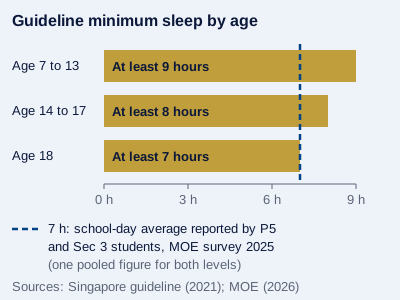
About 7 hours on average. That is the figure Primary 5 and Secondary 3 students reported for their school days in MOE's 2025 survey, one pooled average for both levels and a slight increase on 2023.
Set that average beside the guideline and the gap shows. The guideline asks learners of 7 to 13 for at least 9 hours and learners of 14 to 17 for at least 8, so a reported average of 7 sits below the floor for both age bands. MOE gave the figure in a parliamentary reply on sleep health on 5 August 2026. It is one average across both levels, built from what students said about their own school nights, so each learner checks their own nights against their own age band.
MOE also names one of the forces behind the gap. When MOE set out its healthier screen use measures in November 2025, it named sleep among the things screen use displaces, together with physical activity and social interaction. For a learner in an exam year that matters, because sleep is when the day's revision is consolidated into memory, as the Rasch and Born review describes below. That is why this guide treats sleep as part of the revision plan itself, written into the timetable alongside the papers and the practice sessions.
What does sleep do for memory and revision?
Sleep helps keep what was learned during the day. A major review by Rasch and Born in 2013 drew on more than a century of research to conclude that sleep benefits how well memories are retained.
The review, published in Physiological Reviews, describes the mechanism this way: memories formed while awake are reactivated during slow-wave sleep and consolidated there. REM sleep that follows may then help stabilise the transformed memories. Researchers are still mapping the details, and the review's central conclusion is the one that guides a revision plan: sleep benefits the retention of memory.
For revision, the practical meaning is simple. A chemistry mechanism rehearsed at eight in the evening has not finished being learned when the book closes. Part of the work happens after the lights go out, during the reactivation the review describes. That is why this guide plans bedtime with the same care as the revision sessions themselves.
The Singapore guideline makes a related point from the health side. It links recommended sleep, achieved regularly, with better attention, learning, behaviour, emotional regulation, and mental and physical health. Attention lets a learner take the material in, learning holds it, and emotional regulation keeps a learner steady when a hard paper opens with an unfamiliar question. The guideline ties all three to the same regular nights.
What happens to attention and memory after a week of short sleep?
In a Singapore study of adolescents, they declined, and the decline grew as the week went on. The Need for Sleep Study, run by Duke-NUS and published in 2016, measured it directly in learners aged 15 to 19.
The study, led by June Lo with Michael Chee and colleagues, took 56 healthy adolescents aged 15 to 19, students from top high schools who were not habitual short sleepers, into a boarding school after the school year had ended, so no lessons ran during it. After 3 baseline nights of 9 hours in bed, 30 learners spent 7 nights with 5 hours in bed and 26 spent 7 nights with 9 hours. Both groups then had 3 recovery nights of 9 hours.
Five hours in bed sits well under the guideline floor of 8 hours for the 15 to 17 year olds in the study, which is what makes the comparison useful for a secondary learner. Here is what the research team measured, one finding at a time.
- Sustained attention: the 5-hour group did progressively worse as the week went on.
- Working memory, which keeps the middle steps of an A-Math problem in mind while you finish it: this dropped for the teenagers held to 5 hours.
- Executive function, which covers planning and switching between tasks: it also declined.
- Sleepiness rose and positive mood fell in the 5-hour group across the week.
- Recovery: after 2 recovery nights of 9 hours, sleepiness and sustained attention were still short of their baseline.
- The 9-hour group, tested on the same schedule, was the comparison for each of these changes.
Is six hours of sleep enough for a student?
For a school-age learner, six hours sits below the Singapore guideline at every age it covers. The floor is 8 hours from 14 to 17 and 7 hours at 18.
Two Singapore studies help show what that gap does. In the Need for Sleep Study, a week of 5-hour nights steadily lowered attention, working memory and mood in 15 to 19 year olds. A 2019 study by Cousins, Van Rijn, Ong and Chee followed 120 adolescents aged 15 to 19 in four groups over three nights: 5 hours, 6.5 hours, 5 hours plus a 1.5-hour nap, and 9 hours. On one short-term memory test, the Four Mountains Test of topographical memory given in the middle of the afternoon, both the 5-hour and the 6.5-hour night groups were impaired. On that test, six and a half hours a night carried a measurable cost.
So the honest reading for a sixteen-year-old in Sec 4 is that six hours a night through exam season trades away part of what the revision was for. One short night before a single paper is a different case from a run of them, and the studies above measured runs of three to seven nights. The safer plan keeps the guideline hours night after night and finishes heavy work early enough that a short night stays rare.
Is it better to sleep or keep revising the night before an exam?
Keep the usual bedtime. In a 2016 Duke-NUS study of 56 adolescents, English vocabulary crammed into single sessions was forgotten more after a week of 5-hour nights, while vocabulary spaced over four days held up under the same short sleep.
That evidence comes from a 2016 study by Huang, Deshpande, Yeo, Lo, Chee and Gooley, run on the same 56 adolescents as the Need for Sleep Study, after the school year had ended: 30 on 5-hour nights and 26 on 9-hour nights for one week. Each learner studied 40 difficult English words of the kind found in GRE vocabulary lists. Some words were spaced across 4 days, and others were massed into single sessions, with total study time kept equal. Recall was tested straight away, then a day later and five days later.
Under sleep restriction, recall of the massed words fell further than in the well-rested group. Recall of the spaced words stayed similar in both groups. The authors' conclusion was that spaced learning protected recall against short sleep, and that short sleepers forgot more of what they crammed. The study tested vocabulary only, so it speaks most directly to word lists, definitions and other facts learned by heart.
A second study, by Cousins and colleagues in 2019, followed young adults aged 19 to 27 who learned factual material in two blocks, with the hour between the blocks spent napping, taking a break or cramming. At 30 minutes the crammers did as well as the nappers. After a week the nap group kept its advantage and the cramming group had lost theirs.
Read together, these studies favour learning new material earlier in the month and spreading it out, with the night before a paper kept for familiar topics. The nap study tested recall at 30 minutes and at one week, and cramming had lost its edge by the second test. The SEC written papers run from September into October, so topics revised in August meet the papers weeks later. When Dunlosky's team weighed up study techniques in 2013, the two they rated high utility were spreading practice across days, called distributed practice, and testing yourself on the material, called practice testing. Both suit an evening that ends with a short self-test on familiar topics, followed by lights out at the usual hour.
What have the Singapore sleep studies found, side by side?
Four Duke-NUS studies, published in 2016 and 2019, each measured one question: the cost of short sleep, spaced against crammed study, a nap against cramming, and a nap inside a short night. Their participants, tests and limits are set out below.
Read each row as one study with its own participants: the nap study's young adults are older than most secondary learners. The Rasch and Born review sits behind all four as the wider evidence that sleep supports memory.
| Study (year) | Who took part | What was compared | What was found | Limit to keep in mind |
|---|---|---|---|---|
| Lo et al. (2016), Need for Sleep Study | 56 healthy adolescents aged 15 to 19 (30 on 5 hours, 26 on 9 hours), in a boarding school after the school year had ended | 7 nights of 5 hours in bed against 9 hours, then 3 recovery nights of 9 hours | Attention, working memory and executive function declined across the week in the 5-hour group; sleepiness and attention still short of baseline after 2 recovery nights | One controlled week with no lessons running |
| Huang et al. (2016) | The same 56 adolescents | 40 hard English words, spaced over 4 days or massed into single sessions, equal study time; recall at 0, 24 and 120 hours | Massed words were forgotten more under short sleep; spaced words held up in both groups | Vocabulary only, over one week of 5-hour nights; one randomised study |
| Cousins et al. (2019), nap study | Young adults aged 19 to 27: 27 napped, 27 took a break, 30 crammed | 1 hour of napping, a break, or cramming, placed between two blocks of learning factual material | At 30 minutes nap and cramming both beat the break; after 1 week only the nap kept its advantage | Young adults; younger learners were not tested |
| Cousins, Van Rijn, Ong and Chee (2019), split sleep | 120 adolescents aged 15 to 19 in four groups | Over 3 nights: 5-hour night, 6.5-hour night, 5-hour night plus 1.5-hour nap, 9-hour night | On one short-term topographical memory test (Four Mountains Test) given mid-afternoon, both short-night groups were impaired; the split group did not significantly differ from the 9-hour group | One memory test, measured for a period after the nap; the authors state that split sleep is no replacement for adequate night sleep |
Do naps help revision and what are their limits?
A nap placed between two learning blocks helped young adults keep factual material a week later in a 2019 Duke-NUS study. In a second 2019 study of adolescents aged 15 to 19, a 5-hour night plus a 1.5-hour nap left one short-term memory score not significantly different from 9-hour sleepers, and the authors were clear that a nap does not stand in for a full night.
In the first study, by Cousins, Wong, Raghunath, Look and Chee, young adults aged 19 to 27 learned factual material in two blocks, and spent the hour between them napping, taking a break, or cramming. Tested half an hour later, the nappers and the crammers both did better than the break group. Tested a week later, the nap group still held its lead and the crammers had lost theirs. The hour spent asleep outlasted the hour spent cramming.
In the second study, 120 adolescents slept 5 hours, 6.5 hours, 9 hours, or 5 hours plus a 1.5-hour nap over three nights. On the Four Mountains Test of short-term topographical memory, given in the middle of the afternoon, the split-sleep group did not significantly differ from the 9-hour group, while both short-night groups were impaired. The authors scoped that benefit to a period after waking from the nap, and set the limit themselves: split sleep is no replacement for adequate night sleep.
Two cautions follow. The nap-and-cram study ran on young adults and the split-sleep study on learners of 15 to 19, so a Primary 6 learner falls outside both age groups and should read the results as a pointer. And the split-sleep authors state that a nap is no replacement for adequate night-time sleep. This guide sets no nap length or nap time of its own, since neither study was built to find one.
How do you plan revision in an exam month so sleep is protected?
Fix the wake time, spread each subject across the weeks, and end the last heavy session early in the evening. Here is a four-week plan for a Sec 4 learner heading into the SEC written papers, with the bedtime worked out below.
Aisha's calendar follows the SEC exam shape that MOE sets out in its Full Subject-Based Banding FAQs for papers from 2027: oral, listening and practical parts first, English Language and Mother Tongue written papers in September, and every other subject's written papers from October. Aisha sits English in September and Chemistry, A-Math and History from October. She is sixteen, so her guideline floor is 8 hours, and she is up at 6.30am for school.
Week one, late August: she fixes the bedtime worked out below and keeps the same wake time on weekends. Each evening holds two subjects, with the heavy block finishing early and a short self-test closing the night. Week two: she brings back last week's topics in brief practice-test rounds, the spacing that protected vocabulary recall under short sleep in the 2016 Huang study. Week three, English papers: she reviews only familiar English material the evening before. Week four, the run into October: Chemistry, A-Math and History rotate, so each topic returns every few days.
Every change moves learning earlier and spreads it out while her nights stay at full length, the pattern Dunlosky and colleagues rated highest: distributed practice and practice testing.
Worked example
Working out Aisha's bedtime from her alarm
Aisha is sixteen and in Sec 4. Her alarm rings at 6.30am every day, weekends included. When does she need to be asleep to reach the Singapore guideline floor, and when should the lights go out?
- Find her age band: at sixteen she sits in the 14 to 17 band of the Singapore Integrated 24-Hour Activity Guidelines.
- Read the floor for that band: at least 8 hours of sleep, kept regularly.
- Count back 8 hours of sleep from the 6.30am alarm: she needs to be asleep by 10.30pm.
- Set lights-out a little before 10.30pm, by however long she usually takes to fall asleep, and place the wind-down routine before that.
- Check the school device: her Personal Learning Device has had default sleep hours starting at 10.30pm since January 2026, so the device is already off by the time she needs to be asleep.
Asleep by 10.30pm, so lights out a little earlier, seven nights a week, with the heavy revision block finished before the wind-down.
How can you move bedtime earlier during exam season?
Anchor the wake time first, count back to the guideline hours to find bedtime, and keep the same routine each night. MOE already teaches the pieces of this in PE and CCE lessons.
Those lessons cover the recommended sleep duration, regular sleep times, and avoiding caffeine and digital devices before bed. The steps below turn them into an exam-season routine. Start them before the papers begin, since in the Need for Sleep Study two recovery nights of 9 hours left sleepiness and sustained attention still short of where they started.
Secondary learners with a school device have one step done for them. On a secondary school's Personal Learning Device, the default sleep hours of the device management application have begun at 10.30pm since January 2026, thirty minutes earlier than the 11pm start used before, so by the time a learner starts winding down the school laptop or tablet has already gone quiet.
- Fix your wake time for every day of the week, weekends included, and count back to your guideline hours to find bedtime.
- Leave caffeine and digital devices out of the hours before bed, the two habits the PE and CCE lessons name.
- Keep one wind-down routine, in the same order each night: shower, set out the next day's bag, light reading.
- Put phones and tablets outside the bedroom before the routine starts.
- Finish the heaviest subject early in the evening, and save the last half hour for a short self-test on familiar topics.
Do screens and phones before bed affect sleep and revision?
MOE treats them as a sleep issue: it names sleep among the things screen use displaces, and its PE and CCE lessons teach learners to avoid digital devices before bed. The Singapore guideline adds a health limit, linking 2 hours or more of recreational screen time a day to the worst health outcomes, and advises keeping it as low as possible.
MOE made the point from the school side in November 2025, when it described screen time as taking hours away from sleep, from physical activity and from time with other people. The guideline's own concern runs on the health side: it ties heavy recreational screen time to weight gain, motor and cognitive development and psychosocial health. In exam season the displacement lands on the hours this guide is trying to protect, since a learner of 14 to 17 needs at least 8 of them between lights-out and the alarm.
The school system has already moved its own devices. From January 2026, secondary school Personal Learning Devices enter sleep hours from 10.30pm by default, half an hour earlier than before. Where a parent opted for lighter after-school controls on the device, MOE encourages bringing the device's sleep hour earlier to 10.30pm all the same. Personal phones sit outside that setting, so the learner's own habits decide the rest of the evening.
The PE and CCE lessons on sleep name digital devices before bed as one of the habits to avoid. Where the phone sits during an evening of Chemistry, which apps get a timer and how the study room is set up all belong to our guide on putting the phone away during study, so this page stays with what screens do to the night.
Which daytime habits does the same guideline set for revision weeks?
Two habits from the same Singapore guideline fit straight into a revision day: short movement breaks during long sitting, and daily physical activity across the week. The guideline sets them as part of a healthy day, alongside its sleep hours.
The guideline treats the whole day and night as one integrated 24 hours, which is why it sits naturally beside a revision plan. Long desk sessions and little movement are the usual shape of an exam month, and the guideline gives specific numbers for both.
- Movement breaks: for every 30 to 60 minutes of sitting, take a 3 to 5 minute break to stand, stretch or walk. A 50-minute Physics block followed by a short walk to refill a water bottle fits the guideline.
- Daily activity: aim for an average of at least 60 minutes a day of moderate-to-vigorous activity across the week, such as a brisk walk to the MRT, a CCA session, or a game at the void deck court.
- Leisure screens: on a revision day, keep recreational screen time as low as it will go, since the guideline links its heaviest health costs to 2 hours or more of it daily.
- Steady wake time: keep the same wake time every day, weekends included, so the sleep floor can be planned back from it.
What if sleep trouble feels like more than a habit?
Talk to the school counsellor or to your doctor. Exam stress that keeps you awake for night after night deserves a proper conversation with someone trained to help.
In March 2022 MOE said it would continue to augment school counselling support, including recruiting more school counsellors, and that all schools have trained key personnel overseeing student well-being. A form teacher can point the way to them. For questions about sleep as a health matter, the learner's doctor is the right person, and this guide stays with what the published guideline and studies say. Polytechnic, JC and adult learners can turn to their own institution's student services or their family doctor.
For younger learners, Grow Well SG, launched on 21 January 2025 by MOH, MOE and MSF with a focus, for a start, on children up to 12, states that healthy sleeping routines can improve concentration, mood and physical development. A learner of that age who still lies awake on school nights after the routine is in place is a learner for the doctor to see, with the school counsellor alongside when exams are part of the worry.
How do tuition lessons fit a sleep-first exam plan, and where does registering start?
Each Eduprime lesson in an exam-season plan has one tutor and one learner, online or at home, with the tutor chosen for the learner's town and the weeknights the revision calendar leaves open, and the lesson can end early in the evening so the night's sleep stays whole. The first step is a free consultation with our team about the papers ahead and the bedtime you plan to keep.
Lessons fit the plan on this page when they carry the spacing with the learner. A learner can ask the tutor to bring back earlier topics in short practice-test rounds, which is the spaced, test-based revision the studies above favour, and lesson times are agreed to suit the timetable, so the heavy work stays away from bedtime. Eduprime runs 148+ programmes. Once the revision calendar is set, our team looks across a bench that passes 12,000 tutors, each one experienced in the papers a learner is preparing for and skilled at teaching them, and chooses by subject, level, town and the evenings the bedtime leaves open.
- Fill in the registration form through Register Now, or the contact form through Ask a question if you would like to talk first.
- In the free first consultation, talk our team through the subjects you are sitting, the exam months on your calendar and the bedtime you want to protect.
- For lessons at home, our team finds a tutor who can reach your town on the evenings your revision plan keeps open; online lessons are placed on those same evenings.
- Begin with the Starter, made up of four 60-minute lessons, and spread them across the weeks before a paper so each one revisits earlier topics.
- Continue in packages through the exam season, with lessons placed so the last heavy session ends early in the evening.
How much does exam-season tuition cost?
Each tuition page carries a price table with the current rates by level and lesson format, worked out by our pricing engine.
Exam-season tuition for someone new to Eduprime opens with a registration fee charged once only; each tuition page lists it next to the lesson rates in its price table. The revision package itself is paid in full as lessons start, or split so that 50% is paid when it opens and 50% when it reaches its middle. The entry point for an exam month is the Starter: four lessons, each lasting an hour. Our tuition rates guide lays out how rates in Singapore move with level and with home or online lessons, so the cost of the exam months is clear before a timetable is set.
How can a learner check the plan is working?
Through the written record of every lesson. The plan's effect is written down twice over, in tutor notes after each lesson and a monthly progress report that gathers them, so recall and attention on practice papers can be read against the new bedtime.
Look for the signs the studies measured: steadier attention through a full practice paper, and topics from a week ago recalled without a re-read.
- A note from the tutor after each lesson, plus a progress report each month, so recall on earlier topics can be read week by week.
- Tutor replacement is free, any time the learner asks.
- Our team handles every rematch by town and timetable, from the same revision calendar.
- A lesson can be moved or cancelled free with 24 hours' notice, so lessons can shift when the paper dates land.
Where to go next for exam months, spacing and devices
This guide covers sleep as the condition for revision. For the exam months, papers and subjects, the O-Level Singapore guide is the place to start: 2026 brings the final O-Level sitting, and from 2027 learners in Sec 4 and Sec 5 take the SEC papers instead. For a calendar built subject by subject from the four-week pattern Aisha used, open our spaced revision timetable guide. If the phone is what keeps the light on past bedtime, our guide on putting the phone away while studying deals with where it sits and which apps get limits.
Once lessons are on the table, our pages on O-Level tuition in Singapore and secondary school tuition in Singapore describe the subjects covered and how a tutor is arranged, while the tuition rates guide shows how cost moves with level and lesson format.
Sources
- Singapore Integrated 24-Hour Activity Guidelines for Children and Adolescents, summary of consensus statements (2021)
- Singapore Integrated 24-Hour Activity Guidelines for Children and Adolescents, full document (College of Paediatrics and Child Health, Academy of Medicine Singapore, 2021)
- MOE parliamentary reply, Sleep Health Among School-going Children and Adolescents (5 August 2026)
- MOE press release, enhanced measures to promote healthier screen use in students (30 November 2025)
- MOH news release, Grow Well SG (21 January 2025)
- Lo, Ong, Leong, Gooley and Chee (2016), Sleep 39(3), Need for Sleep Study
- Huang, Deshpande, Yeo, Lo, Chee and Gooley (2016), Sleep 39(9), spaced and massed learning under sleep restriction
- Cousins, Wong, Raghunath, Look and Chee (2019), Sleep 42(1), napping and cramming
- Cousins, Van Rijn, Ong and Chee (2019), Sleep 42(4), split sleep
- Rasch and Born (2013), About sleep's role in memory, Physiological Reviews 93(2)
- Dunlosky, Rawson, Marsh, Nathan and Willingham (2013), Psychological Science in the Public Interest 14(1), study techniques
- MOE Full Subject-Based Banding FAQs (SEC exam timetable)
- MOE press release, nurturing confident, resilient learners (7 March 2022)
One-to-one lessons with Eduprime
At home in Singapore or online. The first consultation is free, and a tutor can be changed whenever the learner asks.