IP Maths Tuition Singapore Built on Each School's Own Course
IP maths tuition in Singapore follows the maths course of the learner's own Integrated Programme school, because MOE describes each IP school's programme as unique and IP learners do not need to take the SEC in Secondary 4. Each Eduprime learner gets a one-to-one IP maths tutor, at home or online, across the six-year route.
Last updated
At a glance
- Who it's for
- IP Year 1 and Year 2 learners · IP Year 3 and Year 4 learners, Sec 3 joiners included
- Format
- IP maths from Year 1 algebra to Year 6 H2 or IB maths, taught from a pool of 12,000+ tutors
- Why Eduprime
- Taught in the order the learner's IP school sets
Who it serves
Is IP maths tuition for a Year 1, Year 3 or Year 5 learner?
IP maths tuition serves three stages of the six-year route, and the focus of lessons changes with each one, from Year 1 algebra to Year 6 H2 or IB maths.
IP Year 1 and Year 2 learners
Learners in their first two IP years start a maths course their own school has set. At Temasek Junior College, whose course is public, these years are called Fundamental Mathematics and build competency in algebraic and symbolic manipulation. A weak base here stays hidden, because no SEC paper checks it in Secondary 4. Lessons build speed and accuracy in algebra while the school course is still at its opening stage.
- Expanding and factorising take too long, so timed school papers run out of time
- Algebraic fractions and indices follow rules the learner half remembers
- Word problems need an equation set up first, and that first line is the stuck point
IP Year 3 and Year 4 learners, Sec 3 joiners included
Years 3 and 4 take IP maths deeper, and at Temasek Junior College they carry the names Intermediate and Advanced Mathematics. A Secondary 3 joiner arriving from the SEC track sits with classmates who already have two years of that school's own maths behind them, so missing chapters sit beside new ones from the first weeks. Lessons lay the gap out chapter by chapter against how this particular school orders its course, and close it one chapter at a time.
- Quadratic conditions such as two real, two equal or no real roots trip up the inequality step
- New topics lean on Year 2 algebra that is still shaky
- A Sec 3 joiner meets topics the class covered in Years 1 and 2
IP Year 5 and Year 6 learners
From Year 5 the track sets the maths. A-Level learners take a subject such as H2 Mathematics 9758, while IB learners choose between the two IB Mathematics courses, Analysis and approaches, and Applications and interpretation. On the A-Level track, Year 6 brings the first national maths paper of the whole route. Lessons tie the school's Years 5 and 6 course to the final assessment ahead.
- Two 3-hour H2 papers, each worth half of the total mark
- Probability and Statistics carry 60 of the 100 marks in H2 Paper 2
- Knowing when a graphing calculator answer may stand alone and when the question asks for working
Why Eduprime
Why do IP learners choose Eduprime for maths?
IP maths needs a tutor who follows a school-set course, and these six habits of our lessons come from that one fact.
Taught in the order the learner's IP school sets
Lessons work from the scheme of work and assessment plan the learner brings, so tutoring follows the IP maths chapters the school class is on.
Year 2 algebra rebuilt before Year 3 leans on it
Algebraic manipulation is drilled for speed early, because the discriminant conditions and calculus in SEAB's K341 syllabus all run on it.
The A-Level 2027 codes named from the start
Year 5 choices are planned against SEAB's 2027 list: H1 Mathematics 8865, H2 Mathematics 9758, H2 Further Mathematics 9649 and H3 Mathematics 9820.
Graphing calculator taught with the 9758 rule
Learners read each question for a working instruction, since 9758 allows unsupported GC answers unless the question states otherwise, and written evidence of correct GC use may earn method marks.
The Year 5 track prepared in Year 4
Year 4 lessons look ahead to H2 Mathematics or one of the two IB Mathematics courses, so the move into Year 5 starts on known ground.
A new tutor on request, free
An IP maths learner may switch to another tutor free of charge, on whichever day the learner chooses and as many times as needed.
Year by year
What maths does each IP year group need?
IP maths changes shape every two years, from algebraic fluency in Years 1 and 2 to H2 Mathematics 9758 or IB maths in Years 5 and 6.
IP Years 1 and 2: algebra that becomes automatic
Temasek Junior College calls its Years 1 and 2 course Fundamental Mathematics, built for competency in algebraic and symbolic manipulation; other IP schools name and order these years their own way. Lessons drill expanding, factorising and rearranging until they are quick, then apply them to school word problems.
Worked example for Years 1 and 2. Factorise completely 6x² − 7x − 3. Step 1: multiply the first and last coefficients, 6 × (−3) = −18. Step 2: find two numbers with product −18 and sum −7, which are −9 and 2. Step 3: split the middle term, 6x² − 9x + 2x − 3. Step 4: group the pairs, 3x(2x − 3) + 1(2x − 3). Answer: (3x + 1)(2x − 3). Check by expanding back to 6x² − 7x − 3.
IP Years 3 and 4: depth with no SEC
Temasek Junior College moves to Intermediate and Advanced Mathematics in Years 3 and 4, with graphing calculators and selected software in Year 4. IP learners do not need to take the SEC, so these years feed straight into Year 5. In the same years, SEC-track learners can meet SEAB's Additional Mathematics K341, a G3 syllabus written to prepare learners for H2 Mathematics.
SEAB's K341 strands, for reference: Algebra; Geometry and Trigonometry; Calculus. A full discriminant problem is solved step by step in the method section further down.
IP Years 5 and 6, A-Level track: H2 Mathematics 9758
H2 Mathematics 9758 has two 3-hour papers of 100 marks, each worth 50% of the total mark. Paper 1 holds 10 to 12 Pure Mathematics questions, one a real-world application worth at least 12 marks; Paper 2 gives 40 marks to Pure Mathematics and 60 to Probability and Statistics. The h2 math tuition singapore page covers the exam in full.
Worked example for Years 5 and 6. Find the sum of the first 20 terms of the arithmetic series 3 + 7 + 11 + … Step 1: first term a = 3, common difference d = 4, n = 20. Step 2: use S = n/2 × [2a + (n − 1)d]. Step 3: S = 10 × [6 + 19 × 4] = 10 × 82 = 820. Check: the 20th term is 3 + 19 × 4 = 79, and 20/2 × (3 + 79) = 820.
IP Years 5 and 6, IB track: maths inside the Diploma
The IBO builds the Diploma from six subject groups and a core of three required components: creativity, activity, service; the extended essay; and theory of knowledge. Its Mathematics group offers two courses, Analysis and approaches, and Applications and interpretation. The course detail lives on our two IB maths pages.
Handed down to the ib math aa tuition singapore and ib math ai tuition singapore pages.
Lesson formats
Home or online IP maths lessons?
Both IP maths formats give the learner a tutor of their own who works from the school's scheme, with session notes and the monthly report in each.
Home lessons
For home lessons, Eduprime matches the learner with an IP maths tutor by town and timetable, at hours that fit the school week. Home lessons suit learners who work best with written working on paper beside them, and they make it easy to go through a stack of marked work after a weighted assessment.
- Tutor matched to town and timetable
- Marked work reviewed side by side
- Tutor notes after every session
Online lessons
Online is picked as the mode on the same registration form used for home lessons. Online lessons suit learners with packed IP timetables, and each session ends with notes from the tutor.
- Booked through the same registration form
- The same session notes as home lessons
- Same tutor notes and monthly report
How lessons run
How do IP maths lessons start and run?
IP maths tuition with Eduprime opens with one registration form and a consultation that costs nothing, then follows the IP school's own maths plan.
- 1
Register
Whoever fills it in, the registration form collects the learner's IP year, track and preferred mode, home or online.
- 2
First consultation with our team
Our team goes over the school's maths course, the latest weighted assessment results and the chapters the learner finds weakest. The first consultation is free.
- 3
Tutor matched
We choose an IP maths tutor with experience and skill at that year group, fitted to the learner's timetable and, for lessons at home, to the learner's town.
- 4
School scheme shared
In the first sessions the learner shares the scheme of work, the assessment plan and recent marked work, so lessons follow the school's own order.
- 5
Starter package begins
Starter, the entry package and our smallest, covers four 60-minute IP maths sessions. With 24 hours' notice, any lesson is rescheduled or called off free of charge.
- 6
Notes and reports
After every IP maths session the tutor writes notes, and once a month a progress report gathers them into what was covered and which gaps are still open.
- 7
Review and continue
Weighted assessments are natural points to review the plan; the learner then continues with another package, and can ask for a different tutor at any time.
Our tutors
Who teaches IP maths at Eduprime?
Eduprime's IP maths tutors bring experience and skill across the six-year route; these illustrative profiles show the year groups and tracks they cover.
- Experienced in school-set IP maths courses from Year 1 to Year 4
- Skilled with H2 Mathematics 9758 papers for Years 5 and 6
- Comfortable teaching graphing calculator work beside written method
- Reads a school's IP scheme of work and assessment plan before planning
Ms Tan L.
Focus on algebraic manipulation and word problems
Algebra foundation for Years 1 and 2
“Once factorising takes seconds, the learner finally has time to read the problem.”
Mr Rahman A.
Focus on quadratic conditions and discriminant work
Years 3 and 4 depth topics
“I ask every learner to check a boundary value before writing an inequality.”
Ms Kaur P.
Focus on Paper 2 Probability and Statistics
H2 Mathematics 9758, Section B
“Section B carries 60 of Paper 2's 100 marks, so we name the distribution first.”
Mr Ong J.
Focus on series and the application question
H2 Mathematics 9758, Paper 1
“The real-world question is long, so we plan the model before any working.”
Ms Chen Y.
Focus on graphing calculator work with written method
Calculator use and modelling
“Before reaching for the calculator, read what the question asks you to show.”
Mr Lee W.
Focus on mapping missing Years 1 and 2 topics
Catch-up for learners new to the IP
“A joiner needs a map of what the class already knows, then a plan to reach it.”
In their words
What do IP maths learners say changed?
IP maths learners describe what changed in their own words; these are illustrative accounts with privacy-style names.
My tutor timed my factorising every lesson for a month. By the next weighted assessment I finished the paper with ten minutes left to check.
Jun Kai L.
IP Year 2 learner · Home lessons · IP maths
I kept writing k < ±6 for discriminant questions. Testing a value on each side of the critical values finally made the range make sense to me.
Hui Min T.
IP Year 3 learner · Online lessons · IP maths
I joined the IP at Sec 3 and the class was already on topics I had never seen. We mapped what I was missing and closed it chapter by chapter over the year.
Aisyah R.
IP Year 3 joiner · Home lessons · IP maths
Paper 2 statistics used to take me twice as long as the pure questions. Now I state the distribution first and the rest of the working follows.
Arjun S.
IP Year 6 learner, A-Level track · Online lessons · IP maths
My tutor read my school's scheme of work before our second lesson, so every session matched what my class was doing that week.
Rachel N.
IP Year 1 learner · Home lessons · IP maths
I used to trust the graphing calculator and skip the setup. Reading each question for what it wanted shown cost me a bit of speed at first and saved me marks later.
Ethan K.
IP Year 4 learner · Home lessons · IP maths
Fees
What does IP maths tuition cost?
IP maths session fees, per 60 minutes and by tutor type, appear in the engine table below; Starter, the smallest package, is four sessions long.
- Widest availability
Online International Tutor
fromS$21.50/ session
60-minute session
The widest bench of tutors across time zones, so a slot is open at almost any hour. Lessons run online over a shared screen.
Online Local Tutor
fromS$36.55/ session
60-minute session
A tutor based here who knows our schools, syllabuses and exams, teaching online.
Home Tutor
fromS$43/ session
60-minute session
A local tutor who comes to the learner, at home or at a nearby study spot, matched to their town and timetable.
Minimum 4 sessions. Larger packages lower the per-session price. One-time S$15 registration fee for new learners.
Free tutor replacement is open to every IP maths learner at any time, as often as they ask, from Year 1 algebra to Year 6 H2 Mathematics or IB maths.
Student journeys
How did two IP learners move forward in maths?
IP maths progress in two illustrative journeys, one in Year 2 and one for a Sec 3 joiner.
Wei Jie understood each algebra topic in class but ran out of time on every weighted assessment, leaving the last questions blank.
- Timed drills on expanding and factorising
- Word problems set up as equations before any working
- Marked work reviewed and lost marks sorted by cause
By the end of the second term Wei Jie was finishing school papers with time to check, and the marks lost to blank questions disappeared.
Wei Jie C., IP Year 2 · Two school terms
Nadia transferred into the IP at Secondary 3 and met a class already fluent in algebra from two school years she had missed.
- Missing Years 1 and 2 topics mapped against the school scheme
- Gaps closed in the order Year 3 needed them
- Quadratic conditions drilled before the school assessment
Nadia reached the class's pace by the end of the year and went into Year 4 working on the same chapters as her classmates.
Nadia H., Sec 3 IP joiner · One school year
No SEC at Sec 4
How is IP maths different with no SEC at Sec 4?
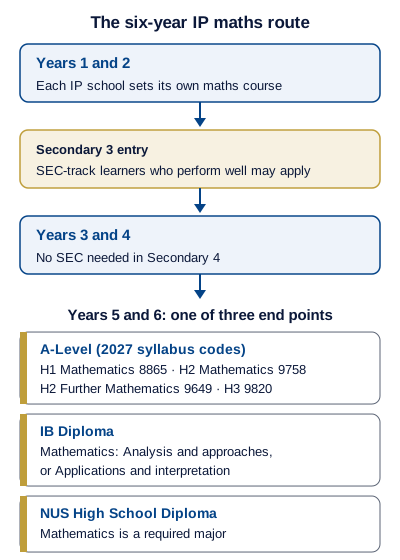
IP maths is the mathematics taught inside a six-year Integrated Programme, which ends at one of three qualifications: the NUS High School Diploma, the IB Diploma or the A-Level. According to MOE, an IP learner can skip the SEC in Secondary 4 and every IP school runs a programme of its own, so the maths course a learner follows depends on the school.
- 01Six years, ending at an NUS High diploma, the IB Diploma or the A-Level.
- 02No SEC needed in Secondary 4, so Year 4 leads straight into Year 5.
- 03Compulsory subjects vary from one IP school to another.
- 04Transfers between IP schools are allowed only in exceptional circumstances.
The six-year route
How does the six-year IP route run for maths?
The IP maths route runs six years with no SEC needed in Secondary 4; the Eduprime integrated programme singapore guide covers IP schools and admission in full.
- 1
Entry: Year 1, or Secondary 3
The IP starts at Year 1, the same point as Secondary 1. MOE states that SEC-track learners who perform well may apply for a move into the IP at Secondary 3. NUS High School takes no part in the S1 posting: Year 1 entry runs through the DSA-Sec exercise or the Supplementary Intake Exercise, and the school also has a Year 3 admission.
- 2
Years 1 and 2: the opening course
Each IP school sets its opening maths course. Temasek Junior College publishes its version as Fundamental Mathematics, built for competency in algebraic and symbolic manipulation, with Polya's and Schoenfeld's problem-solving approaches from IP1. Fluent algebra in these years makes everything after them lighter.
- 3
Years 3 and 4: depth with no SEC
IP learners do not need to take the SEC in Secondary 4, so Year 4 runs straight into Year 5. At Temasek Junior College these years bring Intermediate and Advanced Mathematics, with graphing calculators and selected software in Year 4; other IP schools publish their own sequence.
- 4
Year 5: the end point sets the maths
MOE's SchoolFinder flags 17 secondary schools as IP schools, and the end point differs by school. Anglo-Chinese School (Independent) and St. Joseph's Institution run six-year IPs to the IB Diploma, and Methodist Girls' School learners continue to the IB Diploma at ACS(I). NUS High School leads to its own diploma, and the A-Level is the third end point MOE names.
- 5
Year 6: the final course
On the A-Level track, Year 6 brings the first national maths paper of the route, such as H2 Mathematics 9758. The IB Diploma pairs six subject groups with its core of creativity, activity, service, the extended essay and theory of knowledge. NUS High learners finish the specialisation years of their diploma, with Mathematics among their majors.
Who sets the course
Who decides what an IP learner studies in maths?
Each IP school runs its own maths course
MOE describes every IP school's programme as unique and built on the school's own strengths, and notes that compulsory subjects vary between schools. So two Year 3 learners at different IP schools can be working on different maths chapters in the same week, and the learner's own school course is the reference for every plan.
One school's published course is one example
Temasek Junior College puts its IP maths course in public view: Fundamental Mathematics in Years 1 and 2, Intermediate and Advanced Mathematics in Years 3 and 4, and graphing calculators with selected software in Year 4. Its department states that it designs its own syllabus. Other IP schools set their own order, which is why the learner's own scheme of work is the first thing to bring.
Plan IP maths around weighted assessments
MOE removed mid-year examinations from secondary schools and moved feedback to weighted assessments and classroom assignments, as its parliamentary reply of 3 October 2023 explains. The learner's marked checkpoints therefore come in smaller pieces through the year, and each one is a good moment to review the tutoring plan.
Three tracks side by side
How do the IP A-Level track, the IP IB track and the SEC track compare for maths?
IP maths leaves the SEC track at Secondary 4, and from Year 5 the A-Level and IB tracks take different maths courses and final assessments.
| Aspect | IP A-Level track | IP IB track | SEC track (G3) |
|---|---|---|---|
| National exam at Sec 4 | No SEC needed; Year 4 leads straight into Year 5 | No SEC needed; Year 4 leads straight into Year 5 | The SEC, sat at Secondary 4 |
| Maths in Years 5 and 6 | A-Level 2027 codes: H1 8865, H2 9758, H2 Further Mathematics 9649, H3 9820 | IB Mathematics: Analysis and approaches, or Applications and interpretation | Set by the post-secondary route the learner takes after the SEC |
| Final maths assessment | H2 Mathematics 9758: two 3-hour papers, 100 marks each, 50% each | Set by the IB Diploma; course detail on our IB maths pages | SEC papers at Secondary 4; the G3 list includes Additional Mathematics K341, which assumes G3 Mathematics |
| Calculator in the final exam | An approved graphing calculator without a computer algebra system is expected | As the IB maths course sets it | As the SEC syllabus sets it |
| Who sets Years 1 to 4 maths | The IP school, whose programme MOE calls unique to it | The IP school, whose programme MOE calls unique to it | National syllabuses examined by SEAB |
Three tracks side by side
How are the two H2 Mathematics 9758 papers built?
H2 Mathematics 9758, an A-Level 2027 syllabus on the IP A-Level track, splits its marks evenly across two 3-hour papers.
| Aspect | Paper 1 | Paper 2 |
|---|---|---|
| Time and marks | 3 hours, 100 marks, 50% of the total mark | 3 hours, 100 marks, 50% of the total mark |
| Content | Pure Mathematics | Section A Pure Mathematics, 40 marks; Section B Probability and Statistics, 60 marks |
| Application question | One real-world application question of at least 12 marks | One real-world application question of at least 12 marks, in Section B |
| Number of questions | 10 to 12, all answered | 4 to 5 questions in Section A, 6 to 8 in Section B |
| Graphing calculator | Approved model without a computer algebra system; papers assume access | Approved model without a computer algebra system; papers assume access |
Following the school course
How does an IP maths tutor follow one school's course?
Eduprime IP maths lessons start with the scheme of work the learner's school already uses, because MOE describes each of the IP programmes as unique.
Mapping the school's course, step by step
Six steps take an IP maths tutor from the learner's own scheme of work to a plan that follows one school's course. Temasek Junior College states that its maths department designs its own syllabus and selects its own topics and problems, and MOE notes that IP programmes vary by school. So the learner's school is the first reference for the plan.
- 1
Collect the school's own plan
In the first sessions the learner shares the term's scheme of work, the assessment plan and recent marked work. These show the chapter order, the depth the school expects and the style of question its teachers write.
- 2
Mark the gaps
Each chapter the school has already taught is checked against the learner's marked work. Anything taught but never secured is marked as a gap to close first, in the order later chapters need it.
- 3
Set the next block of lessons
The plan pairs the chapter the class is on with one older gap. The learner stays level with the class while the foundation underneath gets repaired.
- 4
Practise at the school's depth
Practice questions match the depth of the school's own papers, with working laid out one step per line so the learner's teachers can follow every move.
- 5
Review after each weighted assessment
When a weighted assessment comes back, the tutor and learner go through the lost marks and sort each one into a slip, a method gap or a time problem.
- 6
Adjust and report
The plan for the next block shifts toward what the assessment revealed. That shift is written into the session notes the tutor leaves each time and into the monthly progress report, so the learner sees which chapters are secure and which still need work.
A K341-style discriminant problem: for which k are there no real roots?
The problem
Find the range of values of k for which the equation x² + kx + 9 = 0 has no real roots.
Worked solution
- 1Write the condition. A quadratic ax² + bx + c = 0 has no real roots when its discriminant b² − 4ac is less than 0. SEAB lists the conditions for two real roots, two equal roots and no real roots in item A2 of its K341 Additional Mathematics syllabus.
- 2Substitute a = 1, b = k and c = 9 to get k² − 4(1)(9) < 0, which simplifies to k² − 36 < 0.
- 3Factorise to (k − 6)(k + 6) < 0. A product of two brackets is negative only when exactly one bracket is negative, which happens when k lies between −6 and 6.
- 4Check the boundaries. At k = 6 the equation becomes (x + 3)² = 0, with two equal roots, so k = 6 and k = −6 are excluded. At k = 0 it becomes x² + 9 = 0, which has no real roots, confirming the range.
Answer: −6 < k < 6
Writing the answer as k < ±6 is the inequality slip listed in the pitfalls on this page. Testing one value inside the range and checking both boundaries catches it before the answer is written.
Where ground is lost
Where do IP learners lose ground in maths?
IP maths has no SEC checkpoint in Secondary 4, so gaps surface late; two MOE rules and six pitfalls show where.
Two MOE rules that shape IP maths
Two MOE rules decide how gaps in IP maths form and where they get fixed.
No SEC checkpoint
MOE confirms that the SEC in Secondary 4 is optional for IP learners. In a parliamentary reply of 7 November 2023, before the SEC replaced the O-Level, MOE encouraged IP learners to use the time freed from O-Level preparation for broader learning experiences. No national paper checks whether Year 2 algebra held, so a weak base can travel unnoticed into Year 5.
One school for six years
MOE asks each IP learner to commit for the full duration; it strongly discourages transfers and allows a move to another IP school only in exceptional circumstances. A gap in maths is closed inside the learner's current school course, which is why lessons follow that course closely.
Six places IP maths marks slip
Six slips sit close to the rules and worked problems on this page, and each has a fix the learner can practise.
Gaps build quietly, because no SEC paper arrives in Secondary 4.
Treat every weighted assessment as a checkpoint: list each lost mark by topic and carry the list into the next block of lessons.
Algebraic manipulation is accurate but slow, so timed papers end early.
Short timed drills on expanding, factorising and rearranging, with the time recorded so progress is visible.
Quadratic conditions are written with the wrong inequality, such as k < ±6.
Factorise the discriminant inequality, test a value on each side of the critical values and check the boundary cases by substitution.
Show-that answers jump straight to the target expression.
Write one step per line and name the rule used; SEAB's K341 syllabus warns that omitting essential working results in loss of marks.
A graphing calculator answer is left bare where the question asks for working.
Read the question for a working instruction first. In H2 Mathematics 9758 an unsupported GC answer is allowed unless the question states otherwise; where it does, write the steps in mathematical notation and sketch any graph used.
A Sec 3 joiner from the SEC track meets topics the class covered in Years 1 and 2.
List the Years 1 and 2 chapters in the school scheme, tick the ones the joiner already holds, and teach the rest in the order the Year 3 chapters will need them.
Four maths skills an IP learner builds, by year group
Four maths skills run through the published courses and syllabuses on this page, and each looks different at each stage of the route. The skill a learner is behind on at their stage is the one the lessons rebuild first.
| Criterion | Years 1 and 2 | Years 3 and 4 | Years 5 and 6 |
|---|---|---|---|
| Algebraic manipulation | Expands, factorises and rearranges quickly and without sign errors | Handles quadratic conditions and discriminant inequalities without slips | Carries long algebra through series and Pure Mathematics questions without losing a term |
| Reasoning and written working | Shows each step of a solution in order | Writes show-that answers that reach the exact target expression | Sustains multi-part working across a 3-hour paper |
| Modelling and problem solving | Turns a word problem into an equation, using an approach such as Polya's | Plans multi-step problems and checks the answer against the context | Handles a real-world application question worth 12 marks or more |
| Graphing calculator and software use | Uses the calculator the school allows for checking arithmetic | Plots, solves and checks with a graphing calculator, which Temasek Junior College brings in at Year 4 | Knows when a GC answer may stand unsupported and when the question asks for written steps |
Accountability
What can a learner check during IP maths lessons?
IP maths progress lives in session notes the tutor writes each time and in a monthly report, each tied to the school course the lessons follow.
Tutor notes after every session
After each IP maths session the tutor records the chapter covered, the questions worked and the practice set before the next lesson.
Monthly progress report
Once a month the report sums up gaps closed, gaps remaining and the plan for the next block of lessons.
Weighted assessments in the record
When the learner shares a marked weighted assessment, the notes sort each lost mark into a slip, a method gap or a time problem.
School scheme tracked
The notes record which chapter of the school's IP scheme the learner has reached, so tutoring moves in step with the class.
What decides results
What decides an IP maths result?
IP maths results rest on practice between lessons, the school's pace and early algebra; lessons set practice, follow the school scheme and rebuild algebra first.
- 6 years
- of the IP route covered, from Year 1 algebra to Year 6
- 2 × 3-hour papers
- in H2 Mathematics 9758, one of the A-Level track's final maths papers
- 12,000+
- tutors with experience and skill in what they teach
- 4 sessions
- of 60 minutes in Starter, the smallest package
Questions
Which IP maths tuition questions do learners ask?
Cost, tutor matching, the school-set course and the Year 5 split, each answered for learners on the six-year IP maths route.
Next step
From Year 2 algebra to the Year 5 choice
Register and our team matches an IP maths tutor to the school course, home or online, before Year 3 depth and the Year 5 choice of H2 or IB maths.
- Tutor matched to school course
- Home or online lessons
Eduprime · IP maths lessons, home or online
Related pages