How to Prepare for Secondary 1: Your G-Levels and a Term I Study Routine
To prepare for Secondary 1, start with the subject levels your PSLE result gives you. Under Full Subject-Based Banding, which began with the 2024 Sec 1 cohort, a learner posted through Posting Group 1 or 2 with an AL 5 or better in English, Mother Tongue, Maths or Science may start that subject at G3, and levels can move later. Then build a fixed weekly routine with short self-tests, planned around a mixed form class and CCA.
What actually changes between Primary 6 and Secondary 1?
Almost everything around the timetable changes at once: each subject now carries its own level, the form class mixes learners from different Posting Groups, and a Personal Learning Device joins the school bag. The table sets each change against the MOE rule behind it.
The useful way to read the table is row by row, asking what each change means for your week. Subject levels decide the pace of four core lessons. The mixed form class is where you spend about a third of curriculum time, the share MOE gives the Common Curriculum. The device and phone rules decide how homework reaches you and how much of the school day stays screen-free.
One row stays steady. Since Primary 3, each subject has carried at most one weighted assessment a term, and that ceiling holds all the way to Secondary 4 or 5, so a new Sec 1 learner keeps the P6 rhythm and still faces no mid-year examination.
| Area | At the end of Primary 6 | From the start of Secondary 1 |
|---|---|---|
| Subject levels | PSLE subjects taken at Standard or Foundation level | A G-level per subject, G1, G2 or G3, with G3 the more demanding |
| Posting Group | The PSLE result places the learner in PG1, PG2 or PG3 | Used only for admission and the starting subject levels |
| Form class | A primary form class | A mixed form class of learners from different Posting Groups |
| Weighted assessments | At most one per subject per term | The same cap, with no mid-year examination |
| National exam ahead | The PSLE, just completed | SEC, a common national examination from 2027, with each subject shown at its level |
What should a learner do between PSLE results and the first day of Sec 1?
Use the weeks between the results and Term I to read your posting result closely, sketch a first timetable, get ready for the Personal Learning Device and keep Primary 6 maths and English warm with light review. The holiday is for rest too, so each task stays short.
MOE's national exam dates page lists the 2026 PSLE results for release tentatively between Tuesday 24 and Wednesday 25 November 2026. Secondary 1 posting results follow later; in the 2025 cycle they came in December, a few weeks after the PSLE results. In the 2027 school year, Term I runs from January to March, so the first weekly routine has to exist by early January.
Treat the checklist below as a series of small jobs spread across the holiday. Each one takes an afternoon at most, and together they leave the first week of Sec 1 free for meeting the form class and finding the way around a new school.
- Read the posting result together with the subject levels it sets for English Language, Mother Tongue, Mathematics and Science, and note which, if any, start at G3.
- Once the school issues the Personal Learning Device, set it up as the school instructs, and learn where homework and class announcements will appear.
- Draw a blank weekly grid with school hours, travel time and two short study slots on most weekdays, ready to fill once the real timetable arrives.
- Review fractions, ratio and percentage problems from P6 maths in three or four short sittings, writing answers from memory before checking.
- Read for twenty minutes on most days, then close the book and answer two or three questions about the reading from memory before looking back.
- Pack a simple planner, physical or digital, and decide where it lives so it gets opened every day.
How does Full Subject-Based Banding change a Sec 1 learner's school week?
Full SBB, which started with the 2024 Secondary 1 cohort, means your week is organised around subjects at their own levels inside a mixed form class. Your Posting Group mattered for admission and your starting levels, and after that the week is shaped by subjects.
The form class is the home base. It brings together learners from different Posting Groups, and MOE does not allow anyone to opt out of it. Learners are in mixed form classes through lower secondary, schools have the autonomy to decide how best to structure them, and each school assesses whether the mixed form class experience should extend into upper secondary.
About a third of curriculum time goes to the Common Curriculum, the subjects every learner in the form class takes together at a common level and standard. The rest of the week is built around subjects that carry a G-level, and here your own mix matters.
For planning, this means the study routine should be built subject by subject. Count the subjects at each level, then give the more demanding ones a slightly larger share of the weekly self-test slots.
Which subjects can start at G3 or G2, and what AL is needed?
Four subjects can start at a more demanding level at the beginning of Sec 1: English Language, Mother Tongue Languages, Mathematics and Science. The rule applies to learners eligible for Posting Groups 1 and 2: with AL 5 in a subject, a learner whose other subjects start at G2 may take it at G3, and a learner whose subjects start at G1 may take it at G2 or G3; with AL 6, or AL A at Foundation, a G1 learner may take it at G2.
MOE gives its own worked example. A learner with a PSLE score of 23 and an AL 5 in Mathematics is admitted through Posting Group 2, takes most subjects at G2, and takes Mathematics at G3 from the start of Sec 1. The overall score decided the Posting Group, and the single subject result opened the higher level in that subject.
For the 2025 P6 cohort, about 65% of learners eligible for Posting Groups 1 and 2 could take at least one subject at a more demanding level, similar to the year before. The next section works the same rule through for a learner posted through Posting Group 1, then follows what can change after Term I begins.
| Posting Group and usual starting level | PSLE result in the subject | Level the subject may start at |
|---|---|---|
| Posting Group 2, most subjects at G2 | AL 5 or better | G3 |
| Posting Group 1, most subjects at G1 | AL 5 or better | G2 or G3 |
| Posting Group 1, most subjects at G1 | AL 6, or AL A at Foundation | G2 |
| Most subjects at G3 | English, Maths or Science taken at Foundation | A less demanding level, in consultation with the school |
Can a subject level change after Sec 1 starts?
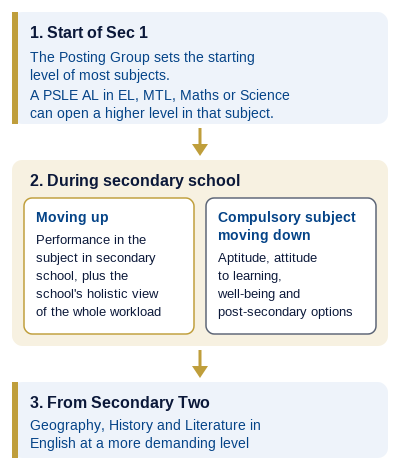
Yes. A subject can move to a more demanding level after Sec 1 begins, based on your performance in that subject in secondary school and a holistic assessment by the school that you can cope with the subject and your overall workload.
Moving a compulsory subject to a less demanding level is also possible, and the school weighs several things before it decides.
Keep the long view in mind. In upper secondary, English Language, Mother Tongue Languages, Mathematics, Science and the Humanities are compulsory, so steady work in each of them through Sec 1 keeps every option open. The decision belongs to the school, and what a learner controls is the evidence: the work in that subject, term after term.
- Moving up: performance in that subject in secondary school, plus how well you cope with the subject and the whole workload.
- Moving a compulsory subject down: aptitude, attitude to learning, socio-emotional well-being and the effect on post-secondary options.
- Humanities: a more demanding level becomes available from Secondary Two.
Worked example
One Posting Group 1 learner: starting levels, then room to move
A learner is admitted through Posting Group 1, so most subjects start at G1. The PSLE results in the four core subjects are Mathematics AL 5, Science AL 6, Mother Tongue AL A at Foundation and English Language AL 7. At which level may each subject start?
- Start from the Posting Group: Posting Group 1 sets most subjects at G1 at the start of Sec 1.
- Mathematics, AL 5: a G1 learner with AL 5 may take the subject at G2 or G3.
- Science, AL 6: a G1 learner with AL 6 may take the subject at G2.
- Mother Tongue, AL A at Foundation: a G1 learner may take the subject at G2.
- English Language, AL 7: no entry rule opens a higher level, so it starts at G1 with the other subjects.
Mathematics may start at G2 or G3, Science and Mother Tongue at G2, and English Language at G1. Any subject that starts below G3 can move up later, on performance in secondary school and the school's holistic assessment.
What is a mixed form class, and which subjects are shared?
A mixed form class is the class you belong to in lower secondary, made up of learners from different Posting Groups. Together you take the Common Curriculum, six subjects that fill about a third of curriculum time.
The six Common Curriculum subjects are Art, Character and Citizenship Education, Design and Technology, Food and Consumer Education, Music and Physical Education. Where they are examined, they are assessed at a common level and standard for the whole class, so every learner in the form class meets the same expectations in them whatever their G-level mix.
Learners are in mixed form classes in lower secondary, no learner may opt out, and each school has the autonomy to decide how best to structure its form classes. The class is a good place to make friends across different subject mixes.
For planning, give each of the six subjects a line in the planner from the first week. Any task or due date a teacher announces goes there the same day, next to the G-level subjects, so the week shows every subject in one place.
How do you build a weekly study routine around CCA and school?
Fix a small number of short study slots on the same days every week, give each main subject two quick self-tests a week, and keep one longer review on the weekend. Plan the CCA afternoons in first, because they are the fixed points of the week.
Here is a worked example of a first-term week for a learner taking Mathematics at G3 and English, Mother Tongue and Science at G2, with CCA on two afternoons. Term I in 2027 runs from January to March, so this pattern covers about ten weeks before the one-week March vacation.
Monday, CCA day: no study slot, only the planner check and packing for Tuesday. Tuesday: 25 minutes of Mathematics self-test on that week's lessons, then 20 minutes of Science, written from memory before checking notes. Wednesday, CCA day: 15 minutes of Mother Tongue vocabulary self-test after dinner. Thursday: 25 minutes of Mathematics, then 20 minutes of English, answering three questions on a reading from class from memory before checking. Friday: 20 minutes of Science, 10 of Mother Tongue and 10 of English, plus a look at next week's due dates.
Saturday or Sunday: one review of about an hour that goes back to topics from two and three weeks earlier, mixing questions across subjects. A 2013 review of educational research by Dunlosky and colleagues rated practice testing and distributed practice as high-utility techniques, and rated summarisation, highlighting and rereading as low utility. The weekday self-tests and the weekend return are this plan's way of using the two high-utility techniques. The days and minutes are practice-based starting points; adjust them once the real homework load is clear.
Remember the community hours too. Under LEAPS 2.0 every secondary student contributes at least six hours a year to the community, so mark the dates when they are announced.
How should a learner handle the first weighted assessments of Sec 1?
Treat each weighted assessment as a milestone that checks a few weeks of learning. Each subject has at most one per term, and secondary schools no longer hold mid-year examinations, so steady weekly work feeds straight into them.
How weighted assessments and the end-of-year examination fit together over four terms has a guide of its own on our site; this section stays with a Sec 1 learner's first attempts. The steps below turn each one into a manageable task.
- Write the date of every weighted assessment in the planner the day it is announced.
- Ask the teacher which topics and skills it covers, and list them on one page.
- Two weeks before, switch the weekday self-tests in that subject to questions from the listed topics.
- In the final week, do one timed practice from memory and mark it honestly.
- Afterwards, sort every lost mark into gaps in knowledge, careless slips or time, and carry that list into the next two weeks of self-tests.
- Keep the marked script in one folder per subject; by the end-of-year examination it becomes the revision map.
How should a learner study a subject taken at a more demanding level?
Study a G3 subject with a steady weekly pace, a self-test after every few lessons and questions raised early with the teacher. The PSLE result in that subject opened the level; after that, moving up rests on performance in the subject in secondary school and a holistic assessment by the school.
Pace comes first. G3 is the more demanding level, and topics in a subject build on one another, so a topic missed early can be needed again in later weeks. Reading over the notes feels productive, yet the 2013 Dunlosky review rated rereading as low utility. Closing the book and answering three or four questions from memory shows straight away what has stuck.
Ask questions early. A learner who writes the confusing point in the planner and asks the teacher the next day keeps the gap small, while the topic is still the current one.
Watch the workload as a whole. The school looks at how a learner copes with the subject and with the overall workload, so a G3 subject that swallows every evening is a signal to rebalance the routine, protecting sleep and the other subjects. Balance is part of doing well at G3.
What are the rules on the Personal Learning Device and phones in secondary school?
Every secondary student has a Personal Learning Device with a Device Management Application, and from January 2026 smartphones and smartwatches stay unused during school hours. The device is a study tool with set limits, and those limits are worth building into the routine.
The device also carries the digital skills of lower secondary. Spreadsheets, word processing and presentations are folded into subject tasks, so getting comfortable with them during the holiday pays off quickly. Home-based learning days are scheduled regularly through the year in secondary schools, and on those days the device is the classroom.
- Personal Learning Device: owned by every secondary student and used across subjects in lessons and homework.
- Device Management Application: keeps the device in a regulated environment that supports cyber wellness.
- Sleep hours: the device's default lock-out now starts at 10.30pm, half an hour earlier than the old 11pm, a change that took effect in January 2026.
- Smartphones and smartwatches: a Sec 1 learner leaves both untouched from the first bell to the last, through recess and CCA and through any supplementary, enrichment or remedial lesson, under the rule MOE applied from January 2026.
- Storage: each school decides where phones wait, in lockers or another designated spot or simply in the school bag, and a school may grant an exception when there is a need.
- Planning tip: finish device-based homework well before 10.30pm so the sleep hours never cut a task in half.
How do CCA and LEAPS 2.0 fit into the study week?
LEAPS 2.0 recognises four domains, Participation, Achievement, Leadership and Service, and Participation rests on one school-based CCA, so the CCA belongs in the study plan from the first week.
Participation counts the years spent in a CCA and conduct within it, and sustained engagement in the same CCA earns higher recognition. That favours choosing a CCA you can see yourself staying in for several years, and then treating its training days as fixed points in the timetable.
Service has its own requirement. Every secondary student contributes at least six hours each school year to the community, and a Values-in-Action project is one way to do it. Achievement and Leadership grow out of the same commitment over time.
In practice, the weekly routine works best when CCA afternoons carry no study slot at all and the self-tests sit on the other weekdays. Planned this way, the evening after a long training day stays free for rest.
Which mistakes do new Sec 1 learners make?
The common mistakes are using rereading as the only revision method, leaving the planner empty, treating Common Curriculum lessons as free periods and waiting until the end-of-year examination to ask for help. Each one has a simple fix.
Most of these mistakes start small in Term I and only show up at the first weighted assessments. Catching them early is easier than undoing them in Term III.
- Leaning on rereading. Highlighting and rereading sat near the bottom of the utility ratings Dunlosky and colleagues published in 2013, which is why a Sec 1 planner swaps them for short weekday quizzes and a spaced look back at the weekend.
- An empty planner. Homework, project stages and assessment dates arrive from many subjects at once, and the planner keeps them in one place.
- Treating Common Curriculum lessons as free periods. Where they are examined, they are assessed at a common level and standard for the whole class, so their tasks belong in the planner with everything else.
- Waiting for the end-of-year examination to ask. Ask the teacher while the topic is still the current one, and note the answer in the planner.
- Studying late on CCA days. The plan above keeps CCA afternoons free of study slots, so move any slot that lands there to a lighter day.
- Copying a classmate's timetable. Subject levels differ inside the same form class, so each routine needs its own shape.
Why does the move to secondary school feel hard, and what helps?
Many new things arrive in the same month. A 2011 review by Benner of research on the American school system describes school transitions as frequent and predictable, and notes that they can disrupt student functioning across developmental domains. Knowing that makes the first term easier to plan for.
Benner's review, published in Educational Psychology Review, gathered research on the move into high school in the United States. It observes that this research often looks at one developmental domain at a time, academic or socio-emotional, and calls for a more integrated model across domains. The system there differs from Singapore's. A Sec 1 learner still meets several changes in January together: new subject levels, a new form class, a device, CCA and a new school building.
What helps is structure. A planner, a small number of fixed study slots and a weekly review give a learner something steady while the rest settles. A friendly face in the form class and early questions to teachers do the same for the social and academic sides. The routine built in the first term is the one that carries a learner through the rest of the year.
What can a tutor add to a Sec 1 learner's G-level subjects, and where does registration start?
Our team matches a tutor for the subject the learner needs, by the learner's town and timetable for home lessons. The first step towards these lessons is a consultation with our team, and that conversation costs nothing.
Each G-level subject is taught to a single learner, by video or face to face where the Sec 1 learner lives, and our team picks the tutor with the learner's town and school week in view. Each tutor is skilled in the subject and experienced at teaching it. Our bench runs past 12,000 tutors, and the subjects a Sec 1 learner needs sit among the 148+ programmes we teach. Lessons are matched to the learner's timetable around CCA afternoons, with worksheets and lesson plans included.
A Sec 1 learner is a minor, so a parent or guardian gives the consent and handles payment. The steps below show how the first package runs.
- Consultation: the first talk about Sec 1 subjects happens with our team at no charge, reached through Register Now (the registration form) or Ask a question (the contact form).
- Matching: home lessons are matched to the learner's town and timetable, and online lessons to the timetable.
- Starter package: four lessons, each one 60 minutes long, open the work on a Sec 1 subject at its own G-level.
- Moving a lesson: a lesson can be moved or cancelled free of charge with 24 hours' notice.
- After every session: the tutor writes notes, and a monthly progress report follows.
How much does Sec 1 tuition cost?
Rates for Sec 1 lessons live in the price table on our secondary tuition pages, so the figures a learner sees there are the current ones. A first-time Eduprime learner also finds the one-off registration fee printed in that table.
A package can be settled in one payment, or split into two halves, one when lessons begin and one at the package's midpoint. For a Sec 1 learner the entry point is Starter: four lessons, 60 minutes apiece. How rates differ between levels, and between home and online lessons in Singapore, is laid out in our tuition rates guide.
How can a learner and the registrant check progress in the first year?
Three records track a Sec 1 year side by side: the weighted assessment marks the school returns, our monthly progress report and tutor notes after every session. Reading them together gives a clear picture across the year.
Because a subject sees no more than one weighted assessment a term, every returned script marks a clear stage in the year. The learner's parent or guardian receives the monthly progress report, and the learner can read the tutor notes to see what each session covered.
- Monthly progress report: sent each month to the learner's parent or guardian.
- Tutor notes: written after every session, for the learner to read alongside the school's returned work.
- Weighted assessment results: one checkpoint per subject per term, compared against the tutor notes from the weeks before.
- Free tutor replacement: whenever the learner asks, our team brings in a new tutor, however many sessions have passed.
Where to read next
This guide covers the study side of the first secondary year. How Sec 1 places are allocated, what the Posting Groups mean and the role of the PSLE score belong to our PSLE guide. The SEC, the common national examination that follows the O- and N-Level examinations after their final 2026 sitting, and how G-level subjects are graded sit in our o level singapore guide, which treats the years after Sec 1 as one pathway.
For the assessment rhythm across the year, read our guide to weighted assessments. For lessons, see secondary school tuition, or the subject pages for secondary maths and secondary science. Our tuition rates guide covers cost.
Sources
- MOE, 1 March 2023
- MOE: Full Subject-Based Banding overview and timeline
- MOE: Full SBB FAQ
- MOE: Full SBB, the secondary school experience
- MOE press release, 25 Nov 2025: Release of 2025 PSLE Results
- MOE: national examination dates
- MOE, 29 December 2020
- MOE, 30 November 2025
- MOE: A Holistic Education for Secondary School Students, LEAPS 2.0 (PDF)
- MOE, 28 September 2018
- MOE, 7 March 2022
- MOE, 14 July 2026
- Benner (2011), The Transition to High School: Current Knowledge, Future Directions, Educational Psychology Review 23(3)
- Dunlosky et al. 2013, review of ten learning techniques (PubMed 26173288)
One-to-one lessons with Eduprime
At home in Singapore or online. The first consultation is free, and a tutor can be changed whenever the learner asks.