Skip to content

Weighted Assessment in Singapore: How to Study for WAs and the End-of-Year Exam

A weighted assessment in Singapore is a school test, quiz, presentation or project whose score counts towards a learner's overall subject result for the year. MOE's cap holds from Primary 3 through Sec 4/5: no more than one WA per subject in any school term, and by 2023 every primary and secondary level had dropped its mid-year exam. The plan the research backs: practice tests through each term, then end-of-year revision spread over weeks.

What is a weighted assessment in Singapore schools?

A weighted assessment, or WA, is an assessment the school sets during the term whose score counts towards the learner's overall result in that subject for the year. From Primary 3 upwards, MOE allows no more than one per subject in each school term.

The word "weighted" carries the meaning. Each WA adds a share to the year's subject result, and MOE allows that share to differ from one WA to the next. A short quiz early in the year can carry a small share while a later test carries a larger one, so two WAs in the same subject need not count equally.

MOE describes assessments as periodic checkpoints. They show how learning is progressing through the year, and their results help schools and learners decide which subjects and levels suit the learner. So a WA does two jobs at once: it adds marks to the year, and it tells the learner what to repair before the end-of-year exam arrives.

Behind the term sits a national MOE rule for every primary and secondary school, starting at Primary 3: no more than one weighted assessment per subject, per school term. MOE's 2022 release adds that the range of assessments a school runs may include termly WAs. So a subject can carry a WA in a term or none at all, and the school's own notices tell the learner how many to expect in each subject.

When were mid-year exams removed in Singapore and for which levels?

In stages. Primary 1 and 2 lost all weighted assessments and exams from 2019; Primary 3, Primary 5, Sec 1 and Sec 3 lost the mid-year exam between 2019 and 2021; every remaining primary and secondary level followed by 2023. Junior colleges and Millennia Institute began removing it from 2024.

MOE announced the first step on 28 September 2018. Sec 1 went first, in 2019, and the other three levels of that round followed over the next two years. In March 2022 MOE set the finish line: no mid-year exam at any primary or secondary level by 2023. At that point, in March 2022, more than one-third of secondary schools had already dropped it at Sec 2, and about one in 14 primary schools at Primary 4.

MOE has stated the aim in its own words: less weight on examinations and grades, more time for engaging lessons, and learners who direct their own study.

How the mid-year exam was removed, level by level (MOE releases)
YearLevels changedWhat changedMOE source
2019Primary 1 and Primary 2All weighted assessments and examinations removed; no overall mark or gradePress release, 28 Sep 2018
2019 to 2021, Sec 1 firstPrimary 3, Primary 5, Sec 1, Sec 3Mid-year examination removed, phased inPress release, 28 Sep 2018
2022 to 2023Primary 4, Primary 6, Sec 2, Sec 4/5Mid-year examination removed at every remaining level by 2023Press release, 7 Mar 2022
From 2024JC and Millennia InstituteMid-year examinations removed for consecutive cohortsPress release, 1 Mar 2023

Worked example

Worked example: could this year still have a mid-year exam?

Two learners were in Sec 2, one in 2022 and one in 2023. Which of them could still have sat a mid-year exam?

  1. Place the level: Sec 2 sits in the last group, with Primary 4, Primary 6 and Sec 4/5, in MOE's March 2022 release.
  2. Read the 2022 rule: schools could remove the exam for those levels in 2022 if they were ready.
  3. Read the deadline: the exam was to be gone from every primary and secondary level by 2023.
  4. Apply both rules to each learner's year.

The 2022 learner could have sat one, if that school had kept it that year; the 2023 learner's year fell under MOE's deadline.

Which levels have weighted assessments and what are the rules?

From Primary 3 to Sec 4/5, and in JC and Millennia Institute, schools may set weighted assessments, no more than one per subject per term. Primary 1 and 2 have none: their assessments give feedback and count towards no mark or grade.

The pattern across the four stages: the youngest learners are assessed for feedback alone, every later stage may carry WAs under the same cap, and the mid-year exam is gone everywhere. The JC cap comes from MOE's 2023 release; the primary and secondary cap dates from the 2018 announcement.

In Primary 1 and 2, teachers still assess. They use those checks to see what a learner understands and to give timely feedback, and the report describes learning in words in place of marks.

Weighted assessment rules by stage of schooling
StageWAs countedWA capMid-year examHow learning is reported
Primary 1 to 2None; assessments count to no mark or gradeNo WAsNone: P1 had no semestral exams and P2 no mid-year exam in 2018; all P1-2 exams went from 2019Qualitative descriptors in place of marks
Primary 3 to 6If set, they count towards the year's subject resultNo more than one per subject per termRemoved; every level by 2023Whole-number marks; no class or level position
Sec 1 to Sec 4/5If set, they count towards the year's subject resultNo more than one per subject per termRemoved; every level by 2023Whole-number marks; no class or level position
JC and Millennia InstituteWhen the college sets themNo more than one per subject per termRemoved for consecutive cohorts from 2024Not set out in the MOE releases this guide draws on

Worked example

Worked example: the most WAs one subject can carry in a year

A Primary 5 learner's school runs the four-term MOE year. At most, how many science WAs can that year carry?

  1. Find the rule: no more than one WA per subject, per school term, from Primary 3 to Sec 4/5.
  2. Count the terms: Term I to Term IV, four in all.
  3. Multiply the cap by the terms: 1 times 4 is 4.
  4. Read the result as a ceiling, since MOE says schools may include termly WAs.

At most four science WAs; the school's notices give the real number, which can be lower.

How much does a weighted assessment count towards the final result?

MOE publishes no national percentage. Its rules: no more than one WA per subject per school term, WA scores count towards the year's subject result, and each WA may be assigned a different weighting. For the share a particular WA carries, the learner asks the subject teacher.

MOE's 2022 release gives termly WAs a stated job: to assess learning progress and to balance the weighting of the end-of-year examination. It gives no national figure for that balance. That is why two friends in different schools may give different answers to the same question, and why a figure read online about someone else's school says nothing reliable about one's own.

The real numbers for one learner sit close to hand, and a learner who asks early in the year can plan with confidence:

  • The subject teacher, who can say how much a coming WA counts towards the year and which topics it covers.
  • Any notice or instructions the school gives for a WA, with its format and the topics it covers.
  • The marking rubric, when one is given, which shows where the marks sit inside the WA.
  • The returned script, whose marks show where this learner gained and where the marks were lost.

What does a weighted assessment look like: test, quiz, presentation or project?

MOE names class tests, quizzes, presentations and group projects as forms a WA can take. Each form rewards a different kind of preparation, and the weighting can differ from one WA to the next, so the school's notice for each one is the first thing to read.

One line per form, with what preparation suits it. In every case the school's marking rubric, when one is given, decides where the marks go, so it is worth reading before any practice starts.

  • Class test: a timed written paper on the term's topics. Prepare by doing class worksheets closed-book under the same time limit, then marking and correcting them against the answers.
  • Quiz: short and usually narrow. Prepare with five-minute recall sessions spread through the week before, writing answers from memory and checking them straight after.
  • Presentation: marks for what is said and how clearly it is said. Prepare by rehearsing aloud to another person, timing the talk, and practising replies to two questions they ask.
  • Group project: marks earned by a team over several weeks. Prepare by agreeing roles and a draft date early, finishing one's own part ahead of that date, and keeping a short record of who did what.
  • Any form: write down the date, scope and format the day the notice arrives, so the preparation can start weeks ahead of the WA.

How does the four-term school year shape when WAs and the end-of-year exam fall?

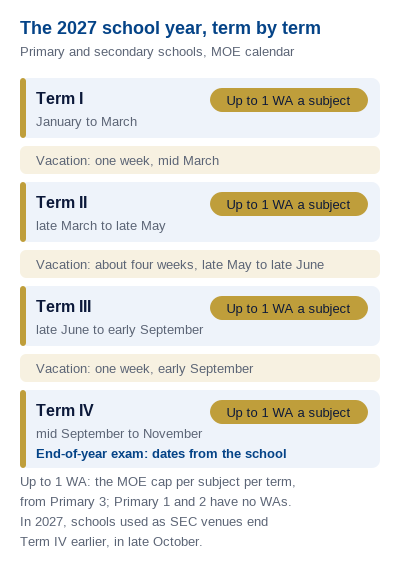
Four terms, each followed by a vacation, make up the Singapore school year, so a subject's WAs land no more than one to a term, and the end-of-year exam comes late in the year on dates the school announces. MOE's calendar for 2027 sets the rhythm below at month level.

The 2027 calendar, released by MOE in July 2026, gives primary and secondary schools this pattern. The dates of each WA and of the end-of-year exam come from the learner's own school, so the plan below works in months and leaves the days to the school's notices.

Two features matter for a study plan. Between Term II and Term III comes the long break, late May to late June, and it suits a sorting pass over the WA notes from Terms I and II. The one-week break in early September sits just before Term IV, the last term of the year, which makes it a strong window for whole-year revision.

  • Term I: January to March.
  • Vacation: one week in mid March.
  • Term II: late March to late May.
  • Vacation: about four weeks, late May to late June.
  • Term III: late June to early September.
  • Vacation: one week in early September.
  • Term IV: mid September to November, with the year-end vacation from late November.
  • In 2027, schools used as venues for SEC written papers end their final term earlier, in late October.
The 2027 primary and secondary school year as four terms with vacations between them; each term carries up to one weighted assessment per subject from Primary 3, and the end-of-year exam comes late in the year on dates the school sets.
The 2027 school year at month level, from MOE's calendar: up to one WA per subject in each term from Primary 3, and the end-of-year exam late in the year.

How should a learner study through one term with a WA in it?

Start practice testing in the first weeks of the term and keep it short and regular until the WA. The worked example follows a Sec 2 maths learner through a 10-week term with the WA placed in week 8 for illustration; the school's notice sets the real week.

Practice testing and distributed practice carry this term plan, and both earned a high-utility verdict when Dunlosky and colleagues weighed common study techniques in their 2013 review. The same review notes that most students report rereading and highlighting, and it points them towards practice testing as the better use of the time. So every week of this plan contains questions answered from memory, spread over several days.

Dunlosky and colleagues gave distributed practice, study spread across separate sessions, the same high rating as practice testing. This plan therefore places its practice across the weeks of the term, with the WA week itself kept light.

  • Weeks 1 and 2: after each maths lesson, the learner answers three questions on that day's topic from memory the next evening, with the textbook closed, then checks.
  • Week 3: the learner copies the WA format and topic list from the school notice into a one-page checklist, one row per topic.
  • Weeks 3 to 6: twice a week, a 20-minute mixed set from every topic covered so far, marked by the learner, with each wrong answer written into an error log by topic.
  • Week 6: the learner reviews the error log and redoes every logged question closed-book; topics with repeat errors get one extra set each.
  • Week 7: one full practice paper under the WA's time limit, built from class worksheets, marked the same day.
  • Week 8, the WA: the evening before is a light pass through the error log and an early night.
  • Weeks 9 and 10: the script returns and goes through the steps in the next section, and its weak topics move onto the end-of-year list.

What should a learner do when a WA script comes back?

Work through the script before filing it: sort every lost mark by cause, redo the wrong questions from memory a few days later, log them, and ask about anything unclear. MOE names weighted assessments and classroom assignments as feedback sources, and the returned script is where that feedback lives.

Hattie and Timperley's 2007 review in the Review of Educational Research found feedback to be among the major influences on learning and achievement, with an effect that can run positive or negative. The same review found that the type of feedback and the way it is given differ in how well they work. The steps below are a working routine for putting a returned script's comments to use.

  • Read every comment first and look at the total last.
  • Sort each lost mark into one cause: a content gap, a method slip, a careless error, running out of time, or a misread question.
  • Two or three days later, redo each wrong question with the correction covered.
  • Enter each one in the error log with its topic and cause, so the pattern across WAs becomes visible.
  • Ask the subject teacher about any comment the learner cannot act on, and bring the script to the next lesson.

How should a learner revise for the end-of-year exam without a mid-year exam?

Treat the end-of-year exam as a whole-year paper: build one topic list for the year, use the error logs from every WA as the map, and spread revision across Term III, the early-September week and Term IV.

With the mid-year exam gone, the end-of-year exam is the year's school examination at the levels that hold one, and it can draw on topics taught in every term. MOE's 2018 announcement counted what the switch released: about three weeks of curriculum time in every two-year block. Revision for a whole year of content therefore needs its own plan, laid out weeks ahead.

Distributed practice, rated high in utility by the 2013 review, is the backbone here. Each topic returns several times over the weeks, and each return is a short test from memory, so the year's topics stay in rotation right up to the exam.

  • Early Term III: list every topic of the year in each subject on one page.
  • Mark each topic from the WA error logs: red for repeat errors, amber for single errors, green for clean.
  • Term III: two short mixed practice sets a week, red topics first.
  • The early-September vacation week: one timed full paper per main subject, marked the same day.
  • Term IV until the exam: rotate every topic at least twice more, with amber and green topics returning on a spaced schedule.
  • The final week: error logs and formula or key-term sheets only, and full nights of sleep.

How is preparing for weighted assessments different in primary, secondary and JC?

MOE's cap stays the same from Primary 3 to JC, no more than one WA per subject per term, while the study routine grows with the learner: short recall in Primary 1 and 2, a guided routine in upper primary, a self-run plan in secondary and a full subject-by-subject schedule in JC.

Primary 1 and 2 carry no weighted assessments, and their assessments count towards no mark, so the aim there is reading, number sense and the habit of recalling what was learnt. Teachers still use those assessments for feedback, which makes their comments worth reading.

From Primary 3 the cap of no more than one WA per subject per term applies, and from then on the learner takes over more of the planning each year. In JC and Millennia Institute the same cap holds under MOE's 2023 release, which also says the removed mid-year exam is not replaced by more school-based assessments.

Preparing for WAs by stage (suggested routines)
StageRoutine lengthWho plansWhat to bring to each session
Primary 1 to 210 to 15 minutes of recall a dayThe adult who registered the learner sets the routine with the learnerRecent worksheets and the teacher's written comments
Primary 3 to 6Short daily recall plus two practice sets a week before a WAThe learner, with an adult's helpThe WA notice, the topic checklist and the error log
Sec 1 to Sec 4/5Two or three mixed practice sets a week per weak subjectThe learner, who sets the weekly planThe WA notices, returned scripts and the error log
JC and Millennia InstituteA weekly schedule across all subjects, planned around up to one WA per subject per termThe learnerLecture notes, tutorial sheets and marked scripts

What does the report book show after the changes?

Since 2019 the report book shows no class or level position, and marks above Primary 2 are rounded to whole numbers without decimal points. Primary 1 and 2 reports describe learning in words in place of marks.

MOE made these changes in its 2018 announcement, and the report book is formally called the Holistic Development Profile. In 2022 MOE added that schools which had removed the mid-year exam can report learning by drawing on multiple sources of assessment, with regular assignments as a channel for feedback.

Two awards changed with it. The Edusave Merit Bursary for Primary 1 and 2 and the Good Progress Award for Primary 2 and 3 now rest on qualities such as diligence, curiosity and collaboration.

For a learner, the useful reading is the subject mark next to last year's mark, and the teacher's comments.

Which revision habits should a learner swap out before WAs and the end-of-year exam?

Five habits are worth swapping: rereading, highlighting, summarising, a last-night cram, and putting a marked script away unread. Rereading, highlighting and summarisation sat in the low-utility group when the 2013 review by Dunlosky and colleagues graded study techniques.

For the first four habits, the same review rated a replacement higher: practice testing and distributed practice. The fifth wastes the feedback a marked weighted assessment gives. Most learners already hold what the swaps need: their own worksheets, scripts and notes.

  • Rereading as the main method: most students report it, and the review rated it low. Close the book and answer questions from memory instead.
  • Highlighting: the review rated it low too. Turn each highlighted line into a question and answer it two days later.
  • Cramming the night before: one long session sits opposite distributed practice, which the review rated high. Spread the same work over the weeks before the paper.
  • Summarising pages of notes: the review placed summarisation among the low-utility techniques. A short practice set on the same topic does more.
  • Filing a returned script unread: the lost marks show which topics belong on the end-of-year list. Work through it with the steps above.

What changes in Primary 6 and Sec 4 when a national exam ends the year?

Primary 6 learners sit the PSLE, and from 2027 Sec 4 and Sec 5 learners sit the national Singapore-Cambridge Secondary Education Certificate (SEC). Their formats and scoring belong to our level guides; this page covers how the school year around them is shaped.

Primary 6: the PSLE is the national exam of that year, and our PSLE guide covers its subjects and scoring. The WA habits on this page still carry the learner through the terms before it.

Sec 4 and Sec 5: from 2027 the national exam is the SEC, which follows the O-Level and N-Level examinations that ended with the 2026 sitting. A candidate meets the SEC orals, listening and practicals first, earlier in the year; the written papers for English Language and Mother Tongue come in September, and the other subjects are written from October.

In 2027, a learner whose school serves as an SEC exam venue sees the final term close early, in late October, and sets the year's last round of revision against that shorter term.

Where does one-to-one tuition sit in a year of WAs, and what are the steps to start?

One-to-one lessons can be pointed at the learner's next WA while the end-of-year topic list keeps moving. A learner starts with a free first consultation with our team, booked from the registration or contact form; after it comes Starter, a package of four 60-minute sessions.

Each learner works alone with one Eduprime tutor, online or at home, and a home tutor is matched to the learner's town and timetable. After the consultation our team picks that tutor from more than 12,000 on our books, each one experienced and skilled in the subject they teach; across all levels and skills, Eduprime runs over 148 programmes. Learners register first and the team chooses the match, so the steps run in this order.

  • Consultation: a free first consultation with our team; Register Now leads to the registration form, Ask a question to the contact form, and both book it.
  • Matching: subject, level and the learner's weekly timetable decide the tutor, plus the learner's town when lessons happen at home; online lessons are the other format.
  • Starter package: four 60-minute sessions, paid either in one go or in two halves, the first when lessons begin and the second at the package's midpoint.
  • First sessions: the learner brings the WA notice, recent scripts and the error log, so the lessons can start from the topics of the next WA.
  • Ongoing: worksheets and lesson plans are part of the service, tutor notes follow every session, and a progress report arrives each month.

How much does tuition around WA season cost?

The price depends on the level and the lesson format. Our tuition rates guide shows the current figures for every level, filled by our price engine, so this guide types none of its own.

Joining Eduprime for the first time adds a single registration fee for a new learner, and the engine prints that figure as well. Each package is settled one of two ways: all at once, or half when it begins and half at its midpoint. No package is shorter than Starter, four 60-minute sessions, after which the learner decides what comes next. A lesson can be moved or cancelled free with 24 hours' notice, and our tuition rates guide sets the figures for each level side by side.

Between one WA and the next, how does a learner see whether tuition is helping?

Three records answer it when read together: each WA mark compared with the WA before it in the same subject, plus the monthly progress report and tutor notes after every session. MOE itself describes assessments as periodic checkpoints of learning progress, and they serve that job here too.

The learner's own error log is a fourth record worth reading. Fewer repeat errors on the same topic, and cleaner working, are signs the learner can see in the log before the next WA mark arrives.

  • Monthly progress report: one each month, read next to the learner's WA marks.
  • Tutor notes after every session: the learner can read them next to their own error log.
  • WA results: each one compared with the previous WA in the same subject, cause by cause from the error log.
  • Tutor replacement: if the learner would rather work with someone else, our team swaps the tutor free of charge, whenever asked and however many sessions have already run.
  • Lesson changes: a lesson can be moved or cancelled free with 24 hours' notice to our team.

Where to go next for exams, methods and tuition

This guide covers the school-based rhythm of WAs and the end-of-year exam. A learner heading into Primary 6 will find the national exam explained in our PSLE guide; from 2027 a Sec 4 or Sec 5 learner sits the SEC, whose papers and grading fall outside this guide.

The two techniques these WA plans lean on have guides of their own: retrieval practice, for testing from memory, and the spaced revision timetable, for setting revision across the weeks before the end-of-year exam.

For lessons, our primary school tuition and secondary school tuition pages describe one-to-one tuition at each stage, and our tuition rates guide shows what it costs. Register Now when the next WA is on the calendar, or Ask a question first.

Sources

One-to-one lessons with Eduprime

At home in Singapore or online. The first consultation is free, and a tutor can be changed whenever the learner asks.