N-Level Exam Singapore: What N(A) and N(T) Learners Sit and Where It Leads GCE Normal Level (N(A) / N(T))
The N-Level exam in Singapore is the Singapore-Cambridge GCE N-Level, held each year by Cambridge International Education, MOE and SEAB as two national examinations, N(A) and N(T). The 2026 written papers ran from September to October, results are expected in December, and 2026 is the final sitting under that name before the SEC takes over in 2027.
4.7 average from 4,406 reviews across these programmes
Last updated
What is the N-Level exam in Singapore and who sits it?
The N-Level exam is the Singapore-Cambridge GCE N-Level, which has run since 2008 as two separate examinations, N(A) and N(T). Cambridge International Education joins SEAB and MOE in setting it afresh each year.
The N(A) examination is open to school candidates and private candidates alike. SEAB describes its school candidates as students in mainstream schools offering G2 subjects, which is the language of Full Subject-Based Banding. The N(T) examination has its own syllabuses for English, Mathematics, Science and Mother Tongue, plus a set of applied subjects designed with ITE.
The cohort is a large one. In 2025, 8,987 Secondary 4 learners sat the N(A) examination and 4,479 sat N(T), according to the results release MOE published in December 2025. Each of those learners took home one results slip, and that slip decides which doors open next: a fifth year of secondary school, the Polytechnic Foundation Programme, the Direct-Entry-Scheme to Polytechnic Programme, or a Higher Nitec course at ITE.
This year carries extra weight. For the 2026 N(T) and N(A) cohort, the September and October papers are the last to carry the GCE N-Level name, because SEAB folds both examinations and the O-Level into a single Singapore-Cambridge Secondary Education Certificate from 2027.
The sections below follow a learner through it in order: the two courses, the subjects and their codes, the grades, the calendar, results day, each pathway, and the switch to the SEC.
What is the difference between N(A) and N(T)?
N(A) and N(T) are two separate N-Level examinations with their own syllabuses. N(A) feeds most directly into Sec 5, the PFP and DPP, while N(T) leads mainly into ITE Higher Nitec courses.
The clearest way to see the gap is paper by paper. Each N(A) subject carries a Syllabus A or a named subject code, and each N(T) subject carries a Syllabus T or a Basic Mother Tongue code, so the same subject name hides two different papers with different demands. The table sets the two side by side on the points that change what a learner studies and where the results lead.
Movement between the two is possible at one fixed point. Schools may transfer a Secondary 4 N(T) learner with strong results laterally to Secondary 4 N(A), and the section on lateral transfer below gives the exact grades.
| Item | N(A) | N(T) |
|---|---|---|
| English | English Language Syllabus A (1190) | English Language Syllabus T (1195) |
| Mathematics | Mathematics Syllabus A (4045), with Additional Mathematics (4051) as an option | Mathematics Syllabus T (4046) |
| Mother Tongue | Chinese (1196), Malay (1197), Tamil (1198) and five non-Tamil Indian languages | Basic Chinese (1202), Basic Malay (1203), Basic Tamil (1204) |
| Science | Science in three pairings: Physics and Chemistry (5105), Physics and Biology (5106), Chemistry and Biology (5107) | Science Syllabus T (5148) |
| Applied subjects | None on the N(A) list | MOE-ITE Applied Subjects A101, A201 and A301 |
| Certificate minimum | Grade 5 or better in one or more subjects | Grade D or better in one or more subjects |
| Main next step | Sec 5 N(A), PFP, DPP or a three-year Higher Nitec at ITE | Three-year Higher Nitec, or four-year Higher Nitec with the Enhanced Foundation Programme |
What subjects are in the N-Level exam, with their codes?
The 2026 N-Level subjects span English, Mathematics, Science, humanities, Mother Tongue languages and practical subjects, each with a four-digit SEAB code that differs between N(A) and N(T).
Codes matter more than they look. A learner revising from past papers or a ten-year series should check that the code on the cover matches the syllabus being examined, because English Language 1190 and English Language 1195 test different things under the same name. The table lists the codes SEAB published for 2026 school candidates; a blank N(T) or N(A) column means the subject does not appear on that course's 2026 list.
N(A) also offers Bengali (3236), Gujarati (3237), Hindi (3238), Panjabi (3239) and Urdu (3240) as Mother Tongue options, and Literature in English (2022), History (2195) and Geography (2246) as full subjects beside the combined humanities papers.
| Subject | N(A) code | N(T) code |
|---|---|---|
| English Language | 1190 (Syllabus A) | 1195 (Syllabus T) |
| Mathematics | 4045 (Syllabus A) | 4046 (Syllabus T) |
| Additional Mathematics | 4051 | Not listed |
| Science | 5105 (Physics, Chemistry) · 5106 (Physics, Biology) · 5107 (Chemistry, Biology) | 5148 (Science Syllabus T) |
| Humanities | 2125 (Social Studies, Geography) · 2126 (Social Studies, History) · 2127 (Social Studies, Literature in English) | Not listed |
| Chinese / Basic Chinese | 1196 | 1202 |
| Malay / Basic Malay | 1197 | 1203 |
| Tamil / Basic Tamil | 1198 | 1204 |
| Nutrition and Food Science | 6073 | 5979 |
| Art | 6127 | 6128 (Art, revised) |
| Design and Technology | 7055 | 7062 (Syllabus T) |
| Principles of Accounts | 7086 | Not listed |
| Computer Applications | Not listed | 7018 |
| Elements of Business Skills | Not listed | 7066 |
| Music | Not listed | 6129 |
| MOE-ITE Applied Subjects | Not listed | A101 Mobile Robotics · A201 Smart Electrical Technology · A301 Retail Operations |
Which N-Level subjects have their last exam in 2026?
Three N-Level subjects reach their final examination year in 2026: N(A) Principles of Accounts 7086, and N(T) Computer Applications 7018 and Elements of Business Skills 7066.
In SEAB's subject list, 2026 is the final examination year for all three, which lines up with the closing of the GCE N-Level itself ahead of the 2027 SEC. For a learner who sat any of them this year, the result stands on the certificate in the normal way. Juniors planning their subject mix should look at the SEC subject list for their own year, which the O-Level and SEC guide covers.
- N(A) Principles of Accounts (7086): last examined in 2026.
- N(T) Computer Applications (7018): last examined in 2026.
- N(T) Elements of Business Skills (7066): last examined in 2026.
How is the N-Level graded and what earns a certificate?
An N(A) certificate needs Grade 5 or better in at least one subject, and an N(T) certificate needs Grade D or better in at least one subject, according to SEAB.
N(A) subjects are graded in numbers and N(T) subjects in letters, which is why the two certificate rules read differently.
In N(A), a lower number is a better grade, and the same logic runs through the pathway aggregates: a raw ELMAB3 of 12 or lower is one condition for the Polytechnic Foundation Programme, and 19 or lower is one condition for Sec 5 and DPP. Each route also sets minimum grades in named subjects, which the sections below list in full.
The national figures show most learners clear the certificate line comfortably. In 2025, 99.4 per cent of N(A) candidates (8,934 learners) scored Grade 5 or better in at least one N(A) subject, and 97.7 per cent of N(T) candidates (4,375 learners) scored Grade D or better in at least one N(T) subject. The real decisions sit higher up the scale, in the grades each pathway asks for subject by subject.
MOE's reply to Parliament in February 2026 gave a three-year view, 2023 to 2025:
- N(A) English Language and Mathematics: more than 9 in 10 learners at Grade 5 or better.
- N(A) Mother Tongue Language: more than 8 in 10 learners at Grade 5 or better.
- N(T) English Language and Mother Tongue: about 9 in 10 at Grade D or better; N(T) Mathematics about 8 in 10.
When are the N-Level orals, written papers and results in 2026?
The 2026 N-Level orals ran in July, the written papers from September to October, and MOE lists the results release as tentatively December 2026.
As of November 2026 the papers are done and the cohort is waiting on results. Past N(A) and N(T) results have usually come out in mid-December, and MOE confirms the exact day closer to the time. Private candidates registered back in April. The oral examinations for English Language Syllabus A lasted 20 minutes and the Mother Tongue orals 15 minutes.
Those durations belong to the 2026 timetable, which is the final sitting of the GCE N-Level before the SEC takes over in 2027.
| Stage | Month (2026) | What happens |
|---|---|---|
| Private candidate registration | April | Private candidates register with SEAB for the year's papers |
| Oral examinations | July | English Language, Mother Tongue and Basic Mother Tongue orals; EL Syllabus A oral 20 minutes, MTL oral 15 minutes |
| Written papers | September to October | All written papers across N(A) and N(T) |
| Results | December (tentative) | Results slips issued; past releases fell in mid-December |
What happens on N-Level results day and which applications open?
On N-Level results day, school candidates collect their slips at their own secondary school, and the ITE and DPP application windows open that same afternoon.
Results day moves fast, so it helps to know the order before the slip is in hand. The sequence below follows MOE's arrangements for the 2025 results, the most recent release on record. Only one major application waits: the Polytechnic Foundation Programme opens in January, on the day O-Level results come out.
- Collect the results slip at the learner's own secondary school. A proxy may collect it with the documents the school asks for.
- Work out the raw ELMAB3 aggregate and check each subject grade against the Sec 5, PFP and DPP rules in the sections below.
- ITE applications open on the afternoon of results day and stay open for four days after it.
- DPP applications open on results day and run on the same dates as the ITE window.
- For advice, book a session at the ECG Centre @ MOE, and compare courses on MOE CourseFinder and the MySkillsFuture Student Portal.
- ITE posting results come out about a week after results day.
- PFP applications open in January, on O-Level results release day.
Who qualifies for Sec 5 N(A) and what does the fifth year lead to?
A Sec 4 N(A) learner qualifies for Sec 5 N(A) with a raw ELMAB3 of 19 points or lower and at least Grade 5 in every ELMAB3 subject, with CCA bonus points excluded.
ELMAB3 is the aggregate of English Language, Mathematics and three other subjects, and both conditions must hold at once. A learner with a strong aggregate who still has one subject below Grade 5 misses the rule, which is why the weakest ELMAB3 subject deserves as much attention in Sec 4 as the strongest. CCA bonus points, which help elsewhere in admissions, play no part here.
Schools read the N(A) results together with school-based O-Level preliminary results when they confirm the fifth year. In 2025, 76.4 per cent of school N(A) candidates were eligible for Sec 5 N(A), so for most of the cohort the question is whether the fifth year is the right move for them, more than whether it is open.
The fifth year continues under Full Subject-Based Banding: MOE keeps the option of a Secondary 5 for eligible students. The O-Level and SEC guide sets out what a Sec 5 learner sits at the end of that year.
For a learner who chooses Sec 5, the year leans heavily on English, Mathematics and the sciences, which is where our O-Level English, O-Level Mathematics and O-Level Combined Science pages pick up the lesson side.
Worked example
Testing both Sec 5 conditions at once
Ravi's raw N(A) grades are English Language 3, Mathematics 2, and three other ELMAB3 subjects at 4, 2 and 6. Does he qualify for Sec 5 N(A)?
- Add the five ELMAB3 grades, leaving out CCA bonus points: 3 + 2 + 4 + 2 + 6 = 17.
- A raw ELMAB3 of 17 meets the rule of 19 points or lower.
- Check each ELMAB3 subject against Grade 5 or better: four subjects pass, and the subject at Grade 6 falls below the line.
- Both conditions must hold at once, so the single Grade 6 decides the outcome.
Ravi misses the Sec 5 N(A) rule on that one Grade 6, even with an aggregate of 17. Lifting his weakest ELMAB3 subject to Grade 5 is the work that opens the fifth year.
What is the Polytechnic Foundation Programme and who is eligible?
The Polytechnic Foundation Programme is a one-year, two-semester diploma foundation programme at the polytechnics, with about 2,000 places in total for N(A) learners with a raw ELMAB3 of 12 or lower who also meet the subject requirements of their chosen PFP cluster or course.
The PFP is the fastest route from the N-Level into a polytechnic diploma, and its bar is the highest of the post-N-Level pathways. MOE sets the following conditions, all read from raw grades with CCA bonus points excluded. Meeting them makes a learner eligible to apply; MOE states plainly that eligibility does not by itself secure admission, so the strongest applications clear the thresholds with room to spare.
Timing trips many learners up. PFP applications open in January, on the day O-Level results are released, which is weeks after N-Level results day.
In the meantime, PFP-bound learners first progress to Sec 5 N(A), and they must attend their Sec 5 N(A) classes until the last Friday of January, which in 2026 was 30 January, while they await notification of eligibility and confirmation of a PFP place. Keeping up with Sec 5 work during those weeks protects the fallback route.
- Raw ELMAB3 aggregate of 12 points or lower, CCA bonus points excluded.
- English Language at N(A) Grade 3 or better.
- Mathematics or Additional Mathematics at N(A) Grade 3 or better.
- One relevant subject at Grade 3 or better, where the relevant subject depends on the PFP cluster applied for.
- The two other ELMAB3 subjects at Grade 4 or better.
Worked example
Checking a PFP application against each condition
Aisha's raw N(A) grades are English Language 2, Mathematics 3, a subject relevant to her PFP cluster 3, and two other ELMAB3 subjects 2 and 2. Can she apply for the PFP?
- Raw ELMAB3, CCA bonus points excluded: 2 + 3 + 3 + 2 + 2 = 12, inside the limit of 12.
- English Language at 2 and Mathematics at 3 meet the Grade 3 rule.
- The cluster subject at 3 meets its Grade 3 rule, and the other two, both at 2, clear Grade 4.
Aisha is eligible to apply in January, on O-Level results day. Eligibility alone does not secure admission, so she keeps up with her Sec 5 N(A) classes meanwhile.
How does the Direct-Entry-Scheme to Polytechnic Programme work, and is it ending?
DPP is a two-year Higher Nitec course at ITE in which completing the course with a set Higher Nitec GPA, plus a Mathematics condition for technical courses, secures a place in a mapped polytechnic diploma; MOE discontinues it from the AY2028 ITE intake.
Entry asks for a raw ELMAB3 of 19 or lower plus the course's own subject rules. The subject floor is English Language Grade 4, or Grade 3 for Business and Services courses, Mathematics Grade 4, and Grade 5 in three other subjects. For AY2026 MOE offered about 1,200 DPP places across the three ITE Colleges, and the application window opens on N-Level results day, on the same dates as ITE applications.
Inside ITE, the target is the Higher Nitec GPA. A learner on DPP needs a minimum raw GPA of 2.5 for Applied Sciences, Engineering and ICT courses, or 3.0 for Business and Services courses, excluding CCA points, to move on to the mapped polytechnic diploma. For Applied Sciences, Engineering and ICT courses, DPP graduates also need to pass a Mathematics elective at ITE or have scored C and above for O-Level Mathematics.
The scheme is winding down. MOE announced in 2023 that DPP ends from the AY2028 ITE intake, and the wider ITE route gains a polytechnic assurance of its own: from the AY2027 polytechnic intake, Higher Nitec graduates with a minimum raw GPA of 3.5 are assured a place in a polytechnic course mapped to their Higher Nitec course. Learners weighing DPP against a regular Higher Nitec should read both GPA figures side by side.
Which ITE courses can N(A) and N(T) learners take?
N(A) graduates may take three-year Higher Nitec courses at ITE, and N(T) graduates may take three-year Higher Nitec courses or four-year Higher Nitec courses with the Enhanced Foundation Programme.
The four-year course adds the Enhanced Foundation Programme to the Higher Nitec, giving an N(T) learner an extra year inside ITE. Both routes are applied for in the ITE window that opens on results day.
The ITE route reaches further than many learners expect. From the AY2027 polytechnic intake, a Higher Nitec graduate with a minimum raw GPA of 3.5 is assured a place in a polytechnic course mapped to that Higher Nitec course, so steady grades across a Higher Nitec course turn into a diploma route.
From AY2028, direct entry into Year 2 of a Higher Nitec course is set at G2, the subject level that maps to today's N(A) work.
For a learner choosing between courses, MOE CourseFinder and the MySkillsFuture Student Portal list each ITE course with its focus, and the ECG Centre @ MOE offers counselling on the fit.
Which pathway after the N-Level suits which learner?
The pathway after the N-Level depends on the raw ELMAB3, the grade in each subject and the learner's goal: Sec 5 for another year of secondary study, PFP or DPP for a polytechnic diploma, ITE Higher Nitec for applied training.
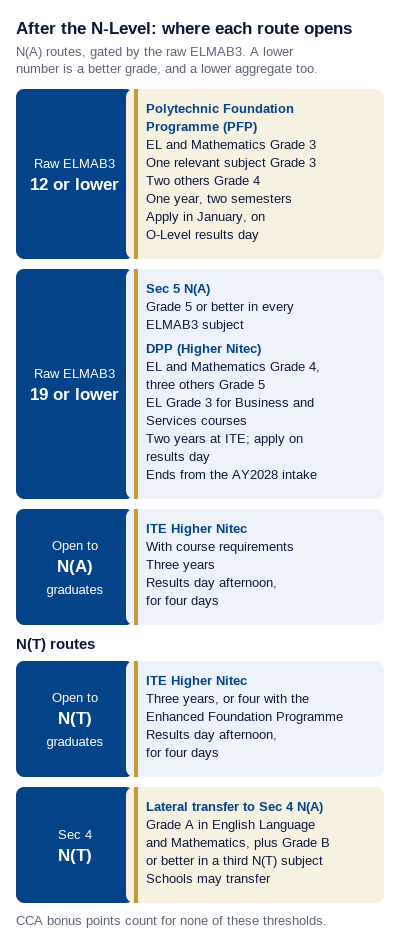
Read the table from the left. The entry rule is the gate, the length is the time to the next qualification, and the last column is the date that decides whether the application happens at all.
A learner who qualifies for more than one route can apply for ITE or DPP on results day and still wait for the PFP window in January. The diagram draws the same routes as a ladder, with the raw ELMAB3 gates for N(A) at the top and the N(T) routes below.
The grades in the table are raw N(A) grades unless marked otherwise, and CCA bonus points count for none of these thresholds.
| Pathway | Entry rule | Length | Leads to | When to apply |
|---|---|---|---|---|
| Sec 5 N(A) | Raw ELMAB3 19 or lower and Grade 5 or better in every ELMAB3 subject | One more year of secondary school | The national examination at the end of Sec 5 (see the O-Level and SEC guide) | Confirmed with the school after results |
| Polytechnic Foundation Programme | Raw ELMAB3 12 or lower; EL and Mathematics Grade 3; one subject relevant to the PFP cluster Grade 3; two others Grade 4 | One year, two semesters | A polytechnic diploma course | January, on O-Level results day |
| DPP (Higher Nitec) | Raw ELMAB3 19 or lower; EL Grade 4 (Grade 3 for Business and Services); Mathematics Grade 4; three others Grade 5 | Two years at ITE | A mapped polytechnic diploma with Higher Nitec GPA 2.5 or 3.0; technical courses also need an ITE Mathematics elective pass or O-Level Mathematics C and above | Results day, with the ITE window; ends from the AY2028 intake |
| ITE Higher Nitec (N(A)) | Open to N(A) graduates, with course requirements | Three years | Higher Nitec; GPA 3.5 assures a mapped polytechnic course from AY2027 | Results day afternoon, for four days |
| ITE Higher Nitec with EFP (N(T)) | Open to N(T) graduates | Three years, or four with the Enhanced Foundation Programme | Higher Nitec, with the same polytechnic GPA route | Results day afternoon, for four days |
Can an N-Level learner move up a course or sit O-Level subjects early?
Yes. A Sec 4 N(T) learner with Grade A in English and Mathematics and Grade B or better in one other N(T) subject can be transferred laterally to Sec 4 N(A) by the school.
Lateral transfer gives an N(T) learner one more year on the N(A) syllabus, and from there the Sec 5, PFP and DPP rules in this guide apply. The grade bar is specific: Grade A in both English Language and Mathematics, plus Grade B or better in a third N(T) subject.
A learner aiming for it should treat the gap between Syllabus T and Syllabus A in English and Mathematics as the main work of the transfer year.
Sitting O-Level subjects early is common among N(A) learners. In 2025, 56.3 per cent of school N(A) candidates also sat GCE O-Level subjects at Sec 4. Schools take the combined N(A)-Level and school-based O-Level preliminary examination results into consideration when they decide eligibility for Sec 5 N(A) or a post-secondary pathway.
Both moves follow the logic of Full Subject-Based Banding, where a learner takes each subject at the level that fits. The O-Level and SEC guide explains how those subject levels work from 2027.
Is 2026 the last N-Level exam, and what replaces it?
Yes. The GCE N(A) and N(T) Levels sit for the last time under their own name in 2026, and from 2027 they merge with the O-Level into one Singapore-Cambridge Secondary Education Certificate, the SEC.
The SEC starts with the 2027 graduating cohort. Subjects are taken at three levels, G1, G2 and G3, with minimum passing grades of D at G1, 5 at G2 and E8 at G3.
According to SEAB, an SEC certificate keeps the standard and recognition that N(T), N(A) and O-Level certificates carry now, and every SEC result arrives in a single January release the year after the papers. On the SEC calendar, English and Mother Tongue written papers sit in September, other written papers from October, and orals before the written papers.
Its roots lie in Full Subject-Based Banding: the 2024 Secondary 1 cohort was the first to enter school without N(T), N(A) and Express courses, and Posting Groups 1, 2 and 3 took their place, each mapped to the PSLE score range of an older course.
Two admission changes look ahead to current Sec 2 and Sec 3 learners. From AY2028 the PFP reads G3 grades by mapping them to their G2 equivalent, and MOE expects up to 2,600 learners a year to become eligible, up from about 1,700.
From the 2028 Polytechnic Year 1 intake, the benchmark becomes four G3 subjects plus one G2 subject, with the net aggregate cut-off at 22, down from 26, and 24 for Nursing, down from 28. The O-Level and SEC guide carries the full grade tables.
What should a learner do between the last N-Level paper and January?
Between the last N-Level paper and January, a learner should shortlist pathways in November, apply on results day in December, and keep Sec 5 work going in January while waiting on the PFP.
The weeks after October feel quiet, and they are the best time to prepare a decision that will be made in a few days. The timeline below follows the 2026 calendar at month level.
- October: the written papers end. Note each paper honestly while it is fresh, as a rough guide to which subjects are secure and which are borderline.
- November: shortlist courses on MOE CourseFinder and the MySkillsFuture Student Portal, check each against the Sec 5, PFP, DPP and ITE rules, and book an ECG Centre @ MOE session if the choice is unclear.
- December: collect the results slip at school. Work out the raw ELMAB3, then submit ITE and DPP applications in the window that opens that afternoon and runs for four days. ITE posting results follow about a week later.
- January: a PFP-bound learner reports to Sec 5 N(A) classes and applies for the PFP on O-Level results day, staying in Sec 5 until the PFP notification arrives. A learner staying in Sec 5 starts the year's syllabus from the first week.
How much does N-Level tuition cost, how do lessons run and how do I register?
The price table on this page lists what Eduprime charges for N-Level tuition, worked out by our pricing engine for one-to-one N(A) and N(T) lessons taught in the learner's home or online.
Lessons are one-to-one. The N-Level tutor, paired with the learner by home town and school-week timetable, teaches either at the learner's home or online. The first package, the Starter, gives an N(A) or N(T) learner four 60-minute lessons to begin on the paper that needs the most work.
It can be paid in full, or 50 per cent at the start and 50 per cent mid-package. A one-time registration fee applies only to a learner new to Eduprime, and its amount sits in the same price table.
For an N(A) or N(T) learner, the lessons follow the exact syllabus code on the results slip. A Sec 4 N(T) learner aiming at lateral transfer works on the step from Syllabus T to Syllabus A in English and Mathematics. A Sec 4 N(A) learner chasing a PFP place works on lifting English and Mathematics to Grade 3. Every worksheet and lesson plan for these N-Level papers is included in the package.
An N-Level learner ready to begin presses Register Now, which opens the registration form. The first consultation is free and is with the Eduprime team, who match the tutor after hearing the learner's subjects, grades and goal, so the tutor is matched by our team after registration. Anyone with a question about N(A) or N(T) lessons can press Ask a question and write to us through the contact form.
Who checks an N-Level tutor's work, and how does the learner see progress?
From the first lesson, an N(A) or N(T) learner receives tutor notes after every session and a monthly progress report, and can change to a different tutor whenever the fit is wrong, at no charge.
More than 12,500 skilled, experienced tutors teach with Eduprime. That depth lets our team adjust an N-Level match until it suits the learner's course, whether N(A) or N(T), and the subjects on the timetable.
- Tutor notes after every session and a monthly progress report, each written against the learner's own N(A) or N(T) subjects.
- A change of tutor costs nothing and can be asked for as often as the learner needs, at any stage of the package.
- A free first consultation with the Eduprime team before any lesson.
Where should each next N-Level question go?
This guide explains how the N-Level exam works. For lessons in N(A) or N(T) subjects, the N-Level tuition page sets out how we teach each course, and the secondary school tuition page covers Secondary 1 to 4 more broadly.
Learners moving up to Sec 5, or curious about the SEC, will find the O-Level and SEC guide the natural next read, followed by our tuition pages for O-Level English, O-Level Mathematics and O-Level Combined Science. Subject help sits on the Mathematics, Science and English tuition pages, and Mother Tongue help on the Chinese, Malay and Tamil tuition pages. Posting Groups and the PSLE have their own guide.
- n level tuition singapore
- secondary school tuition singapore
- o level singapore guide
- o-level english tuition singapore
- o-level math tuition singapore
- o-level combined science tuition singapore
- math tuition singapore
- science tuition singapore
- english tuition singapore
- chinese tuition singapore
- malay tuition singapore
- tamil tuition singapore
- psle guide singapore
Sources
- SEAB: Secondary Education Certificate (SEC)
- SEAB: About GCE N(A) Level
- SEAB: 2026 GCE N(A) syllabuses examined for school candidates
- SEAB: 2026 GCE N(T) syllabuses examined for school candidates
- SEAB: 2026 Singapore-Cambridge GCE N-Level examination timetable
- MOE: National examination dates
- MOE: Release of 2025 GCE N(A) and N(T) Level results (18 Dec 2025)
- MOE: Results release arrangements for 2025 N(A) and N(T) (11 Dec 2025)
- MOE: Polytechnic Foundation Programme eligibility criteria
- MOE: Changes to admissions for ITE upgraders from AY2027 (21 Jul 2023)
- MOE: Full SBB changes to the SEC timetable and Polytechnic Year 1 admission (4 Mar 2024)
- MOE: Full Subject-Based Banding secondary school experience
- MOE: Learn for Life, nurturing diverse talents and expanding pathways (1 Mar 2023)
- SEAB: Examination certificates for GCE private candidates
- MOE: Parliamentary reply on N(A) and N(T) grade distribution (4 Feb 2026)
Fees
What a lesson costs
Every programme is priced per 60-minute session in three formats. These are the lowest figures among the programmes on this page; each programme page shows its own.
- Widest availability
Online International Tutor
fromS$24/ session
60-minute session
The widest bench of tutors across time zones, so a slot is open at almost any hour. Lessons run online over a shared screen.
Online Local Tutor
fromS$40.80/ session
60-minute session
A tutor based here who knows our schools, syllabuses and exams, teaching online.
Home Tutor
fromS$48/ session
60-minute session
A local tutor who comes to the learner, at home or at a nearby study spot, matched to their town and timetable.
Minimum 4 sessions. Larger packages lower the per-session price. One-time S$15 registration fee for new learners.
Programmes
Programmes for N-Level
N-Level subjects paced for Normal stream students, each learner matched to a tutor who knows the exact papers they sit.

Chinese Tuition Singapore for Foundation to Higher Chinese

English Tuition Singapore for PSLE, SEC and A-Level

Malay Tuition Singapore for PSLE, SEC K321 and H1 Malay

Maths Tuition Singapore from Primary to JC

N-Level Tuition Singapore for SEC G1, G2 and G3 Subjects

O-Level Combined Science Tuition Singapore for Every Pairing

O-Level English Tuition Singapore for the SEC

O-Level Maths Tuition Singapore for Secondary E-Math

Science Tuition Singapore for Primary and Secondary
Secondary Maths Tuition in Singapore for G1 to G3

Secondary School Tuition Singapore for Sec 1 to Sec 5
Secondary Science Tuition Singapore from Five Themes to the SEC

Tamil Tuition Singapore, Primary to Junior College
Or browse by category
Frequently asked
N-Level: your questions
Is 2026 the last N-Level exam in Singapore?
Yes. SEAB states that 2026 is the last year the GCE N(T)- and N(A)-Level qualifications are awarded, together with the O-Level. From 2027 the three are combined and renamed the Singapore-Cambridge Secondary Education Certificate (SEC), run jointly by SEAB, MOE and Cambridge. The 2026 N-Level written papers closed on 13 October, and results for that sitting are released in December.
I will be in Sec 5 in 2027. Which exam do I sit?
A learner in Sec 5 in 2027 sits the SEC: SEAB names the Sec 5 students who entered Sec 1 in 2023 among its first candidates. Each subject is taken at G1, G2 or G3, and SEAB keeps the same paper format and standard as N(T), N(A) and O-Level respectively. Levels can differ across subjects, with one level per subject, and one certificate lists every subject with its level. Private candidates can enter the SEC too.
Are my N-Level results still valid after the switch to the SEC?
Yes. SEAB states that GCE N(T), N(A) and O-Level qualifications remain valid after 2027, and that GCE and SEC qualifications are equivalent. For Post-Secondary Education (PSE) admission from 2028, MOE lets a learner combine results from up to two examination years, using SEC results, past GCE N- or O-Level results, or both. The N-Level grades a learner already holds therefore count alongside the SEC subjects taken in a fifth year.
What are my options after the N-Level?
MOE lists a fifth year in secondary school as one option for eligible learners. A learner from the 2026 N(A) cohort can also look at the Polytechnic Foundation Programme (PFP), a one-year programme MOE describes as an alternative to the Sec 5 N(A) year. From the 2028 PSE, SEC holders at any level, G1, G2 or G3, may apply to JC, MI, polytechnic diplomas, the PFP and ITE Higher Nitec. Each course applies its own requirements.
When are the SEC papers held, and when do results come out?
SEAB runs one SEC timetable from 2027. Non-written components such as orals come before the written papers. English Language and Mother Tongue Language are written in September, and the other written papers run in one period from October. Results follow in January of the following year, and MOE expects the first SEC results in mid-January 2028, opening a six-day PSE application window from results day.
How can tuition help a Sec 5 learner preparing for the SEC?
Eduprime tutors plan lessons around the SEC level a learner takes in each subject, G1, G2 or G3, starting from the topics the N-Level results show need the most work. SEAB keeps the G2 and G3 papers at the N(A) and O-Level format and standard, so practice on those papers stays relevant. Home lessons are matched to the learner's town and timetable, online lessons run from anywhere, packages start from 4 sessions, and the form opens a free initial consultation.
Find your N-Level tutor today
Tell us the subject and your exam timeline, and we match a screened tutor to your town and timetable for home lessons, or teach you online.